Module 2 - nuerolinguistics
 Call Kai
 Learn
 Practice Test
 Spaced Repetition
 Match
 Flashcards
 Knowt Play
1/42

There's no tags or description
Looks like no tags are added yet.
43 Terms
Auditory Localization ex: owl
Owl flies silently - How does it locate mice under snow auditorily? - position, direction, distance of sound source
Computational Level goal: Locate mouse
Input of computation: location
Output of computation: sound
Location of object - visual field
Large difference - close
Small difference - far away
Each nueron - 2 inputs
One connecting one way
Sound - hits one ear before the other
Sound activation - every line passes nueron down
Signal comes from left ear then right ear hears it later - passes nueron up
cochlea configuration
Sound/frequencies travels through cochlea
Base of cochlea (5mm) - narrow - tuned for high frequencies (8000 Hz)
Apex of cochlea (30mm) - wider - lower pitch frequencies (200 Hz)
Amplifies version of sound
tonotopy
cortical spatial code for frequency information/pitch
frequency mapped to spatial gradient in the brain
Sounds with adjacent frequencies activate adjacent neurons to each other
spatial code created in cochlea perceived in auditory cortex
Could also say neurons in primary auditory cortex have different frequencies
Speech perception
Acoustic signal → | nuero auditory represent tion (nuerogram) → | Nuero phonological representation (phonological sketch) - figure out what you are hearing
| Lexical item
|

Cochlea
coiled mechanism containing organ that converts sound waves to electrical brain impulses
thousands of tiny hair cells move when the fluid vibrates
processes then send action potentials along nervous system
Spatial codes - hair cells at diff locations moved by diff frequencies
Cochlea layout/positioning
Cochlea goes from narrow to wide
Diff frequencies emphasized at different parts

Cochleagram
neural responses that represent sound at the brain’s periphery
maps how the inner ear processes frequencies
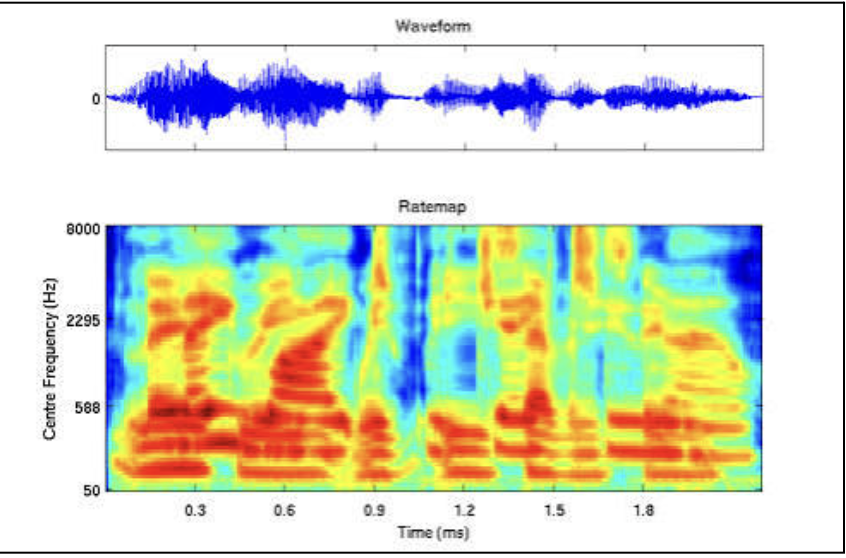
Auditory cortex -
-where patterns encoded with fine degree of detail
X & y axis that encode spectral & temporal details of stimuli
Phonemes
phonemes - speech sounds that words are built of
physical description of a speech sound
Physically real
Sounds of thing in environment
ex [p]
the singular sound [p] of something in an environment

Phone
Mental description of a speech sound
Mental/ symbolic representation- stands for something
Features define the phoneme
ex /p/
mental representation/symbol of p

Ganong effect different from McGurk
Shows that continuous acoustic info not enough to explain brain recognition of phonemes & words
person's knowledge of vocabulary (top-down processing) changes how they hear an ambiguous speech sound (bottom-up processing
if hearing ambigious speech sound halfway between /g/ and /k/) followed by
-ift, people heargift(a real word) rather than kift (a nonsense word).
diff from Mcgurk because its top down lexical knowledge vs visual cues
Was found that electrodes at different sites respond to different phonemes
Nemo Mesogarani- shows that populations of neurons in STG have phonemic receptive fields
1 electrode may be sensitive to class of stop consonants, not specific phones
Criteria for being a phoneme
1 - Minimal pairs - Does it change the meaning
Ex:
/kæt/
/gæt/
2 - Rule application - Can it be applied to multiple words?
Ex:
in+possible
In+credible
Distinctive features
what phonemes are built from
Phonemic receptive fields
areas of neurons in the auditory cortex
tuned to select, process, and differentiate phonemes.
Phonemic receptive fields ex - Mesgorani et al (2014)
Different groups of phonemes (dipthongs + vowels, nasal, plosives) have different activations of neurons - phonemic receptive fields

Temporal windows of integration - short
25-40 ms- left hemisphere response
make sense of the structure properties of diff phonemes
Phonemes, features
auditory input: better speech comphenesion- fine structure preserved
words- no fine structure at all - can still understand
Temporal windows of integration - long
200-300 ms- right hemisphere response
understand properties of syllables & other structures in temporal envelope, audiovisual integration
identify temporal properties of syllables like stress, intonation, prosody,
Asymmetric Sampling in Time (AST) hypothesis
study Zeng et al (2002)
listeners perform better when
when fine structure information goes to left hemisphere (phonemic feature length) & envelope info goes to right hemisphere (syllable length)
- auditory input: better speech comprehension (higher performance) when speech envelope preserved
- words - no envelope- impossible to understand
Lateralization
Tuning function in lateral Heschl’s gyrus
Explaining in cases of aphasia - intact prosody because it is located in right hemisphere

Analysis by synthesis ex - phonemic receptive fields
Takes info in a neurological way and maps it to cochlea
Generally goes forward
take information about sensory event and you build upwards - what do you think is true about phonology of word - can build upwards in this
Top down thingy
Info filters backwards and can influence what you hear/supposed to hear
Breaking something down to understand it
Break it down by building it up
Figure out what words are by figuring out what parts are made of - figure out what parts are made of by figuring out what words are
How is sound represented in auditory cortex?
Look at:
1. tonotopy - cortical spatial code for sound/frequency information
how frequency is mapped to spatial gradient in the brain
2. receptive field of neuron - connection between a certain stimulus and the response of a given neuron
Speech envelope tracking
how the brain's cortical activity synchronizes with the slow, rhythmic amplitude fluctuations (the overall volume or energy shape) of spoken language over time
The Speech Envelope: This is the slow-moving outer contour of a sound wave
Neural Synchronization: When people listen to speech, neurons in the auditory cortex fire in phase with these slow acoustic peaks and valleys. [1, 2]
Role in Comprehension: strength and precision of this tracking often correlate with how well a listener understands speech, handles background noise, or processes language.
Analysis by synthesis
acoustic info → nueral representation of Sound (neurogram) → phonological representation
Analysis aided by synthesis of speech output - based on top down knowledge |

Speech envelope
outline of the peaks (loud moments) and troughs (soft moments) in waveform - gives speech patterns of syllables & stress
Mapping phonological features in the brain - Multi-voxel pattern analysis
Used to understand the neural representations that matter to a particular set of voxels in the brain
Manner and place of articulation of voicing
Whats going on in phonological sketch - underspecification
Formant
a peak in frequency energy - amplified frequency representing specific sound in vocal tract
F1 (First Formant): Inversely related to vowel height. Open vowels (like /a/) have a high F1 frequency, while close or high vowels (like /i/ or /u/) have a low F1 frequency.
F2 (Second Formant): Related to the backness or frontness of the tongue. Front vowels (like /i/) have a high F2, while back vowels (like /u/) have a low F2.
F3 (Third Formant): Helps define speaker identity, voice quality, and finer acoustic characteristics.
Speech envelope
Outline of speech
Don’t have high level information
captures Rhythm, prosody, vowels, melodies, a periodic noise
Neurogram
nueral representation of Sound
- defined by property of tonotpopy - how pitch/frewuency information is being activated in brain - how is it laid out
Periodotopy
linear spatial arrangement of speech envelope
Right hemisphere tracking speech - you know where you are at a discourse level - of speech
Receptive field of neuron
connection between a certain stimulus and the response of a given neuron
Phonotopy
phonemes with similar fearures activate nearby nueronal populations
Categorical perception
Sound is gradient
perception is categorical.
Auditory perception + linguistic theory
Using EEG we can see
Gradient acoustic encoding.
Categorical symbolic representations.
Decomposing features of symbolic representations.
Dedicated areas that are respondent to and tracking speech sounds
Manner
Place - in IPA - based on where your articulators - lips - come into contact
Voice - is it voiced or not
Sound
Mismatch response (MMR)
MMR - a signal that emerges around 200 ms after hearing a deviant item vs when its presented as a standard
MMR
Sensitive to phonemic difference, not just acoustic differences
Expected since brain has rapid sensitivity - less than 200 ms for phonemic features
Used to understand whether different stimuli match or not
If 2 ppl with different sounding voices make the same speech sound - does it activate the same or different mental representations in a listener?
Mismatch Response - Oddball design
Oddball design
In odd ball experiment there are
Standards - Certain stimuli are presented frequently - 80% of time
Deviants - some stimuli presented rarely - 20%
2 pieces of evidence that speech perception can’t be understood using just continuous info
mainly be speech signals vary greatly & variation handled with ease
Evidence 1 : Categorical perception - phenomenon stating that if you have speech sounds that have been artificially altered & start with 1 syllable, then change incrementally to another, listeners don't perciere a smooth change Ganong effect - If hearing ambiguous sound between [s] vs [ʃ] (sh sound) they'll percive whichever one makes more sense in a word - more likely to hear [s] for a male voice : “said” -more likely to hear [ʃ] for a female voice : “shed” Evidence 2 :electrodes show classic non- linear response associated with categorical perception
|
2 routes we take when doing the phonological processing of words
Dorsal pathway - sound to articulation
Ventral pathway- - sound to meaning
Dorsal pathway
|
Ventral pathway
Ventral pathway
|
IFG - Dorsal stream
Broca’s area is part of the dorsal steam that maps speech sounds to articulatory representations.
How does this fit with what we know about Broca’s aphasia?
Voice onset time
Voice onset time - Time delay between release of consonant (burst) and onset of voicing
Different VOT between p(h)- aspirated, p, and b
mismatch negativity
(MMN) is an automatic, (ERP) component recorded via (EEG) that reflects the brain's ability to detect sensory or auditory changes
Oddball paradigm
Zeng 2002 experiment
Study - experimenters lateralized sound properties into different ears
phonemic feature length vs syllable length
the study demonstrated a clear hemispheric lateralization preference: