ARC 2701 1 st Millennium(ish) European - Early Christian
 Call Kai
 Learn
Learn Practice Test
 Spaced Repetition
 Match
Match Flashcards
 Knowt Play
1/39

There's no tags or description
Looks like no tags are added yet.
Name | Mastery | Learn | Test | Matching | Spaced | Call with Kai | Chat |
|---|
No analytics yet
Send a link to your students to track their progress
40 Terms
Why is mythology/religion relevant to architecture?
Ornament, Hierarchy, Ritual
It is only when Rome becomes ___ that we get relevant Christian architecture.
Christian
312CE ___ (Eastern
Emperor, Trier) Marches on
Rome (Maxentius, Western
Emperor) crosses the Tiber
river at the Mulvian Bridge.
Constantine
___ became the
principal patron of Christianity. Rome would
become Christian, and Christianity would
take on the aura of imperial Rome.
Constantine
___ CE Constantine (Eastern Emperor, Trier) Marches on Rome
(Maxentius, Western Emperor) crosses the Tiber river at
the Mulvian Bridge.
___ CE declares Christianity the official religion of the Roman empire
312, 325
Early Christian architecture put greater emphasis on the ___.
interior
Christian churches needed ___ interior spaces to house the growing congregations and to
mark the clear separation of the faithful from the unfaithful.
large
Early Christian architecture put greater emphasis on the interior. Christian
churches needed large interior spaces to house the growing congregations and to
mark the clear separation of the faithful from the unfaithful.
This leads to the architectural form that would become the core of western Christian
architecture up to our own time: the ___ ___.
Christian Basilica
The Basilica was typically more utilitarian in general layout and
decoration than the temples. Basic ___ and
___construction, usually timber roofs.
brick, arch
This building type becomes a) appropriated for
use as, and b) the model later for, early
Christian churches
Basilica

___ Christian basilica in its purity and
simplicity of its design./an austerity
in decoration is seen early on (in the___).
Early, west

label diagram
bascilica-plan church, central plan church
Churches divided into two types: the
Basilica church (Roman basilica) and
the ___-___ church (Roman
Pantheon).
Central-Plan
The Basilica becomes the dominant
___ church form.
The Central-Plan becomes the
dominant ___ church form.(However, both are used, their
popularity changing in different
periods.)
Western, Eastern
A ___ is a semi-circular or polygonal projection serving as
the termination of the main building axis, containing the
altar.
Apse
The ___ is the main space of the basilica church, where the
congregation sits/stands during worship service. Has
higher ceiling than the aisles, usually with clerestory
windows.
Nave
The ___ is the ambulatory / circulation space on the side
perimeter of the nave.
Aisle
A ___ is an enclosed porch or narrow meeting area at
the entrance to a church.
Narthex
A ___ is an open courtyard at the entrance of a church,
usually surrounded by covered aisles. The atrium of the
Early Christian church was originally a place for the
congregants to wait and prepare for worship.
Atrium

label diagram
apse, nave, aisle, narthex, atrium

label diagram
atrium, apse, clerestory
In the Basilican Church of S. Peter, the columns were likely ___ (the re-use of earlier building material or decorative sculpture on new monuments).
SPOLIA

Oldest surviving ecclesiastical basilica, meaning
built specifically to be a Christian church
Santa Sabina
The Santa Sabina is the ___ surviving ecclesiastical basilica, meaning
built specifically to be a Christian church.
oldest

Santa Sabina preserves its original colonnaded rectangular plan with apse and architectural style. Its decorations have been restored to their original ___ design.
restrained
Central Plan Church: Main form is a centralized ___ shape
(square, circle, octagon), topped by a dome
symmetrical, dome

Label diagram of Central Plan Church
apse, narthex, atrium, dome

Label diagram of Central Plan Church
apse,dome, atrium, narthex
330 CE moves the capital from Rome to ___.
Constantinople

CE 523-549, Ravenna, Italy
Basilica of St. Apollinare in Classe
A ___ is a bell tower, usually built beside or attached to a church.
Campanile
The Basilica of St. Apollinare in Classe was described as an outstanding example of the early Christian basilica in its ___ and simplicity of its design
purity
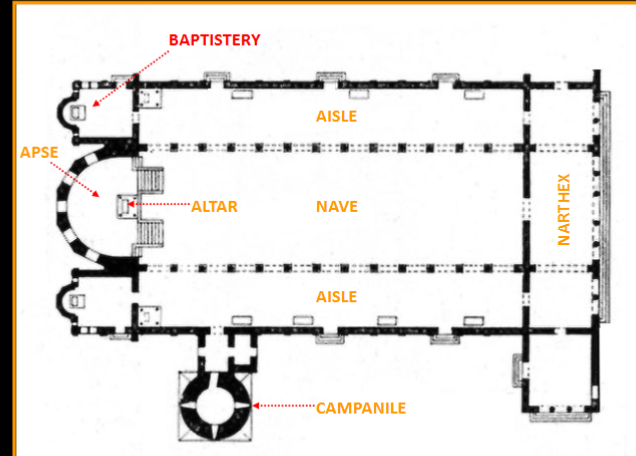
What is this a floor plan of?
Basilica of St. Apollinare in Classe
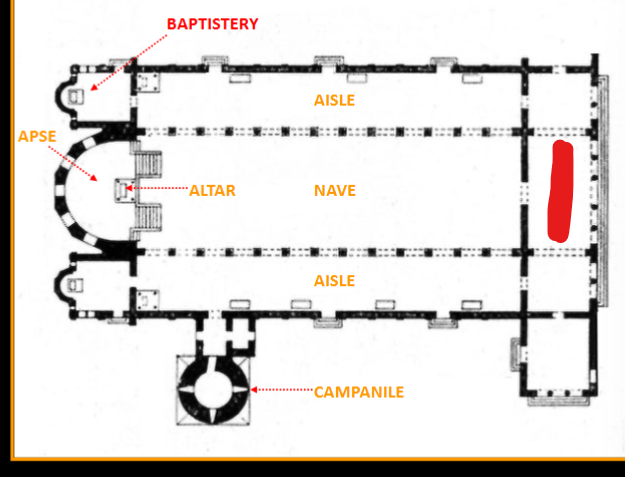
Label Basilica of St. Apollinare in Classe floor plan
Narthex

Label Basilica of St. Apollinare in Classe floor plan
Campanile
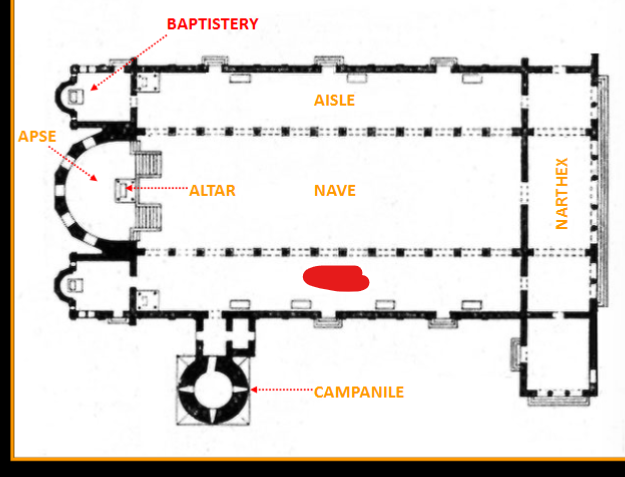
Label Basilica of St. Apollinare in Classe floor plan
Aisle

Label Basilica of St. Apollinare in Classe floor plan
Nave
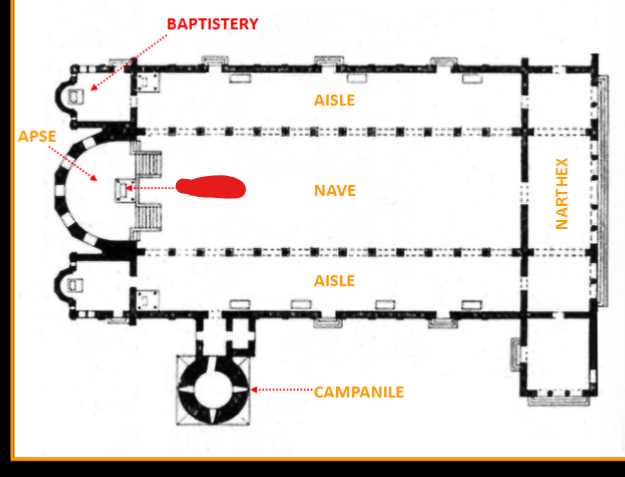
Label Basilica of St. Apollinare in Classe floor plan
Altar

Label Basilica of St. Apollinare in Classe floor plan
Apse