HESI A2 Anatomy & Physiology 2026
 Call Kai
 Learn
 Practice Test
 Spaced Repetition
 Match
 Flashcards
 Knowt Play
1/77

There's no tags or description
Looks like no tags are added yet.
78 Terms
What is erythropoiesis and where does it occur?
A. The formation of red blood cells; Heart
B. The formation of white blood cells; Spleen
C. The formation of bile; Liver
D. The formation of red blood cells; Red bone marrow
D. The formation of red blood cells; Red bone marrow
Explanation- Erythropoiesis is the production of red blood cells. In the early development of a fetus, erythropoiesis takes place in the yolk sac, spleen, and liver. However, after birth, all erythropoiesis occurs in the bone marrow.
Which of the following male reproductive organs is also a part of the urinary system?
A. Epidiymis
B. Vas deferens
C. Urethra
D. Ureter
C. Urethra
Explanation- In males, the urethra is the tube through which urine is voided. It is also the tube that semen flows through during sexual activity. Therefore, it is part of both the urinary and reproductive systems in males.
The shoulder is an example of which type of synovial joint?
A. Ball-and-socket
B. Pivot
C. Saddle
D. Hinge
A. Ball-and-socket
What is the function of endocrine glands?
A. They secrete products directly into a duct that carries the products to where they are needed.
B. They transmit nerve impulses between parts of the body.
C. They secrete hormones directly into the blood.
D. They are a group of cells that respond to specific hormones.
C. They secrete hormones directly into the blood.
A sprain occurs when which of the following structures is stretched or torn?
A. Ligament
B. Tendon
C. Muscle
D. Fibrous joint
A. Ligament
Which of the following organelles would you expect to find an abundance of in leukocytes?
A. Ribosomes
B. Lysosomes
C. Mitochondria
D. Golgi bodies
B. Lysosomes
Which of the following best describes the anatomical position?
A. Standing upright, facing away from the observer, upper extremities at the body's sides, feet flat and directed outward, and the palms facing anteriorly.
B. Standing upright, facing away from the observer, upper extremities at the body's sides, feet flat and directed forward, and the palms facing towards anteriorly.
C. Standing upright, facing the observer, upper extremities at the body's sides, feet flat and directed forward, and the palms facing posteriorly
D. Standing upright, facing the observer, upper extremities at the body's sides, feet flat and directed forward, and the palms facing anteriorly
D. Standing upright, facing the observer, upper extremities at the body's sides, feet flat and directed forward, and the palms facing anteriorly
What does the presence of antidiuretic hormone stimulate?
A. Water reabsorption from the urinary filtrate
B. The increase of calcium levels in the blood
C. The release of water into the bladder to be voided as urine
D. Calcium reabsorption by the nephrons
A. Water reabsorption from the urinary filtrate
Explanation- The most important job of antidiuretic hormone (ADH) is to conserve water in the body by reducing the loss of water in urine. It does this by telling your kidneys how much water it needs to put back into your body instead of voiding it as urine.
Which of the following types of cancer would present warning signs that are identified using the ABCDE method?
A. Leukemia
B. Melanoma
C. Basal cell carcinoma
D. Squamous cell carcinoma
B. Melanoma

Where is the popliteal artery located?
A. Behind the knee
B. On the underside of the wrist
C. Near the top of the cubital fossa
D. Below the jaw line between the trachea and sternomastoid muscle
A. Behind the knee
Which of the following is defined as "a group of similar cells and their intercellular matrix that carry out a specific function together?"
A. Neuroglia
B. Tissues
C. Organs
D. Organ systems
B. Tissues
Which of the following lists the correct pathway of blood through the circulatory system?
A. Left ventricle, vena cava, systemic circuit, aorta, right atrium, right ventricle, lungs, left atrium
B. Right ventricle, aorta, systemic circuit, vena cava, left atrium, left ventricle, lungs, right atrium
C. Right atrium, tricuspid valve, right ventricle, pulmonary valve, pulmonary artery, lungs, pulmonary vein, left atrium, mitral valve, left ventricle, aortic valve, aorta, body tissues, vena cava, right atrium
D. Right ventricle, vena cava, systemic circuit, aorta, left atrium, left ventricle, lungs, right atrium
C. Right atrium, tricuspid valve, right ventricle, pulmonary valve, pulmonary artery, lungs, pulmonary vein, left atrium, mitral valve, left ventricle, aortic valve, aorta, body tissues, vena cava, right atrium
A patient with a lower than normal amount of thrombocytes could be at risk of ____________.
A. inability to fight infection
B. unnecessary blood clotting
C. extensive bleeding
D. fatigue and shortness of breath
C. extensive bleeding
Which bones form via intramembranous ossification?
A. The malleus, incus, and stapes
B. The manubrium and xyphoid process
C. The ulna, radius, and carpals
D. The flat bones of the skull, the mandible, and clavicles
D. The flat bones of the skull, the mandible, and clavicles
Which of the following best describes the primary function of hemoglobin?
A. Carries oxygen to tissues and organs
B. Regulates balance and thermoregulation
C. Detects increases in carbon dioxide and decreases in oxygen in the blood
D. Engages in the process of phagocytosis
A. Carries oxygen to tissues and organs
A patient complains of decreased sensation in the distal part of their arm and an inability to adduct and abduct their fingers. Based on these symptoms, which nerve is most likely compromised?
A. Tibial
B. Ulnar
C. Femoral
D. Olfactory
B. Ulnar
Which organ is responsible for most of the nutrient absorption in the body?
A. Small intestine
B. Gall bladder
C. Stomach
D. Large intestine
A. Small intestine
Which of the following statements about the endocrine system is false?
A. The adrenal glands secrete cortisol and aldosterone.
B. Growth of pubic and axillary hair is induced by testosterone and estrogen.
C. Oxytocin and antidiuretic hormone are stored in and secreted by the posterior pituitary gland.
D. The hypothalamus is commonly known as the "master gland."
D. The hypothalamus is commonly known as the "master gland."
Which of the following best describes the function of the mitral valve?
A. Lets blood flow from the right atrium to the right ventricle
B. Lets blood flow from the right ventricle to the right atrium
C. Lets blood flow from the left atrium to the left ventricle
D. Lets blood flow from the left ventricle to the left atrium
C. Lets blood flow from the left atrium to the left ventricle
Which of the four chambers of the heart has the thickest muscular wall?
A. Right atrium
B. Left atrium
C. Right ventricle
D. Left ventricle
D. Left ventricle
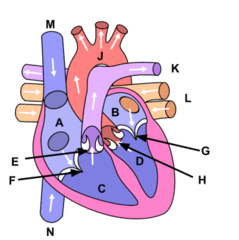
Using the provided image, choose the anatomical structure designated by letter B.
A. Right atrium
B. Left atrium
C. Right ventricle
D. Left ventricle
B. Left atrium
How does serotonin affect the body?
A. It stimulates the uterine muscles to contract during childbirth and promotes lactation.
B. It helps to regulate urine output and maintains osmolarity.
C. It helps to regulate motivation, euphoria, and fine motor function.
D. It helps to regulate mood, anxiety, sleep, memory, and appetite.
D. It helps to regulate mood, anxiety, sleep, memory, and appetite.
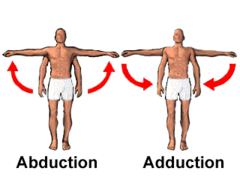
Which of the following muscles pulls a body part away from the midline of the body?
A. Adductors
B. Abductors
C. Flexors
D. Extensors
B. Abductors
A patient complaining of pain in their sternum reveals that they were recently in a mild car accident. Which of the following structures may have been injured in the accident?
A. Xiphoid process
B. Fontanelle
C. Vastus lateralis
D. Vomer
A. Xiphoid process
Explanation- The xiphoid process is the most inferior (bottom) part of the sternum, located in the middle of your ribcage.

Which of the following options correctly lists the layers of the epidermis from the most superficial to the deepest layer?
A. Stratum germinativum, stratum lucidum, stratum corneum, stratum granulosum
B. Stratum lucidum, stratum granulosum, stratum germinativum, stratum corneum
C. Stratum germinativum, stratum granulosum, stratum lucidum, stratum corneum
D. Stratum corneum, stratum lucidum, stratum granulosum, stratum germinativum
D. Stratum corneum, stratum lucidum, stratum granulosum, stratum germinativum

Which of the following structures is part of the upper respiratory system?
A. Trachea
B. Pharynx
C. Lungs
D. Bronchi
B. Pharynx
Explanation- The major passages and structures of the upper respiratory system include the nose, nasal cavity, oral cavity, throat (pharynx), and voice box (larynx).

Which part of the brain is involved in processing auditory information?
A. Temporal lobe
B. Frontal lobe
C. Occipital lobe
D. Parietal lobe
A. Temporal lobe
Explanation- The temporal lobe contains the primary auditory cortex, which receives direct sound input from the ears, so it plays a major role in auditory functioning (hearing).

What is the function of the sebaceous glands?
A. To secrete oil that lubricates the skin and prevents drying.
B. To secrete the aqueous layer of the tear film to lubricate the eye.
C. To secrete a watery substance onto the surface of the skin to regulate body temperature.
D. To secrete earwax to protect the ear from bacteria and viruses.
A. To secrete oil that lubricates the skin and prevents drying.
Which type of tissue is most widely distributed throughout the body?
A. Epithelial tissue
B. Nervous tissue
C. Connective tissue
D. Muscle tissue
C. Connective tissue

Which of the following is a molecule carrying genetic instructions for the development, functioning, growth, and reproduction for all organisms?
A. Ribosomes
B. Nucleus
C. RNA
D. DNA
D. DNA
Where is the tibialis anterior located?
A. The back of the lower extremities
B. The front of the lower extremities
C. The back of the upper extremities
D. The front of the upper extremities
B. The front of the lower extremities
Cerumen is secreted by apocrine glands located in which of the following structures?
A. The organ of corti
B. The external auditory canal
C. The eustachian tube
D. The cochlea
B. The external auditory canal
Which blood vessel returns blood from the lungs back to the heart?
A. Pulmonary vein
B. Pulmonary artery
C. Superior vena cava
D. Inferior vena cava
A. Pulmonary vein
What, in addition to adenosine triphosphate, must be present for a muscle to contract?
A. Lactate
B. Oxygen
C. Calcium
D. Sodium
C. Calcium
Which of the following organelles is responsible for digesting damaged cellular structures, as well as macromolecules and bacteria ingested by the cell?
A. Endoplasmic Reticulum
B. Golgi Apparatus
C. Lysosomes
D. Mitochondria
C. Lysosomes
Which of the following could result from a damaged olfactory nerve?
A. Loss of sensation in the arm
B. Reduced sense of smell
C. Discomfort in the lumbar region
D. Distorted vision
B. Reduced sense of smell
Which of the following describes cellular respiration?
A. It is an oxidative anabolic activity
B. It is a reductive anabolic activity
C. It is an oxidative catabolic activity
D. It is a reductive catabolic activity
C. It is an oxidative catabolic activity
The respiratory system is composed of organs that facilitate gas exchange between the blood and the external environment. Which of the following describes the group of organs that function during gas exchange?
A. Tissue
B. Organ
C. Organelle
D. Organ System
D. Organ System
Which of the following organ systems is correctly paired with its function?
A. Digestive/ waste elimination
B. Circulatory/ obtaining nutrients necessary for growth, energy and normal body processes
C. Excretory/ transport of substance to all tissues of the body
D. Endocrine/ regulation of homeostasis through hormone signaling
D. Endocrine/ regulation of homeostasis through hormone signaling
Mitosis occurs in which layer of the skin?
A. Dermis
B. Stratum corneum
C. Keratin
D. Stratum germinativum
D. Stratum germinativum
What is secreted by the adrenal glands?
A. Progesterone and estrogen
B. Oxytocin only
C. Oxytocin and antidiuretic hormone
D. Cortisol and aldosterone
D. Cortisol and aldosterone
Which organelle is responsible for storing DNA?
A. Nucleus
B. Rough Endoplasmic Reticulum
C. Golgi Apparatus
D. Lysosomes
A. Nucleus
Which of the following causes bone matrix resorption in response to a decrease of calcium levels in the blood?
A. Osteoclasts
B. Osteoblasts
C. Osteoprogenitor
D. Osteocytes
A. Osteoclasts

Which of the following is the correct sequence of transport of filtrate from the nephrons to the renal pelvis?
A. Proximal Convoluted Tubule - Loop of Henle - Distal Convoluted Tubule - Collecting Duct - Minor Calyx - Major Calyx - Renal Pelvis
B. Collecting Duct - Proximal Convoluted Tubule - Loop of Henle - Distal Convoluted Tubule - Minor Calyx - Major Calyx - Renal Pelvis
Distal Convoluted Tubule - Proximal Convoluted Tubule - Loop of Henle - C. Collecting Duct - Minor Calyx - Major Calyx - Renal Pelvis
D. Minor Calyx - Major Calyx - Proximal Convoluted Tubule - Distal Convoluted Tubule - Loop of Henle - Collecting Duct - Renal Pelvis
A. Proximal Convoluted Tubule - Loop of Henle - Distal Convoluted Tubule - Collecting Duct - Minor Calyx - Major Calyx - Renal Pelvis

Which of the following features of veins results in the venous system operating at lower pressures than the arterial side?
A. Veins have thinner, more compliant vessel walls than arteries.
B. Veins carry oxygen-deficient blood.
C. Veins have thicker, less compliant vessel walls than arteries.
D. Veins have valves.
A. Veins have thinner, more compliant vessel walls than arteries.
Which of the following salivary glands primarily contributes to the production and secretion of saliva?
A. Submandibular glands
B. Lingual glands
C. Sublingual glands
D. Parotid glands
A. Submandibular glands
What is the outermost layer of the epidermis?
A. Stratum lucidum
B. Stratum corneum
C. Dermis
D. Stratum germinativum
B. Stratum corneum
A tissue sample studied under a microscope exhibits the following characteristics: an extracellular matrix providing rigidity to the tissue, and the presence of lacunae. Which type of tissue is this?
A. Epithelial
B. Bone
C. Adipose
D. Nervous
B. Bone
Explanation- Bone (particularly spongy bone) is a type of connective tissue that consists of a rigid extracellular matrix. Lacunae are small spaces in the bone tissue. Each lacuna contains an osteocyte, which is a mature bone cell.
In which part of the body would you find aqueous humor?
A. In the cavities of synovial joints
B. Throughout the lymphatic system
C. Between the lens and cornea in the eye
D. Within the mediastinum
C. Between the lens and cornea in the eye

Which blood vessel delivers blood directly into the right atrium?
A. Coronary artery
B. Brachial artery
C. Vena cava
D. Aorta
C. Vena cava
Explanation- The largest vein, the vena cava, dumps deoxygenated blood directly back into the heart at the right atrium.
Which of the following makes up the largest component of whole blood?
A. Platelets
B. Red blood cells
C. White blood cells
D. Plasma
D. Plasma
Which system coordinates and regulates processes within the body through the use of hormones?
A. Circulatory system
B. Respiratory system
C. Muscular system
D. Endocrine system
D. Endocrine system
What is one of the functions of the hypothalamus?
A. Regulating blood sugar levels
B. Regulating heart rate and blood pressure
C. Regulating calcium levels in the blood
D. Regulating body temperature
D. Regulating body temperature
The anterior lobe of pituitary glands is called which of the following?
A. Neurohypophysis
B. Infundibulum
C. Adenohypophysis
D. Adenosine monophosphate
C. Adenohypophysis
Which of the following terms describes the process of forming new red blood cells?
A. Autopoiesis
B. Erythropoiesis
C. Hematopoiesis
D. Thrombopoiesis
B. Erythropoiesis
Explanation- If you remember that red blood cells are also called erythrocytes, it makes sense that erythropoiesis is the term for forming new red blood cells. "Poiesis" means "to make."
Which of the following structures functions in directing sound waves into the ear?
A. Eardrum
B. External Auditory Canal
C. Auricle (Pinna)
D. Modiolus
C. Auricle (Pinna)
Important Note: There are also auricles within the heart. The heart has two auricles, and each one is attached to the anterior surface of the outer walls of both the left and right atria. These pouch-like structures help to increase the capacity of each atrium, which in turn increases the volume of blood each is able to hold. In order to determine which auricle is being discussed in a particular question, look closely for clues that suggest the question is either focused on the ear or the heart.
The pharynx is a conduit for air and food. It is divided into three segments which contain lymphoid structures that play significant roles in protection and defense. Which segment of the pharynx contains the pharyngeal tonsils?
A. Nasopharynx
B. Oropharynx
C. Laryngopharynx
D. Hypopharynx
A. Nasopharynx

Which of the following acts as a store for fats and aids in bone function?
A. White blood cells
B. Yellow bone marrow
C. Red bone marrow
D. Granulocyte
B. Yellow bone marrow
Which of the following is not a function of cortisol?
A. Release growth hormones
B. Inhibits the release of histamine
C. Raises blood sugar levels
D. Reduces inflammation
A. Release growth hormones
What type of cell division occurs in the gonads?
A. Hemopeiosis
B. Meiosis
C. Binary fission
D. Mitosis
B. Meiosis
Which muscle is located towards the front of the lower leg?
A. Tibialis posterior
B. Adductor longus
C. Tibialis anterior
D. Vastus lateralis
C. Tibialis anterior

What connects skin to superficial muscles?
A. Epidermis
B. Stratum corneum
C. Hypodermis
D. Stratum germinativum
C. Hypodermis
Reabsorption of water and electrolytes occur in various parts of the renal tubules. In which segment is sodium mostly reabsorbed?
A. Distal Convoluted Tubules
B. Proximal Convoluted Tubules
C. Loop of Henle
D. Collecting Ducts
B. Proximal Convoluted Tubules
The right atrium receives blood from the __________.
A. vena cava
B. aorta
C. right ventricle
D. left atrium
A. vena cava
The _______________ artery is located in the upper arm, and is a continuation of the ________________ artery.
A. brachial; carotid
B. axillary; brachial
C. carotid; axillary
D. brachial; axillary
D. brachial; axillary

An irregular epiphysis at each end is present in which of the following?
A. A typical long bone
B. A short bone
C. Compact bone
D. Sesamoid bone
A. A typical long bone
The _________________ carry oxygen rich blood away from the heart, while the ________________ carry oxygen-depleted blood back towards the heart.
A. veins; arteries
B. veins; arterioles
C. arteries; veins
D. capillaries; veins
C. arteries; veins
Stratum basale and stratum spinosum are included in which layer of the epidermis?
A. Stratum granulosum
B. Stratum lucidum
C. Stratum corneum
D. Stratum germinativum
D. Stratum germinativum
The functions of the circulatory system include all of the following except:
A. to distribute hormones throughout the body.
B. to remove carbon dioxide from the body.
C. to deliver carbon dioxide to body tissues.
D. to distribute oxygen and nutrients to body tissues.
C. to deliver carbon dioxide to body tissues.
Which hormone is primarily responsible for stimulating the production of sperm in the male reproductive system?
A. Follicle-stimulating hormone (FSH)
B. Luteinizing hormone (LH)
C. Estrogen
D. Progesterone
A. Follicle-stimulating hormone (FSH)
Which part of the neuron is responsible for receiving signals from other neurons?
A. Axon
B. Dendrite
C. Cell body
D. Synapse
B. Dendrite
Which of the following correctly describe the process and components involved in the transformation of food during digestion?
select all that apply.
A. Mastication
B. Bolus formation
C. Chyme production
D. Peristalsis
A. Mastication
C. Chyme production
D. Peristalsis
What is the primary function of the Loop of Henle in the nephron?
A. Filtration of blood plasma
B. Reabsorption of water and salts to concentrate urine
C. Collection of urine before it moves to the bladder
D. Transport of urine from the kidney to the bladder
B. Reabsorption of water and salts to concentrate urine
Which of the following are functions of the skeletal system?
A. Movement
B. Blood cell formation (hematopoiesis)
C. Detoxification
D. Hormone production
A. Movement
B. Blood cell formation (hematopoiesis)
C. Detoxification
Which part of the heart initiates the electrical impulses that regulate the heartbeat?
A. Atrioventricular (AV) node
B. Purkinje fibers
C. Bundle of His
D. Sinoatrial (SA) node
D. Sinoatrial (SA) node
What is the primary function of dendrites in a neuron?
A. Transmitting electrical signals away from the cell body
B. Receiving incoming signals from other neurons
C. Producing myelin to insulate the axon
D. Controlling the nucleus of the neuron
B. Receiving incoming signals from other neurons
Which of the following correctly describes the function of the small intestine in the digestive system?
A. It primarily stores feces before elimination
B. It produces hydrochloric acid to break down proteins
C. It absorbs nutrients such as amino acids and simple sugars into the bloodstream
D. It mechanically breaks down food through mastication
C. It absorbs nutrients such as amino acids and simple sugars into the bloodstream
Which of the following hormones are produced by the anterior pituitary gland?
A. Growth hormone (GH)
B. Thyroid-stimulating hormone (TSH)
C. Antidiuretic hormone (ADH)
D. Adrenocorticotropic hormone (ACTH)
A. Growth hormone (GH)
B. Thyroid-stimulating hormone (TSH)
D. Adrenocorticotropic hormone (ACTH)