L2: Psychological theories & Models affecting health & illness behavior change
 Call Kai
 Learn
 Practice Test
 Spaced Repetition
 Match
 Flashcards
 Knowt Play
1/37

There's no tags or description
Looks like no tags are added yet.
Name | Mastery | Learn | Test | Matching | Spaced | Call with Kai | Chat |
|---|
No analytics yet
Send a link to your students to track their progress
38 Terms
AIMS OF THE PUBLIC HEALTH:
• prevent ___
• promote a better ___
• create environmental conditions in which people can be healthy by intervening at the ___
• Varying commitments on part of patients to follow ___ for the health care are complex. These regimens might be dietary intake, physical activity, prescription drug use and adherence to protocols.
• ___ are helpful to the development of intervention and research in interdisciplinary science of ___. In the field of ___, it has been recognized that this in health are influenced by multiple levels of influence.
• To be effective in these endeavors, public health practitioner must know how to apply the basic ___ of the social and behavioral science to inform their efforts.
• A thorough understanding of theories used in public health, which are mainly derived from the social and behavioral sciences, allow practitioners to: ___
disease and death
quality of life
institutional, community, and societal level
prescribed medication
Models; health behavior; Behavioral medicine
principal, theories, research finding, and method
• Assess the fundamental causes of a public health problem
• Develop interventions to address those problems.
It is a cognitive model which states that behaviour is determined through a set of beliefs about threats to an individual’s well-being and the effectiveness and results of particular actions or behaviors. Social scientists at the ___ has developed this in order to understand the failure of people to adopt disease prevention strategies. It tells that a person's belief in a ___ along with a person's belief in the ___.
The Health Belief Model
U.S. Public Health Service
personal threat of an illness or disease
effectiveness of the recommended health behavior
According to this model, the individual beliefs about health and health conditions play a role in determining health-related behaviors.
Health Belief Model (HBM)
The HBM derives from ___ and ___ theory with the foundation that the two components of healthrelated behavior are:
• The desire to ___, or conversely ___
• The belief that a specific health action will ___
psychological
behavioral
avoid illness
get well if already ill
prevent, or, cure, illness
6 CONSTRUCTS OF HBM
• PERCEIVED SUSCEPTIBILITY
• PERCEIVED SEVERITY
• PERCEIVED BENEFITS
• PERCEIVED BARRIERS
• CUES TO ACTION
• SELF-EFFICACY

This refers to a person's subjective perception of the risk of acquiring an illness or disease. There is wide variation in a person's feelings of personal vulnerability to an illness or disease.
Perceived susceptibility
This refers to a person's feelings on the seriousness of contracting an illness or disease (or leaving the illness or disease untreated). There is wide variation in a person's feelings of severity, and often a person considers the ___ (e.g., death, disability) and ___ (e.g., family life, social relationships) when evaluating the severity.
Perceived severity
medical consequences
social consequences
This refers to a person's perception of the effectiveness of various actions available to reduce the threat of illness or disease (or to cure illness or disease). The course of action a person takes in preventing (or curing) illness or disease relies on considering and evaluating both ___ and ___, such that the person would accept the recommended health action if it was perceived as beneficial.
Perceived benefits
perceived susceptibility
perceived benefit
This refers to a person's feelings on the obstacles to performing a recommended health action. There is wide variation in a person's feelings of barriers, or impediments, which lead to a cost/benefit analysis. The person weighs the effectiveness of the actions against the perception that it may be expensive, dangerous (e.g., side effects), unpleasant (e.g., painful), time-consuming, or inconvenient.
Perceived barriers
This is the ___ that triggers the decision-making process to accept a recommended health action. These cues can be internal (e.g., chest pains, wheezing, etc.) or external (e.g., advice from others, illness of a family member, newspaper article, etc.).
Cue to action
stimulus
This refers to the level of a person's confidence in his or her ability to perform a behavior successfully. This construct was added to the model most recently in the ___. This is a construct in many behavioral theories as it directly relates to whether a person performs the desired behavior.
Self-efficacy
mid-1980s
There are several limitations of the HBM which limit its utility in public health. Limitations of the model include the following:
•It does not account for a person's ___ that dictate a person's ___ of a health behavior.
• It does not take into account behaviors that are ___ and thus may inform the decision-making process to accept a ___ (e.g., smoking).
• It does not take into account behaviors that are performed for non-health related reasons such as ___.
• It does not account for ___ that may prohibit or promote the recommended action.
• It assumes that everyone has access to equal amounts of ___ on the illness or disease.
• It assumes that ___ are widely prevalent in encouraging people to act and that ___ are the main goal in the decision-making process.
attitudes, beliefs, or other individual determinants; acceptance
habitual; recommended action
social acceptability
environmental or economic factors
information
cues to action
health actions
It prioritizes on the innovation of behavior change along with the innovation as an idea, practice or object which is considered as new.
DIFFUSION OF INNOVATION THEORY
This is developed by ___. It originated in ___ to explain how, over time, an idea or product gains momentum and diffuses in a specific population or social system. The result of this is that people adopt a ___
DIFFUSION OF INNOVATION THEORY
E.M. Rogers in 1962
communication
new idea, behavior, or product
Under ___: ___ means that a person does something differently than what they had previously (i.e., purchase or use a new product, acquire and perform a new behavior, etc.). The person must perceive the idea, behavior, or product as ___ is the key to adoption
DIFFUSION OF INNOVATION THEORY
Adoption
new or innovative
There are five established adopter categories, and while the majority of the general population tends to fall in the middle categories, it is still necessary to understand the characteristics of the target population. When promoting an innovation, there are different strategies used to appeal to the different adopter categories.
• INNOVATORS (2.5%)
• EARLY ADOPTERS (13.5%)
• EARLY MAJORITY (34%)
• LATE MAJORITY (34%)
• LAGGARDS (16%)
These are people who want to be the first to try the innovation. They are venturesome and interested in new ideas. These people are very willing to take risks, and are often the first to develop new ideas. Very little, if anything, needs to be done to appeal to this population.
INNOVATORS
These are people who represent ___. They enjoy leadership roles, and embrace change opportunities. They are already aware of the need to change and so are very comfortable adopting new ideas. Strategies to appeal to this population include ___ and ___. They do not need information to convince them to change.
EARLY ADOPTERS
opinion leaders
how-to manuals
information sheets on implementation
These people are rarely leaders, but they do adopt new ideas before the average person. That said, they typically need to see evidence that the innovation works before they are willing to adopt it. Strategies to appeal to this population include ___ and ___.
EARLY MAJORITY
success stories
evidence of the innovation's effectiveness
These people are skeptical of change, and will only adopt an innovation after it has been tried by the majority. Strategies to appeal to this population include information on how many other people have tried the innovation and have adopted it successfully.
LATE MAJORITY
These people are bound by ___ and very ___. They are very skeptical of change and are the hardest group to bring on board. Strategies to appeal to this population include ___ in the other adopter groups.
LAGGARDS
tradition
conservative
statistics, fear appeals, and pressure from people
The stages by which a person adopts an innovation, and whereby this is accomplished, include awareness of the need for an innovation, decision to adopt (or reject) the innovation, initial use of the innovation to test it, and continued use of the innovation.
DIFFUSION OF INNOVATION THEORY
There are five main factors that influence adoption of an innovation, and each of these factors is at play to a different extent in the five adopter categories.
Relative Advantage
Compatibility
Complexity
Triability
Observability
The degree to which an innovation is seen as better than the idea, program, or product it replaces.
Relative Advantage
How consistent the innovation is with the values, experiences, and needs of the potential adopters.
Compatibility
How difficult the innovation is to understand and/or use.
Complexity
The extent to which the innovation can be tested or experimented with before a commitment to adopt is made.
Triability
The extent to which the innovation provides tangible results
Observability
Limitations of Diffusion of Innovation Theory
• Much of the evidence for this theory, including the ___, did not originate in ___ and it was not developed to explicitly apply to adoption of new behaviors or health innovations.
• It does not foster a ___ to adoption of a ___.
• It works better with ___ rather than ___.
• It doesn't take into account an individual's ___ to adopt the new behavior (or innovation).
adopter categories
public health
participatory approach
public health program
adoption of behaviors
cessation or prevention of behaviors
resources or social support
___ started as the ___ in the ___ by ___. One feature of SCT is about on ___ and its emphasis on external and internal ___. It considers the unique way in which individuals acquire and maintain behavior, while also considering the social environment in which individuals perform the behavior. The theory takes into account a person's ___, which factor into whether behavioral action will occur. These past experiences influences ___, all of which shape whether a person will engage in a specific behavior and the reasons why a person engages in that behavior.
Social Cognitive Theory (SCT)
Social Learning Theory (SLT)
1960s
Albert Bandura
social influence
social reinforcement
past experiences
reinforcements, expectations, and expectancies
The Social Cognitive Theory
• Reciprocal Determinism
• Observational Learning
• Expectations
• Behavioral Capability
• Reinforcements
• Self-efficacy
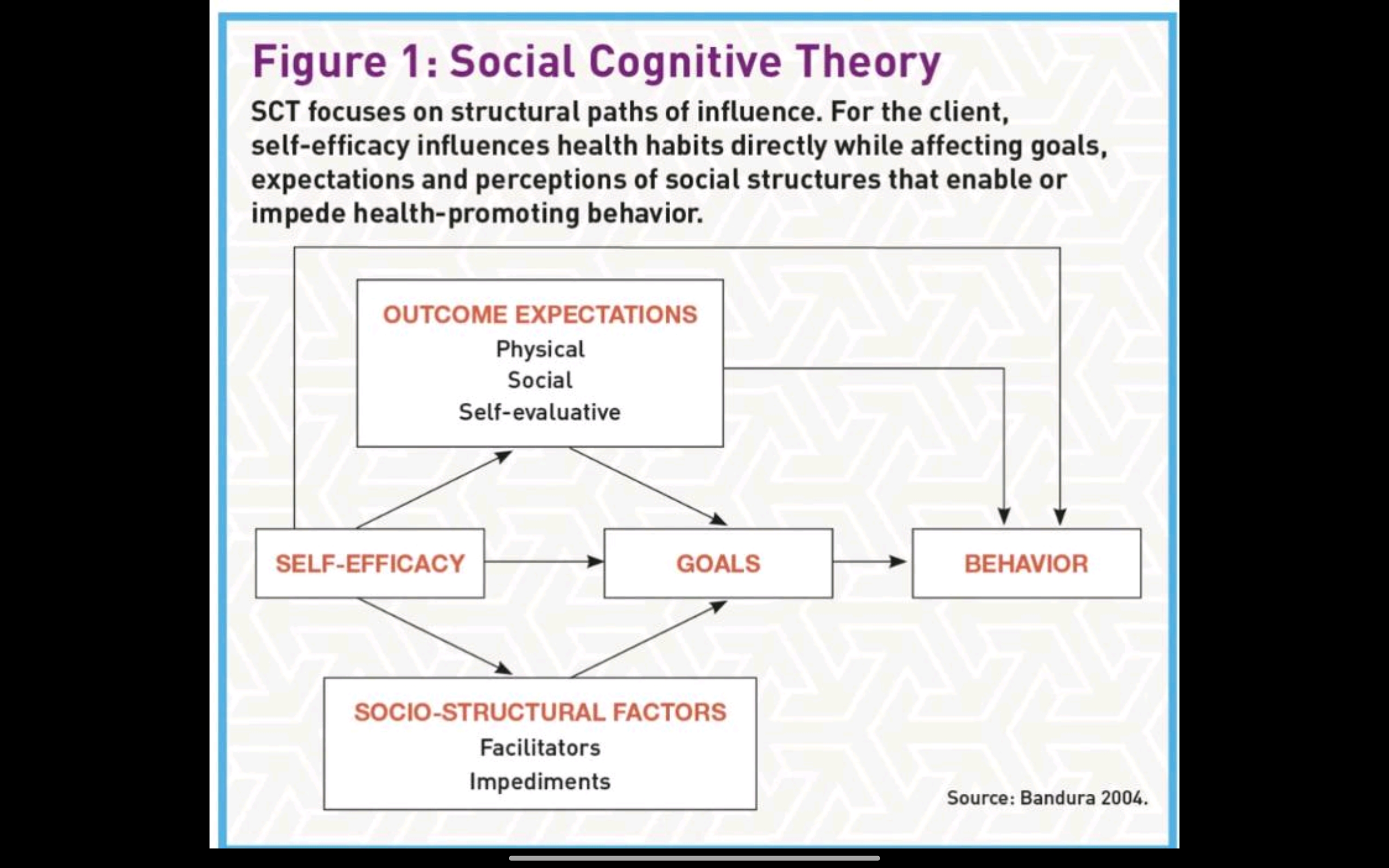
This is the central concept of SCT. This refers to the dynamic and reciprocal interaction of ___ (individual with a set of learned experiences), ___ (external social context), and ___ (responses to stimuli to achieve goals).
Reciprocal Determinism
person
environment
behavior
This asserts that people can witness and observe a behavior conducted by others, and then reproduce those actions. This is often exhibited through ___. If individuals see successful demonstration of a behavior, they can also complete the behavior successfully.
Observational Learning
"modeling” of behaviors
This refers to a person's actual ability to perform a behavior through essential ___ . In order to successfully perform a behavior, a person must know what to do and how to do it. People learn from the consequences of their behavior, which also affects the environment in which they live.
Behavioral Capability
Knowledge and skills
This refers to the internal or external responses to a person's behavior that affect the likelihood of continuing or discontinuing the behavior. This can be self-initiated or in the environment, and this can be positive or negative. This is the construct of SCT that most closely ties to the ___
REINFORCEMENTS
reciprocal relationship between behavior and environment.
This refers to the anticipated consequences of a person's behavior. ___ can be health-related or not health-related. People anticipate the consequences of their actions before engaging in the behavior, and these anticipated consequences can influence successful completion of the behavior. This is derived largely from previous experience. While ___ also derive from previous experience, it focus on the value that is placed on the outcome and are subjective to the individual.
EXPECTATIONS
Outcome expectations
expectancies
This refers to the level of a person’s ___ in his or her ability to successfully perform a behavior. This is unique to SCT although other theories have added this construct at later dates, such as the ___. This is influenced by a person's specific capabilities and other ___, as well as by ___ (barriers and facilitators).
SELF-EFFICACY
confidence
Theory of Planned Behavior
individual factors
environmental factors
Limitations of Social Cognitive Theory
• The theory assumes that ___ will automatically lead to ___, when this may not always be true.
• The theory is ___, based solely on the dynamic interplay between ___. It is unclear the extent to which each of these factors into actual behavior and if one is more influential than another.
• The theory heavily focuses on ___ and in doing so disregards ___ that may influence behaviors, regardless of past experience and expectations.
• The theory does not focus on ___, other than through reference to past experience. There is minimal attention on these factors.
• The theory can be ___, so can be difficult to operationalize in entirety
changes in the environment; changes in the person
loosely organized; person, behavior, and environment
processes of learning ; biological and hormonal predispositions
emotion or motivation
broad-reaching