Myasthenia Gravis
 Call Kai
 Learn
Learn Practice Test
 Spaced Repetition
 Match
Match Flashcards
 Knowt Play
1/28

There's no tags or description
Looks like no tags are added yet.
Name | Mastery | Learn | Test | Matching | Spaced | Call with Kai | Chat |
|---|
No analytics yet
Send a link to your students to track their progress
29 Terms
What is myasthenia gravis?
- An autoimmune disease characterised by weakness of skeletal muscle.
- Caused by a decrease in transmission of autoantibodies through the neuromuscular junction causing muscular weakness
Describe the pathophysiology of myasthenia gravis.
- Autoantibodies against the muscle nicotinic acetylcholine receptors are made.
- They bind to these receptors preventing acetycholine binding to them.
- This causes inhibition of the transmission at the NMJ causing muscular weakness.

How is acetylcholine produced?
Acetylcholine is made from acetyl-CoA and choline.
The enzyme choline acetyltransferase (ChAT) combines them.
It's stored in vesicles until nerve signals trigger its release.
What are choline esterases and what are the two types of choline esterases?
- Enzymes which break down acetylcholine.
- Types include: acetylcholinesterase (AChE) and butyrylcholinesterase (BuChE)
Describe AChE.
- Can be membrane bound in the synaptic cleft or soluble in the presynaptic terminal.
- Only found at ACh synapses and sweat glands (SymNS)
- Specific for ACh.
Describe BuChE.
- Widespread distribution in body e.g., plasma, liver skin.
- Less specific to substrates.
Describe the events in a normal healthy NMJ.
- Action potential reaches axon terminal which causes voltage gated Ca2+ channels to open.
- This causes an influx of Ca2+ which depolarises the axon terminal.
- This leads to exocytosis of vesicles containing acetylcholine
- Acetylcholine then diffuses across the synaptic cleft interacting with Nicotinic acetylcholine receptors.
Which muscles are most likely to be affected by myasthenia gravis?
- Muscles which are most in use e.g., Eyes and face
- Use-dependent producing symptoms such as drooping eyelids and lack of facial expression.
What are the causes of myasthenia gravis?
- Age (peaks between 60-80 in men and 20-3- in women)
- Loss of nAChRs at the NMJ
What are the symptoms of myasthenia gravis?
- Ocular symptoms e.g., drooping eyelids, double vision.
- Lack of facial expressions
- Slurred speech
- Difficulties chewing and swallowing.
- Fatigue and shortness in breath which can lead to myasthenic crisis which is severe.
What are tests for myasthenia gravis?
- Ice test
- Blood tests for autoantibodies
- Neurophysiology
- Edrophonium test
Describe the Ice Test for myasthenia gravis.
Placing ice on the muscle helps improve symptoms as it cools the muscle.
What are treatments for myasthenia gravis?
- Acetylcholinesterase inhibitors e.g., pyridostigmine
- Immunosuppressive therapy e.g., azathiopurine
- IV immunoglobulin
- Thymectomy
Why are acetylcholinesterase inhibitors good treatments for myasthenia gravis?
- MG causes a decresae in binding between acetylcholine and receptors.
- Prevents the breakdown of acetylcholine in the synaptic cleft.
- This allows acetylcholine to present for much longer in the synaptic cleft so it can keep exciting neurons (increase in twitch tension).
- This increases the binding between acetylcholine and receptors treating the disease.
What are the 3 main groups of cholinesterase inhibitors?
- Short acting e.g., Edrophonium
- Medium e.g., neostigmine and pyridostigmine
- Irreversible e.g., malathion and novichok.
What are general effects of cholinesterase inhibitors?
- Bradycardia, vasodilation, decreased BP
- Contraction of smooth muscle in bladder and bronchioles.
- Pupil constriction, constriction of ciliary muscles.
- Secretion of enzymes.
- Sweat increase
How is myasthenia gravis managed?
- Avoid disease triggers
- Symptomatic treatment
- Immunosuppressant drugs
- Immunomodulatory treatments
What are triggers for myasthenia gravis?
- Infection
- Stress/trauma
- Thyroid dysfunction
- Anaemia
- Electrolyte imbalances
- Medicines
How are oral acetylcholinesterase inhibitors prescribed?
- 15mg QDS with food.
- Can increase to 60mg QDS
What are side effects of acetylcholinesterase inhibitors?
- Muscle and abdominal cramps (nicotinic effects)
- Cramps, diarrhoea, increased sweating (muscarinic)
Why do acetylcholinesterase inhibitors produce these side-effects?
- They activate the parasympathetic nervous system which stimulates contraction.
- This causes smooth and skeletal muscle to contract causing convulsions, difficulty breathing, increased gut motility and pupil constriction.
How can side-effects be managed?
- Making sure patients are taking drugs with food.
- Co-prescribing with oral-anticholinergic drugs e.g., glycopyrrolate.
- Providing loperamide for diarrhoea.
Why are acetylcholinesterase inhibitors cautioned with asthma, bradycardia, hypotension, peptic ulceration?
- Stimulates constriction of airways and therefore exacerbates asthma.
- Stimulates muscarinic receptors in the heart which control SA and AV nodes which slow down heart rate exacerbating bradycardia and hypotension.
- Stimulates gastric acid secretion which can worsen peptic ulcers.
What structural features allows acetylcholine to bind to acetylcholine esterase?
- Trimethyl on nitrogen fits into he hydrophobic pocket of enzyme.
- Ester oxygen forms an H-bond with the tyrosine residue on enzyme.
- Ionic interaction between Positive nitrogen and aspartic acid.
These hold acetylcholine in place for hydrolysis to occur (catalytic triad).
- Close to the catalytic triad which catalyses hydrolysis of acetylcholine.
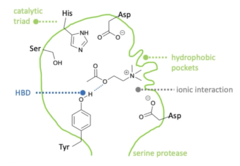
How does the catalytic triad catalyse hydrolysis of acetylcholine?
Activates serine for nucleophilic attack
Show the hydrolysis of acetylcholine.
- This leaves acetylcholine esterase inactive as the serine residue is still acylated.
- Requires regeneration to reuse enzyme.

How is acetylcholine esterase regenerated?

What structural features are required to develop a reversible acetylcholine esterase inhibitor?
- Suitable leaving group e.g., phenol
- Group that is less susceptible to hydrolysis than acetyl which allows slower regeneration.
- Positively charged nitrogen atom which allows orientation of molecule in active site.

Describe irreversible acetylcholine esterase inhibitors.
- Contain reactive groups, such as phosphorus, capable of forming strong covalent bonds with the serine residue which cannot be hydrolysed.
- This leads to prolonged activation of cholinergic receptors.