psyc 307 midterm 2
 Call Kai
 Learn
 Practice Test
 Spaced Repetition
 Match
 Flashcards
 Knowt Play
1/103

There's no tags or description
Looks like no tags are added yet.
104 Terms
The ship of Theseus
1000s of years ago
Imagine theseus owner of ship
Over time replace the ships parts
Over time every piece of the ship have een replaces
Is it still the old ship or is it now a new ship?
Authorship and ownership is really important
is self updating?
Similarly, the “self” is continuously updated over time
Yet in Western culture, a sense of a stable self is the most important thing
I think, therefore i am
Many Eastern contemplative traditions, such as buddhism and taoism, say this” self” is a illusion
Where self is, truth is not. Where truth is, self is not
Figment of our imagination
Getting rid of evil is the goal
Self-Concept
How we perceive ourselves plays a crucial role in how we relate to many things in life.
The self-concept is implicated in:
Directing what social information we should attend to
How we derive meaning from event
What is meaningful
What kinds of relationships we have
How we experience our emotions
How we make moral judgments
What we are motivated to work towards
Measured using twenty statements test
self-concept in WEIRD
Classic paper by Markus and Kitayama (1991).
Much of what is known in social psychology has been studied with people with predominantly an independent self.
In much of the non-Western world, in contrast, an interdependent self is more common.
The WEIRD problem all over again
Independent View of Self
You are at the center with relationships surrounding you
Yourself and others you have relationships are independent, no overlap
Within a group(porus so ppl can come and leave)
experienced as largely independent from others.
important aspects of the self are personal characteristics.
aspects of themselves are Self-contained- they arise from the individual and not from interactions with others
present themselves in ways consistent with these attributes
remains largely constant across roles and situations.
influencing the situation is the priority
To make it better for me
direct communication style
Really understand who you are
Worst fear: misunderstood
Pic
Individual doesn’t overlap
Large X(aspects of identity)are in individual
Circle around individual is solid - stable in diff situations
Dotted line indicating fluid movement within ingroup

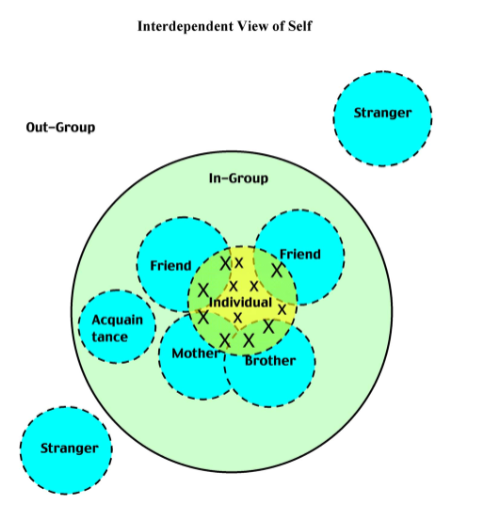
Interdependent View of Self
More overlap
Groups are more defined, harder to enter and leave
individual’s sense of self is importantly
interconnected to the selves of others.
key aspects of the self include roles, relationships, and memberships.
Role as a sibling is different than role of friend
Sense of self is changing
Because roles change across situations, the self is also somewhat fluid across situations.
adjusting to situations is the priority
indirect communication style
Thinking ppl will understand you
Fear of exclusion
Pic
Individual overlaps with other significant relationships
Large Xs are in intersections between self and significant relationships
These relationships show what group they belong to
Self is dotted so experience of identity is fluid and changing depending on the relationships
Solid line between ingroup/outgroup, so less/no movement
They define themselves through important people so have to be close for that
twenty statements test application
People are asked to describe themselves with a number of statements that begin with
“I am _______.”
I am canadian/siste/intorvert
The kinds of statements that they list are then counted and analyzed.
Although everyone can access both self-construals, people from different cultures
Comparison of American college students vs. various groups in Kenya
More personal characteristics in american undergrads and nairobi undergrads
Workers say more roles but still some personal characteristics
Other ppl in kenya groups have very little personal and a lot roles .
Seen in all western countries and starting even in kindergarten
Cultural differences in self-concept brain study
Chinese and western participants studied under fMRI
Asked to consider how well a number of trait adjectives characterized them or their mothers
Westerner show different regions in brain activation
Chinese show same brain activation (medial prefrontal cortex for self representation)
Variability in interdependent self
Arabian - can be quite assertive
Latin america - collectiveist values but self-reliant and consistent, emphasizing self-expression
South asia - use argue in conflict which is more independent
Self-Construal Scale
Ind
I enjoy being unique and different from others in many respects
I'd rather say "No" directly, than risk being misunderstood
I am comfortable with being singled out for praise or rewards
INTER
Even when I strongly disagree with group members, I avoid an argument
Parliament in japan vs us
Yelling screaming vs agreeable
If my brother or sister fails, I feel responsible
My relationships with others are more important than my own accomplishments
ingroup /outgroup
Interdependent
Ingroup serves to direct appropriate behaviours and obligations towards these relationships
Important to distinguish those towards whom they have obligations from and those they do not
Being a member of one ingroup is a serious role and not easy to get into
Rare to lose a member(become outgroup)
not always good
stronger obligation, so less ability to leave and more competition
Independent
People in ingroup is not as important to self
New relationships and old lost doesn’t have much impact to the self
More willing to form news connections and less stressed when old ones die
Individualism-Collectivism and where its found
Individualism: A cultural pattern in which individual goals and preferences take priority over group goals. (This matches Independent self-construal)
Men are more individual
Individual rights take priority
mosty United States, closely followed by other English-speaking countries and by Western European nations
Collectivism: A cultural pattern in which group goals and preferences take priority over individual goals. (This matches Interdependent self-construal)
Women are more collective - only on relatedness(perception of others’ feelings)
Latin America and Asia, Africa, Southern Europe, Eastern Europe, and the South Pacific
80% of the world pop
Possible variation within countries
ex. hawaii cuz more asain ancestry
higher social class is associated With dominant cultural values
Periods of economic growth tend to be linked with growing rates of independence and recessions, with increasing interdependence
Individualism-Collectivism examples
Influencing vs Fitting in?
Suppose you, as a manager, are hiring a new employee to work in your department. Which of the two following considerations are more important to you?
1. She must fit into the group in which she is to work (COL)
Be a team member
2. She must have the skills, the knowledge, and a previous success record (IND)
Highest is the US and Canada, lowest is Singapore and japan
Morality justice-based or obligation-based?
You run a department of a division of a large company. One of your subordinates, whom you know has trouble at home, is frequently coming in significantly late. What right does this colleague to be protected by you from others in the department
highest “no right” in US and Germany, lowest in Italy and France
How Individualism-Collectivism is measured at the cultural level
More individualistic cultures tend to have:
Small household size
Adults living alone
High divorce rates
Unique baby names
Global Patterns of Individualism-Collectivism
Individualism has been increasing in the world
But outside of the West, most of the world remains collectivistic — large cultural differences remain
Some of the strongest predictors of individualism are a country's:
Economic development
Higher education rates
Length of exposure to the Latin church's family and marriage practices (historical bans on monogamy and cousin marriage)
cultural individualism changes were initiated by some changes in policies enacted by the Western Church
new religious laws: weaken the intensity of kinship, (obligations and ties toward large clans and families)
prohibited marriage to family and arranged marriage
Why is US so individualistic
The country remained a frontier and attracted those who sought more individual freedom than was available in their homelands
Analyses reveal that American counties that were on an underpopulated frontier for a longer period of history are more individualistic than others
people had to fend for themselves and no time for niceties
people who move here are more independent in general
Socio-economic class difference
Within countries groups also vary in their self-concepts.
The wealthier and more educated groups tend to be more independent than the less wealthy and less educated groups
Different jobs/roles (need to rely on other)
Kid expectations (what their future is nurtures them to be col/inv)
low economic status - greater value on conforming to authority figures
Middle-class Americans emphasise self-direction
Many of the cross-cultural findings discussed in this course also hold for comparisons of socio-economic differences within the west
University students tend to come from higher social class backgrounds, which means their self-constructual is more independent than the general population
first generation university students
Achievement gap between first generation and continuing generation students
Cultural mismatch hypothesis
University cultural norms favor independent self-construal
Cultural mismatch —> lower grades
Independent message: “Paving your own path”
Interdependent message: “being part of community”
Cultural Fit
the extent to which an individual is aligned with the dominant cultural meaning that surround them
cultural differences in thoughts on gender equality
men and women shared fairly similar views about gender equality.
India, Pakistan, and Nigeria are more likely to embrace traditional gender attitudes than women from European nations
men had significantly more traditional gender views than women—probably because traditional gender views benefit men more than women.
Christianity, specifically Protestantism, were more likely to have egalitarian gender views, Muslims were associated With more traditional gender views
Northern countries had mostly egalitarian views than southern countries
urbanization = equality
individualism = equality
Self-awareness
Self-Consistency
Motivated to feel you have a consistent self - not universal
The interdependent self is more contextually variable than the independent self
The interdependent self is more grounded in roles, and therefore, it varies across situations more than the independent self.
In one study, Japanese and American students completed the Twenty Statements Test in different situations
There were 4 test-taking situations:
prof, peer, alone, lots of peers
The key variable of interest was how similarly positive were people’s self-descriptions across situations
American self-descriptions were highly similar across different situations.
Their self-descriptions were also uniformly positive. This reflects a self-enhancing cultural tendency
Japanese self-descriptions varied significantly across different situations.
They were more positive when alone and most critical when with their professor.
Their self-descriptions were also less positive than the Americans’. This reflects a self-critical cultural tendency
Consistency across situations was associated with higher feelings of authenticity, likeability, and social skills for European Americans but not for East Asian
But they do have consistency throughout time within each Of these relationships
opportunities for this identity change across life so greater changes in their self-concept with age
cognitive dissonance.
We have a powerful motivation to be consistent,
Cognitive dissonance is the distressing feeling we have when we observe ourselves behaving inconsistently or against our own sense of self-consistency.
how to fix
acting more consistently - hard how?
dissonance reduction - change our attitudes so we no longer appear to be so inconsistent
ex. 2 likeable options but only choose one
decision is made,
dissonance might follow, because there are features of the alternatives that are inconsistent with that choice. (still appealing)
To reduce the unpleasant feelings, people often rationalise by
viewing things consistent with their making a good decision as more important(postives in chosen and negative in reject)
inconsistent with their decision as less important (negatives in chosen, positives in reject)
findings
Canadians showed this tendency
choice of CD nd later ranking showed this
Japanese didn’t
will rationalise decisions they make for others (motivation to be consistent with others’ expectations)
rationalise decisions when they consider what others decided
Self-awareness
Subjective self-awareness vs objective self-awareness
In one study, Euro- and Asian-Canadian participants reported their memories for a variety of events. These were coded as 1st person or 3rd person imagery
In some of the events they were the center of attention (e.g., your birthday party) and some they were not the center of attention (e.g., watching a movie with friends).
Third person memories
subjective self-awareness
“inside out” perspective - better suits the independent self, as the self is the ultimate arbiter of one's standing in the world
subjective cuz depends on the person
objective self-awareness
“outside in” perspective - is better suited for the interdependent self, as it is more important to understand how others are viewing them
looking at oneself objectively
“Inside out” vs “Outside in”
If I’m outside in, my self-view is guided by impressions of how others perceive me
if inside out, my thoughts about myself are less affected by others’ thoughts
creativity test
American participants’ self-evaluations were relatively unaffected by whether they thought another person had seen either their good score or their average score
Hong Kong participants' self-evaluations were affected by their knowledge of what another person knew about their performance.
who knows the self
the individual should know the self the best - has all the experiences/inner
but people are motivated to see themselves in certain ways, which can often distort the accuracy of their self-assessments.
Self-awareness can be changed by putting them in front of certain stimuli.
more self-critical as they become aware of how they might be falling short of their standards because they become judge
The children from individualistic cultures donated fewer candies than they had earlier predicted, whereas collectivistic cultures donated about the same number
growth mindset
Our self-concept is largely fluid and responds to the efforts we make.
The belief that we can easily change, and are expected to change
Cultures in which growth mindsets are more common have been characterised as "embrace difficulty” cultures
fixed mindset
theory that aspects of the self are resistant to change
Personality model name
five-factor model of personality
five-factor model of personality
Correlations among the different items in survey are lower in non-Western
maybe the measure has a problem of generalizability
Does the Big Five capture all personality worldwide
fairly cross-culturally robust but not exhaustive
but little evidence in support of big five in non-indutrualized
items didn’t correlate well enough to yield distinctive traits
rather than 5, they had 2
could be that these questions are not the right fit
number of personality traits are dependent on the number of different niches
niche diversity hypothesis
number of personality traits are dependent on the number of different niches
when people live in an environment where there are opportunities for many different skill sets and traits to be cultivated and rewarded, personality comes to take on a larger set of basic underlying factors as they compete with each other for the different roles that are available
geography on personality
Minnesota and Wisconsin are a Friendly and Conventional region, with
highest Extraversion, agreeableness, and conscientiousness
Western States, from Oregon to Arizona, are a Relaxed and Creative region
lowest neuroticism and the highest openness to experience
Northeastern States, especially New York and Massachusetts, are a Temperamental and Uninhibited region
highest on neuroticism and the lowest on conscientiousness
Personality traits tend to cluster because
people influence one another through their daily interactions
the demands of the local environment, such as the climate.
People also move to places where there are more like-minded others
2017 Nobel Prize in Literature
greatest novelists in the English language Kazuo Ishiguro
I’ve always felt I’ve had a sort of peripheral view of British society. I grew up here, but I never felt completely part of it. That distance gives you a certain kind of clarity
Being an “outsider” offers a unique perspective into a society. But why?
acculturation
Process of learning and adapting to a new culture that is different from their own
heritage culture is og
host culture is new
remote acculturation
learnign from afar by regularly watching itss media or eating its food
Common pattern in where people move
likely to go to regions of a country that are more similar to their home culture in terms of climate
migrants
People who move from a heritage culture to a host culture
sojourners- those who intend to stay temporarily (job-related move for period of time)
immigrant - those who want to stay permanently
stages of acculturation
honeymoon stage - first few months
Good time, excited and enjoying a novel and exotic environment
culture shock/crisis stage - next 6-18 months
Increasingly negative view of the host culture
feeling of anxious, helpless, irritable, disoriented and home sick
Language, food, time
Time perspective: slow pace of life (punctuality)
Event time vs clock time
Distress, anxiety, disorientation, due to:
Loss of familiar cues
The breakdown of communication
Identity crisis
new interesting thing are less interesting and ppl are getting over your exoticness so you don’t have a common topic of convo
Adjustment stage - several years after getting past crisis
start to addjust and begin to enjoy experiences more
language, relationships, differences are more adapted to host culture
start to think more like the locals around them
people beoming increasingly competent at funtioning in their new culture

Who adjusts better?
People who don’t move to tighter social norms
younger people cuz less set in the ways of their heritage culture
Greater cultural intelligence and empathy
The ability to understand and adapt to different cultural contexts.
The ability to understand and relate to the feelings and perspectives of people from different cultures.
Better implicit pattern recognition
What behaviours are more appropriate in a new culture
People who are aware of how they are learning about their new culture
Cultural distance
The more similar one’s heritage culture is to one’s host culture, the easier it is to acculturate
Greater cultural distance from the host culture tend to be related to more distress, more medical consultations, and more difficulty in making friendships with people from the host culture.
For example, Malaysian exchange students who studied in culturally similar Singapore showed more successful adjustment than those who studied in more culturally distant New Zealand (Ward & Kennedy, 1995)
Tsimshian (stratification and permanent) most easy acculturation, Cree (less stratified and migratory) least easy, Carrier (middle food accumulation and stratification) intermediate results
Acculturation Strategies
Do they attempt to participate in larger society of their host culture
Do they strive to maintain their own heritage culture and identity
Sometimes by choice, sometimes forced by the community
The most common strategy is integration. This is the most successful strategy, and people tend to fare the best, as a person has two cultural communities from which to draw support.
effort to fit in and participate in host while maintaining heritage
also absence of prejudice or prsonailites that fit are more likely to use this
Marginalization is the least common, and it has the fewest positive outcomes
little effort to fit in and maintain heritage
Assimilation is intermediate in frequency
In some studies, assimilation strategies yield as positive outcomes as integration strategies.
efforts to fit in but not maintaining heritage
disconnection to the past
Separation is intermediate in frequency
effort to maintain heritage but not fit in
rejecting the host culture so they themselves are being rejected

what influences which acculturation strategy to use
Immigrants who are targets of prejudice are less likely adopt assimilation or integration strategies
Physically distinct ethnic groups are less likely to have a positive view cuz they face more prejudice
Separation or marginalization cuz the host culture doesn’t meet their needs or desires
Societies vary in the model of multiculturalism that they pursue, which changes the acculturation strategies that are most available
Canada strives for a mosaic model, where each cultural group maintains its distinct characteristics, and participates in the national culture. This favors integration
The US strives more for a “melting pot” model, where each ethnic group’s distinct characteristics are melted away as they learn to assimilate to the dominant culture
Anti-immigrant attitudes due to the majority feeling threatened, as they think their status and power are diminishing with the influx of minority
identity denial
people’s cultural identity is questioned because they are not recognised as matching the prototype of the culture they are living in
ex., when questioned about being an american to asian americans, more likely to try to demonstrate their authentic American identity
ex., likely to be perceived as American if overweight
Stereotype threat
fear of behaving in a way that will confirm a negative stereotype about one’s group
People cope with stress from ST by disidentifying (not caring) with stereotyped domains and adopting strategies to avoid reminders of the stereotype
combating
learn of its existence
Multicultural People
What kind of self-concept do people have who live in more than one culture?
Multicultural experiences affect self-concept in two ways, and there is evidence for both blending and frame-switching
Blending
bicultural people to show characteristics in between the 2 cultures
Evidence for Blending
self-concepts of multicultural people look intermediate to those of monocultural people from different cultures
For example, the ways of thinking of Asian-Americans are in between those of Americans and Asians.
Consider the self-esteem of people with exposure to both Canadian and East Asian cultures
One study looked at the self-esteem of people longitudinally across two points in time: prior to moving to a new culture and then again 7 months after moving.
When Japanese had lived in Canada for 7 months, their self-esteem increased, Canadians had lived in Japan for 7 months, their self-esteem decreased significantly.
compared the self-esteem of people with exposure to East Asian and Canadian culture cross-sectionally.
“Never Been-Abroad” Japanese have moderate self-esteem scores whereas European-Canadians have high self-esteem.
The self-esteem of East Asians increases with exposure to North American culture.
The self-esteem of 3rd Generation Asian-Canadians is indistinguishable from European-Canadians. If this result can be generalized, it suggests that three generations is necessary for complete acculturation.
Frame-switching
People maintain multiple self-concepts and switch between them depending on context
Code-switching - changing your communication to suit cultural context
benefit from acting and presenting to other in diff cultures
Mind forms link between ideas that tend to get activated together
especially common in bicultural who were born in North America compared to those who immigrated
NA bicultural have lifetime of bicultural experiences
Evidence for Frame-Switching
Evidence of frame-switching is clear in language use.
Language itself can cue cultural knowledge
Hong Kong Chinese participants reported more independent self- construal when the questionnaire was in English, and more interdependent construal in Chinese
Barack Obama the frame-switcher
Sometimes act white/black
Switching to appear to different crowds
Depending on context, he connects to the audience/ talks differently
bicultural identity integration
the extent to which people see their 2 cultures as compatible or in opposition
higher bicultural identity integration = frame-switching
low bicultural identity integration = in A context feel especially B and vice versa
promotion orientation
trying to achieve a positive outcome
prevention orientation
trying to avoid a negative outcome
Are bicultural ppl only ones with multiple knowledge structures that can be primed
Americans could be lead to think like Chinese
situated cognition
cultural ideas are more information available to all but brought forward differently - existential universals
Third Culture Kids
Children who grow up with their expatriate parents in multiple places outside their heritage culture.
TCK’s tend to learn their heritage cultures from afar - something called remote acculturation.
They tend not to feel strong connections to any of their cultures, but have more of a global identity.
Research on TCK’s is rather new as they’re a difficult sample to study.
They rely more on “marginalization” acculturation strategies.
Feel like a minority wherever they go, and often associate more with other TCK’s. They see themselves as “fish out of water.”
Have trouble answering the question, “where are you from?”
Develop earlier maturity, very international in outlook, score lower in prejudice, are creative, see themselves as “nomads”
Do Multicultural Experiences Foster Creativity?
A key part of creativity is insight -when you see a problem in a novel way.
Creative insight might be fostered by adjusting to new cultural environments, where you learn to see things differently. Having more than one perspective leads to more creative insights.
Many famous artists and writers had multicultural experiences.
In the process of adapting to a new culture, one needs to begin to see things in a new way.
There can be some particular benefits to learning how to see things differently
Once I went (abroad) it was extremely exciting for me to become a new personality, to be detached from everything that bound me, noticing everything that was different. That noticing of difference was very important
Douglas Cardinal - “Without any preconceptions, I evolve a design from the inside out, open to all possibilities.”
Create buildings that blend into nature
Creativity of Fashion Designers
The fashion industry rates the creativity of different fashion designers each year.
This study compared the ratings of the creativity of the designers based on:
Breadth (number of foreign countries lived in)
Depth (number of years spent abroad)
Cultural Distance (how culturally different are the places they’ve lived).
Each of these was associated with more creativity (see Godart et al., 2015).
Breadth and cultural distance showed a curvilinear relation (meaning that the ideal was a moderate amount of multicultural experience)
perhaps creative people are more likely to move
ppl with O, E, C, tendency to experience awe seek cross-cultural
but openness increases when people move
greater psychological richness: the sense that life is filled with interesting and perspective changing experiences (Oishi et al, 2019)
greater trust of others
more belief in moral relativity
right and wrong is not absolute
less likely to follow own moral compass and act immorally
integrative complexity
willingness and ability to acknowledge and consider different viewpoints on the same issue
Culturally Diverse Groups
More creativity & better decisions
Wisdom of crowd: broader reservoir of information
A lot of information from different people
Shift in perspective
Antidote against confirmation bias and groupthink
Offer positive contact and cultural role models (contact hypothesis) leading to reductions in prejudice
Better decisions due to more perspectives
BUT: less social cohesiveness and more prone to conflict
Positive atmosphere and interactions
Most important
Make an effort to create a positive atmosphere
Superordinate identity and common goals
Something to relate to
Clear norms
Perspective taking
Wisdom of the crowd
The group has diversity of opinion
Individual opinions are independent of one another
The crowd should be able to to aggregate individual opinion into one collective decision
Galton: weight of the ox
Prediction markets more accurate than expert opinion
Average judgment converges on the correct solution
19th century scientist that created medicine
One day at a farm farm where you guess the weight of the ox
Any single person that makes a guess - not right
But average all the opinion and its is a really good guess on the weight
“Herd mentality” is detrimental to wise decisions and creativity and often lead to disastrous group decisions
Aggregated information yields better and more creative solutions
diverse views in a group weaken the confirmation bias, and they combine the best features of different ideas
Diverse groups of non-experts beat even expert opinion
Homogenous groups are not wise groups
Not considering different way of looking at the problem
May also explain why multicultural people are more creative and innovative
In a way they are like a group of different experiences
wisdom of crowd example
Study analyzed 9 million scientific papers and 6 million scientists worldwide
What predicts scientific paper’s impact
How diverse the people were (cultural background/gender)
How connected the scientist was to people in other cultures
Homophily: the tendency to associate with culturally similar others
More common
More diverse, more impactful
Positive Parasocial Contact: The Salah Effect
Media exposure to celebrities - known as parasocial contact - from perceived outgroups can also reduce prejudice.
Mo Salah, an elite Egyptian soccer player with a visible Muslim identity, joined Liverpool FC in 2018 until 2026
Racism and homophobia had been as issue among Liverpool FC fans
After he joined the club, hate crimes in Liverpool area dropped by 16% and Islamophobic tweets dropped by 50%
Experimentally, thinking about salah decreased islamophobia attitudes among liverpool fans
Science scores and self-confidence across cultures
How well they are doing on average in science out of 800 and how confident are you in science
Opposite of thought: more confident = better scores
In east asian, their culture makes them more humble and rate lower
Reference group effect: everyone is doing better, so you think you're not doing as well
Too confident, so not working as hard
Self-Enhancement
Self-enhancement is a motivation to focus on and elaborate more about one’s strengths than on one’s weaknesses.
As with most psychological phenomena, it had primarily been studied with Western populations, which suggested the motivation was very pronounced
Most North Americans possess high self-esteem.
Most North Americans view themselves in unrealistically positive terms
Most North Americans use self-esteem maintenance strategies to discount any negative feedback that they might encounter
Is this a basic human need, or is it culturally learned?
Some evidence for the latter is that the motivation has been increasing over time
Positive Views Have Been Increasing Over Time in the USA
Evidence for cultural learning cuz how it be changing over time
Generational increase in self-esteem
self-serving bias