Chemistry Unit 4: Periodic Trends
 Call Kai
 Learn
Learn Practice Test
 Spaced Repetition
 Match
Match Flashcards
 Knowt Play
1/21

There's no tags or description
Looks like no tags are added yet.
Name | Mastery | Learn | Test | Matching | Spaced | Call with Kai | Chat |
|---|
No analytics yet
Send a link to your students to track their progress
22 Terms
When does it get harder to remove successive electrons?
For every electron removed, each electron after gets harder to remove for an ion
Ionization energy decreases when?
As radius increases
When does nuclear charge felt by valence increase?
across the row
larger effective nuclear charge pulls valence shell closer to nucleus
addition of electron to valence shell repels but doesn’t shield as well as if it were added to the core
greater nucleus charge happens so electrons are brought closer to nucleus
What happens to the radius of ions of an element (nuclear charge fixed)
radius increases with increasing # of electrons
What happens to radius of ions or atoms with the same # of electrons
isoelectronic species
increases with decreasing nuclear charge
Largest cation
Rb+
Cs+
smaller than anions
Smallest anion
F-
The larger the positive charge…
The smaller the cation
for isoelectronic
The larger the negative charge…
The larger the ion
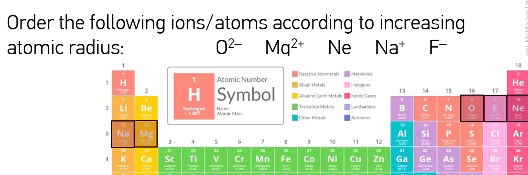
more negative repels electrons so theyre bigger
more positive attracts electrons and hold closer so radius smaller

Ionization energy
energy needed to eject an electron
must be (g)
Increases left to right
decreases moving down
Filled and half filled subshells
electrons are harder to remove
have special stability
Metals properties
conductive, high melting/boiling point, ductile, mallaeble, shiny
metal + Oxygen = basic —> form cation
metal + non metal —> metal loses electrons
most metallic = bottom left of periodic table
which elements are liquid at room temp
Br and Hg
WHich class of metals have highest melting points
Transition metals + Carbon
WHich elements are the most dense
Gets more dense going from top → bottom
most dense is the transition metals
Polar vs non polar covalent
electronegativity:
0.5<= x <= 2 → polar covalent (2 nonmetals)
>2 → ionic bond
<0.5 → non-polar covalent
= 0 → pure covalent bond (02, N2, etc)
reactivity of metals
Alkalai metals: down periodic table = more reactive
halogens: down periodic table = less reactive
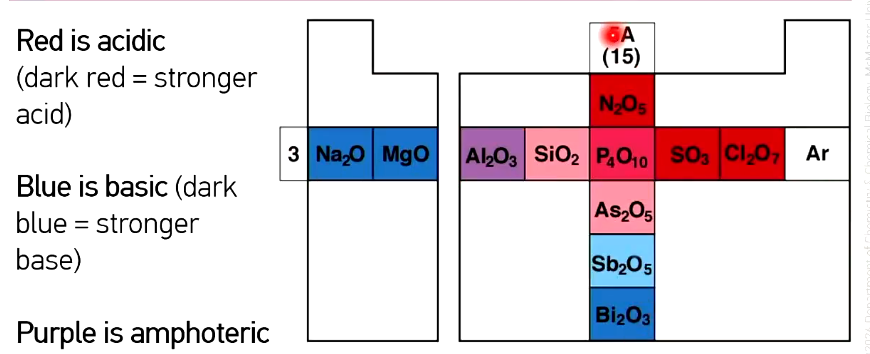
Acidity of oxides
worlds largest producer of potash
CANADA (saskatchewan)