540 Exam 3
 Call Kai
 Learn
Learn Practice Test
 Spaced Repetition
 Match
Match Flashcards
 Knowt Play
1/169

There's no tags or description
Looks like no tags are added yet.
Name | Mastery | Learn | Test | Matching | Spaced | Call with Kai | Chat |
|---|
No analytics yet
Send a link to your students to track their progress
170 Terms
Distal Row of Carpal Bones (thumb→pinky)
trapezium, trapezoid, capitate, hamate

Proximal Row of Carpal Bones (thumb→pinky)
scaphoid, lunate, triquetrun, pisiform
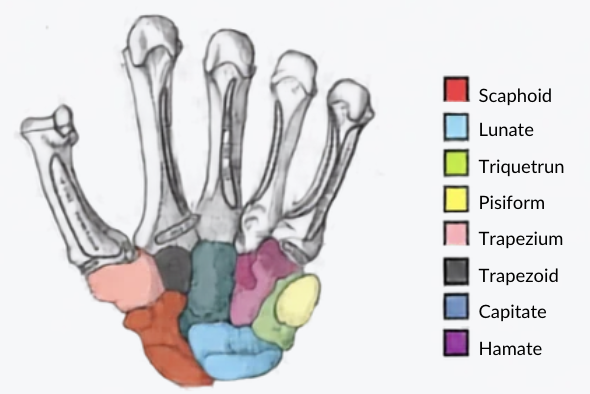
The __ row of carpal bones is more stable
distal
The __ row of carpal bones is more mobile, serving a mechanical function, gliding during motion.
proximal
The __ row of carpals articulates with the metacarpals
distal
The axis of all wrist motion passes through the ___
capitate
Radiocarpal Joint
biaxial, condyloid joint
articulation between the convex radius and concave carpals (scaphoid, lunate, triquetrum)
Does the ulna directly contact the carpal bones?
no—it is separated by an articular disc (TFCC)
At the radiocarpal joint, the radius articulates with the…
scaphoid, lunate, triquetrum
Midcarpal Joint
joint between the proximal and distal carpal rows
Wrist Motion requires movement of what two joints?
radiocarpal and midcarpal
Proximal Carpals
scaphoid→lunate→triquetrum→pisiform
serves as the mobile mechanical link between radius and distal carpals
Biomechanics of Proximal Carpal Row
instead of being pulled by muscles, the proximal row functions as a mechanical unit between the forearm and rest of wrist
The proximal carpals have few/no direct muscle attachments. What is the one exception?
FCU’s tendon attaches to the pisiform (associated with the ulnar volar wrist) and influences the proximal row
Wrist movement does not occur at one joint alone. The radiocarpal and midcarpal joint work together with the proximal carpal bones serving as an important mechanical link. During flexion and extension, how many degrees are performed by each joint?
40-50 at radiocarpal joint
23-35at midcarpal
Many ADLs require __% of full wrist motion
50-80%
During wrist flexion, the proximal row glides ___
posteriorly
During wrist extension, the proximal carpals glide ___
anteriorly
During wrist radial deviation, the proximal carpals glide ___
ulnarly
During wrist ulnar deviation, the proximal row glides ___
radially
Anterior Wrist Flexors
Flexor Carpi Ulnaris (FCU)
Palmaris Longus
Flexor Carpi Radialis (FCR)
Flexor Carpi Ulnaris (FCU) Function
flexes and ulnarly deviates wrist

Flexor Carpi Ulnaris (FCU) origin, insertion, nerve
O: medial epicondyle
I: pisiform, 5th metacarpal
N: ulnar
The Flexor Carpi Ulnaris (FCU) is innervated by the ___
ulnar nerve
Palmaris Longus Function
assists with wrist flexion

Palmaris Longus origin, insertion, nerve
O: medial epicondyle
I: palm
N: median

The Palmaris Longus is innervated by the ___
median nerve
Flexor Carpi Radialis (FCR)
flexes and radially deviates the wrist
Flexor Carpi Radialis (FCR) origin, insertion, and nerve
O: medial epicondyle
I: 2nd/3rd metacarpals
N: median
The Flexor Carpi Radialis (FCR) is innervated by the ___
median nerve
The FCU and FCR are synergists for what motion?
wrist flexion
The FCU and FCR are antagonists for what motions?
radial/ulnar deviation
Posterior Wrist Muscles
Extensor Carpi Radialis Longus (ECRL)
Extensor Carpi Radialis Brevis (ECRB)
Extensor Carpi Ulnaris (ECU)
Extensor Carpi Radialis Longus (ECRL) Function
wrist extension and radial deviation

Extensor Carpi Radialis Longus (ECRL) origin, insertion, nerve
O: distal humerus
I: base of 2nd metacarpal
N: radial

The ECRL is innervated by the ___
radial nerve

Extensor Carpi Radialis Brevis (ECRB) Function
wrist extension

ECRB origin, insertion, nerve
O: lateral epicondyle
I: base of 3rd metacarpal
N: radial nerve

The ECRB is innervated by the ___
radial nerve

The ECRL and ECRB insert at the base of the 2nd metacarpal and at the base of the 3rd metacarpal. WHich one inserts at the 2nd metacarpal?
ERCL
Extensor Carpi Ulnaris (ECU) Function
wrist extension and ulnar deviation

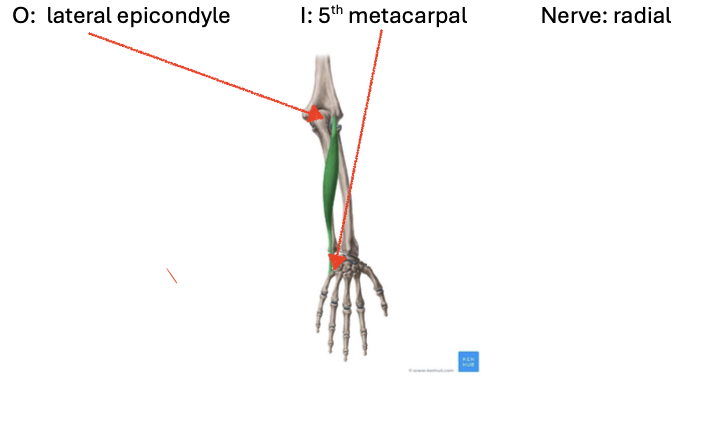
ECU origin, insertion, nerve
O: lateral epicondyle
I: 5th metacarpal
N: radial
grip is strongest when?
35 degrees of wrist extension
Do the wrist flexors or extensors have more torque? What does this cause?
wrist flexors (FDP and FDS) have 70% > torque, thus the extensors must work hard to maintain the wrist position so the flexors don’t become actively insufficient
Why are the FDP and FDS “bullies”?
they have about 70% greater torque than the extensors, so the extensors must work hard to maintain the wrist position so the flexors font become actively insufficient
Flexor Reticulum
strong band of connective tissue that crosses the anterior side of the wrist
transverse carpal ligament (distal and deep)
palmar carpal ligament (proximal and superficial)

Transverse Carpal Ligament
distal and deep portion of the flexor reticulum

Palmar Carpal Ligament
proximal and superficial portion of the flexor reticulum
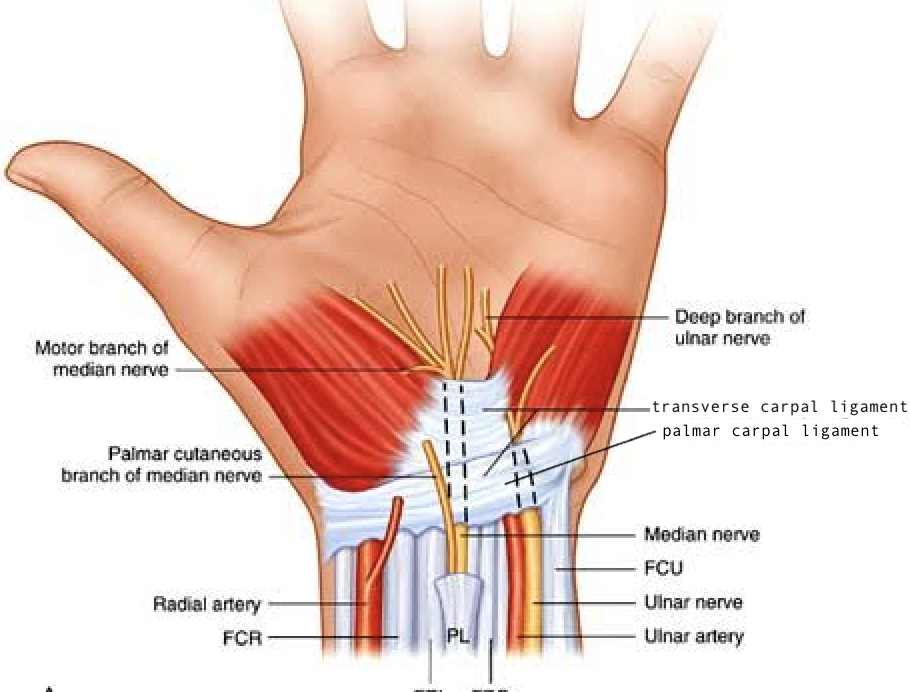
Flexor Reticulum Function
holds the flexor tendons close to the wrist to prevent bowstringing; helps maintain carpal stability

Carpal Tunnel
passage way of the wrist with the flexor reticulum serving as the roof and the carpal bones serving as the sides and floor.
median nerve
4 FDS tendons
4 FDP tendons
1 FPL tendon
Extensor Reticulum
strong horizontal fibrous band of connective tissue located on the posterior wrist that holds extensors down
Extensor Reticulum Function
holds extensor tendons close to the wrist as they cross into the hand; prevents tendons from stringing away from wrist during movement
Main Job of the Wrist Ligaments
stability—hold carpal bones together while still allowing wrist movement
Palmar Ligaments (palmar radiocarpal and palmar ulnacarpal)
located on the palm side of wrist
generally stronger and help stabilize the wrist, esp. during loading
Dorsal Ligaments (dorsal radiocarpal and dorsal intercarpal)
located on posterior wrist
help provide stability during wrist extension
Radial Collateral Ligaments
thumb-side of wrist
helps prevent excessive ulnar deviation
Ulnar Collateral Ligaments
pinky-side of wrist
helps limit excessive radial deviation
Injured ligaments cause…
pain, instability, and changes in wrist mechanics
Colles Fracture
distal radius fracture with posterior displacement
due to FOSH
common in elderly due to bone fragility

Smith’s Fracture
distal radius fracture with anterior displacement
due to falls on back of hand

Greenstick Fracture
incomplete fracture, usually at the radius
more proximal than colles fractures
common to children due to soft, flexible bones

Ganglion Cysts
common and benign, fluid-filled (synovial fluid) cysts that are generally harmless but can cause discomfort or restrict movement if they press on nearby nerves or structures
vary in size, may fluctuate over time
usually appear as bumps on the dorsal wrist
Wrist Sprain
wrist hyperextends, putting stress on the ligaments (which hold bones together) causing them to stretch or tear
due to FOSH
Carpal Tunnel Syndrome
compression of the median nerve causing numbness, tingling, pain, and weakness that starts gradually and can worsen over time
(median nerve is crucial for sensation and movt in thumb, index, and middle finger)

Extrinsic vs Intrinsic Muscles
Extrinsic
originate in the forearm
tendons travel to the hand
generate larger movements and force
Intrinsic
originate in hand
primarily located in the hand
support precision and coordination
Extensor Digitorum Function
MCP, PIP, DIP extension; assists with wrist flexion

Extensor Digitorum origin, insertion, nerve
O: lateral epicondyle
I: distal phalanges (2-5)
N: radial

The Extensor Digitorum is innervated by the ___
radial nerve

Flexor Digitorum Superficialis (FDS) Function
MCP and PIP flexion

Extensor Indicis Function
MCP, PIP, DIP extension of index finger

Extensor Indicis origin, insertion, nerve
O: extrinsic
I: index
N: radial

The Extensor Indicis is innervated by the ___
radial nerve

Extensor Digiti Minimi Function
MCP, PIP, DIP extension of pinky

Extensor Digiti Minimi origin, insertion, nerve
O: lateral epicondyle
I: 5th distal phalanx
N: radial

The Extensor Digiti Minimi is innervated by the ___
radial nerve

Flexor Digitorum Superficialis (FDS) Function
MCP and PIP flexion
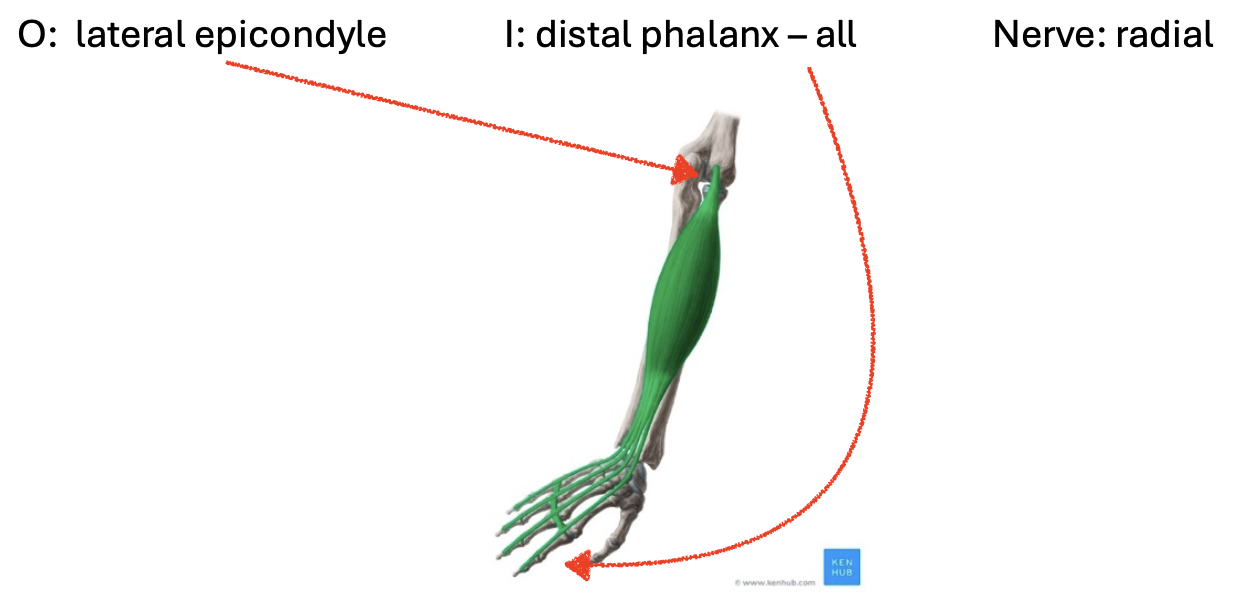
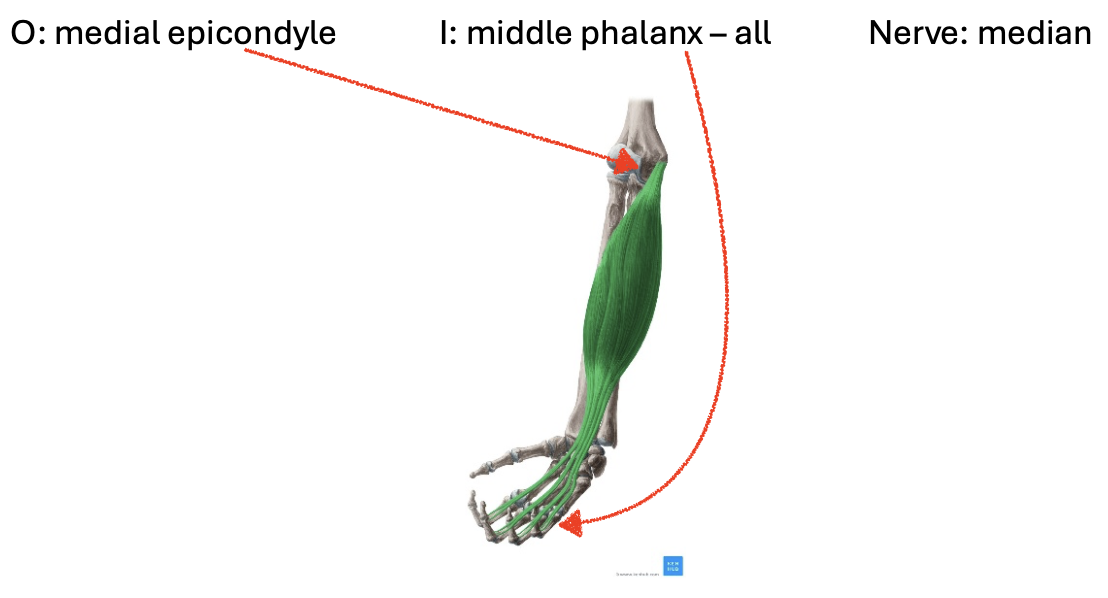
Flexor Digitorum Superficialis (FDS) origin, insertion, nerve
O: medial epicondyle
I: middle phalanges (2-5)
N: median

The Flexor Digitorum Superficialis (FDS) is innervated by ___
median nerve
Flexor Digitorum Profundus (FDP) Function
MCP, PIP, DIP flexion

Flexor Digitorum Profundus (FDP) origin, insertion, nerve
O: extrinsic
I: distal phalanx
N: median/ulnar

The Flexor Digitorum Profundus (FDP) is innervated by the
median (2,3) and ulnar (4, 5) nerves

Flexor Digiti Minimi Function
MCP flexion of pinky

Flexor Digiti Minimi origin, insertion, nerve
O: intrinsic
I: 5th proximal phalanx
N: ulnar

The Flexor Digiti Minimi is innervated by the ___
ulnar nerve

Lumbricales Function
MCP flexion; PIP/DIP extension

Lumbricles origin, insertion, nerve
O: intrinsic
I: extensor digitorum
N: median/ulnar
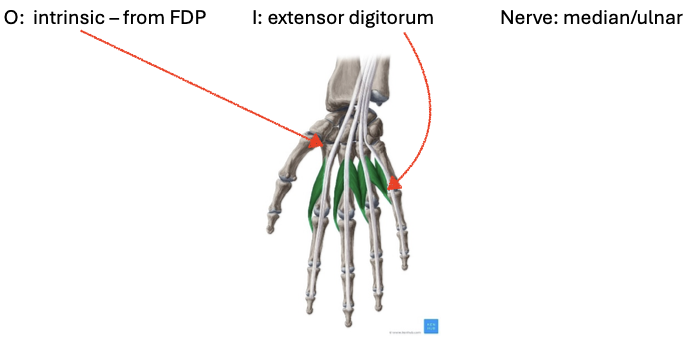
THe Lumbricles are innervated by the ___
median (1st-2nd lumbs), ulnar (3rd-4th lumbs)

Dorsal Interossei Functions
MCP abduction; PIP/DIP extension

Dorsal Interossei origin, insertion, nerve
O: intrinsic
I: proximal phalanx
N: ulnar

The Dorsal Interossei is innervated by the ___
ulnar
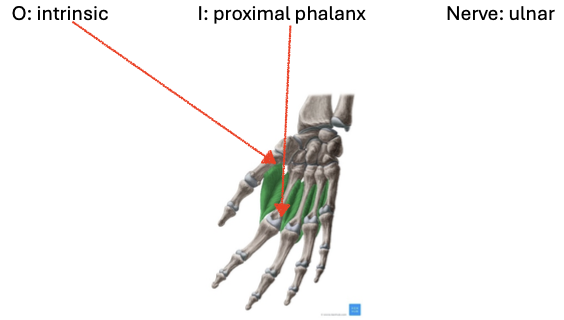
Palmar Interossei Function
MCP adduction; PIP/DEIP extension

Palmar Interossei origin, insertion, nerve
O: intrinsic
I: proximal phalanx
N: ulnar

The Palmar Interossei are innnervated by the ___
ulnar nerve

Abductor Digiti Minimi Function
MCP abduction of pinky

Abductor Digiti Minimi origin, insertino, nerve
O: intrinsic
I: 5th proximal phalanx
N: ulnar

The Abductor Digiti Minimi is innervated by the ___
ulnar nerve

Opponens Digiti Minimi Function
5th digit opposition

Opponens Digiti Minimi origin, insertion, nerve
O: intrinsic
I: 5th metacarpal
N: ulnar
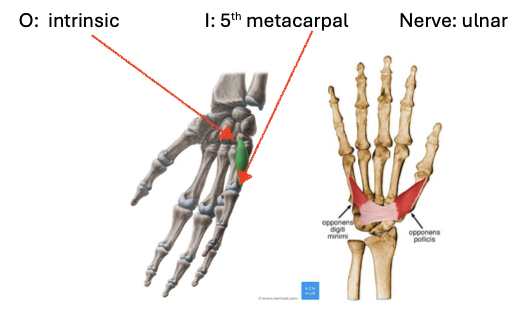
The Opponens Digiti Minimi is innervated by the ___
ulnar nerve

What are the muscles of the snuff box
EPL, EPB, APL
