Anatomy and Physiology first test (Unit 1)
 Call Kai
 Learn
Learn Practice Test
 Spaced Repetition
 Match
Match Flashcards
 Knowt Play
1/90

Earn XP
Description and Tags
garcia class, Anatomy vs. physiology, Levels of organization, Basic information about body systems, Survival needs and situations, Anatomical and positional words, Organ systems summary, Body regions, Body planes, Body cavities
Name | Mastery | Learn | Test | Matching | Spaced | Call with Kai | Chat |
|---|
No analytics yet
Send a link to your students to track their progress
91 Terms
Anatomy vs Physiology
Anatomy: The study of the positioning of body structures
Physiology: The study of the functions of those body structures
Levels of Organization
Atom, Molecule, Macromolecule, Organelle, Cell, Tissue, Organ (system), Organism
Skeletal System
provides support and protection, gives body shape
Nervous system
detects impulses from sense, control center
Cardiovascular/Circulatory System
Transports nutrients and gases around the body
Respiratory System
Exchanges gases (O2 and CO2)
Digestive System
Break down and absorb nutrients in intenstines
Muscular System
Provides movement for all parts of the body, internally and externally
Integumentary System
protects body, regulates temp, prevents water loss
Lymphatic System
fights infection and provides fluid for cells
Excretory System
removes waste from the blood (urine)
Endocrine System
Secretes hormones and regulates body functions
Reproductive System
Produces cells using sexual reproduction
Survival needs
Nutrients, Water, Atmospheric pressure, temperature, Oxygen
Characteristics of life/Necessary Life Functions
Maintain Boundaries(separate internal/external), Movement, Responsiveness, Digestion, Metabolism, Excretion, Reproduction, Growth
Superior
a part above another part (thoracic cavity is superior to the abdominopelvic cavity)
Inferior
a part is below another part (neck is inferior to the head)
Anterior/Ventral
toward the front (the eyes are anterior/ventral to the brain)
Posterior/Dorsal
toward the back (the pharynx is posterior to the oral cavity)
Medial
an imaginary midline dividing the body into equal right and left halves, a part is medial if its closer to the midline than another part (nose is medial to the eyes)
Lateral
towards the sides, away from the midline (the ears are lateral to the nose)
Proximal
a part nearer to the center of the body or closer to the point of attachment or origin (the elbow is proximal to the wrist)
Distal
The opposite of proximal, a body part is farther from the center of the body or the point of attachment (fingers are distal to the wrist)
Mid saggital Plane
Dividing by slicing it into left and right halves

Cranial/frontal/coronal plane
splitting into an anterior and exterior

transverse plane
split into superior and inferior halves

Meninges
Membranes that protect the Dorsal body cavities
Serosa
Protect ventral body cavities (double layered) (has a different name depending on which cavity)
Parts of Serosa
the outer layer aka parietal serosa and inner layer aka visceral (organ) serosa, between the layers is a fluid aka serous fluid
Dorsal Body Cavity
Brain, Spinal Cord
Ventral Body Cavities
Thoracic, Abdominal, Pelvic
Abdominal Cavity
contains very important internal organs and is divided into quadrants (right upper quadrant, left upper quadrant, lower right quadrant, lower left quadrant) or regions
Abdominal Cavity regions
right hypochondriac region, epigastric region, left hypochondriac region, right lumbar region, umbilical region, left lumbar region, right iliac region, hypogastric region, left iliac region

Thoracic Cavity parts
superior mediastinum, Pleural cavity, pericardial cavity


what cavity
Cranial cavity
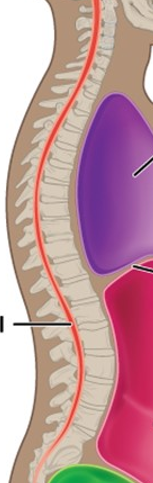
what cavity (open image)
Vertebral cavity

what cavity (open image)
Dorsal Cavity

what cavity
Thoracic (superior mediastinum, pleural cavity, pericardial)

what cavity
Abdominal Cavity

what cavity
Pelvic cavity

what cavity
Abdominopelvic Cavity

what cavity (open image)
Ventral Body Cavity
Muscular Tissue
movement of skeleton, beating of heart, movement of food through digestion system
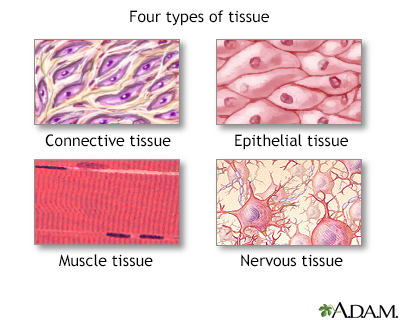
Connective tissue
makes up bone, cartilage and blood, connects organs together

Nervous Tissue
conducts electrical impulses through the brain, spinal cord, glands

Epithelial Tissue
makes up skin, lining of internal pathways and glands

what makes different types of tissues/cells/etc function in different ways?
STRUCTURE
Structure determines function
Parts of the Cell
nucleus, endoplasmic reticulum, mitochondria, golgi apparatus, lysosomes, centrioles, vacuoles, cell membrane, cytoplasm
nucleus
control center, contains genetic info (DNA and RNA)

endoplasmic reticulum
synthesizes proteins and ships them around the cell (can be smooth or rough)
Rough = protein synthesis through endo ret)
Smooth = lipid synthesis through endo ret)

mitochondria
converts food into ATP (energy) organ where cellular respiration happens (oxygen and sugar from blood)
Mitochondria uses oxygen and sugar → produces ATP and Heat

golgi apparatus
transports material around the cell in sacs called vesicles

lysosomes
breaks down waste

centrioles
aid in cell division

vacuoles
store nutrients and water

cell membrane
keeps stuff inside and keeps others outside, gate keeper SEMI IMPERMEABLE

cytoplasm
gel like fluid in cell, holds everything in place

Principle of complementarity
the function of a cell is dependent on the structure of that cell
Totipotent cell
when a single cell has the potential to form all the cells in an entire organism (Toti = whole/total) (use larger portion of genes compared to other specialized cells)
blastocyst
few days after cell (egg and sperm) fertilizes, the single cell dives into a ball of cells
pluripotent
can differentiate into many types of specialized cells but they cannot form a whole organism
unipotent
as blastocyst continue to divide the cells become more and more specialized, aka UNIPOTENT (uni = one) can only create more of their own type (divided and specialized more so they use less of their genetic material compared to totipotent)
epigenetics
ability to regulate the expression of certain genes
homoeostasis
body’s ability to preserve stable internal conditions (equilibrium = equal) when external environment changes
negative feedback loop
helps body maintain homeostasis by reducing changes in the body to bring it back to balance (too hot → sweating/cooling) (frequent)
positive feedback loop
continue to drive body further away from its typical state (infrequent) (ex: giving birth)
Control of Homeostasis
Receptor - reacts to/recognizes a stimulus and sends info to control center through a afferent pathway
Control Center - determines what response is needed, sends signal to effector through an efferent pathway
Effector - drives reaction, does whats needed to reach balance
how many chromosomes and chromosome pairs are in the genetic material of body cells
46 chromosomes and 23 pairs made of DNA and contained in the nucleus
What is the Shape of DNA
A double helix (looks like a twisted ladder)
What is DNA made of?
side of the ladder are made of sugar and phosphate molecules
rungs (ladder steps) are made of nitrogen bases (adenine, thymine, cytosine, guanine)

Principle of Base pairing
A (Adenine) ALWAYS bonds with T (thymine)
C (cytosine) ALWAYS bonds with G (guanine)

How are proteins created
gene (IN DNA) codes for all proteins through transcription and translation
Protein Transcription
converting DNA code into mRNA message (DNA → TRANSCRIPTION→ mRNA) (transcription - you transcribe the same language into a different form ex: speech → text)
Protein Translation
Convert mRNA into a protein (mRNA → translation → Protein) (translating changes it to a different language so same with this, change from RNA to Protein)
mRNA base pairing rule change
in RNA there is no T (thymine) so it gets replaced by U (uracil)
A (Adenine) ALWAYS bonds with U (Uracil)
C (cytosine) ALWAYS bonds with G (guanine)

mRNA to Protein translation process
mRNA strand leaves cell’s nucleus and heads to the ribosome where proteins are made, starting at start codon (first set of 2 mRNA bases), tRNA (thing that translates) molecules bring in amino acids that match with the codons on the mRNA
amino acids link together into a polypeptide chain which folds into a PROTEIN
stop codons
UAG, UGA, UAA (when they show up, the entire translating process stops)
Why do Cells have to divide?
when a cell is too large, the process of bringing in nutrients and removing waste becomes inefficient and too expensive, to prevent this cells divide on a regular cycle
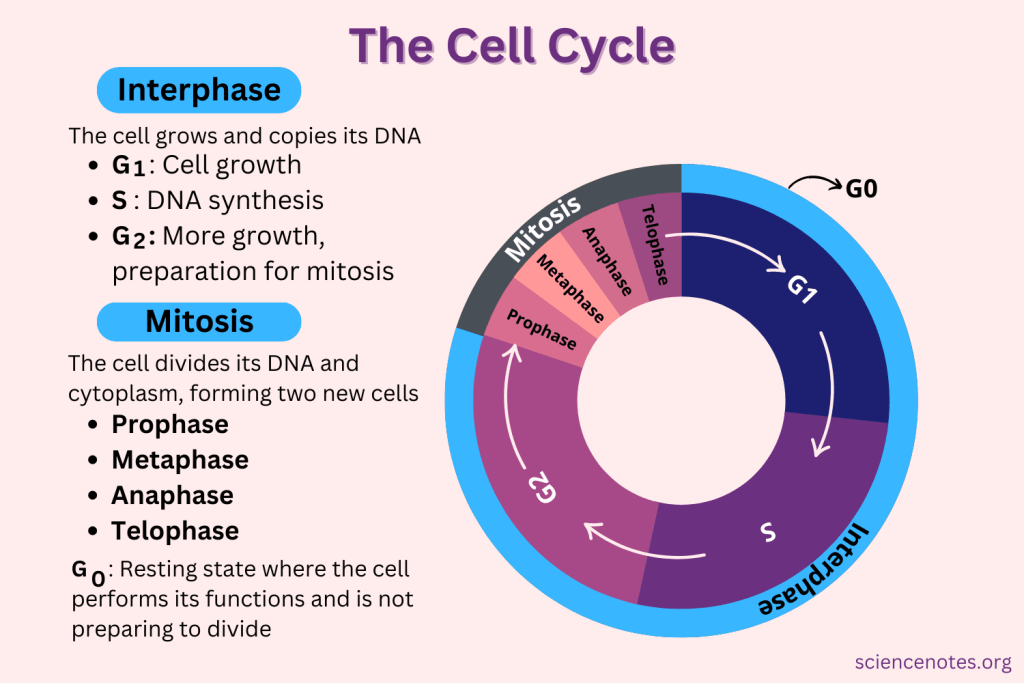
Mitosis
period of DIVISION in somatic (body) cells (ALL NON REPRODUCTIVE CELLS)
Mitosis process
division of the chromosomes and then cytoplasm, one parent cell makes 2 IDENTICAL daughter cells

Meiosis
Period of division in sex cells (gametes) (IN ALL REPRODUCTIVE CELLS)
Meiosis process
1 parent cell makes 4 different daughter cells

What happens when cells need to move things in and out
cell membrane (semi permeable) allows some substances to pass through and blocks others
(made of lipids which are hydrophobic and therefore keeping other liquids or substances out)
Passive Transport
Transport that does NOT require energy, move naturally from HIGH concentration to LOW concentration (no energy needed to do that)
DIFFUSION of substances and OSMOSIS (diffusion of water) are both passive transport processes
Active Transport
larger molecules must be helped/facilitated across the membrane by channels made of proteins, goes from LOW concentration to HIGH concentration, this is going against the natural process and so therefore REQUIRES energy
ENDOCYTOSIS: moving into cell (uses energy cause membrane has to open)
EXOCYTOSIS: moving out of cell
Facilitated Diffusion
uses a transporter or protein channel to move HIGH concentration into LOW (passive transport)
Simple Diffusion
it crosses the membrane (diffusion) High concentration into Low (passive transport)
Why have meiosis and mitosis?
mitosis makes identical body cells for growth and repair, while meiosis makes unique sex cells for reproduction
Concentration Gradients
the difference in the concentration of a substance between two connected areas - if it goes with the grain (high → low concentration, no energy) or against (low → high concentration, energy used)
metabolism vs maintaining balance
Metabolism is the chemical engine that powers your cells, while maintaining balance (homeostasis and energy balance) is the regulatory goal that keeps those processes stable
Cell Cycle
interphase → pmat (Prophase, Metaphase, Anaphase, and Telophase) phase AKA Mitosis or Meiosis (Meiosis compared to mitosis has one more pmat phase)