CHEMMAT 121: Quiz 1 - Deformation & Structure of Solids
 Call Kai
 Learn
Learn Practice Test
 Spaced Repetition
 Match
Match Flashcards
 Knowt Play
1/19

There's no tags or description
Looks like no tags are added yet.
Name | Mastery | Learn | Test | Matching | Spaced | Call with Kai | Chat |
|---|
No analytics yet
Send a link to your students to track their progress
20 Terms
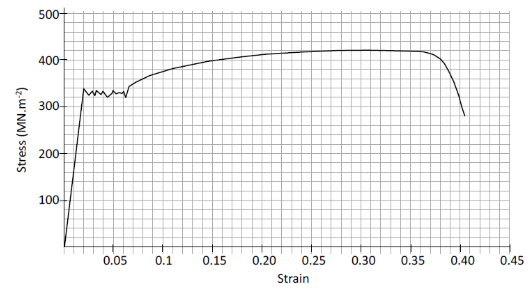
What is the ductility of this steel sample from the stress-strain curve given?
39 % EL
( Locate fracture point → Find the slope → Calculate the elastic recovery → Find permanent strain → Convert to percent elongation )
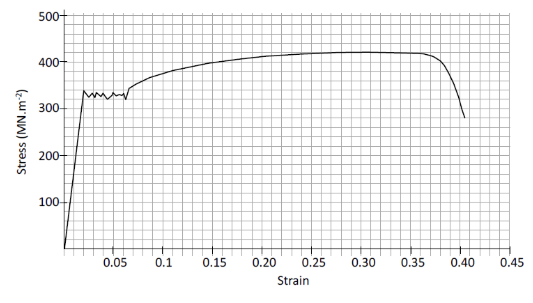
After examining the whole shape of the stress strain curve, which of these is the correct statement?
This steel sample is ductile and experiences necking before fracture
Choose ONE correct statement from the following:
A tensile test is performed on a round metal bar, 4.9 mm in diameter. It behaves elastically up to a load of 1,353 N. At 1,756 N the bar begins to neck. The load at fracture is 1,274 N. The Ultimate Tensile Stress (MPa) of the metal is
93.12 MPa
( Identify the Ultimate Load → Calculate og area → calculate UTS )
Choose ONE TRUE statement from the following:
When a metal is elastically deformed, it will return to its original shape and size.
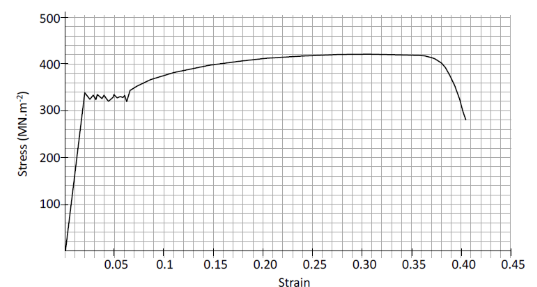
The Young’s Modulus for steel, calculated from this stress-strain curve, is:
180 GPa / 180,000 MPa
( Locate the Elastic Region → Find a point → Read the Strain → Calculate )
A metal rod is 20mm in diameter and 80mm in length. This rod is loaded in tension, and the force and extension are measured. When the rod is stretched by 1.2mm, a load of 2.8kN is measured.
If the Poisson’s ratio of the metal is 0.3, what is the new diameter of the rod in this loaded condition?
19.91 mm
( Calculate Longitudinal Strain → Calculate Lateral Strain → Calculate new Diameter )
A bar is used to make a component in an aircraft. The bar is made from an aluminium alloy with a yield stress of 173 MPa. During use, the component has to support a tensile load of 2,827 N. If this component requires a safety factor of 2, what would its minimum cross-sectional area (mm2) be?
32.68 mm² ( Calculate Allowable Stress → Calculate Minimum Area )
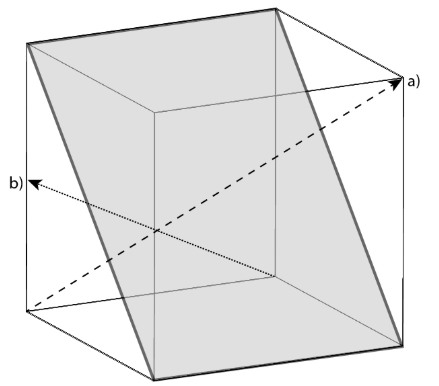
The shaded plane could be called:
( 1 0 1 )
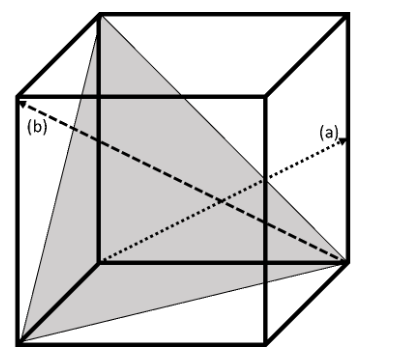
The direction labelled (b) could be named:
[1 1 1]
Which ONE of the following statements is TRUE?
Slip systems describe the most likely planes and directions where dislocations will move.
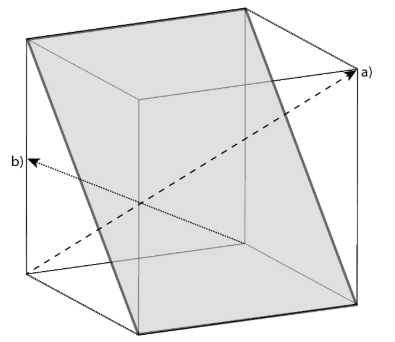
The direction labelled b) could be named:
[ 0 1 1]
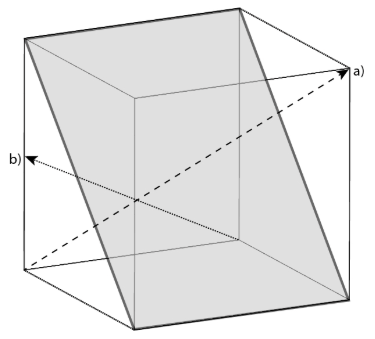
The direction labeled a) could be named:
[ 1 1 1]
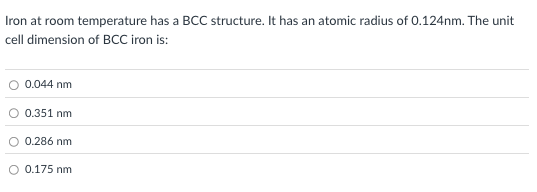
Iron at room temperature has a BCC structure. It has an atomic radius of 0.124nm. The unit cell dimension of BCC iron is:
0.286 nm
Which ONE of the following statements is FALSE?
Dislocations require more energy to move than slip.
Choose ONE statement from the following that is TRUE:
The actual density of a material will always be lower than theoretical.
Choose ONE correct statement from the following:
Silicate structures are electrically neutral overall due to oxygen “bridging” between the SiO44- tetrahedra.
NaCl has the “Rock Salt” structure. Given that the ionic radius of Na+ = 0.109 nm and of Cl-=0.186 nm, calculate the unit cell dimension, a, of the structure (in nm).
0.59
Ceramics typically have very high Young’s modulus. Which one of the following statements best explains this?
The interatomic bonds in ceramics are typically very strong covalent and ionic bonds.
Glass is a type of amorphous ceramic with no long-range order. Which ONE of the following statements regarding glass are CORRECT?
Rapid cooling of molten SiO2 promotes the formation of amorphous glass rather than a crystalline solid.ins