Unit 2 Part 2: Industrialization
 Call Kai
 Learn
 Practice Test
 Spaced Repetition
 Match
 Flashcards
 Knowt Play
1/89

There's no tags or description
Looks like no tags are added yet.
90 Terms
True or false
The Industrial Revolution led to an increase in factory work.
True
Dull, repetitive tasks, no wage regulation. 22 cents per hour, 14-hour days and 59 hours per week
Used immigrants and child labor. No health regulations
Minors breathed in toxic fumes and were killed in explosions
Factory workers- heavy machinery caused injury and death.
What are these conditions?
Working Conditions during the Industrial Revolution
Creator: Karl Marx
Goal: government controls property and business (response to how badly workers were treated during the Industrial Revolution)
Anti-capitalism
Wants a bloody revolution to overthrow (derrocar) the business/factory/private ownership (bourgeoisie) and help the workers (proletariat)
New Ideas During This Time?
Communism
Goal: Want government regulation to protect workers
Halfway between communism and capitalism
No one person controls an industry (no Rockefeller or Carnegie)
New Ideas During This Time?
Socialism
Focus on overthrowing (derrocar) the government (no government)
Unions were not all against the government, but have members that are.
New Ideas During This Time?
Anarchy (the idea of having no government or central authority controlling society)
When workers stop working to demand better pay or working conditions.
Strike
When workers stand outside their workplace with signs to protest and show support for their demands.
Picket
Goal: to protect workers and negotiate better pay
STRIKE & PICKET: all workers refuse to work until needs are met. Ex: Higher pay and safer working conditions. Would stop production and cause the company to lose money
What is the name of this group that is trying to help the workers?
Labor Unions
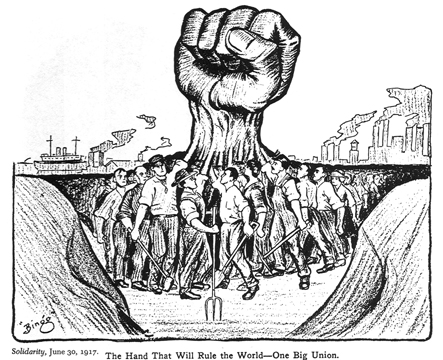
How does this cartoon represent the goal of labor unions?
labor unions unite workers to become stronger and fight for better wages, working conditions, and workers' rights. Strength in numbers/together
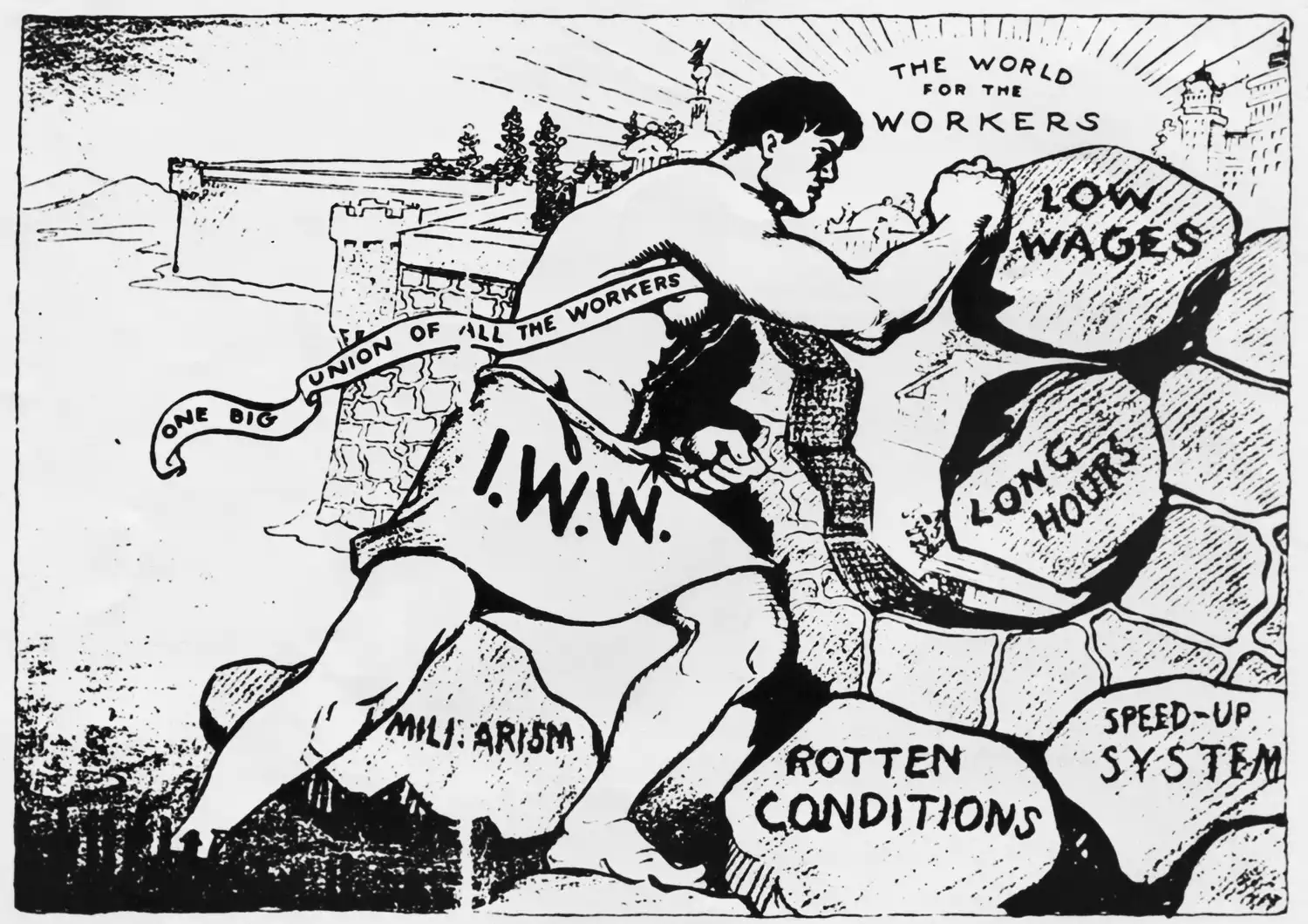
1) What is happening in this cartoon?
2) According to this cartoon, why should workers join the union I.W.W.?
3) Unions are popular with robber barons? Why or why not?
1) A worker from the I.W.W. union is breaking down a wall of unfair working conditions.
2) Workers should join to fight for better wages, shorter hours, and better working conditions.
3) No, because unions fight for workers' rights and higher wages, which can reduce the profits of robber barons.
The founder is Samuel Gompers
They only accepted skilled workers and white men
Still active. What labor union is this?
American Federation of Labor (AFL)
The founder is Terrance Powderly
Anyone can join/ nationwide industrial union
Lost support after Haymarket Riot. What labor union is this?
Knights of Labor (KOL)
Forced workers to take an oath promising not to join unions (no government regulation protecting unions)
Could get fired if joined a union. Companies would violently stop strikes
What are the companies doing?
Companies Fought Back
Companies Fought Back
KOL (Knights of Labor) strikes for poor working conditions
Non-union member throws a bomb into a crowd and kills police. 5 people are found guilty and hanged
Results: showed how union strikes were treated (created negative public opinion toward labor unions)
What kind of protest/strike is this?
Haymarket Riot 1886
Companies Fought Back
Steelworkers protested wage cuts at Carnegie Steel during 4 month long strike. Carnegie not happy.
Pinkerton Police are called in. Private army sent to stop strike with violence. Pinkerton lost so state military called in
Result: unions kicked out of steel industry
What kind of protest/strike is this?
Homestead Steel Strike 1892
Companies Fought Back
Railway strike. VERY powerful. The cause was cut wages
No railroads = no movement for farm goods
US Government had to stop the strike
Result: Showed how powerful unions could be.
What kind of protest/strike is this?
Pullman Strike 1894
How did the public often perceive unions as the result of events like the Haymarket riot and the Homestead strike?
The unions were viewed as promoting violence and anarchy
The Turning Point
Fire in a factory that killed 146 workers (mostly women and immigrants)
No safety regulations to stop the fire or save the workers. What event is this?
Triangle Shirtwaist Factory Fire 1911
The Turning Point
Showed people the horrible working conditions
Made people want to join unions and help factory workers
What effect is this?
Effects of Triangle Shirtwaist Factory Fire 1911
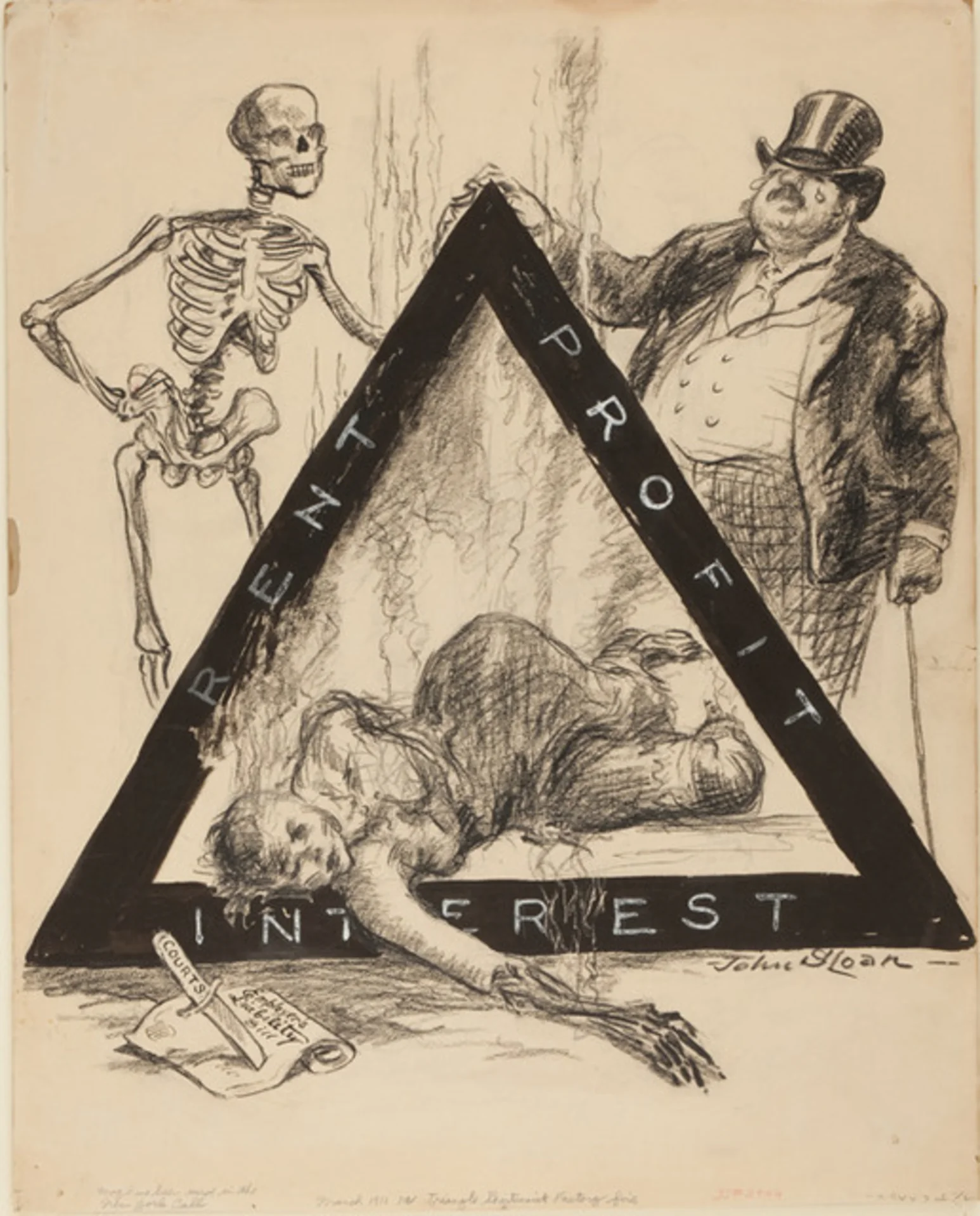
1) Who is in this cartoon?
2) What is happening in this cartoon?
3) How would a union respond to the ideas in this cartoon?
1) A wealthy businessman, a worker who has died, and a skeleton representing death.
2) criticizes wealthy businessmen for putting profits and their own interests above workers’ lives and safety.
3) A union would demand safer working conditions, better wages, and protection for workers’ rights.
Late 1800s-Early 1900s Immigration
Make you want to leave your country (war, economic or political strife, famine, etc.)
Why do people immigrate to the USA?
Push (empujar) Factors
Late 1800s-Early 1900s Immigration
Things that pull you to a country (economic opportunity, culture, family, etc.)
Why do people immigrate to the USA?
Pull (tirar) Factors
Few services, lack of job opportunities, unhappy life, poor transport links, natural disasters, wars and food shortage.
What factors are these?
Push (empujar) Factors
Access to services, better job opportunities, more entertainment facilities, better transport links, improved living conditions, hope for a better way of life, family links
What factors are these?
Pull (tirar) Factors
Immigration increased in the 1900s
153,640 immigrants in 1880, 1.04 million by 1910
By 1910, nearly 15% or all Americans were born in another country (these people were born in other countries and then moved to the United States)
What change is this?
Changes in immigration in the U.S since the late 1800s and early 1900s
Entered the USA at Ellis Island in New York (took about a day for a medical inspection)
Two waves of this kind of immigrants in the 1800s
“Old Immigrants” Northern and Western Europe (Ireland, England, Germany). 1800-1890, Irish Potato Famine, became "Americanized"
“NEW Immigrants” Southern and Eastern Europe (Italy, Greece, Russia, etc.) Escaping war and poverty
What kind of immigrants are these?
European Immigrants
Came from northern or western Europe, were Protestant, literate and skilled, were quick to assimilate, came from countries with democracy, not completely poor, and spoke English.
What kind of generalized immigrant is this?
Old European immigrants (first wavers)
Came from southern or eastern Europe, majority not Protestant (were Catholic, Orthodox, Jewish), illiterate and unskilled, were clannish (cerrados) and reluctant to assimilate, came from undemocratic countries, arrived poor, didn't always speak English.
Often created Ethnic Enclaves (neighborhoods where people from the same culture live together)
What kind of generalized immigrant is this?
New European Immigrants (second wavers)

1) Who is in this cartoon?
2) What is this cartoon saying about immigration during this time?
1) Wealthy businessmen and poor immigrants arriving in America.
2) suggests that wealthy businessmen welcomed immigrants because they provided cheap labor and helped them make more money.
Came into America through Angel Island. Was far from their mainland and processing took weeks/months
These immigrants left to escape political strife (lucha/conflicto) at home and sought economic opportunity
What kind of immigrants are these?
Asian Immigrants
Their Pull factor was work. California Gold Rush (they were hoping to find gold and become wealthy), Transcontinental Railroad (were hired to help build the railroad) and laundry workers.
Lived in Chinatowns after the railroad was complete
Looked, ate, and spoke different. Didn't want to assimilate. Easy targets for anger
What kind of immigrants are these specifically?
Chinese Immigrants
Chinese Immigrants
White man murdered a Chinese man.
Court said that Chinese people were not allowed to testify in court because of racist laws at the time.
Murderer set free (asesino puesto en libertad) the court overturned (anuló) Hall’s conviction.
What supreme Court case is this?
People v. Hall
Banned all Chinese immigrants
Chinese people not allowed to re-enter the U.S. if they left.
What act is this?
Chinese Exclusion Act 1882
1870 Census: 55 of these people were living in the USA
Cheap Labor Source. Farms, Mines, and Railroads
Hawaii also saw an increased of these immigrants.
What kind of immigrants are these specifically?
Japanese Immigration
Japanese Immigration
The Japanese government agreed to prevent further immigration. Exception for wives
Not a law (only an agreement between the two governments). The US government and the Japanese government worked together.
What kind of agreement is this?
“Gentleman's Agreement 1907
True or false
An effect of immigration led to a rise in nativism
True
Idea that Native-born Americans were superior and immigrants were undesirable. They didn't like immigrants at all.
Nativism
This criminal group started to gain power
Disliked Jews, African Americans, and immigrants
What criminal group is this?
Klu Klux Klan

1) Who is in this cartoon?
2) What is this cartoon saying about immigration during this time?
1) Chinese immigrants and white Americans.
2) White Americans wanted to stop Chinese immigration, even though immigrants had helped build the country.
An organization that controlled a city’s politics by exchanging favors for political support. What term is this?
political machine
1) How did Political Machines help immigrants?
2) What did immigrants have to do in return for those favors?
1) They helped immigrants find housing, jobs, and other important services.
2) Immigrants had to vote for the machine’s candidates and support its political interests. This caused a lot of corruption
The most famous political machine located in New York City's that gained power by helping immigrants in exchange for political support. Powerful political force that dominated New York City politics for decades. What political machine is this?
Tammany Hall
The leader of Tammany Hall who became famous for corruption and stealing public money through overpriced city projects.
Boss Tweed
1) why the courthouse cost so much?
2) why this corruption could ultimately hurt taxpayers and voters?
1) Contractors overcharged their work and gave some of the money to Boss Tweed.
2) Taxpayers because their money was wasted on overpriced projects and voters because politicians used their power for personal profit instead of helping the public.

1) Why were cartoons an effective tool to show people how corrupt Tammany Hall and Boss Tweed were?
2) Who does the thumb represent?
3) What is this cartoon by Nast saying about political machines?
1) because they communicated complex political corruption to both literate and illiterate people
2) The thumb represents Boss Tweed.
3) Political machines controlled the government and abused their power.
The New York Times exposed his corruption and public pressure led to his arrest and conviction. Whose downfall is this?
Boss Tweed

1) Who is in this cartoon and what represent?
2) What is happening in this cartoon?
3) What is this cartoon trying to say?
1) The Tammany Tiger represents Tammany Hall, and the politicians watching represent corrupt political leaders.
2) The Tammany Tiger is attacking people while politicians watch from above.
3) The cartoon criticizes political corruption and shows that corrupt politicians are hurting the public.

1) What is happening/represent in this cartoon?
2) What is this cartoon trying to say?
1) A Chinese person is seen being excluded. This represents that different groups of people are welcome in the U.S but not Chinese immigrants.
2) The cartoon criticizes America for treating Chinese immigrants unfairly while allowing other groups to enter the country.
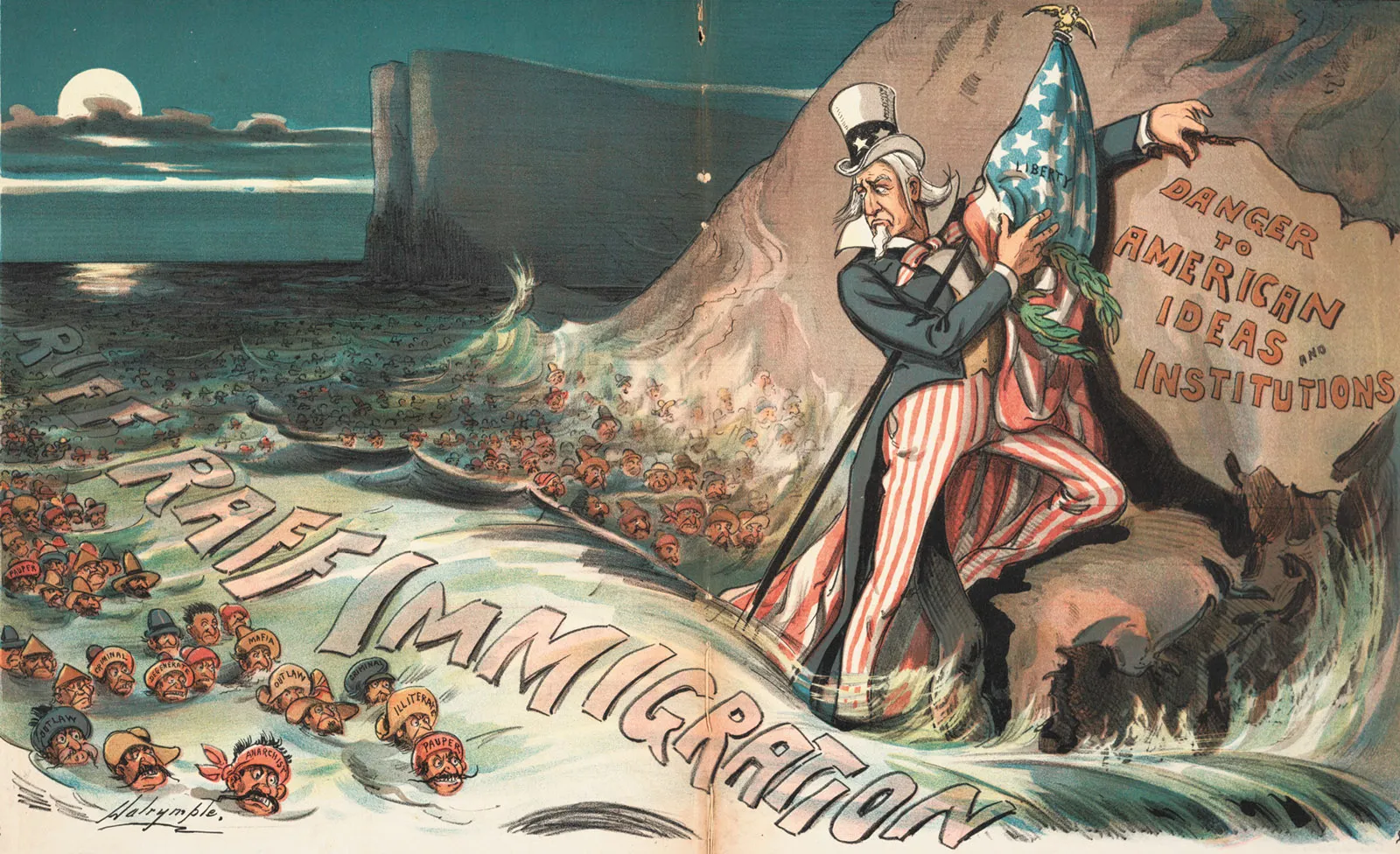
1) Who is in this cartoon?
2) What is this cartoon trying to say?
1) Uncle Sam, representing the United States, and immigrants arriving in America.
2) The cartoon suggests that immigrants are a threat to American values and institutions, showing the anti-immigration attitudes of that time.

1) Who is in this cartoon?
2) What is this cartoon trying to say?
1) A large, wealthy man representing powerful people and a small police officer representing the law.
2) the law treats poor and powerful people differently. It questions whether the law can punish wealthy people as fairly as it punishes ordinary people.
Time period when activists and politicians attempted to fix the political and economic issues in the US in the late 19th and early 20th century. What time period was this?
Progressive Era
What methods were used during the Progressive Era to address political and economic problems? (there are 3)
Unionization, social activism and government action

The First Reformers
Writers and journalists (use a "rake" to go through the "muck" of society)
Exposed the horrors of the Industrial Society, established institutions and leaders as corrupt. What kind of reformers are these?
Muckrakers
Which amendment banned alcoholic drinks?
18th Amendment
The First Reformers
Religious reformers. Wanted churches, government, and private business to help people
Wanted temperance aka a ban on alcohol. What is this movement?
Social Gospel Movement
Apartments that are overcrowded and in unsafe conditions, mostly poor people lived here. What term is this?
Tenement houses
Progressive Reform/Poverty and Tenement Houses
Jacob Riis wrote How the Other Half Lives (1890). Took photos of city life and tenements. How did this help the reformers?
Help reformers see how bad tenements were.
Progressive Reform/Poverty and Tenement Houses
Upper-class people opened their houses to the poor. Share education and resources.
Example: Jane Adams and The Hull House. What houses are these?
Settlement Houses
Meat packing was unclean and dangerous
Workers would get hurt while packing meat (blood would get into the meat)
Diseased meat would spread sickness. What issues are these?
Food Cleanliness
Issues and Reform/Food Cleanliness
Muckraker who wrote The Jungle. Focused on meat packing and horrible working conditions. Which muckraker is this?
Upton Sinclair
Act that helped prevent unsafe or falsely labeled food and medicine. It helped lead to the creation of the FDA. What act is this?
Pure Food and Drug Act
Ensures sanitary slaughtering (sacrificio) and processing of livestock (ganado). A law requiring meat inspections and sanitary processing. What act is this?
Meat Inspection Act
Sinclair said, "I aimed at the public's heart, and by accident I hit it in the stomach." What was his original goal in writing The Jungle?
To expose the terrible working conditions (overworked and underpaid workers) and unfair treatment of workers in meatpacking factories.
Rats were found in the meat used to make sausages. Workers washed their hands in water used to make sausage. Old meat scraps were mixed with dirt, and nails. What is this list about?
The disgusting things that were in the meat packaging industry.
This Progressive President quickly passed the first law regulating the meat, food, and drug industries, called the Meat Inspection Act of 1906. Which president is this?
Theodore Roosevelt

1) What actions are happening in this cartoon?
2) What is this cartoon saying about The Jungle and its impact?
1) President Theodore Roosevelt investigates the dirty conditions in the meatpacking industry.
2) The Jungle exposed unsafe conditions in meatpacking factories and pushed the government to improve food safety laws.
A person who worked to protect the health and welfare (bienestar) of society, to promote moral improvement, to create economic reform and income equality, and to foster efficiency in business. Who are these people?
Progressive Reformers
A women’s group that worked to ban alcoholic drinks. They achieved their goal because the 18th Amendment was created, which banned alcohol in 1920. What union is this?
Woman's Christian Temperance Union (WCTU)

What is shown on the chart?
How the federal government helped make progressive changes.
Goal: Improve living conditions and protect workers and families.
Biggest achievement: The Illinois Factory Act of 1893 limited child labor and women’s working hours.
What kind of reform is this?
Social welfare
Goal: Ban alcohol to improve society.
Biggest achievement: The 18th Amendment banned alcohol in 1920.
What kind of reform is this?
Moral reform
Goal: Reduce inequality between the rich and the poor and improve workers’ treatment.
Biggest achievement: Muckrakers exposed corruption and unfair business practices.
What kind of reform is this?
Economic reform
Goal: promote the idea of scientific management to make businesses faster and more productive.
Biggest achievement: The assembly line helped Henry Ford mass-produce cars. What kind of reform is this?
Efficiency and profitability in business

1) What actions are happening in this cartoon?
2) What is this cartoon saying about the goals of the Women's Christian Temperance Union?
1) A woman rides a horse and destroys barrels of alcohol.
2) The WCTU wanted to stop alcohol consumption and reduce problems caused by drinking.
Which amendment gave women the right to vote?
19th amendment
What is women's suffrage?
The right to vote. Women fought for this right because they could not vote.
Women's Suffrage
Fought for the right for women to vote. What woman is this?
Susan B. Anthony
Women's Suffrage
Part of a militant group (group that used strong protests and demonstrations to demand women's rights) Arrested and force-fed (while in prison, officials force-fed her when she refused to eat)
Helped pass the 19th Amendment in 1920 (right for women to vote). What woman is this?
Alice Paul
Cities run by Political Machines (rigged election, stole money, bribery and did help immigrants but corrupt)
Most famous: Tammany Hall (New York) run by Boss Tweed. What issues are these?
Political Corruption
Issues about Political Corruption
political cartoonist and muckraker who mocked Tweed (criticized and made fun of Boss Tweed)
1871 riot (disturbios) that Tweed couldn't stop. Tweed sentenced to jail and lost power. Who is this person?
Thomas Nast
The 15th Amendment said African Americans could vote, but nobody let them.
There were poll taxes (pay money to vote), literacy tests, and grandfather clauses to stop them from voting (Jim Crow Laws)
The South was deeply segregated due to Jim Crow laws. African Americans were being lynched by the KKK. What issues are these?
Racial Issues
Racial Issues
Big Idea: he believes that equality would come gradually. Said that African Americans should work their way up (go to vocational schools). Who is this person?
Booker T. Washington
Racial Issues
He wanted equality now. Go to college (He believed higher education was important for African Americans)
Co-created the NAACP (National Association for the Advancement of Colored People) to help African Americans and fought racism. Who is this person?
W.E.B. DuBois
Racial Issues
Went to the South and wrote about lynching. She was a muckraker. Co-created the NAACP (National Association for the Advancement of Colored People). Who is this person?
Ida B. Wells
Many people thought morality was weakening in the USA and the reason was drunk people. What issue is this?
Moral decay issues
A Square Deal for all = equal opportunity for all ( corporations, consumer protections and conservations)
Called the "Trust Buster" because he took action against powerful companies that unfairly controlled markets.
Used the Sherman Antitrust Act (1890) to stop monopolies/trusts because federal government could break up bad monopolies/trusts. Said there were good and bad trusts
Passed the Meat Inspection Act and Pure Food and Drug Act. Conservationist because he made 5 new national parks. Who Progressive Presidents is this?
Theodore Roosevelt

What is this cartoon saying about Roosevelt?
The cartoon shows Roosevelt fighting bad trusts and supporting good trusts to control big businesses and monopolies.
Federal government can collect income tax. What amendment is this?
16th Amendment
The Progressive Presidents
Passed the 16th Amendment (Federal government can collect income tax). Who Progressive Presidents is this?
William H. Taft
The Progressive Presidents
New Freedom (His plan to give businesses more competition and reduce the power of large companies)
Limited the banks and trusts and created Child Labor Laws.
Clayton Anti-Trust Act (banning certain unfair business practices that limited competition and protected labor unions from being treated as illegal). Who Progressive Presidents is this?
Woodrow Wilson