W9 Nitrogen Catabolism
 Call Kai
 Learn
 Practice Test
 Spaced Repetition
 Match
 Flashcards
 Knowt Play
1/82

There's no tags or description
Looks like no tags are added yet.
83 Terms
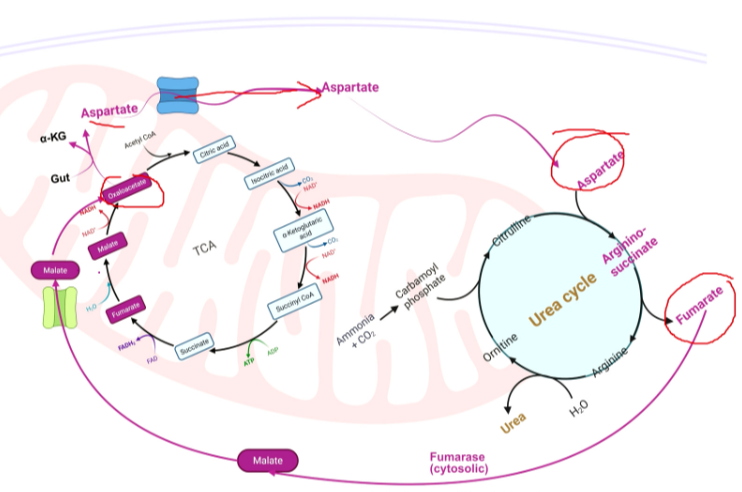
Kreb’s Bicycle
The connected cycle that cycles malate and aspirate between the TCA and Urea
Amino Acids that Stimulate Glucagon Release
Ala, Cys, Met, Gly (G-CAM)
Released by AA catabolism***
Regulation of Urea Cycle
Urea cycle is stimulated by HIGH protein and regulated by Glucagon
Amino acid load is reduced by amino acid catabolism which increases OAA and alpha-KG levels for gluconeogenesis (gluconeogenesis → glucagon).
Regulation of CPS1
CPS1 is allosterically activated by N-acetylglutamate
N-Acetylglutamate is produced along with glutamate when AA catabolism is increased (feedforward mechanism)
N-acetylglutamate
Metabolite produced from glutamine GLU and Acetyl-CoA when AA catabolism is HIGH
Acts as an allosteric regulator for CPS1
ACTIVATES urea cycle
Feedforward activator
(think F26BP but for urea cycle)
N-Acetylglutamate synthase (NAGs)
Enzyme that produces N-acetylglutamate from Glutamate and Acetyl-CoA
Activated by Arginine
STIMULATE UREA SYNTHESIS (stimulate N-catabolsim)
Enzymes that Catalyze Ammonia Assimilation in Humans
1 Glutamate Dehydrogenase
2 Glutamine Synthetase
3 Carbamoyl-Phosphate Synthetase 1
4 Glycine Synthase
Stages of the Urea Cycle
0 Activation of Ammonia
1 Formation of Citrulline
2 Formation of Arginosuccinate
3 Formation of Arginine
4 Formation of Urea
Ammonia Toxicity
When high concentrations of ammonia result from the inability to assimilate ammonia
Ammonia dangerous as it crosses membrane barriers and blood brain barrier to ruin membrane potential
Hyperammonemia
Excessive concentrations of ammonia in blood/body
Different amounts in diff lifecycle due to diff ez capacity (highest in infants, lowest in adults)
Causes of hyperammonemia
1 Genetic differences in Urea cycle or NAGS
2 gastrointestinal bleeding
3 Drug therapeutics
4 High K+
Treatments for Urea Cycle Disorders (UCD)
Aromatic Benzoate and Phenylbutyrate
Treatments for N-Acetylglutamine Synthase (NADs) Disorders
Carbonyl glutamate
Carbonyl glutamate bypasses the need fot NADs to activate CPS1 for the Urea cycle by activating
Ornithine Transcarboxylase Deficiency
A urea cycle disorder that impairs OTC, ornithine transcarbomylase
Most common UTD
Deadly and Chronic (early in urea cycle)
Causes
1 Build up of Ammonia (→ CP can’t enter urea cycle)
2 Build up of Carbonyl-Phosphate (→ buildup of oleric acid)
Orodic Acidrea
Orodic Acid Buildup caused by accumulation of Carbonyl-Phosphate.
Is an intermediate in pyrmidine synthesis
Arginase Deficiency
UCD caused by impaired arginase synthase production
Last step in Urea cycle impairment → more mild/acute
Causes buildup of ARGININE
Harmful neurological impact
Reductive Amination
Reaction catalyzed By GLUTAMINE DEHYDROGENASE that adds N from Ammonia to alpha-ketoglutarate form Glutamate
Requires NADPH (anabolic, requires E)
Glutamine Synthase
Ammination
TRAPS AMMONIA by converting GlutamATE to GlutAMINE
Anabolic, requires 2 ATP
Can be coupled with REDUCTIVE AMINATION to add 2NH4+ to Alpha-KG
A-KG + NH4+ + NADPH → Glutamate + NH4+ + 2ATP* → Glutamate
Only occurs when cellular energy is HIGH
Importance of Glutamine
Glutamine transports Ammonia (carries 2 ammonia) AWAY from muscles and Brian
Main way to trap and transport NH4
Provides source of N for cellular biosynthesis
Treatments for UCD
aromatic acid benzoate
phenylbutarate
Treatment for Deficiencies in NAGs
Carbamoyl Glutamate
Double Filter System
Liver Acinus
Periportal Zone
Perivenous Zone
Glutamine Synthetase
Low capacity, High affinity for ammonnia
Fenestration
Ornithine Transcarboxylase Deficiency
UTD where a lack of OTD prevents enough conversion of ornithine to citrulline
Causes buildup of ammonia and carbamoyl phosphate
Arginase Deficiency
UTD where lack of arginine prevents adequate ammonia assimilation
Statins
Inhibit production of cholesterols and upregulate the cholesterol clearance genes
Chylomicron
Lipid transport molecule that is formed in the intestine and transports mostly TAGS to liver
High TAG
Low Protein
Low Density
Have APOCII protein
Very Low Density Lipoprotein (VLDL)
Lipid transport molecule that is formed in the LIVER and transports cholesterol, cholesterol esters, and TAGS out of the liver. Acquires APOCII and APOB100 in blood when it becomes metabolically active
Higher cholesterol
Empties itself of TAGS in blood
Low Density Lipoprotein
Lipid transport molecule that evolves form VLDL in the blood stream. Its ApoB100 receptors bind to cells and allows for their entry into cells through receptor mediated endocytosis.
Lots of cholesterol and cholesterol esters
High Density Lipoprotein
Lipid transport molecule formed in the liver that transports cholesterols from tissues to the liver for clean up. Is a scavenging and reverse transport.
Contains many cholesterol and protein molecules
Contains ApoA-1 receptors
Also releases ApoCII and ApoE that bind to VLDL to make it metabolically active
ApoA-1
Apolipoproteins on HDL that activate LCAT. Esterifies with CHOLESTEROL to drive reverse cholesterol transport
ApoB100
Apolipoprotein on LDL and VLDL that bind to the LDL receptor on cells to mediate receptor-mediated endocytosis of the transportation molecules and allows cholesterol delivery into cells.
ApoC-II
Apolipoprotein on chylomicrons and VLDL that activates lipoprotein lyases that enable the release of TAGS into the bloodstream (triglyceride hydrolysis).
Steps in receptor mediated endocytosis
1 LDL binds to receptor through ApoB100 recognition
2 Receptor-mediated endocytosis occurs as the receptor and ligand enter the cell through endocytosis
3 Cholesterol esters, cholesterol, membrane lipids, and proteins are processed
Atheroslerosis
Disease that results when there is a problem with the receptor mediated endocytosis of LDL and excessive LDL circulation in the blood.
Leads to inflammatory activation of monocytes that target cholesterol and LDL
Leads to the formation of macrophages and foam cells
Foam Cells
Immune cells that have ingested excessive amounts of cholesterol or cholesterol esters, stimulated by an immune response to LDL inflammation
HMG-CoA reductase Activators
PPP (Phosphoprotein Phosphate) → dephosphorylates to activate
HMG-CoA reductase Represors
AMPK, PKA → Phosphorylate to repress
Oxidized Cholesterols or Oxysterols → feedback inhibition that initiates the Ez’s degradation
Essential Amino Acids
Thr, His, Ile, Lys, Met, Trp, Phe, Leu, Val
(THIK MWF LV)
(“THInK MWF LuV”)
Conditionally Essential Amino Acids
Gly, Gln, Ala, Cys, Try, Pro, Ser, Arg
Conditionally-esscential amino acids created from esscential amino acids
Cys (met) and Tyr (Phe)
Conditionally essential amino acids that may need to be consumed/used at higher quantities
Ala (need more at certain points in life)
Gln (need a lot in gnereral)
Gly (collagen)
Pro (connective tissue)
Sources of Amino Acids
1 Dietary intake
2 Protein Proteolysis
3 De novo synthesis
Scelenocystein
21st amino acid that’s made with the element selenium
If present in enough concentration, AA synth continues past stop codon
Helps maintain reducing environment in cells
involved in anti-oxidants (glutathione peroxidase)
Protein Turnover
Replacement of older proteins as they are broken down within the cell; breakdown of proteins to meet homolytic needs
Proteostasis
The constant process of protein synthesis and degradation; REGULATION of protein turnover that ensures misfolded, damaged, or aged proteins are removed
Mechanisms of Proteolysis
1 Ubiquination & Proteosome Degradation
2 Autophagic Pathway
3 Lysosome Degradation
Ubiquitination
The selective targeting of proteins for degradation in proteosomes by tagging them with ubiquitin. Added in a series of reactions involving 3 intermediate enzymes
Ubiquitin
Molecule covalent added to proteins for degradation tagging
Also involved in DNA repair, Cell signaling, Protein repair, and Protein Trafficking
(DC PrPt)
HGHLY Selective
Cytosol and Nucleus
ATP-dep
Ubiquitination Enzymes
E1 Ubiquitin initiating enzyme
E2 Ubiquitination conjugation enzyme
E3 Ubiquitin protein lyase
Autophagy
the BULK degradation of cytoplasmic compartments; protein aggregates, organelles, and anything bulk in cytoplasm
Requires E
Fuels N metabolism
Cytoplasm → Autophagosome → Lysosome
Lysosome Degredation
The degradation of ENCLOSED PROTEIN, membrane protein, and long-lived intracellular materials
Passive, does NOT require ATP
helps degrade extracellular AA
Sequential Proteolysis
The continuation of the degrative process between the stomach and small intestine. Starts/initiated in the stomach and continues in the small intestine with bulk degradation.
Zymogens
Inactive or pro-enzymes that can be transported through different tissues safely before they are activated in their target tissue or at certain time.
prevents self-degradation
Pepsin
Zymogen activated to pepsin in the stomach by low pH.
Initiates degradation of proteins.
Auto-cyclic activation; pepsinogen activates it
Released by pancreas
Trypsinogen
Zymogen activated to trypsin in small intestine/intestinal lumine
Amplifies degradation by acting as a CNETRAL ACTIVATOR for protease action
Activates other zymogens like chymotrypsin → chymotrypsin
Released by pancreas
AA absorbtion Mechanism
Amino acids are absorbed by a mechanisms similar to glucose assimilation in the intestine
AA enter lumine through 2ndary active transport w. Na+ symporter
Aminopeptidases = transporters that allow AA entry into cell
AA facilitated diffusion into bloods stream
N+/K+ antiport
Peptide transporters
Transport di and tri peptides into intestinal cells
Amino Acid Oxidation
Process that occurs to break down (oxidize) amino acids when
1 There are excessive AA released from protein turnover (excessive amount)
2 #AA > body’s needs for AA (not needed)
3 Cellular proteins are used as fuel when carbohydrates are unavailable (use for fuel)
Transamination
The process of transferring an amino group
removes an amino group form an AA and adds it to a keto-acid
Keto-acid becomes and AA and AA becomes a keto-acid
Allows for AA and Nitrogen catabolism
Catalyzed by aminotransferases or transaminases

Pyridoxal Phosphate (PLP)
Essential cofactor and coenzyme form of VB6
In AMINOTRANSFERASES, receives amino group in E2 complex and is what holds onto the amino group in the enzyme
Converted to PMP as amino-carrying intermediate

Key aminotransferases
Ala aminotransferase (ALT)
Asp aminotransferase (ASP)
Ala aminotransferase (ALT)
Aminotransferase that converts Ala to PYR
Asp aminotransferase (ASP)
Aminotransferase that converts Asp to OAA
Cyclic amino acids UNABLE to undergo TRANSAMINATION
Proline and histidine; have secondary amino groups
Amino acids that CAN’T undergo TRANSAMINATION because of TOXIC biproducts
Threonine and Lysine have toxic byproduct when they’re transamainiated
Oxidative Deamination
The process of removing an AMINO group from an AA and to create Alpha-KG and ammonia for the purpose of NITROGEN CATABOLISM
Reversable
Makes NADPH (oxidative process)
NH4+ formed enters Urea cycle
in Liver’s MITOCHONDIRAL matrix

Glutamate dehydrogenase
Enzyme that catalyzes OXIDATIVE DEAMINATION
Removes hydrogen and to create NADPH
HIGHLY regulated
TransDeamination
The coupling of TRANSAMINATION and Ox-DEAMINATION to fully break-down or deaminate an AA fully
AA + keto-acid → Keto-Acid + Glutamate → (+H2O) → Alpha-KG + NH4+ (+NADPH)
Glutamate Dehydrogenase inhibition
GDH is inhibited under HIGH E conditions
ATP, NADPH, GTP = inhibitors
Glutamate Dehydrogenase activation
GDH is activated under LOW E conditions
ADP, GDP, NADP+ = activators
Deamination routs
1 Glutamine Dehydrogenase (Ox-deamination)
2 Glutaminase
3 Asparaginase
Glutaminase
MITOCHONDRIAL enzyme that deaminates GlutAMINE to GlutamATE
Important enzyme in removing brain ammonia
Wide dist.
Asparaginase
Enzyme that deaminates AsparagINE to AsprerATE
Helps remove Ammonia to urea cycle in brain*
Regulation of UREA cycle
Urea cycle is regulated by LEVEL OF PROTEIN or AMMONIA
High protein = high urea cycle
Only “on“ when needed
Stimulated by GLUCAGON → stimulated by Ala, Gly, Met, and Cys release (G-CAM)
Stimulated by AA CATABOLISM —> GLUCONEOGENEIS
CPS1 HIGLY regulated
CPSI is activated by N-acetylglucosamine in a feedforward mechanisim initiated by AA catabolism
Glucomic Amino Acids
Amino acids that can be converted to intermediates that can enter TCA/Gluconeogenesis
Ala (PYR)
Asp, Asn (OAA)
Gln, Glu (A-KG)
Q AND E (cue-andy → candy)
Ketogenic Amino Acids
Amino acids that can form intermediates that can be converted to KETONE BODIES
Leu, Lys
Ala, Ser, Cys, Gly (Potential Ketogenic)
“LiKe And SubsCriGe”
Ketogenic and Glucogenic Amino Acids
Amino Acids that can form intermediates ot enter TCS/Gluconeogenesis or form Ketone Bodies
Ile, Phe, Try, Trp, Thr
IF WYT (“if whit”)