TEAS biology section smart edition pt.3
 Call Kai
 Learn
Learn Practice Test
 Spaced Repetition
 Match
Match Flashcards
 Knowt Play
1/56

There's no tags or description
Looks like no tags are added yet.
Name | Mastery | Learn | Test | Matching | Spaced | Call with Kai | Chat |
|---|
No analytics yet
Send a link to your students to track their progress
57 Terms
❤ FIRST: What does the cardiovascular system do?
Heart = pump 🫀
Blood vessels = roads 🛣
Blood = delivery 🚚
The heart pumps blood through your blood vessels to deliver oxygen and nutrients around your body.
❤ 1. Cardiac Muscle
Cardiac muscle = the muscle of your heart.
Your heart is made mostly of cardiac muscle .
It's your job:
💪 Contract → pump blood
Super important:
Cardiac muscle works automatically .
You don't have to think:
"Okay heart, beat now." 😂
It does it on its own.
🧠 Memory:
CARDIAC = HEART
Cardiac muscle = heart muscle
TEAS clue:
If you see “involuntary muscle found in the heart” → Cardiac muscle
🩸 2. Arteries
blood vessels that carry blood AWAY from the heart.
This is one of the biggest TEAS things to memorize.
🧠 Memory:
A = AWAY
Arteries = Away from heart
Don't worry about oxygen yet.
The most important definition is direction .
❤ → 🩸
Heart → artery → body
Important exception:
The pulmonary artery carries oxygen-poor blood from the heart to the lungs.
So don't memorize:
❌ "Arteries always carry oxygen-rich blood."
Instead, memorize:
✅ Arteries carry blood AWAY from the heart.
❤ 3. Systole vs ❤ 4. Diastole
❤ 3. Systole
This one is about the heartbeat cycle .
Systole = heart contracts/squeezes.
Think:
❤ SYSTOLE = SQUEEZE
When the heart squeezes, it pushes blood out.
🧠 Memory:
Systole = Squeeze
❤ 4. Diastole
Diastole = heart relaxes and fills with blood.
Think:
❤ DIASTOLE = REST
SW:
Systole
❤ SQUEEZE
Diastole
❤ RELAX + FILL
🔥 Easy pair:
Systole = Squeeze
Diastole = Relax
If the TEAS asks:
"When does the heart contract?"
→ Systole
"When does the heart relax and fill?"
→ Diastole
📈 5. Electrocardiogram (EKG)
recording of the heart's electrical activity.
Break it down:
Electro = electrical ⚡
Cardio = heart ❤
Gram = recording 📝
SW:
⚡❤📝 EKG = records the heart's electrical activity
An EKG does NOT directly show how much blood is being pumped.
It records the heart's electrical signals .
🧠 Memory:
EKG = Electrical Heart Recording
❤ NOW LET'S LEARN THE HEART ITSELF
Your heart has:
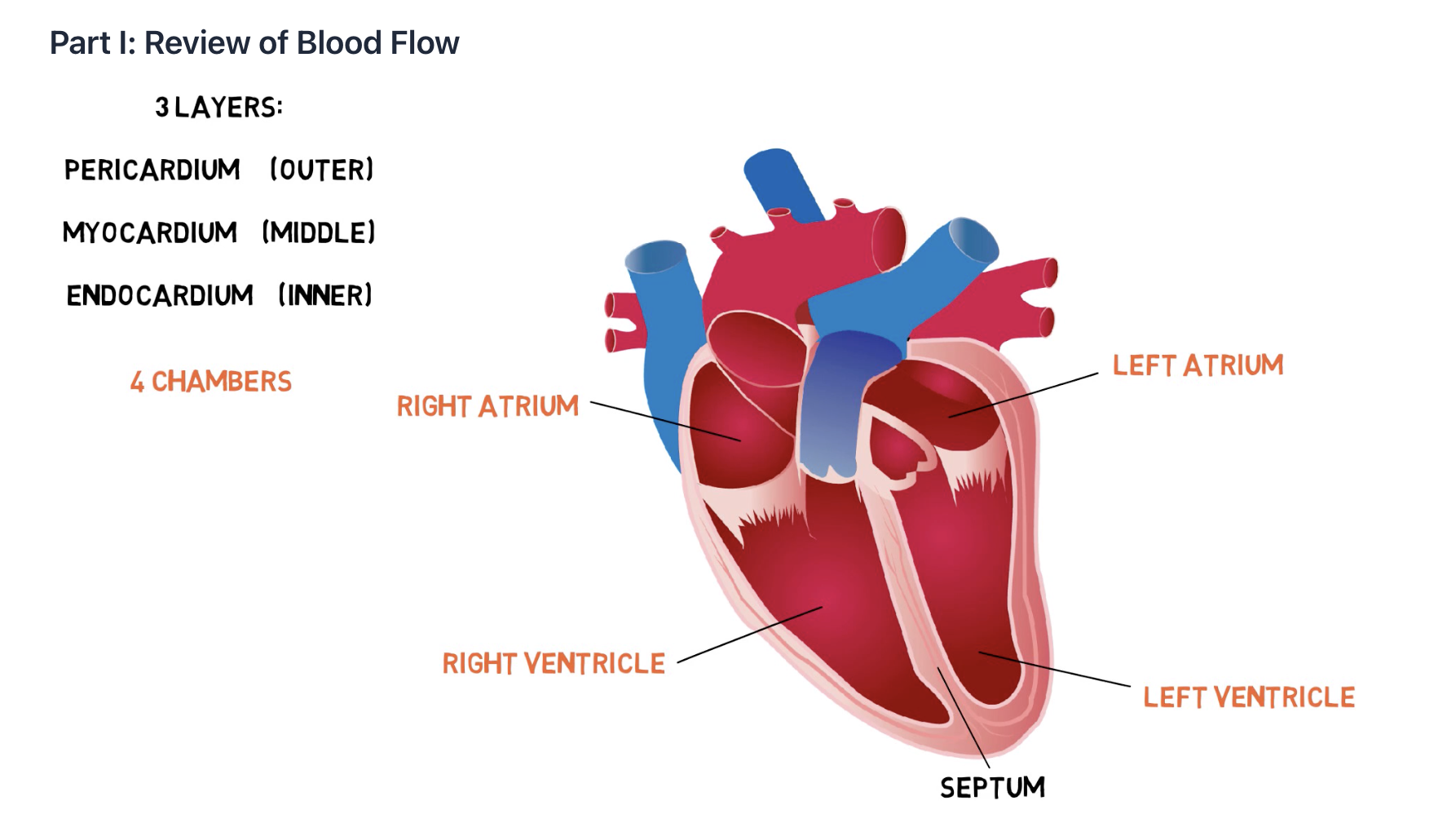
4 chambers
Think of the heart as a 2-story, 2-sided house 🏠.
There are:
2 atria on TOP
2 ventricles on BOTTOM
❤ 6. Chambers of the Heart TOP = ATRIA
Atria = receive blood
Think: Atria = ARRIVE
Blood arrives in the atria.
Right atrium
Receives oxygen-poor blood from the body.
Left atrium
Receives oxygen-rich blood from the lungs.
❤ BOTTOM = VENTRICLES
Ventricles = pump blood OUT.
Think:
Ventricles = VROOM 🚗 → push blood out
Right ventricle
Pumps blood → lungs
Left ventricle
Pumps blood → body
🧠 THE BIG MEMORY TRICK Atria = Arrive
Blood comes in
Ventricles = Vroom
Blood goes out
That's probably the easiest way to remember the chambers.
❤ THE 4 CHAMBERS CHEAT SHEET
Chamber | What it does |
|---|---|
Right atrium | Receives blood from body |
Right ventricle | Pumps blood to lungs |
Left atrium | Receives blood from lungs |
Left ventricle | Pumps blood to body |
Right side → LUNGS
Left side → BODY
🫀 7. Layers of the Heart Wall
The heart wall has 3 layers .
You don't need to make this complicated.
Outside → Inside:
Epicardium → Myocardium → Endocardium
1⃣ Epicardium
Epicardium = outer layer
Think:
EPI = outside/top
2⃣ Myocardium
Myocardium = muscle layer
This is the layer that contracts and pumps .
🧠 Memory:
MYO = MUSCLE
This is the BIG one to remember.
3⃣ Endocardium
Endocardium = inner lining
It lines the inside of the heart chambers.
🧠 Memory:
ENDO = INNER
⭐ HEART WALL MEMORY
EPI = OUTSIDE
MYO = MUSCLE
ENDO = INSIDE
SW:
Outside → Muscle → Inside
🚪 . Valves of the Heart
🚪 ONE-WAY DOORS
They make sure blood goes the right direction .
They help prevent blood from flowing backward.
There are 4 valves .
🚪 1. Tricuspid Valve
Between:
Right atrium → Right ventricle
🧠 Memory:
TRI = 3
Tricuspid = right side.
🚪 2. Pulmonary Valve
Between:
Right ventricle → Pulmonary artery → lungs
🧠 Memory:
Pulmonary = LUNGS
🚪 3. Mitral Valve
Also called bicuspid valve .
Between:
Left atrium → Left ventricle
🧠 Memory:
MITRAL = LEFT
🚪 4. Aortic Valve
Between:
Left ventricle → Aorta → body
🧠 Memory: Aortic = BODY
❤ THE HEART'S BLOOD FLOW
🧠 BODY → RIGHT → LUNGS → LEFT → BODY
More specifically:
Body
↓
Right atrium
↓
Tricuspid valve
↓
Right ventricle
↓
Pulmonary valve
↓
Lungs
↓
Left atrium
↓
Mitral valve
↓
Left ventricle
↓
Aortic valve
↓
Body
🔥 BODY → RIGHT → LUNGS → LEFT → BODY
🧠 SUPER EASY TEAS CHEAT SHEET
of the heart
Term | Remember |
|---|---|
Cardiac muscle | ❤ Heart muscle |
Arteries | A = Away from heart |
Systole | Squeeze |
Diastole | Relax + fill |
EKG | Records heart's electrical activity |
Atria | Arrive → receive blood |
Ventricles | Vroom → pump blood out |
Right side | Goes to lungs |
Left side | Goes to body |
Epicardium | Outside |
Myocardium | Muscle |
Endocardium | Inside |
Valves | One-way doors 🚪 |
Tricuspid | Right side |
Pulmonary | To lungs |
Mitral | Left side |
Aortic | To body |
1.Cardiac = heart ❤
2. Arteries = Away
3. Systole = Squeeze
4. Diastole = Relax
5. EKG = electrical activity ⚡
6. Atria = Arrive
7. Ventricles = Vroom/pump out
8. Body → Right → Lungs → Left → Body
🩸 1. Pulmonary Circulation
Circulation = WHERE the blood goes 🩸
Cardiac cycle = WHAT the heart is doing while pumping ❤
Pulmonary = lungs.
SW:
🫁 Pulmonary circulation = heart ↔ lungs
Its main job is to get oxygen into the blood and remove carbon dioxide.
Super easy pathway:
Right ventricle
⬇
Pulmonary artery
⬇
🫁 LUNGS
⬇
Pulmonary veins
⬇
Left atrium
🧠 Memory:
PULMONARY = LUNGS
And:
Right → Lungs → Left
The right side sends blood to the lungs.
The left side receives it back.
🩸 2. Systemic Circulation
the whole body.
SW:
❤ Systemic circulation = heart ↔ body
Its main job is to deliver oxygen and nutrients to the body .
Super easy pathway:
Left ventricle
⬇
Aorta
⬇
🧍 BODY
⬇
Veins
⬇
Right atrium
🧠 Memory:
SYSTEMIC = BODY
And:
Left → Body → Right
🔥 THE BIGGEST MEMORY TRICK
systemic vs pulmonary
🫁 Pulmonary:
RIGHT → LUNGS → LEFT
🧍 Systemic:
LEFT → BODY → RIGHT
Put them together:
RIGHT → LUNGS → LEFT → BODY → RIGHT
❤ 3. Cardiac Cycle
One complete heartbeat = one cardiac cycle.
The heart basically does:
FILL → SQUEEZE → EMPTY → RELAX → FILL AGAIN
That's it! ❤
❤ Step 1: Heart Fills
The heart is relaxed
Blood flows into the chambers.
Think
Relax = Fill
This is part of diastole .
❤ Step 2: Atria Contract
The atria squeeze and push more blood into the ventricles.
Remember: Atria = receive/arrive
They're helping finish filling the ventricles
❤ Step 3: Ventricles Contract
Now the ventricles squeeze.
This is systole .
Systole = SQUEEZE
The ventricles push blood out:
Right ventricle → lungs
Left ventricle → body
❤ Step 4: Ventricles Relax
The ventricles relax.
Blood starts filling them again.
That's diastole .
Then the cycle repeats.
🔄 Fill → Squeeze → Empty → Relax → Fill
🧠 SUPER EASY TEAS CHEAT SHEET
systmeic/ pulmonary
Term | Think |
|---|---|
Pulmonary | 🫁 Lungs |
Systemic | 🧍 Body |
Pulmonary route | Right → Lungs → Left |
Systemic route | Left → Body → Right |
Cardiac cycle | ❤ One complete heartbeat |
Diastole | Relax + Fill |
Systole | Squeeze + Pump out |
“Which circulation goes to the lungs?”
→ 🫁 Pulmonary
Right goes to the lungs, left goes to the body; systole squeezes, diastole fills. ❤
“Which circulation supplies the body?”
→ 🧍 Systemic
“Which side sends blood to the lungs?”
Right
“Which side sends blood to the body?”
→ Left
“When does the heart contract?”
Systole
“When does the heart relax and fill?”
Diastole
⭐ One sentence to memorize:
Right goes to the lungs, left goes to the body; systole squeezes, diastole fills. ❤
what are the four chambers?
right atrium, right ventricle, left atrium, left ventricle
What are the four valves
tricuspid valve, pulmonary valve, mitral valve, aortic valve

how blood travels through the blood vessels around the body
Think of blood vessels like roads :
🚗 Arteries = take blood AWAY from the heart
🚗 Veins = bring blood BACK to the heart
🕸 Capillaries = tiny exchange area
The picture is basically showing:
HEART → ARTERY → ARTERIOLES → CAPILLARIES → VENULES → VEIN → HEART
❤ Step 1: Blood leaves the heart
The artery carries blood away from the heart .
In this picture, the artery is shown in red because it is carrying oxygenated blood .
🧠 Memory: A = AWAY
Artery = Away from heart
🔴 Step 2: Arterioles
The artery gets smaller and becomes: Arterioles
Think
Artery → smaller artery = arteriole
They are like small branches coming off the main artery.
🧠 Memory: ARTERY → ARTERIOLE = BIG → SMALL
🕸 Step 3: Capillaries
Now the blood reaches the capillaries .
These are the tiny blood vessels .
This is where the important exchange happens.
The blood gives rise to tissues:
🫁 Oxygen
🍎 Nutrients
And picks up:
💨 Carbon dioxide
🗑 Waste
🧠 Memory: CAPILLARIES = EXCHANGE
Think of them as a delivery station 📦.
Blood delivers oxygen/nutrients and picks up waste.


how blood travels through the blood vessels around the body
step 4-5
🔵 Step 4: Venules
After the capillaries, the vessels start getting bigger again.
Tiny vessels called: Venules
collect the blood.
Think:
Capillary → venule → vein
🧠 Memory:
VENULE = tiny vein
Just like:
arteriole = tiny artery
venule = tiny vein
🔵 Step 5: Vein
Finally, the blood enters the vein .
The vein carries blood: BACK TO THE HEART
🧠 Memory: VEIN = BACK
SW:
Artery = AWAY
Vein = BACK

🧠Now look at the whole picture
Follow the blood like you're driving on a road:
❤ HEART
⬇
🔴 ARTERY
Away from heart
⬇
🔴 ARTERIOLE
Smaller artery
⬇
🕸 CAPILLARIES
Exchange oxygen/nutrients for waste
⬇
🔵 VENULE
Tiny vein
⬇
🔵 VEIN
Back to heart
⬇
❤ HEART
And repeat! 🔄
🚨 ONE IMPORTANT THING ABOUT THE RED AND BLUE
The picture makes it look like:
Red = oxygenated
Blue = deoxygenated
That's usually true in diagrams, but don't use that as your main definition.
Why?
Because there are exceptions:
🫁 Pulmonary artery
Carries deoxygenated blood away from the heart → lungs.
🫁 Pulmonary vein
Carries oxygenated blood back to the heart.
So the safest TEAS rule is:
ARTERY = AWAY from heart
VEIN = TOWARD heart
“Arteries Away, Veins Visit back.”
And:
“Capillaries = exchange.”
Then remember:
A → A → C → V → V
Artery → Arteriole → Capillary → Venule → Vein
“Where does oxygen and nutrient exchange happen?”
Capillaries
“Which vessel carries blood away from the heart?”
Artery
“Which vessel carries blood toward the heart?”
Vein
“What is a small artery called?”
Arteriole
“What is a small vein called?”
Venule
“What is the overall pathway?”
→ Artery → arteriole → capillary → venule → vein ❤🩸
what is the systemic circulation?
🫁 Pulmonary circulation ends here:
Lungs → Pulmonary veins → Left atrium
The pulmonary vein brings oxygenated blood back from the lungs.
Then:
Left atrium
⬇
Mitral valve
⬇
Left ventricle
⬇
Aortic valve
⬇
Aorta
⬇
🧍 BODY
🧍 THAT is systemic circulation.
So think:
🫁 Pulmonary: Right heart → Lungs → Left heart
🧍 Systemic: Left heart → Body → Right heart
Pulmonary = LUNGS 🫁
Systemic = BODY 🧍
And the full loop is:
RIGHT → LUNGS → LEFT → BODY → RIGHT
“oxygenated blood leaves the left ventricle through the aorta to supply the body,” that's systemic circulation .

🫁 Pulmonary vs. 🧍 Systemic
🫁 PULMONARY = LUNGS
Pulmonary circulation is the trip between the heart and lungs .
Its job is to pick up oxygen .
Think:
RIGHT → LUNGS → LEFT
🫀 Right ventricle
↓
🫁 Lungs
↓
🫀 Left atrium
So pulmonary = lungs .
🧍 SYSTEMIC = BODY
Systemic circulation is the trip between the heart and the rest of the body .
Its job is to deliver oxygen to the body .
Think: LEFT → BODY → RIGHT
🫀 Left ventricle
↓
🧍 Body
↓
🫀 Right atrium
So systemic = body
🔥 The easiest way to memorize it
Just remember:
🫁 PULMONARY = PULMONARY → LUNGS
🧍 SYSTEMIC = SYSTEM → WHOLE BODY
And then:
RIGHT → LUNGS → LEFT → BODY → RIGHT
That's the entire circulation!
Which circulation supplies the body's tissues?
→ 🧍 Systemic

Where does pulmonary circulation start?
→ Right ventricle
Where does pulmonary circulation end?
→ Left atrium
Where does systemic circulation start?
→ Left ventricle
Where does systemic circulation end?
→ Right atrium
⭐ One sentence to memorize:
Pulmonary gets oxygen from the LUNGS; systemic delivers oxygen to the BODY. ❤🫁🧍

pulmonary artery vs pulmonary veins
🫁 Pulmonary ARTERY
Heart → Lungs
Carries deoxygenated blood
Leaves the right ventricle
Goes to the lungs to get oxygen
🧠 Memory:
Pulmonary ARTERY = Away to lungs
🫁 Pulmonary VEIN
Lungs → Heart
Carries oxygenated blood
Goes to the left atrium
Brings oxygen-rich blood back from the lungs
🧠 Memory:
Pulmonary VEIN = Visits heart
Pulmonary artery | Pulmonary vein | |
|---|---|---|
Direction | ❤ → 🫁 | 🫁 → ❤ |
Blood | Deoxygenated | Oxygenated |
Ends/starts | Right ventricle | Left atrium |
ARTERY = AWAY
VEIN = BACK
And don't let the oxygen part confuse you: pulmonary artery is the exception —it carries deoxygenated blood.
what happens in the EKG?
❤ First: What is an EKG?
EKG = Electrocardiogram
It records the heart's electrical activity .
Think: ⚡ EKG = heart's electrical report card
🧠 The BIG 3 to memorize
Your picture has:
P → QRS → T
Think:
P = Atria
QRS = Ventricles
T = Ventricles relaxing
1⃣ P Wave = Atria
The little bump labeled P.
It represents the electrical activity that causes the atria to contract .
Remember:
🅿 P = Push from the atria
The atria pushes blood into the ventricles.
🧠 TEAS memory:
P = Atria
2⃣ QRS Complex = Ventricles
This is the BIG spike in the middle. 📈
It represents the electrical activity that causes the ventricles to contract .
Remember:
QRS = BIG SQUEEZE
The ventricles squeeze and pump blood out.
🧠 Memory:
QRS = Ventricular Squeeze
🔥 If TEAS asks:
"Which part of the EKG represents ventricular contraction?"
→ QRS complex
3⃣ T Wave = Ventricles Relax
The rounded wave after the big spike.
T wave = ventricular repolarization , which is associated with the ventricles preparing to relax
For TEAS-level learning, think:
T = ventricles relax
🧠 Memory:
T = Take a break 😌


❤ So what's happening in order?
Look at your picture from left → right :
🅿 P
Atria contract
⬇
📈 QRS
Ventricles contract
⬇
🌊 T
Ventricles relax
⬇
🔄 Repeat!
🧠 SUPER EASY MEMORY TRICK
Say this:
P = Push
QRS = Squeeze
T = Take a break
Or even shorter:
P = Atria QRS = Ventricles T = Relax
🔥 P → QRS → T
Top → Bottom → Rest
What about Systole and Diastole?
❤ Systole = contraction
Systole = heart squeezes
The QRS is associated with ventricular systole .
🧠 Systole = SQUEEZE
❤ Diastole = relaxation/filling
Diastole = heart relaxes and fills with blood.
The ventricles are in diastole after they finish contracting.
🧠 Diastole = REST

🚨 TEAS CHEAT SHEET
EKG
EKG part | Super easy meaning |
|---|---|
P wave | Atria contract |
QRS complex | Ventricles contract |
T wave | Ventricles relax/repolarize |
Systole | Heart contracts/squeezes |
Diastole | Heart relaxes/fills |
EKG | Records electrical activity |
P = Atria 🫀
QRS = Ventricles 💪
T = Rest 😌
And:
Systole = SQUEEZE
Diastole = RELAX
blood pressure

the blood has …?
🩸 First: What is plasma?
Plasma = the liquid part of your blood.
Think of blood like a soup 🍲:
🩸 Blood cells + platelets = the solid “stuff”
💧 Plasma = the liquid/soup they're floating in
So plasma is basically the liquid transportation system for things your body needs.
💧Why does plasma have so many things?
Because water can carry things around .
Think of plasma like a delivery truck 🚚
It carries:
💧 Water
The main ingredient of plasma.
🍬 Sugar
Mostly glucose, cells which use for energy .
🥑 Fat
Used for energy and other body functions.
🥩 Proteins
Help with things like clotting, immunity, and maintaining fluid balance .
🧂 Salts
Help with fluid balance, nerves, and muscles .
So plasma isn't just "water." It's water carrying important substances around the body.
Think: PLASMA = LIQUID DELIVERY TRUCK 🚚💧
It carries:
WSFPS
💧 W ater
🍬 S ugar
🥑 F at
🥩 P rotein
🧂 S alt
Plasma = liquid part of blood that carries substances around the body.
⭐ TEAS memory:
PLASMA = transportation 🚚 / liquid
RED = oxygen 🫁
WHITE = fight 🛡 infection
PLATELETS = patch 🩹 help clot blood

what does blood do?W
Think of blood as your body's delivery + cleanup + protection system 🚚🛡.
1. 🫁 Transports gases
Blood carries:
Oxygen → to your cells
Carbon dioxide → away from your cells
🧠 Memory: Blood = gas delivery 🚚
2. 🍎 Transports nutrients
Blood carries things your cells need, like:
Glucose (sugar)
Nutrients from food
🧠 Memory: Blood = food delivery 🍎
3. 🩹 Forms clots
When you get hurt, platelets help form a clot to stop bleeding.
🧠 Memory: Platelets = PATCH 🩹
4. 🛡 Fights infection
White blood cells help protect you from germs and infections.
🧠 Memory: White = FIGHT 🛡
5. 🗑 Transports waste
Blood picks up waste from your cells and carries it to organs that remove it.
For example:
CO₂ → lungs
Other wastes → kidneys
🧠 Memory: Blood = garbage truck 🗑
6. 🌡 Regulates body temperature
Blood helps move heat around your body and helps keep your temperature stable.
🧠 Memory:
Blood = temperature control 🌡

🔥 SUPER EASY MEMORY TEAS
Think of blood as:
🚚 Deliver → 🩹 Patch → 🛡 Protect → 🗑 Clean → 🌡 Control
Or remember "Blood is the body's delivery truck + security guard + garbage truck."
Blood job | Think |
|---|---|
Gases | 🫁 Oxygen/CO₂ |
Nutrients | 🍎 Food |
Clotting | 🩹 Platelets |
Infection | 🛡 WBCs |
Waste | 🗑 Garbage |
Temperature | 🌡 Keeps stable |
If you see "What is a function of blood?" , look for something involving:
transporting, protecting, clotting, waste removal, or temperature regulation.

what is this?
This picture is showing how your body stops bleeding . It's called hemostasis .
Think of it like FIX THE HOLE → PATCH IT → LOCK IT 🩹
1⃣ Vascular spasm = SQUEEZE 🩸
A blood vessel gets injured.
The vessel quickly tightens/squeezes to slow down bleeding.
🧠 Memory: Spam = SQUEEZE
2⃣ Platelet plug = PATCH 🩹
Platelets rush to the injured area and stick together.
They make a temporary plug over the hole.
🧠 Memory: Platelets = PATCH
3⃣ Fibrin/clotting = LOCK IT 🕸
Fibrin forms a strong net around the platelet plug.
This makes the clot stronger and helps stop the bleeding
🧠 Memory: Fibrin = NET
🔥 TEAS CHEAT CODE
Remember:
SQUEEZE → PATCH → LOCK 🩸🩹🔒
Vascular spasm → Squeeze
Platelets → Patch
Fibrin → Net/lock
⭐ One sentence:
The vessel squeezes, platelets patch, and fibrin locks the clot.

what does this mean?
This picture is showing what antigens and antibodies each blood type has .
4 BLOOD TYPES
Blood type | Antigens ON RBC | Antibodies IN blood |
|---|---|---|
A | A | B |
B | B | A |
AB | A + B | None |
O | None | A + B |
🧠 EASY MEMORY
Think:
Antigen = what you HAVE 🏷
Antibody = what you FIGHT 🛡
SW:
🅰 A
Has A fights B
🅱 B
Has B → fights A
🆎 AB
Has BOTH → fights NOTHING
⭕ O
Has NOTHING → fights BOTH
🔥 Memorize this:
A = A/B
B = B/A
AB = BOTH/NONE
O = NONE/BOTH
The first word = antigens you have .
The second word = antibodies you have .
🚨 TEAS connection
If the wrong antigen enters your blood, your antibodies can attack it → agglutination = clumping .
SW:
Antigen = ID tag 🏷
Antibody = attacker 🛡
Agglutination = clumping 🩸🩸
3 blood cell types + their size + their job
🩸 First: Which one is the smallest?
Look at the numbers:
🔴 RBC: 0.008 mm
⚪ WBC: 0.02 mm
🟡 Platelet: 0.003 mm
⭐ Smallest → Biggest
Platelets → RBCs → WBCs
Because:
0.003 < 0.008 < 0.02
🧠 Memory:
Platelets = tiny 🟡
RBC = middle 🔴
WBC = biggest ⚪
🩸 Now understand each one
🔴 Red Blood Cells
Scientific name: Erythrocytes
Job: Carry oxygen and carbon dioxide.
🧠 ERYTHRO = NETWORK/ Red = oxygen 🚚
Size: 0.008 mm
⚪ White Blood Cells
Scientific name: Leukocytes
Job: Fight infection and protect your body.
🧠 LEUKO = WHITE
White = fight 🛡
Size: 0.02 mm → BIGGEST
platelets
Scientific name: Thrombocytes
Job: Help blood clot and heal wounds.
🧠 THROMBO = clot
Platelets = patch 🩹
Size: 0.003 mm → SMALLEST
Platelet = smallest
WBC = biggest
🩸 4 things blood transports
1. Gases 🫁
Oxygen: lungs → body cells
Carbon dioxide (CO₂): body cells → lungs to breathe out
🧠 Memory: O₂ IN, CO₂ OUT.
2. Nutrients 🍎
- Blood carries nutrients from digested food to your cells for energy and other needs.
🧠 Memory: Nutrients = food delivery.
3. Wastes 🗑
Blood carries waste to the liver and kidneys , which helps process and remove it.
Kidneys remove many wastes through urine.
🧠 Memory: Waste = take out the trash.
4. Hormones 📩
Hormones are chemical messages made by glands.
Blood carries those messages to the organs or tissues that need them.
Hormones = messages delivered.
“Good Food, Trash, Messages” — blood carries gases, nutrients, wastes, and hormones .
Also remember the 3 primary functions of blood :
Transportation = carries things around
Regulation = helps control body temperature and fluid balance
Protection = fights infection and helps stop bleeding
Albumin
a protein in plasma that keeps water in the blood vessels and carries substances around.
Think of albumin as a water holder + delivery truck 🚚💧
💧 Water balance: Helps keep water inside blood vessels instead of leaking into surrounding tissues.
🚚 Carrier protein: Carries certain substances through the blood.
⭐ Main fact: Albumin is the most abundant protein in plasma (about 60% of plasma proteins).
ALBUMIN = ANCHOR ⚓
It helps keep water where it belongs!
🔥 TEAS tip
If the question asks which plasma protein helps maintain water balance, the answer is albumin.
Remember: Albumin = holds water + carries substances.
🌡 Blood and body temperature
Blood helps keep your body temperature balanced , along with regulating chemicals and water balance.
🔥 1. Vasodilation = VESSELS OPEN
When you're hot, your blood vessels widen .
More blood flows near the skin.
More heat escapes.
Your body cools down. 🥵➡😌
🧠 Memory: DILATE = DUMP heat!
🥶 2. Vasoconstriction = VESSELS CLOSE
When you're cold, your blood vessels narrow .
Less blood flows near the skin.
Less heat exhausts.
Your body keeps more heat. 🥶➡🌡
🧠 Memory: CONSTRICT = CONSERVE heat!
Term | What's happening? | Result |
|---|---|---|
Vasodilation | Vessels widen | Lose heat, cool down |
Vasoconstriction | Vessels narrow | Keep warm |
🔑 Catchy phrase to memorize
HOT = OPEN to let heat OUT. 🔥 COLD = CLOSE to keep heat IN. 🥶


🩸 Who can RECEIVE blood?
A receives from A and O
B receives from B and O
AB receives from EVERYONE
O receives from O ONLY
🧠 Memory trick:
A sticks with A
B sticks with B
AB accepts all
O accepts Only O

2. Who can donate blood?
Now flip it around! Ask: Who can use my blood?
A donates to A and AB
B donates to B and AB
AB donates to AB ONLY
O donates to EVERYONE
🧠 Memory trick:
A → A and AB
B → B and AB
AB → AB ONLY
O → ALL
⭐ Remember these 2 big rules
AB = best receiver (can receive all ABO types).
O = best donor (can donate to all ABO types).
Tricuspid valve
regulates blood flow between the right atrium and right ventricle.

Pulmonary valve
regulates blood flow from the right ventricle into the pulmonary artery.
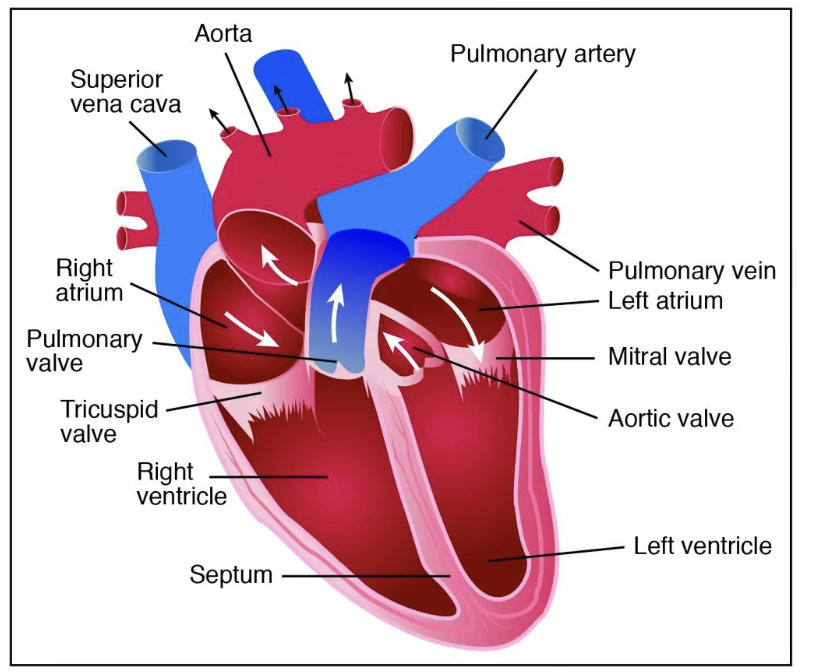
Mitral valve
regulates blood flow from the left atrium into the left ventricle.

Aortic valve
regulates blood flow from the left ventricle to
the aorta. The aorta is the largest artery in the body.

Deoxygenated blood flows through
pulmonary circulation
oxygenated blood flows through
systemic circulation.
🫀 Cardiovascular vs. Circulatory System
: Cardiovascular = heart and blood vessels. Circulatory = the whole blood-moving system.
System | What it means | Memory trick |
|---|---|---|
Cardiovascular system | Heart + blood vessels + blood | Cardio = heart |
Circulatory system | You move blood around the body; often used as another name for the cardiovascular system | Circulate = move around |
Cardiovascular = the heart and its blood-vessel network.
Circulatory = the job of circulating blood around the body.
It's the blood vessels ALL around your body! 🫀
The cardiovascular system includes:
❤ Heart: Pumps the blood.
🩸 Arteries: Carry blood AWAY from the heart.
🩸 Veins: Carry blood TOWARD the heart.
🔴 Capillaries: Tiny vessels where blood exchanges oxygen and nutrients with your cells.
Blood vessels travel throughout your entire body, including your arms, legs, organs, and brain.
🧠 Easy TEAS memory trick
Heart = pump + blood vessels = pathways + blood = delivery.