Soil Fertility: Exam 1
 Call Kai
 Learn
 Practice Test
 Spaced Repetition
 Match
 Flashcards
 Knowt Play
1/122

There's no tags or description
Looks like no tags are added yet.
123 Terms
Francis Bacon
Father of empiricism and the scientific method.
Believed that water formed the principal nourishment of plants and that soil was only there for support and temperature protection.
Van Hemont
Grew the stem of a willow tree in isolated water for 5 years.
The tree gained 164 lbs of biomass, while the soil only lost 2 ounces.
Believed that water became biomass, missing the importance of the lost soil.
John Woodward
Grew spearmint in water with a varying range of impurities.
Amount of growth increased with more impurities (e.g., mud) in the water.
Provided evidence that something in the soil was needed for plants to grow and that most of the water used by plants exits to the atmopshere.
95% of Plants
Carbon, oxygen, and hydrogen
Bushel
A unit of a crop in dry capacity.
Each type of crop has a different amount.
Crop Bushel Examples
Corn — 56 lb
Soybean — 60 lb
Oat — 32 lb
Factors Influencing Fertilizer Decisions
Soil: pH, texture, CEC, organic matter
Crop: yield goal, rooting, demand timing
Weather: rainfall, temperature, loss risk
Economics: crop value, fertilizer price, risk
Environment: water, air, downstream effects
Macronutrients
Nitrogen (N)
Phosphorus (P)
Potassium (K)
Magnesium (Mg)
Sulfur (S)
Calcium (Ca)
Micronutrients
Boron (B)
Chlorine (Cl)
Manganese (Mg)
Iron (Fe)
Copper (Cu)
Zinc (Zn)
Molybdenum (Mo)
Sand
2 — 0.05 mm
Low chemical activity; needs massive amounts to override the effects of other soil.
Creates the skeleton of soil.
Weight-bearing, allowing plants to be supported.
Permeable and aerated.
Low water holding capacity.
Poor nutrient availability and low in organic matter.
Leaches fertilizer easily.
Silt
0.05 to 0.002 mm
Limited ability to retain plant nutrients.
Retains and releases water readily.
Easily eroded; not sticky.
Clay
0.002 to 0 mm
Dominates soil behavior at low percentages.
Binds soil together.
Charged; may be positive or negative.
High nutrient exchange; retains organic matter well.
High water holding capacity.
Low leaching and poor aeration.
Sticky and heavy, especially when wet.
Soil Texture
Percent sand, silt, and clay be weight.
This is based on particle size, not the mineral type.
Particles larger than 2 mm are ignored, as it is no longer considered soil.

Loam
Soil composed of a mixture of sand, silt, and clay.
It is not an equal 33% mix of each particle, but instead a mix that combines the traits of all three components.
Most desirable soil texture, especially for farming.
Good tilth (crop suitability) and porosity (fluffy not compacted).
Good water holding capacity.
Good nutrient availability.
Surface Area
Typically measured as m2/g for soil.
Influences water retention / release, nutrient retention, and CEC.
Large pores allow rapid water movement (sand), while small pores slows it down (clay).
Discontinuities
Occur where horizons with differing soil textures in a soil profile.
Often seen when there is a change in parent material, compacted zones, or fragipans (dense layer that restricts water and roots).
Results in problems with water movement (sandy over clayey soils creates an anoxic bathtub; clayey over sandy soils completely saturates upper soil).
Soil Structure
The arrangement of the solid parts of soil and pore spaces located between them.
Based on texture, clay type, organic matter, microbes, and soil moisture.
Clay is required for this, as sand and silt have a hard time forming aggregates.
Subangular block, angular blocky, prismatic, platy, massive, and single-grained.
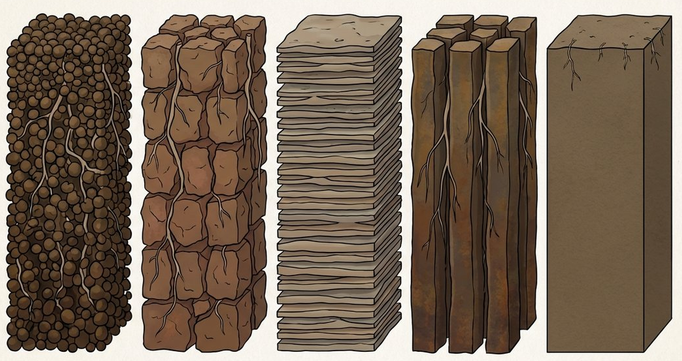
Peds
Distinct structural units of aggregated particles.
Break along natural lines of weakness into a particular size and/or shape.
Aggregate stability reduces run-off and erosion.
Size
How big or small the soil is.
Coarse, medium, fine.
Grade
How easy it is to break soil apart.
Weak, moderate, strong.
Ideal Topsoil
Granular structure.
Provides aeration, drainage, run-off, erosion resistance, and a seedbed.
Pore space is 50% and solid space is 50%
Deep soils with a thick A horizon.
Structureless (0)
Texture dominates soil water movement.
Weak Structure (1)
Soils that are not well developed, such as on steep slopes and floodplain landscapes.
Often associated with Bt and Bw horizons.
Moderate Structure (2)
Neither weakly nor strongly developed; cracks and peds are normally evident.
Most common structural grade found in Virginia.
Water assumed to flow at a rate consistent to or faster than the texture would indicate.
Strong Structure (3)
Well-expressed in well-developed soils.
Cracks and pores are clearly evident from several feet away.
Strong subangular / angular blocky is usually associated with enhanced water percolation.
Soil Porosity
The measure of empty spaces within soil as a fraction of the total volume.
Low in sandy soils; high in clay soils.
Space for air and water within soils.
Soil Porosity Formula
Volume of pores / total volume
1 — (bulk density / particle density)
Tillage
Loosens soil and increases porosity at first, but compacts it over time.
Reduces organic matter, breaks down aggregates, and reduces pore size.
Mitigated by planting grasses / legumes in rotation or incorporating organic matter from post-harvest crop residue.
Particle Density
Average density of minerals in soil.
In general, 2.65 g/cm3 is used for mineral soils.
Highly weathered tropical soils are higher (high in iron oxides); varies in organic soils.
Bulk Density
Weight of soil per volume of soil (g/cm3).
Compaction makes it higher.
High organic matter and finer soil texture makes it lower.
Bulk Density Formula
Dry mass of soil (g) / total volume (cm3)
Total volume = volume of solids + volume of pores.
Cylinder Volume Formula
V = π r2 h
Soil Color
Red — well drained iron soils.
Gray — poorly drained iron soils.
Dark — higher in organic matter.
Soil Definition
A 3D natural body (in the same sense of a mountain or lake) that is a collection of individually different soil bodies.
Composed of minerals, gases, water, organic matter, and soil organisms.
Pedon (Soil Profile)
The smallest three-dimensional body used for classification.
Polypedon
Contiguous, similar pedons forming a soil individual.
Soil Horizons
O — organic materials
A — minerals with humus
E — loss of clay, iron, and aluminum (eluviation)
B — accumulation, alteration, and illuviation
C — parent material
R — hard bedrock
Five Soil-Formation Factors
Climate (water and temperature)
Organisms (plants, microbes, and fauna)
Topography (slope and landscape position)
Time (duration of processes)
Parent material (starting mineral or organic material)
Climate
Water moves solutes, drives hydrolysis, and controls leaching.
Temperature affects reaction rates, vegetation, and decomposition.
Balance determines evapotranspiration, wetness and redox; and salt accumulation.
Organisms
Living species transform the soil profile.
Adding organic residues.
Creating pores and channels.
Mixing and aggregating soil.
Altering acidity and minerals.
Cycling nutrients.
Humans are also a soil-forming force via plowing, cultivation, heavy machinery, etc.
Topography
Slope and landscape positions (relief) redistributes water and matter within the soil.
Summit — erosion-prone and well-drained.
Backslope — runoff and transport.
Footslope — deposition and more moisture (ideal for crop growth).
Toeslope — accumulation of sediment and wetness.
Time
The passage of time allows for soil differentiation.
Young soils have weak A/C or A/R horizons.
Developing soils form an E horizon and accumulate a B horizon.
Mature soils have strong horizons with advanced weathering.
Parent Material
Sets the starting point for soil; it is not yet a soil.
Determines the mineralogy and particle size of the soil.
The transport mechanism leaves diagnostic textures and landforms (residual, transported, or organic).
Soil Taxonomy (USDA Soil Survey Staff)
Soil hierarchy with 12 broad orders that narrow down to site specific series.
Order → suborder → great group → subgroup → family → series.
Upper names are carried down (Ultisols → Udults → Kanhapludults).
First published in 1975 and is used by the United States today.
Emphasizes measurable soil properties and diagnostic horizons.

World Reference Base for Soil Resources
Provides an international system for naming and comparing soils.
Developed through FAO and international soil-science collaboration.
Some countries will use their own national soil classification system instead of this.
Alfisols
Clay accumulation and moderately leached; mildly weathered.
Relatively high base status.
Andisols
Volcanic ash soils with low-density and reactive minerals.
Found in volcanic regions.
Aridisols
Dry soils with limited leaching and an accumulation of salts and carbonates.
Limits water use.
Entisols
Recent soils with little horizon development (youngest).
Found in floodplains, dunes, and steep slopes.
Gelisols
Permafrost soils with frost churning.
Cold-region constraint.
Histosols
Organic soils with thick organic materials.
Found in wetlands and peatlands.
Inceptisols
Soils that are just beginning development.
Cambric horizon with few diagnostics.
Found in young landscapes.
Mollisols
Grasslands soils with a dark, humus-rich surface layer.
High natural fertility.
Oxisols
Extreme weathering with Fe or Al oxides and low activity clays.
Found in stable, tropical landscapes.
Spodosols
Strongly acidic, humus-rich horizon with significant organic Al and Fe accumulation.
Found in acidic, sandy forest settings.
Ultisols
Clay accumulation and strongly leached; intensely weathered.
Low base status.
Most common soil type in Virginia.
Vertisols
Shrink-swell clays with deep-cracks; self-mixing.
Challenging for engineering and tillage.
Ion
An atom or compound that is electrically charged due to the loss or gain of electrons.
Cations
Ammonium
Potassium
Calcium
Aluminum
Magnesium
Iron
Manganese
Copper
Zinc
Sodium
Hydrogen
Anions
Carbonate
Oxide
Hydroxide
Nitrate
Chloride
Sulfate
Phosphate
Cation Exchange Capacity (CEC)
Soil’s ability to hold positively charged ions.
The sum total of exchangeable cations a soil can adsorb.
Interchange between a cation in solution and another cation on the exchange site of any active material (negatively charged clay or organic matter).
Can be separated into permanent charge and pH-dependent charge.
Greatest in silicate clays (2:1 and 1:1).

Anion Exchange Capacity (AEC)
Soil’s ability to hold negatively charged ions.
Interchange between an anion in solution and another anion on the exchange site of any active material (positively charged).
Greatest in oxide clays with greater weathering.

Equivalent (eq)
The amount of an ion that supplies or balances one mole of electrical charge.
It changes depending on the specific ion.
Isomorphous Substitution (Permanent)
Cation substitution in clay layers, replacing one element for another of similar size within a stable structure; preserves the compound’s form and function.
Results in a different charge, but has no change in soil mineral structure.
Occurs in 2:1 (tetrahedral + octahedral + tetrahedral), but not in 1:1 (tetra + octa).
Kaolinite
No isomorphous substitution (Si:Al = 1:1).
Positive and negative changes balance out, making it neutral.
Hydrogen strongly bonds tetrahedral-octahedral sheets together with no CEC.
Pyrophyllite
No isomophric substitution.
2:1-type silicate clay; not common in soil.
Positvie and negative charges balance each other out.
Smectite
Isomorphic substitution (Si:Al = 2:1).
Overall negative charge (-0.4).
Swells up significantly when wet, then retracts when dry.
Montmorillonite
Type of smectite; most prominent in soils.
Al is substituted by Mg in octahedral structure.
High CEC; charges are closer to the inner surface of the mineral.
Adsorption of water between layers, causing swelling.
Vermiculite
Type of smectite.
Al is substituted for Si in tetrahedral and octahedral structures.
Very high CEC; greater negative charges are closer to the outside of the mineral.
Interlayer cations hold units together, limiting swelling and shrinking.
Fine-Grained Mica
Type of smectite.
Al is substituted for Si in tetrahedral structures.
Imparts a greater -ve charge; charges are closer to the outside of the mineral.
K+ is non-exchangeable and therefore isn’t available for CEC; weathering may allow exchangeable cations to enter, becoming a vermiculite instead.
Tetrahedral Structures
Si is substituted by Al.
Octahedral Structures
Al is substituted by Mg or Fe.
pH-Dependent Charge
The charge of a molecule varies with the pH of the surrounding environment.
The broken edges of clay have a large surface area and terminates where ions have charge, resulting in CEC and AEC; sand and silt do not.
Important in organic matter, 1:1 clays, and Fe / Al oxides.
Responsible for CEC in most organic matter.
Controls on Cation Selectivity
Concentration — more of a replacing ion drives exchange through mass action.
Charge and hydration — higher charge and less strongly hydrated ions are often retained more strongly.
Exchange-site composition — replaceability changes with the ions and saturation levels already present.
Clay mineralogy — different minerals show different selectivity patters.
Exchange is reversible, but cations are not retained equally; some are held tighter.
Determining CEC
Sum exchangeable cations (add cations and exchangeable acidity from soil test).
Displace and measure (saturation excahnge sites with a cation, displace it, and then quantify it).
Estimate from soil properties (clay amount, clay mineralogy, and organic matter).
Approximate CEC Ranges for Soil Textures
Sands: 3-5 cmolc/kg
Loams: 10-15 cmolc/kg
Silt loams: 15-25 cmolc/kg
Clay soils: 20-50 cmolc/kg
Organic soils: 50-100 cmolc/kg
Base Saturation (BS)
The percentage of cation exchange capacity (CEC) occupied by basic cations.
When high, soils usually have higher pH, are more fertile, contain more essential plant nutrients but little to none of toxic Al3+, and are more buffered against acid cations.
When lower, soils usually have more Al3+ and hinder most plant growth.
Base Saturation Formula
(Total of basic cations / CEC) × 100%
Basic Cations
NH4+
Na+
K+
Mg2+
Ca2+
Acidic Cations
H+
Al3+
Acidity of Water
Both a weak acid and a weak base (H2O ⇋ H+ + OH-).
Acids ionize to H+ and accompanying anions.
Strong acids release all H+.
Weak acids only release small quantities of H+.
pH Scale
A log scale (10×) that represents H+ concentration.
-log [H+] or -log [mol / liter H+]
Acidic Soils
About 1/3 of global soils; found in SE and NW of the US.
Globally, form a northern and southern belt where precipitation is greater (rainwater is mildly acidic).
Sources of H+ in Soil
Formation of carbonic acid from CO2.
Natural occurennce of many organic acids in soils.
Oxidation of N, S, and Fe compounds.
Acid precipitation.
Cation uptake by plants.
Deprotonation of pH-dependent charges.
Aluminum hydrolysis.
Formation of Carbonic Acid
Atmospheric CO2 is dissolved in rainwater (pH of ~5.7).
Root and microbial respiration in soil release CO2 (~10× than atmospheric air).
Greater acidity in soil than produced in the atmosphere.
Natural Occurrence of Soil Organic Acids
Acid function groups in humus (RCOOH → RCOO- + H+).
Low molecular-weight organic acids are produced by roots and soil microbes, including citric and malic acids.
Oxidation of N, S, and Fe Compounds
Nitrification (NH4+ + 2O2 ⇋ NO3- + H2O + 2H+)
Pyrite weathering (FeS2 + 3½O2 + H2O ⇋ FeSO4 + SO42- + 2H+).
Ammonium added to fields as a fertilizer.
Acid Precipitation
Rain, snow, fog, and dust contain a variety of acids.
Sulfur and nitrogen gases (produced by lightning, volcanic eruptions, forest fires, and combustion of fossil fuels) further acidify them.
Cation Uptake by Plants
Plants take up nutrients (cations and anions) by altering pH.
They extrude H+ or uptake an anion when absorbing a cation.
They extrude OH- / HCO3- or uptake an cation when absorbing a anion.
Most plants uptake more cations than anions, causing them to release excess H+ to maintain electrical neutrality and acidifying the soil.
Deprotonation of pH-Dependent Charges
Protons are removed from the edges of clay mineral Fe and Al oxides and organic matter.
Results in a reduction of pH.
Aluminum Hydrolysis
Al3+ concentration in soil solution increases as pH decreases.
Result of the dissolution of Al(OH)3 or gibbsite, generating H+ and lowering pH.
Reason why Al is considered an acidic cation.
Buffering Capacity of Aluminum
Adding a base will neutralize H+ first, but Al hydrolyzes with the production of H+.
This buffers the increase in solution pH until enough base is added to decrease soluble Al3+.
Al(OH)3 precipitates at pH 6.5, finally decreasing Al and increasing pH.
It can also buffer against the addition of acid, as Al(OH)3 dissolves to release Al in solution when neutralizing OH-.
Active Acidity
H+ is measured in the soil solution as soil pH.
Small pool; it is only the immediate root environment.
Exchangeable Acidity
Readily displaced H+ and Al species.
Held on clay and organic matter surfaces.
Often extracted with an unbuffered salt.
Residual Acidity
Less readily neutralized solid-phase activity.
Associated with organic matter, mineral edges, and hydroxy-Al forms.
Potential (Reserve) Acidity
Combination of exchangeable and residual acidity.
Anion Protonation
Functional groups on organic matter consume H+ during reverse association and increases soil pH (more basic).
Plants also take up anions, which consumes H+.
Reduction Reactions
The biological reduction of N, S, and Fe compounds, which consumes H+ and increases soil pH (more basic).
Mineral Weathering
The dissolution and weathering of primary silicate and non-silicate minerals consume H+ and release base cations, increasing soil pH (more basic).
Fertilizer-Induced Acidification
Nitrate (NO3-) leaching is a product of the nitrification of NH4+ fertilizer; NO3- is more prone to leaching because it has a negative charge, so the negatively charged soil does not hold onto it very well.
Crop recovery of NO3- is not complete, producing H+ and acidifying the soil.
CaCO3 is applied to neutralize the acidity caused by fertilizer.