1 & 2 – LP Modeling, Linear Algebra Review
 Call Kai
 Learn
Learn Practice Test
 Spaced Repetition
 Match
Match Flashcards
 Knowt Play
1/21

There's no tags or description
Looks like no tags are added yet.
Name | Mastery | Learn | Test | Matching | Spaced | Call with Kai | Chat |
|---|
No analytics yet
Send a link to your students to track their progress
22 Terms
A matrix with two rows and three columns is referred to as a what by what matrix?
2 by 3 matrix

What do the first and second subscripts in a matrix refer to?
First subscript refers to the row, second subscript refers to the column

Define a vector and difference between row vs column vector
A vector is a special type of matrix that has only one row (called a row vector) or one column (called a column vector)

Define a square matrix
A matrix with as many rows as it has columns (e.g: 2 × 2 matrix)
Define a symmetric matrix
A square matrix in which xij = xji for all i and j
(Matrix A is symmetric, Matrix B is not symmetric)

Define a diagonal matrix
A symmetric matrix where all the off diagonal elements are 0.

Define an Identity Matrix
A diagonal matrix with only 1s on the diagonal


What happens when you transpose a matrix?
The first row of a matrix becomes the first column of the transpose matrix, the second row of the matrix becomes the second column of the transpose, etc.
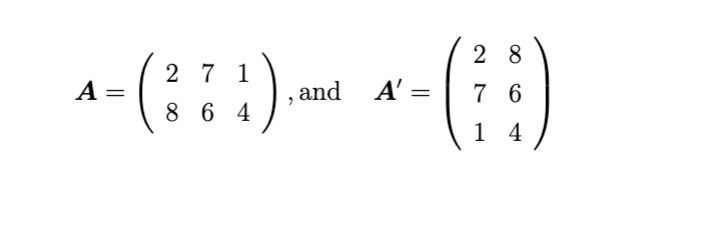
What is the transpose of a row vector?
What is the transpose of a symmetric matrix?
The transpose of a row vector will be a column vector, and the transpose of a column vector will be a row vector.
The transpose of a symmetric matrix is simply the original matrix.
Explain how matrix addition & subtraction works.
For example, if adding matrices A + B = R, what does the notation look like?
To add two matrices, they both must have the same number of rows and they both must have the same number of columns.
The elements of the two matrices are simply added together, element by element, to produce the results.
Matrix subtraction works the same way.
For R = A + B, then rij = aij + bij
Explain how matrix multiplication works in the case of a matrix being multiplied by a scalar,
Each element in the matrix is multiplied by the scalar to produce the product.


Explain how multiplication works with multiplying a row vector by a column vector.
Identify the proper notation for the vectors presented.
The row vector must have as many columns as the column vector has rows.
The bottom one is not legal because the row vector has three columns while the column vector has four rows.
Multiplication works by summing the product of elements in order of how they appear in the row/column (left to right, top to bottom)


Explain how matrix multiplication works in general cases, and also any legal/illegal rules involved.
Take the first row and first column and multiply them according to vector rules. Then take the first row and remaining columns and do the same.
Then go to the second row and repeat the same function.
For matrix multiplication to be legal, the first matrix must have as many columns as the second matrix has rows

How does matrix multiplication work when multiplying a matrix by an Identity matrix?
And, how does it work when multiplying a scalar by an identity matrix?
Any vector/matrix multiplied by an identity matrix is simply the original vector/matrix.
A scalar multiplied by an identity matrix becomes a diagonal matrix with the scalars on the diagonal.


What is the determinant of a 2 × 2 matrix A?
det(A) = ad – bc
Define linear dependence of a vector
A set of vectors is said to be linearly dependent if one of the vectors in the set can be defined as a linear combination of the others,
e.g., v3 = a1v1 + a2v2 for some a1 and a2;
If no vector in the set can be written in this way, then the vectors are linearly independent.
Define the inverse of a matrix in matrix algebra as well as any important rules associated with it.
The inverse of a matrix is that matrix which, when multiplied by the original matrix, gives an identity matrix.
The inverse of a matrix is denoted by the superscript −1.
A matrix must be square to have an inverse.

A square matrix is singular if and only if __?
Its determinant is 0. This implies linear dependency.
Formula to find the inverse of a 2 × 2 matrix

Define a system of linear equations & a solution to the system.
A collection of linear equations involving the same set of variables.
A solution is an assignment of numbers to the variables such that all equations are simultaneously satisfied.

In what matrix notation can a system of linear equations be expressed
Ax = b

If m = n, what rule applies to the system?
Additionally, flip for an example of this system in action.
The system has a solution if and only if A-1 exists (when det(A) ≠ 0).
The equation is then:
x = A-1b
