Speech Therapy
 Call Kai
 Learn
Learn Practice Test
 Spaced Repetition
 Match
Match Flashcards
 Knowt Play
1/31

There's no tags or description
Looks like no tags are added yet.
Name | Mastery | Learn | Test | Matching | Spaced | Call with Kai | Chat |
|---|
No analytics yet
Send a link to your students to track their progress
32 Terms
Individuals with clefts/craniofacial anomalies are at risk for
speech and resonance disorders secondary to velopharyngeal insufficiency or incompetence (VPI), oral anomalies, and dental malocclusion.
Speech therapy __________ correct VPI / structural disorders
WILL NOT
Speech therapy _________ correct abnormal function (Speech sound placement) that may result from these disorders
WILL

Obligatory distortions
occur when function (i.e., articulation) is normal, but structure is abnormal
Speech therapy is not indicated for obligatory distortions.
Obligatory distortions can only be eliminated by correcting structure (i.e., through surgery or prosthetic management).
Examples of obligatory distortions (CANT HELP/ OBLIGED)
1. Weak or Omitted Consonants (Air leaked out through VPI valve, reduces amount of airflow in oral cavity for production of consonants causing consonants to be weak in intensity)
2. Short Utterance Length (A leak od airflow through nose reduces oral airflow available for connected speech)
3. Nasalization of Oral Consonants (When voiced plosives are produced in the presence of sig. VPI- Oral phonemes sound more like nasal counterpart (eg. m/b, n/d) (SAME PLACEMENT)
4. Nasal Grimace (muscle contraction just above the nasal bridge-is a overflow muscle reaction to achieve VP closure)
Compensatory errors
occur when articulation placement (function) is altered due to abnormal structure
Common compensatory productions for VPI include pharyngeal fricatives, pharyngeal plosives, and glottal stops.
Compensatory productions can be corrected with speech therapy, preferably after correction of structure.
Compensatory errors examples
Examples: tongue moves into position to get some kind of block to get some kind of pressure
1. Palatal-dorsal production (stop-plosive produced with dorsum of tongue against mid hard palate) (CENTRAL)
2. (BACKED) Velar Plosive (when large oronasal fistulas in hard palate- substitution of velar sounds /k/ & /g/ for anterior sounds like /t/ and /d/3. Pharyngeal Plosive (can be voiced or voiceless and produced with back of tongue articulating with PPW)
Glottal Stop (voiced plosive produced by adduction of vocal folds, a build-up of subglottal pressure, and then sudden separation of VF;s to release airflow- substitution of /t/ like in “mitten”
Speech therapy w/ an oronasal fistula
Compensatory productions due to a symptomatic fistula cannot be easily corrected with speech therapy until the fistula is closed.
A palatal obturator can be used until the fistula is surgically closed.

Speech therapy before VPI surgery
Speech therapy can be done while waiting for surgery or a prosthesis. However, placement is VERY hard to achieve without oral air flow. Therefore…
Nose plugging should be used to give the child increased oral air flow to convert to air pressure through articulation.
Child should wear nose plug at home as much as possible, not just during practice
*NOSE HOLDING?
Speech therapy after VPI surgery
Changing structure does not change function.
Speech therapy is appropriate for correction of compensatory errors after surgery.
Speech therapy, using auditory feedback, can be effective in getting the new structures to function normally (e.g., to increase lateral wall movement around a new pharyngeal flap).
Speech for Velopharyngeal Mislearning (Obligatory after surgery)
a cause of misarticulations that cause nasal emission and sometimes hypernasality, despite normal velopharyngeal structure and physiology
Speech therapy is effective in normalizing placement and thus, eliminating phoneme-specific nasal emission or phoneme-specific hypernasality.
When in doubt
about the need for surgical correction, it is always best to do a short trial period of speech therapy.
It usually only takes a few weeks to determine whether therapy will be effective.
If nasality is noted with normal articulation, surgical intervention will likely be needed.
General Principles of Speech therapy (SELECT SOUNDS)
Select sounds in which the child is stimulable.
Select sounds that will have the biggest impact on intelligibility /s/
Select anterior sounds before posterior sounds (except with /r/).
can see it and more control over tip than back
Select continuant cognate before a movement sounds (e.g., /n/ (can say forever) before /d/) .
Select the voiceless sound before the voiced cognate.
General Principles of speech therapy cont’d (BE SURE)
Be sure the child can discriminate between the correct versus incorrect sound.
Establish placement of production before the manner.
Work on continuants and voiceless phonemes first without the vowel. /s/
Work on voiced plosives in syllables with the vowel.
Begin with the sound in the initial position.
Use /h/ to transition consonant to the vowel.
General principles of speech therapy cont’d (ONCE)
Once placement is obtained, work on sound in initial position.
Determine whether the medial or final position is easiest.
For medial position, break the word up into syllables.
The phonemic context of a medial sound can change its production.
Example: In American English, the /t/ in words that end with /n/ (e.g., “kitten,” “button,” “mitten,” etc.) is usually not aspirated but instead is co-articulated with a glottal stop)
General principles of speech therapy cont’d (WHEN WORKING FINAL)
When working on final position, break up the word. (b/c typically dissapears)
When working on final word position, combine word with a word that starts with a vowel (e.g., bake it).
Work on sounds in categories. (fricative/affricate)
When moving to the next sound in a category, change one feature at a time. (voiceless/voiced)
General principles of speech therapy cont’d (DIVIDE)
Divide the consonant blends into individual components.
When /s/ is combined with a typically voiceless consonant, the voiceless consonant becomes voiced (e.g., “spell” becomes “sss
… bell”).
Work on the sound in carrier phrases.
Work on the sound in novel sentences.
General principles of speech therapy cont’d (OBTAIN)
Obtain as many correct productions of the sound in the session as possible.
Work on carryover using unstructured speech.
Involve the parents and caregiver.
There should be several short (a few minutes at a time)practice sessions each day whenever possible.
Biofeedback
a technique for making unconscious or autonomic physiological processes perceptible to the senses in order to manipulate them by conscious mental control
Biofeedback can be auditory, visual, or tactile-kinesthetic.
Biofeedback can be low-tech or high-tech using sophisticated instrumentation

Low-tech therapy tools and techniques: straw
For feedback regarding nasal emission or hypernasality
feedback regarding anterior & lateral emission of oral airflow

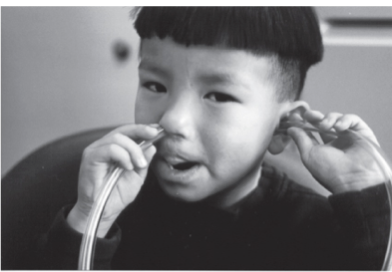
Low-tech therapy tools: listening tube (larger diameter is better)
For feedback regarding nasal emission or hypernasality
For feedback regarding oral airflow


Low-tech tools: oral & nasal listener (ONL)

to provide feedback to the child, and allow the SLP or parent to hear the same sound
feedback for regarding nasal emission or hypernasality

High-tech therapy tools (vowels 30 %, nasals 90-100%, oral NONE)
Digital recording equipment
Nasometer (visual biofeedback)
Pressure-flow instrumentation (ASSESSMENT)
Nasopharyngoscopy (show anatomy)
Specific therapy techniques
Always use visual, tactile and auditory feedback to establish awareness.
See videos in FredLearn for specific placement techniques for the following:
Glottal stop
Pharyngeal plosives
Pharyngeal or nasal fricative/affricate
Palatal-dorsal production (middorsum palatal stop)
Nasalized (or otherwise distorted) /ɚ/ and /r/
Nasalized phonemes
Oral motor exercises… THEY DO NOT WORK
There is NO evidence to support the use nonspeech exercises in improving velopharyngeal function. There is evidence to show why they do not work.
It doesn’t make sense to use exercises for structural abnormalities.
Do NOT use blowing, sucking, whistling, gagging, swallowing, cheek puffing, icing, stroking, palatal massage, electrical stimulation, playing wind instruments, etc. None of these work.
Motor learning & motor memory
Speech requires motor movements that are fast, complex, automatic, and effortless.
This is accomplished by motor learning and motor memory.
doesn’t translate into coartic.
Motor learning
acquisition of new motor skills in order to execute complex motor movements and sequences
Dependent on feedback through “trial and error”
Examples include learning how to:
Play a musical instrument
Perform dance steps
Play a sport
Produce speech sounds in sequence for connected speech
Motor learning phase of speech therapy includes teaching placement and providing feedback.
Motor memory
develops automaticity of the newly learned motor movement
Dependent on constant repetition (e.g., practice)
Makes new learning relatively permanent
Motor memory phase of speech therapy requires frequent, daily practice, which should be done at home between sessions.
General principles
Speech therapy is like taking piano lessons—if you don’t practice at home, you don’t make progress!
Practice frequency & intensity
For best results:
Practice frequency: Frequent sessions should be done at home each day.
Practice intensity: Practice sessions can be a short (a few minutes at a time) but should include drill work for motor memory.
Ultimate goal
Normal speech (without nasal emission) and normal resonance (without hypernasality or hyponasality)
Merely “improved” or “acceptable” speech is not acceptable in most cases.
Summary
Speech therapy is appropriate for:
Compensatory errors after correction of the structure
Misarticulations that cause phoneme-specific hypernasality or phoneme-specific nasal emission
Speech therapy is NOT appropriate for:
Obligatory errors due to abnormal structure, including hypernasality and/or nasal emission due to VPI
can do nasal blocking & trial run though