gen chem 1
 Call Kai
 Learn
 Practice Test
 Spaced Repetition
 Match
 Flashcards
 Knowt Play
1/111

There's no tags or description
Looks like no tags are added yet.
112 Terms
Atom
comes from word atomos(not divisible)
Made of a positively charged nucleus surrounded by negatively charged electrons
Nucleus has protons and neutrons
Mass of proton = mass of neutron

Element
a substance that has a composition only corresponding to one of the symbols in the Periodic Table
Compounds
a substance containing multiple elements
Allotropes
different structural forms of the same element
i.e. Carbon w diamond, graphite
Oxygen with dioxygen and ozone(O3)
Phosphorus with red, white and black versions
Only elements, not compounds
Polymorph
different structural forms of the same compound in the same phase
Mixture
a combination of two or more elements/compounds
Homogenous mixture
a mixture in which the composition is uniform throughout
Heterogenous mixture
a mixture in which the composition is not uniform throughout
law of conservation of mass
mass is not created or destroyed in a chemical reaction
law of definite proportions
in a pure compound, the constituent elements are present in a definite proportion or % by mass
law of constant composition
all samples of a given chemical compound have the same elemental composition
law of multiple proportions
when two elements form a series of compounds, the masses of one element that combine with a fixed mass of the other element are in the ratio of small integers to each other
law of combining gas volumes
When gases react, they do so in a definite integer ratio by volume; volume of each product gas to the volume of either reacting gas is the ratio of simple integers
Avogadro’s hypothesis
Equal volumes of different gases at the same temperature contain equal numbers of particles; can be atomic, diatomic, or polyatomic
Particles and atoms are NOT equivalent
Cannizzaro
calculated the molecular mass of gaseous compounds
Molecules have whole number of atoms and equal volumes of gases under the same conditions haave the same number of molecules
Determined that some molecules must be diatomic
Dalton
a lot of theory
Discovered laws of definite and multiple proportions
Said elements are made of indivisible atoms, all atoms of an element are identical, different elements have different atoms, compounds are formed when unlike elements combine in small whole-number ratios, atoms retain their identities in chemical processes
Wrong because atoms are divisible and isotopes exist
Mendeleev
made modern periodic table and sorted everything by atomic masses
properties determine by atomic number
Rutherford
Gold foil experiment shooting positive alpha particles;
when they were deflected knew plum pudding model was false
Concluded that most mass was the positive nucleus with electrons surrounding it
JJ Thomson
Cathode ray experiment
Found charge to mass ratio of electrons(-1.76×10^8) and that the charge was negative
Thought atom had plum pudding model: electrons in a field of positive charge
Millikan
Oil drop experiment
Found the charge of the electron (1.6×10^-19) and deduced mass from it(9.11×10^-31)
Atomic number
The number of protons an element has
Mass number
Number of protons and neutrons
Isotopes
nuclides of the same element with different mass numbers
Ionic bond
Atoms bound by transferring electrons to form charged atoms(ions)
Cation
positive ion from losing electrons
Smaller than og
Anion
Negative ion from gaining electrons
Bigger than og
Covalent bonds
Atoms bound by sharing electrons
Metals
have luster
are good conductors of heat and electricty
malleable
ductile
Nonmetals
dull color
poor conductor of heat and electricity
brittle
Alkali metals
Li, Na, K, Rb, Cs, Fr
Reactive with water to make alkaline solutions
Ignite or explode near water
Soft metals that can be cut with a knife
Malleable and ductile
Forms M+ ions
Alkaline earth metals
Be, Mg, Ca, Sr, Ba, Ra
Oxides are insoluble in water and stable to heat
Harder and less reactive that alkali metals
Forms M2+ ions
Boron family(triels)
B, Al, Ga, In, Tl
From semimetallic to metallic
Forms M3+ compounds or monovalent compounds
Carbon family
C, Si, Ge, Sn, Pb
From nonmetallic to semimetallic to metallic
Tetravalent and divalent compounds
Pnictogen
N, P, As, Sb, Bi
From nonmetallic to semimetallic to metallic
Chalcogens
O, S, Se, Te, Po
Nonmetallic to semimetallic
Forms oxides and sulfides
Halogens
F, Cl, Br, I, At
Diatomic nonmetals
Melting point increases down the group
Noble gases
He, Ne, Ar, Kr, Xe, Rn
Very unreactive because full octet
Avogadro’s number
6×10²³ in 1 mole
Volume occupied by molecular mass in grams
Avogardro * volume of one molecule
Mole
Avogadro’s number as a unit
= mass/molar mass
Mass of a mole in amu = mass of mole in grams
amu
1g/avogadros number = 1.66×10^-24
Molar mass
mass of 1 mole = to molecular mass in g/mol
STP
Standard temperature and pressure(0C and 1atm): 1 mole of gas takes up 22.4 L
Limiting reactant
The reactant that is used up first
Determined by smallest value of moles/x or mass of X/x(molecular weight of X)
Molecular formula
specifies number of atoms of each element in one molecule
Empircal formula
simplest formula that gives the correct relative number of atoms; can be equal to molecular
Percent yield
actual/theoretical yield * 100
Theoretical yield
moles of limiting reactant * ratio between reactant and product * molar mass of product
Ionization energy
the tendency of an atom to give up an electron
Positive
Electron affinity
tendency of an atom to receive an electron
Most are negative except Group 2 and 8
Change in energy
Energy of products- energy of reactants
Positive means energy is required to effect the transformation(unfavorable)
Negative means energy is released during the transformation(favorable)
Bond energy
energy required to break a covalent bond and separate the atoms
Average of 2 different elements bond energy is always less than the actual bond energy of the 2 elements
Lattice energy
Energy needed to form an ionic solid or gaseous ions
k(Q1Q2/r)
Bond length
distance for which a molecule has the minimum
Electronegativity
the ability of an atom in a molecule to attract electrons to itself
An atom with greater electronegativity has more atoms and will make a polar bond
Increases from left to right, bottom to top
Electronegative atoms form negative ions, while electropositive atoms form positive ions
Ionic bonds have big differences, covalent bonds have small differences
Polarity
Occurs when atoms aren’t shared equally because of electronegativity
Dipole moment
u = Q x r
two charges of equal magnitude Q separated by distance r

Percent abundance
Average mass = (m1x)+(m2*(1-x))'
x is fractional abundance on first isotope
Atomic radius
Increases down a group and decreases from left to right
More protons means smaller radius
valence electrons
the electrons in the outermost shell
Octet rule
8 electrons are favorable for elements
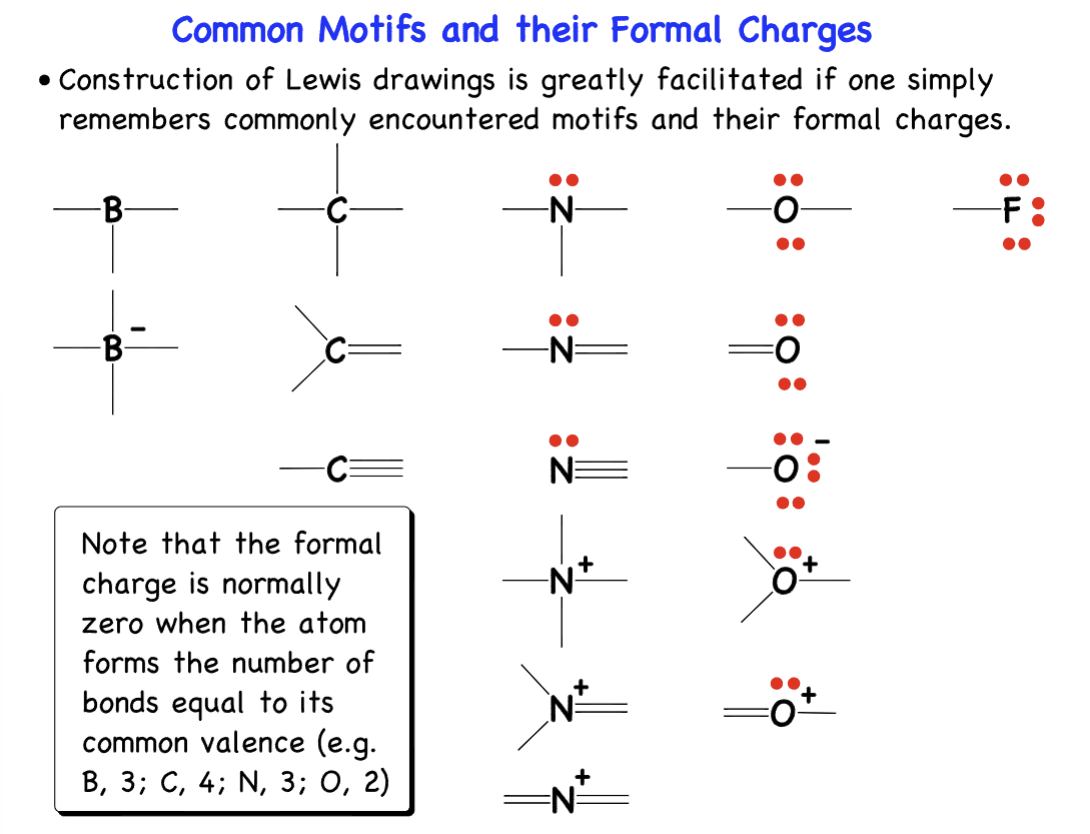
Lewis dot
Put an atom in the center(usually electropositive)
Give outer electrons 8 electrons first
Count the number of electrons(number = number of electrons in neutral atom- formula charge)\
Move electron pairs to satisfy octet
Determine number of unused electrons
Other methods exist
Lone pair
Pair of electrons not bonded in an octet
Dative bonds
Atoms using formal charges to be able to bond
One electron donates a pair and another accepts

Formal charge
Group valence - number of electrons in lone pairs - number of bonds
Resonance structure
When a bond can be represented as a bond of multiple Lewis structures because the bond lengths are equal
Only electron position changes(line)
Degenerate when they are equivalent
Odd-electron molecules
Can’t form a full octet usually
Hypovalent molecules have less than an octet
Can use lone pairs for resonance structures
Valence expansion
Sometimes electrons have more than an octet
Just keep applying the octet rule
Oxidation number
Calculated for bonded atoms
Oxidation numbers add up to the charge on the molecule
Oxidation number is based on the number of electrons an atom gains for a full octet:(i.e, oxygen -2)
VSEPR Theory/molecular geometry
Valence Shell Electron Pair Repulsion
Repulsion between electron pairs is minimized
Noted as AXe(X is coordination numbers, e is lone pairs)

Coordination number
number of atoms bonded
Steric number
Coordination number + lone pairs
Amplitude
maximum displacement from the center
squared determines the intensity of the radiation
Wavelength(lambda)
the peak-to-peak distance
Inversely related to frequency
Frequency(v)
the number of wavelengths that pass a given point in 1 second
Inversely related to wavelength
Speed of light
c = frequency * wavelength
3 × 10^8
Electromagnetic radiation
Electric and magnetic fields moving perpendicular to each other and the propagation of light
Electromagnetic spectrum
From highest to lowest energy
Radio waves
Microwaves
Infrared
Visible
Ultraviolet
X-rays
Gamma rays

Blackbody
I = Constant * T^4
Increases with frequency does opposite of wavelength
Photoelectric effect
E = hv
h = plancks constant = 6.63 × 10^-34
Phi is the work function representing og energy that electrons have to overcome to escape
hv = KE- phi
KE = 1/2mv²
Atomic spectra
v = C(1/2²-1/n²)
Rybdberg:
1/lambda = Rh(1/n1²-1/n2²)
Bohr model
Electron moves in circular orbits about the nucleus
Only fixed sets of orbits are allowed and no energy is emitted
Electrons only pass from one orbit to another
angular momentum
n(h/2pi) = nH
H/2pi
Radius of orbit
n²ao

Energy of orbit
-Re(1/n²)
Resonance condition
For energy to be absorbed or emitted the frequency of the light corresponds exactly to the difference in energy
E = E2-E1