Lecture 17: Action Potential
 Call Kai
 Learn
 Practice Test
 Spaced Repetition
 Match
 Flashcards
 Knowt Play
1/34

There's no tags or description
Looks like no tags are added yet.
35 Terms

neuron
basic functional unit of the nervous system (conducts messages & integrates info)

dendrites
tree like extensions of a neuron that receive info & send signals to cell body
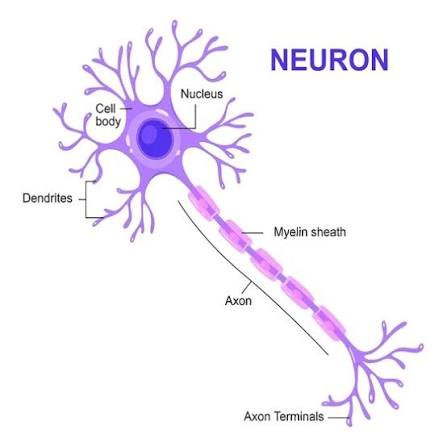
cell body (soma)
contains organelles & integrates info received by neuron
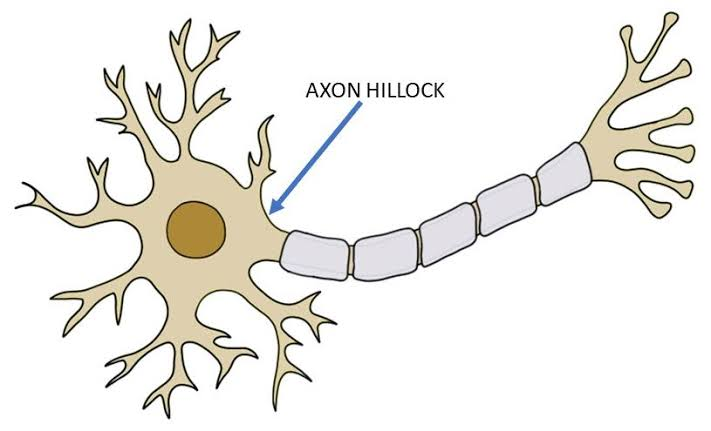
axon hillock
where signals are generated

axon
long structure that transmits signals away from cell body & towards another neuron / effector (ex: muscle)

synaptic terminals
end of axon & communicates with other neurons/effectors
SEQ neuron structures
dentriites (stimulus first)
cell body (soma)
axon hillock
axon
synaptic terminals
afferent neuron (sensory)
carries information from sensory receptors TO the processing center
interneurons
neurons found only in the CNS (responsible for integration)
integration
the NS’s process of receiving, organizing, and evaluating sensory info before sending instructions
efferent neuron (motor)
carries information FROM the processing center TO an effector
SEQ neuron types
sensory receptor
afferent neurons
interneurons (processing center)
efferent neurons (motor)
effector (gland / muscle)
what is membrane potential (MP)?
the electrical charge difference between the inside and outside of a cell
what causes MP?
an uneven distribution of ions which creates electrical energy
True or Flase: ALL cells have membrane potential
True
how is MP measured?
millivolts (mV)
what is the Na+ / K+ pump?
a pumps that uses active transport to move ions AGAINST their concentration gradient (needs ATP)
One complete Na+ / K+ cycle…
pumps 3 Na+ OUT of cell and pumps 2 K+ INTO cell
how to remember Na+ / K+ pump?
salty banana (sodium OUT, potassium IN)
what are ungated ion channels?
always open channels that use facilitated diffusion to move ions from HIGH to LOW concentration
what are voltage-gated ion channels?
channels that use facilitated diffusion and open and close based off changes in voltage
what is resting potential?
when the axon is at rest and the membrane potential is = -70 mV (voltage gated Na+ / K+ channels are closed?
what is depolarization?
when the membrane potential becomes less negative (MORE positive / moves closer to zero)
what is hyperpolarization?
when the MP moves BELOW resting potential / becomes MORE negative (-70 mV to -90 mV)
If the MP changes from -70 to -50 mV, the neuron is…
depolarizing
If the MP changes from -70 to -90 mV, the neuron is…
hyperpolarizing
If the MP reaches -55 mV…
the threshold is reached and an action potential is triggered
if the MP does not reach threshold then…
an action potentional does NOT occur
what is an action potential (AP)?
rapid change in membrane potential that occurs when depolarization reaches threshold
SEQ action potential
resting state (-70 mV)
stimulus (some Na+ channels open)
rising phase (most Na+ chanells open, Na+ rushes in, spike of +35mV)
falling phase (Na+ channels close & K+ channels open, K+ exits)
undershoot (some K+ channels remain open / returns to -70mV)
if more Na+ channels open THEN…
depolarization occurs (less negative)
if K+ channels stay open longer THEN…
more K+ exits & greater hyperpolarization (more negative)
if the channels do not reset & repolarize THEN…
another AP cannot be generated normally
continuous conduction
where an AP occurs step by step by step along an unmyelinated axon (slow & inefficient / uses more E)
saltatory conduction
where an AP “jumps” from node to node