8.4 The Wave Nature of Matter: The de Broglie Wavelength, the Uncertainty Principle, and Indeterminacy
 Call Kai
 Learn
Learn Practice Test
 Spaced Repetition
 Match
Match Flashcards
 Knowt Play
1/24

There's no tags or description
Looks like no tags are added yet.
Name | Mastery | Learn | Test | Matching | Spaced | Call with Kai | Chat |
|---|
No analytics yet
Send a link to your students to track their progress
25 Terms
electron diffraction
when a beam of electron goes through two closely spaced slits, they create an interference pattern as if the electrons were waves.

themselves
Counter to what might be our initial intuition about electron interference, the interference pattern is not caused by pairs of electrons interfering with each other, but rather by single electrons interfering with __________.
remains
If the electron source is turned down to a very low level, so that electrons come out only one at a time the interference pattern _______ (remains/disappears).
individual
The wave nature of the electron is an inherent property of ________ (individual/pairs of) electrons.
wave
____ (Wave/particle) nature explains the existence of stationary states (in the Bohr model) and prevents the electrons in an atom from crashing into the nucleus as predicted by classical physics.
de Broglie relation
𝜆 = h/mv or 𝜆 = h/p, gives wavelength of an electron of mass m moving at velocity v (or with momentum p), demonstrating wavelength is inversely proportional to momentum
𝜆 = h/mv
de Broglie relation (relation between wavelength, mass, and velocity)
velocity
The ________ of a moving electron is related to its wavelength—knowing one is equivalent to knowing the other.
do not
Quantum-mechanical theory is universal and applies to all objects regardless of size. However, thrown baseballs and other large objects _______ (do/do not) exhibit wave properties because its de Broglie wavelength is minuscule and insignificant compared to the object’s size.
unobserved
An ___________ (observed/unobserved) electron can occupy two different states.
observation
The act of ___________ forces an electron into one state or another.
observation
The act of ___________ forces traveling electrons to go through only one slit.
interference pattern
In the laser experiment, we can never both see the _____________________ and simultaneously determine which hole the electron goes through.
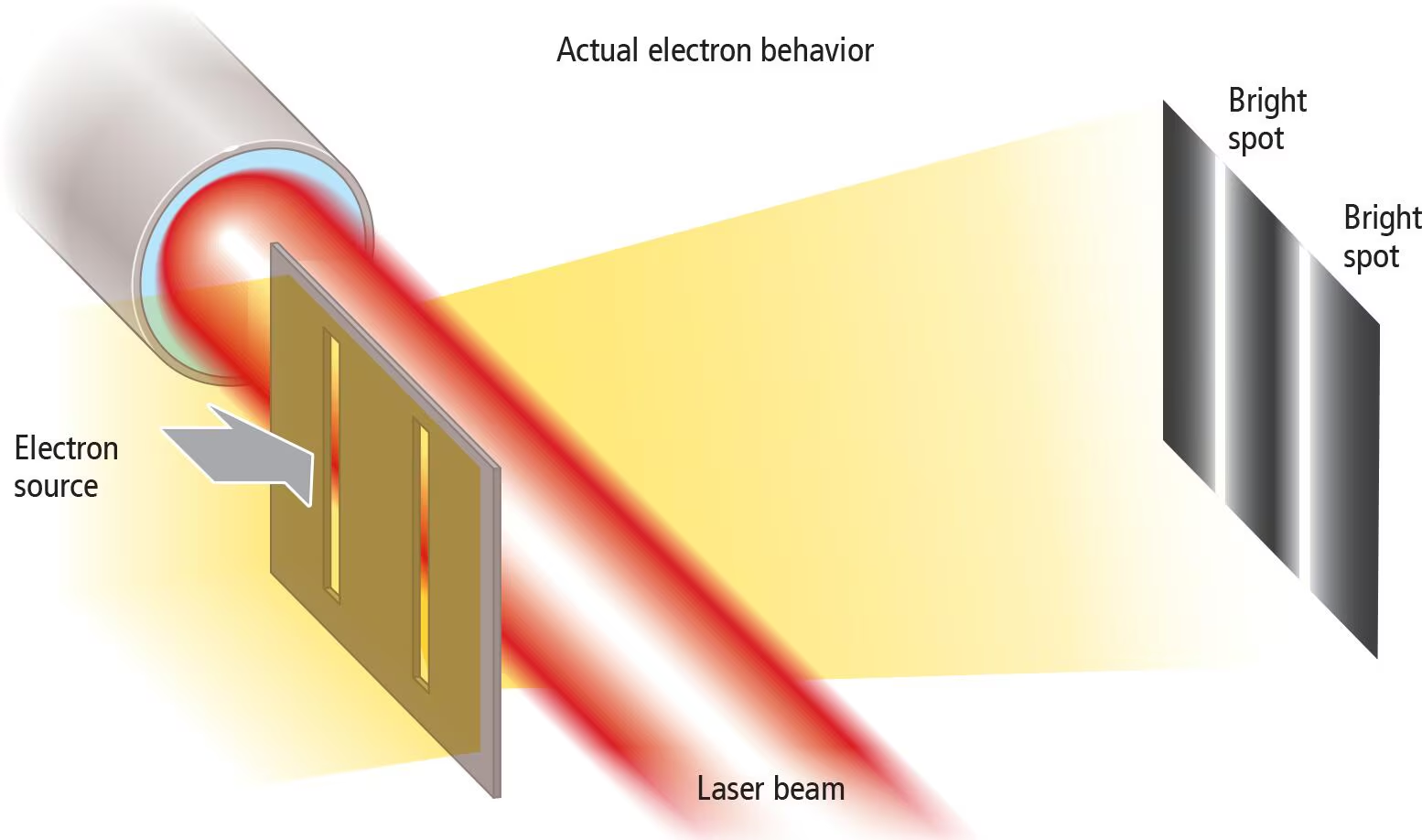
particle, wave
When we try to observe which hole the electron goes through (associated with the ________ (wave/particle) nature of the electron), we lose the interference pattern (associated with the ________ (wave/particle) nature of the electron).
complementary properties
properties that exclude one another; that is, the more you know about one, the less you know about the other (e.g. wave and particle nature of electron)
Heisenberg’s uncertainty principle
∆x * m∆v ≥ h/4π; the principle stating that due to the wave-particle duality, it is fundamentally impossible to precisely determine both the position and velocity of a particle at a given moment in time
∆x * m∆v ≥ h/4π
Heisenberg’s uncertainty principle, relation between uncertainty of position, mass, and uncertainty of velocity
Heisenberg’s uncertainty principle
_____________________________ states that the more accurately we know the position of an electron (the smaller delta x), the less accurately we can know its velocity (the bigger delta v).
velocity, position
The complementarity of the wave nature and particle nature of the electron results in the complementarity of ________ and __________. (What are the variables in Heisenberg’s uncertainty principle?)
either
Heisenberg solves the contradiction of wave-particle duality: an electron is observed as _______(both/either/neither) a particle or a wave.
trajectory
path determined by a particle’s velocity, position, and forces acting on it
deterministic
a characteristic of the classical laws of motion, which imply that present circumstances determine future events
trajectory
We cannot simultaneously know the position and velocity of an electron; therefore, we cannot know its __________.
probability distribution map
statistical map that shows where an electron is likely to be found under a given set of conditions

indeterminacy
the principle asserting that present circumstances do not necessarily determine future events in the quantum-mechanical realm