clinical biochem (weeks 10-12)
 Call Kai
 Learn
 Practice Test
 Spaced Repetition
 Match
 Flashcards
 Knowt Play
1/30

There's no tags or description
Looks like no tags are added yet.
31 Terms
What are the three stages of the Total Testing Process (TTP)?
Pre-analytical (before measurement), analytical (measurement) & post-analytical (reporting & interpretation)

What are some examples of pre-analytical errors?
Wrong patient/tube, haemolysis, poor specimen transport, delayed processing or inappropriate storage
What is an analytical error? Give examples
Error during measurement, such as failed calibration, reagent problems, instrument faults or interference
What are some examples of post-analytical errors?
Incorrect result transcription, wrong units/reference intervals, reporting to the wrong patient or misinterpretation
Why can an initial troponin (protein released into the bloodstream when heart muscle cells are damaged) be normal shortly after chest pain?
It may be too early for troponin to rise; repeat testing & clinical context matter. A normal early result does not rule out a heart attack
Which analytical technique is most commonly used for troponin tests?
An immunoassay, based on antibodies binding to cardiac troponin
What do spectrophotometry, electrodes & electrophoresis measure?
Spectrophotometry = light absorbance
Electrodes = ion activity
Electrophoresis = molecular separation by charge/mobility
What does plasma osmolality describe?
The conc. of dissolved particles relative to the amount of water in plasma
What does ADH do to urine output?
ADH increases water reabsorption in collecting ducts via aquaporins, so urine volume falls & urine concentrates

Marathon runner sweats without drinking: what happens to ADH?
Water loss increases osmolality → ADH secretion rises → urine volume decreases
What triggers the renin-angiotensin-aldosterone system (RAAS)?
Reduced renal perfusion/blood pressure stimulates renin & ultimately aldosterone release

What does aldosterone do in the kidney?
Promotes Na+ reabsorption & K+ excretion; water retention helps maintain blood volume/pressure
What happens to RAAS & aldosterone after severe blood loss?
Renal perfusion falls, RAAS activity increases & aldosterone rises to conserve sodium (and water)
What are hyponatraemia & hypernatraemia?
Hyponatraemia = low plasma Na+
Hypernatraemia = high plasma Na+
Both reflect water-sodium balance

Case: pneumonia, Na+ 108 & osmolality 220. What pattern?
Severe hypotonic hyponatraemia. Consider inappropriate ADH secretion (SIADH) in the clinical context
Which test helps assess suspected SIADH in hyponatraemia?
Urine osmolality & urine Na+, alongside serum osmolality, fluid status & exclusion of other causes
What does hypernatraemia with high osmolality suggest?
A relative water deficit, often dehydration; assess water losses, thrist & urine conc.
How is calculated plasma osmolality estimated (mmol/L)?
Calculated osmolality = (2 x Na+) + urea + glucose, with all concentrations in mmol/L

Calculate osmolality if Na+ = 150, urea = 8, glucose = 6 mmol/L
(2 × 150) + 8 + 6 = 314 mOsm/kg
What is an osmolar gap?
Measured osmolality minus calculated osmolality; a high gap may suggest additional unmeasured osmoles
How does hydrogen-ion conc. relate to blood pH?
More H+ lowers pH (acidaemia); less H+ raises pH (alkalaemia). Normal arterial pH is about 7.35-7.45
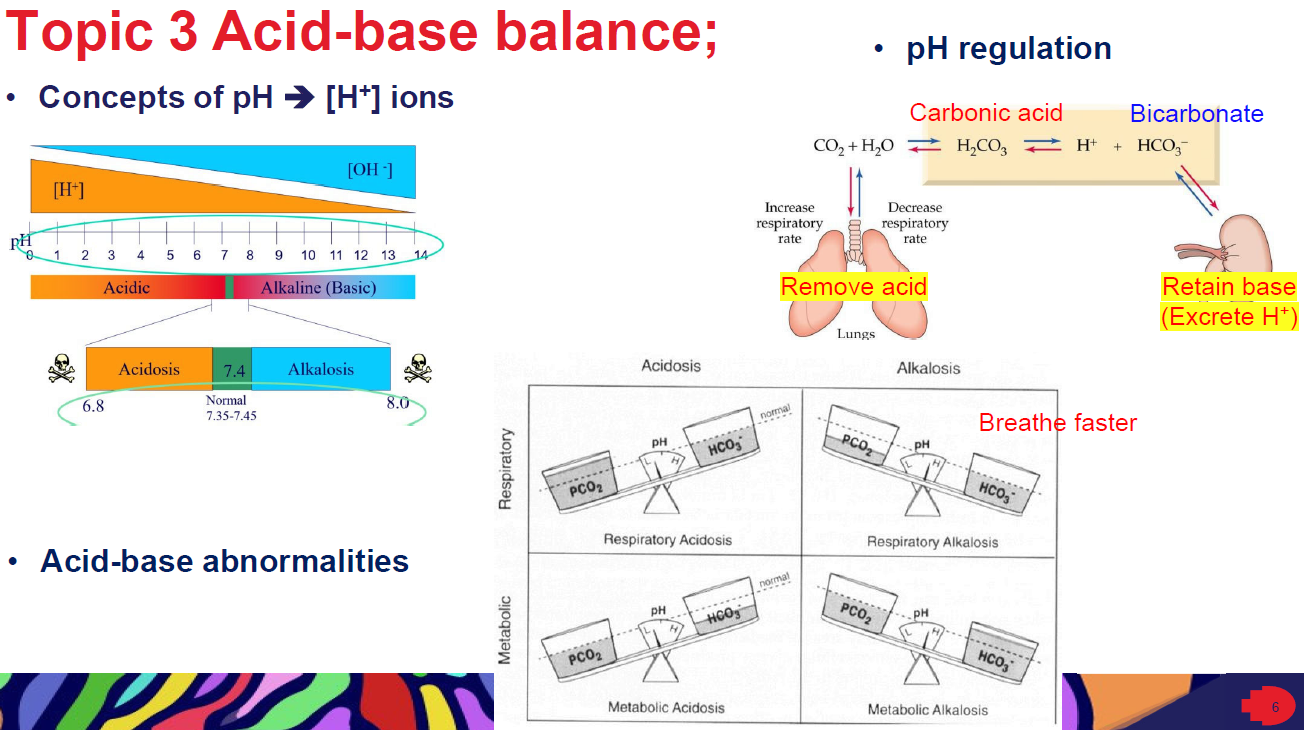
What is the key difference between respiratory & metabolic disturbances?
Respiratory: The primary change is PaCO2
Metabolic: The primary change is bicarbonate (HCO3-)
What ABG (Arterial Blood Gas) pattern suggests respiratory acidosis?
Low pH with raised PaCO2 from CO2 retention (e.g., hypoventilation/COPD (Chronic Obstructive Pulmonary Disease))
What ABG pattern suggests respiratory alkalosis?
High pH with reduced PaCO2 from excessive ventilation (e.g., anxiety-related hyperventilation)
What ABG pattern suggests metabolic acidosis?
Low pH & low HCO3-; respiratory compensation may lower PaCO2

Case: COPD, pH 7.36, PaCO2 63, HCO3- 35. Interpret
Compensated chronic respiratory acidosis: High CO2 with elevated bicarbonate & near-normal ph

Case: renal failure, pH 7.28, HCO3- 12, PaCO2 26. Interpret
Metabolic acidosis with respiratory compensation (CO2 lowered by faster/deeper breathing)
Case: panic attack, pH 7.52, PaCO2 26. Interpret
Respiratory alkalosis: hyperventilation removes CO2, raising pH

Case: persistent vomiting, pH 7.56, HCO3- 45. Interpret
Metabolic alkalosis due to loss of gastric acid; elevated PaCO2 may reflect compensation
How is anion gap (AG) calculated?
AG = (Na+ + K+) - (Cl- + HCO3-). A high AG suggests unmeasured anions/acids

Cardiac-arrest case: Na 136, K 4.5, Cl 96, HCO3- 3.8 → Calculate the anion gap (AG)
(136 + 4.5) - (96 - 3.8) = 40.7 mmol/L; very high anion gap