Physiology of Uterus and Ovaries
 Call Kai
 Learn
 Practice Test
 Spaced Repetition
 Match
 Flashcards
 Knowt Play
1/54

There's no tags or description
Looks like no tags are added yet.
55 Terms
Physiology of Vag
Receive seminal fluid
Excretory duct for menstruation
Lowest portion of birth canal
Physiology of uterus
Menstruation
Pregnancy
Labor and expulsion of fetus
Menarche
Onset of menses 11-14yrs
Thelarche
Onset of development of bre@sts
Menopause occurs between what ages
44-55 yrs
Premature menopause
<40 yrs
Precocious puberty
Uterus enlarges and ovulation occurs prior to age 8
Commonly caused by pituitary or hypothalamic tumor with abnormal pituitary gland function stimulation the production of hormones
Less common causes include ovarian tumors that secrete estrogen or can be idiopathic
Blood to endometrium in order
Internal iliac artery - Uterine artery - Arcuate artery - Radial artery - Straight and spiral arteries
Uterine artery
Courses along lateral margin between layers of broad ligament
Arcuate artery
Encircle the uterus within myometrium
Radial arteries
Penetrates the serosa and myometrium
Straight arteries
Supply deeper 1/3 of endo (basal layer), does NOT slough off with menstruation
Spiral arteries
Supply functionalis/decidual layer of endometrium and vessels are sloughed off and reformed after menses; respond to ovarian hormones
Gonadotropin releasing hormone
Secreted by hypothalamus when estrogen levels are low
Stimulates pituitary gland to produce and release luteinizing hormone and follicle stimulating hormone
Follicle stimulating hormone
Secreted by the anterior pituitary gland
Stimulates estrogen production in ovaries
Responsible for follicle and ova maturation
Luteinizing hormone
Secreted by the anterior pituitary gland
Stimulates theca cells to produce androgens that are converted into estrogen
Responsible for ovulation and corpus luteal development
Estrogen
Naturally produced steroid hormone
Responsible for development of reproductive organs and maintains their function during reproductive years
Stimulates endo to thicken
Stimulates contraction of fallopian tubes
Stimulates Cx to produces mucus prior to ovulation to assist sperm in reaching ovum
What causes development of secondary sex characteristics such as axillary and pubic hair, breast development, fat deposits on breasts thighs and buttocks
Estrogen
Progesterone
Produced by corpus luteal cells post - ovulation
Responsible for symptoms of pregnancy, and endo proliferation after ovulation to prepare for implantation
Blocks development of new follicles
Causes breasts to prepare for lactation, formation of cervical mucus plug in pregnancy (mucus dries up and Cx tightens to form plug)
Stimulates UT blood supply
Low ___________levels have been associated with pre-term delivery
Progesterone
Progesterone supplements help reduce risk of …
Premature delivery
Estradiol
Principle component of estrogen, formed by ovarian follicles, adrenal cortex, and placenta
Responsible for reproductive development and maintenance
Levels monitored to predict ovulation in patients undergoing fertility treatments
Linked to endometriosis, fibroids and carcinoma
Estriol
Component of estrogen
Only type of estrogen found in postmenopausal women
Prolactin
Produced by pituitary gland
Stimulates milk production with pregnancy
Milk production begins 2-3 days post partum
Oxytocin
Produced by pituitary gland
Causal ductal contraction with lactation
Testosterone
Produced by ovary and adrenal glands
Overproduction causes virilization
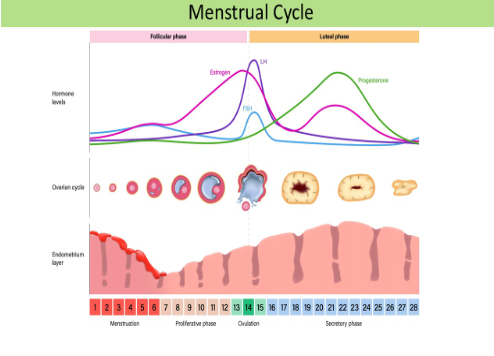
Endo Cycle: Day 1-5 Menstrual phase
At onset and during menstruation, estrogen and progesterone levels are very low, causing uterus to shed lining
<4mm endo thickness at end
Coordinates with early follicular ovarian phase
Endo Cycle: Day 6-10 Early Proliferative phase
Increasing estrogen levels cause endo proliferation
4-8mm endo thickness
Endo appears thick hyperechoic line
Coordinates with late follicular ovarian phase
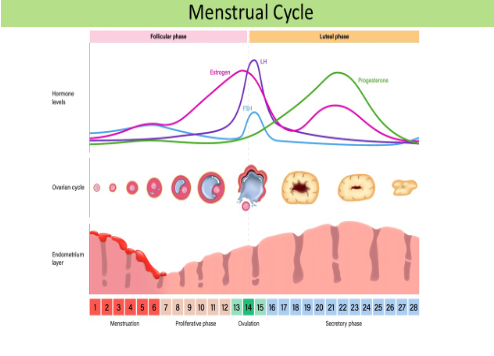
Endo Cycle: Day 11-14 Late Proliferative phase
Increasing estrogen levels continue to cause endo proliferation
<16mm endo thickness at end of late phase
Endo appears to have 3 layers (TRILAMINAR)
Outer layer is hyperechoic, middle is hypoechoic and inner layer is echogenic line
Periovulatory phase
Endo Cycle: Day 15-28 Secretory phase
Increased estrogen and progesterone levels cause a decrease in FSH and LH levels
Mucus is produced in Cx with ovulation
Endo thickens
If no fertilization occurs the corpus luteal cyst involutes causing decreased progesterone levels until Day 1 menstruation
<18mm Endo, hyperechoic
Coordinated with luteal phase
Endo is best evaluated in TA or TV
TV
Premenopausal endo thickness
<18mm
Postmeno endo thickness with estrogen HRT
<8mm
Postmeno endo thickness with estrogen and progesterone HRT
10-12mm
Postmeno symptomatic with no HRT endo thickness
<5mm
Postmeno asymptomatic with no HRT endo thickness
<8mm
Ovarian cycle: Day 1-5 early follicular phase
At onset of menstruation, estrogen and progesterone levels are very low → detected by hypothalamus
Releases GnRH
Pituitary gland senses increased GnRH and releases FSH and LH
FSH causes ovaries to increase estrogen production = follicle growth
FSH and LH stimulate production of estrogen by follicles
Multiple follicles develop by 5-7 days and dominant follicle will grow 2-3mm/day till ovulation
Correlates with the menstrual phase of endo
Ovarian cycle: Day 6-14 Late Ovarian follicular phase
Estrogen and FSH continues to rise
Dominant follicle emerges toward outer wall of OV
Two dominant follicles form dizygotic twins
Dominant follicle visible sonographically during day 8-12
Non-dominant follicles <10mm
Any follicle >15mm release egg, most dominant follicles reach size 15-25mm before ovulation
LH levels surge 24-36hrs before ovulation
Correlated with early proliferative phase of endo
Ovarian cycle: Day 15-25 Luteal phase
LH surge ceases ovulation usually on day 14
Corpus luteal cyst forms to secrete progesterone and estrogen and suppress LH production/release
If no fertilization (no bhCG), corpus luteum involutes 12-14 days after ovulation and progesterone/estrogen levels decrease
When corpus luteum involutes, it becomes corpus albicans
Correlates with the secretory phase of endo
If fertilization DOES NOT occur, increasing progesterone levels will cause a _________ in progesterone levels
Decrease
If fertilization DOES NOT occur, rising level of progesterone inhibits release of GnRH which limits ___ production and then decreases progesterone production
LH
If fertilization occurs, it occurs _____ hrs after ovulation
24-36
If fertilization occurs, first mitotic divisions occur as egg travels through the segments of the…
Fallopian tube
If fertilization occurs, by end of week 1, developing embryo becomes …
Blastocyst
If fertilization occurs, when the blastocyst implants into uterus, it consists of what two parts
Inner cell mass: becomes fetus
Trophoblast: becomes placenta
Most common cause of precocious puberty
Hypothalamic or pituitary tumor
What is sloughed off during menstruation
Functionalis layer, decidual later, spiral arteries
What is responsible for ovulation
Luteinizing hormone
What causes secondary sex characteristics
Estrogen
Levels of ________ are monitored to predict ovulation in patients undergoing fertility treatments
Estradiol
What type of estrogen found in postmenopausal women
Estrone
What is involved in breast development/lactation
Oxytocin, prolactin, progesterone
Estrogen is lowest in menstrual cycle during what phase
Menses
Non-dominant follicles are typically _____ or less in size
10mm
What produces hCG
Trophoblast