KAAP 400 - Lecture 9 & 10
 Call Kai
 Learn
 Practice Test
 Spaced Repetition
 Match
 Flashcards
 Knowt Play
1/33

There's no tags or description
Looks like no tags are added yet.
34 Terms
What are the three main research approaches?
Quantitative: Numbers and statistics; focuses on objective patterns.
Qualitative: Meanings and experiences; provides open-ended depth.
Mixed Methods: Combines breadth and depth by using both quantitative and qualitative approaches.
What are examples of quantitative, qualitative, and observational data in research?
Quantitative: Speed, stride frequency, heart rate, and force output.
Qualitative: Motivation, mood, focus, and nutrition choices.
Observational: Technique during the start and finish.
What can studying Usain Bolt teach researchers?
Studying Bolt shows the importance of precise measurement, observational data, individual differences, and context. Small measurement errors can affect conclusions, numbers alone do not tell the whole story, individual performance may not generalize to everyone, and factors like track conditions must be considered
What is a case study, and what did researchers learn from studying Albert Einstein’s brain?
A case study provides an in-depth analysis of a unique or extreme case and can help generate hypotheses and reveal mechanisms that may be hidden in larger studies. Einstein’s brain was average in size and weight, suggesting that structural organization may matter more than size. Researchers reported larger parietal lobes, complex prefrontal folding, and differences in glial cells per neuron.
How do case studies differ from typical quantitative and qualitative studies?
Quantitative and qualitative studies typically examine groups of participants to identify patterns across multiple people. Case studies/single-subject designs focus on one individual, team, or very small group in depth, aiming for rich, contextual understanding rather than broad generalization.
What is historical research, and what is its purpose?
Historical research examines past events, people, ideas, or practices using sources such as books, journals, newspapers, letters, photographs, government records, and oral histories. Researchers evaluate source credibility, compare changes across time, and examine factors that influenced those changes. Its purpose is to understand how and why something changed over time.
What is a photo diary, and what is it used for in research?
A photo diary is a method where participants document daily experiences, behaviors, or training using photos, videos, or digital logs, often with short descriptions or reflections. Researchers analyze these to identify patterns, motivations, barriers, and context, providing a real-world view of daily experiences.
What is the SHOWED mnemonic used for in Photovoice research?
SHOWED is a structured method for participants to analyze and discuss their photographs:
S = What do you See here?
H = What is Happening here?
O = How does this relate to Our lives?
W = Why does this situation exist?
E = How can this Educate?
D = What can be Done about it?
What did the Photovoice study of health professionals during COVID-19 reveal?
Health professionals documented their experiences through photos and interviews. They faced high risk but felt a strong responsibility to their community. They coped through humor, leisure, and support from the public.
What are the 6 alternative research approaches?

What did Étienne-Jules Marey’s “Falling Cat” study demonstrate?
In 1894, Marey used photographs and film at 12 frames per second to study a cat’s righting reflex. The images showed that cats can turn in mid-air and land on their feet without pushing off a surface, using rotational motion and body contortion.
What type of study was Marey’s “Falling Cat” study?
Marey’s study shows research design in action:
Research Question: How do cats right themselves?
Observation Plan: High-speed photos
Data Collection and Analysis: Examining frame-by-frame rotation of the body
Controls/Consistency of Methods: Repeated falls, same experimental set up
Replicable Results: Other scientists could use the methodology to verify the results
Observational Study. Marey observed cats’ righting behavior using high-speed photographs, analyzed the movement frame-by-frame, used repeated falls with consistent methods, and created a procedure that other scientists could replicate.
What is research design, and why is it important?
Research design is the overall strategy or blueprint that guides a study. It determines how data is collected, measured, and analyzed to ensure findings are valid, reliable, and meaningful. A poorly designed study can produce unreliable or invalid results, so when reading research, look for confounding factors that could affect the results.
What did Aristotle contribute to the history of research design?
Aristotle classified plants, animals, and human behaviors to identify patterns and underlying principles. He helped lay the foundation for modern scientific inquiry through critical thinking, careful documentation, and logical reasoning, although his early research was observational and not systematic.
What did Alhazen (Ibn al-Haytham) contribute to research design and science?
Alhazen, known as the “father of modern optics,” developed rigorous experimental methods using observation, hypotheses, experimentation, and independent verification. He demonstrated that light travels in straight lines and explained image inversion using the camera obscura.
How did James Lind’s scurvy study contribute to the history of research design?
James Lind conducted one of the first controlled medical experiments. He divided 12 sailors with scurvy into 6 pairs, giving each pair a different dietary supplement. Only the sailors who received oranges and lemons improved rapidly. Modern research confirmed that scurvy results from vitamin C deficiency.
What are the main components of research design?
The main components are:
Variables: Identify the independent and dependent variables and control confounders.
Procedure: Define steps for manipulating the IV and keeping methods consistent.
Data Collection & Analysis: Plan who, what, when, and how data will be collected and analyzed.
Documentation: Record methods, results, and analysis to ensure transparency and reproducibility.
Why can’t you simply test the 20 children with obesity at one clinic when studying whether a GLP-1 agonist improves weight loss in children aged 10–14?
Because a sample from one clinic may not represent the broader population. The sample could be small, specific, or biased, limiting how well the findings can be generalized to other children aged 10–14 with obesity.
What is the difference between a population and a sample in research?
The population (N) is the entire group the researcher is interested in studying. The sample (n) is a smaller subset selected from the population that actually participates in the study. Researchers use sample findings to draw conclusions about the larger population.
Why do researchers use samples instead of studying an entire population?
Researchers use a representative sample because studying an entire population can be impractical due to time, cost, and logistical constraints. Ideally, random sampling gives each population member an equal chance of being selected, helping reduce selection bias and improve generalizability.
Why does sample size matter in research?
A larger sample generally produces more reliable and representative results, reduces the influence of random variability, and is more likely to detect meaningful effects or relationships.
Why shouldn’t researchers simply collect as much data as possible?
A sample that is too small may miss a real effect, while a sample that is too large wastes time, money, and participants. Researchers use sample size calculations to determine the optimal number of participants needed to answer the research question while using resources responsibly.
When is it appropriate to collect data from an entire population instead of a sample?
Using the entire population is appropriate when the population is small or accessible, a census is needed, or the population has unique or rare characteristics that require studying everyone. Example: researching a rare disease such as Auto-Brewery Syndrome.
What is participant recruitment, and why are inclusion and exclusion criteria important?
Participant recruitment is the process of identifying, approaching, and enrolling people who meet the study’s eligibility criteria. Effective recruitment helps achieve the needed sample size, reduce selection bias, and improve validity and generalizability. Inclusion criteria describe who can participate, while exclusion criteria describe characteristics that prevent participation.
What are common participant recruitment strategies in research?
Common strategies include advertisements (flyers, websites, social media), clinical recruitment, email lists or participant registries, community outreach, and snowball sampling where participants refer others. The strategy depends on the target population and study design.
What are the four main probability sampling methods?
Simple random: Everyone has an equal chance of selection.
Stratified: Divide the population into subgroups and randomly select from each.
Cluster: Randomly select groups and study everyone within those groups.
Systematic: Select every nth person from a list.
Key idea: Probability sampling gives population members a known chance of being selected, helping create more representative samples.

What are the three main non-probability sampling methods?
Convenience sampling: Select participants who are easy to access.
Quota sampling: Recruit participants until specific group quotas are met.
Snowball sampling: Current participants refer or recruit other participants, often for hard-to-reach populations.
Key idea: Non-probability sampling is non-random, so not everyone has a known chance of being selected.
What is participant retention, and why are sample size, significance level, and power important?
Participant retention is keeping participants involved until a study is completed. Researchers can improve retention through regular communication, reminders, incentives, convenient procedures, and building trust.
Sample size determines how many participants are needed to reliably detect an effect. Too small = may miss a real effect; too large = wastes resources. Significance level (α) is the risk of a Type I error (false positive), while power (1−β) is the probability of detecting a true effect. Higher power reduces the risk of a Type II error (false negative) and generally requires a larger sample
What factors influence the sample size needed for a study?
Four main factors influence sample size:
Effect size: Smaller effects require more participants.
Statistical power: Higher power requires more participants.
Significance level (α): A lower α requires more participants.
Variability: More variability in the data requires more participants.
Main idea: Smaller effects, higher power, stricter significance levels, and greater variability generally mean larger sample sizes.
What are the steps for estimating sample size?
Define the research question.
Choose α (commonly 0.05).
Choose power (1−β) (commonly 0.80).
Estimate the effect size (small, medium, or large).
Estimate variability (standard deviation).
Use a formula or software such as G*Power to calculate the required sample size (n).
The calculation must match the planned statistical test, outcome type, and study design. For example, a t-test examines differences in means, while chi-square examines differences in proportions.
Which variables should be included in a sample size calculation?
The sample size should be based primarily on the study’s primary outcome variable. Important secondary outcomes should also have enough participants for adequate analysis. For example, if testing whether a drug reduces blood pressure, calculate the sample size using the expected change and variability in systolic blood pressure, not secondary outcomes like heart rate.
What is the purpose of a pilot study, and how does it help with power analysis?
A pilot study is a small preliminary study conducted before the main study. It tests the feasibility of recruitment, procedures, and measurements, provides preliminary data on variability and effect size, and helps refine methods. This data can improve power and sample size calculations for the full study.
What are the three core principles of a strong experiment?
Randomization, manipulation, and control. Together, they help make research results trustworthy and meaningful.
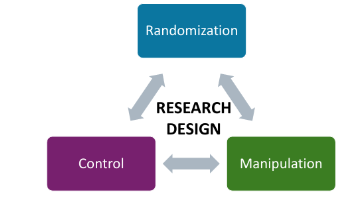
What are randomization, manipulation, and control in research design?
Randomization: Randomly assigns participants to conditions so groups are comparable and confounding variables are distributed evenly.
Manipulation: The researcher deliberately changes the independent variable (IV) to observe its effect on the dependent variable (DV) and test cause-and-effect.
Control: Researchers limit extraneous variables through control groups, standardized procedures, or holding variables constant so changes can be attributed to the IV.