concepts-- quiz 3 and 4 + everything you need afterward
 Call Kai
 Learn
 Practice Test
 Spaced Repetition
 Match
 Flashcards
 Knowt Play
1/128

There's no tags or description
Looks like no tags are added yet.
129 Terms
What is the central question of life-history theory?
Life-history theory asks how natural selection shapes the allocation of limited energy among growth, reproduction, offspring care, maintenance, and survival.
Different allocations produce different combinations of maturation rate, fertility, mortality, and life span.
What is the difference between a proximate and an ultimate explanation?
A proximate explanation asks how a trait works through immediate mechanisms
An ultimate explanation asks why that trait was favored evolutionarily
For example: Seasonal mating, where changing weather or day length triggers hormones, is proximate, while timing births to abundant food and improved offspring survival is ultimate. Both explanations can be true.

What does the graph show about body size, life span, and primates?
Larger animals generally live longer, but body mass does not explain everything.
At comparable body sizes, primates tend to live longer than many other mammals.
Primates generally grow for a longer period, mature later, reproduce slowly, and invest heavily in fewer offspring.
Why do fast and slow life-history traits occur in predictable bundles?
Early reproduction commonly accompanies small bodies and brains, short gestation, large litters, high mortality, and short life.
Late reproduction commonly accompanies large bodies and brains, long gestation, small litters, lower mortality, long life, and an extended juvenile period.
Limited energy and shared developmental constraints connect these traits.

What should you conclude from the baboon life table and survivorship graph?
Mortality is highest during infancy, so surviving the first months or year greatly improves the probability of continued survival.
The survivorship graph also shows lower male survival than female survival.
Male competition, risky behavior, and dispersal may contribute, although the graph shows the pattern rather than proving one cause.
These survivorship patterns are common among primates, but mortality rates and sex differences vary by species.
Why do humans and other primates commonly show a U-shaped mortality pattern?
Mortality is high during infancy because young individuals are vulnerable, falls during later childhood and adulthood, and rises again as aging reduces bodily function.
Environment, disease, violence, and nutrition change the height of the curve, but the general age-related pattern occurs across human populations and other primates.
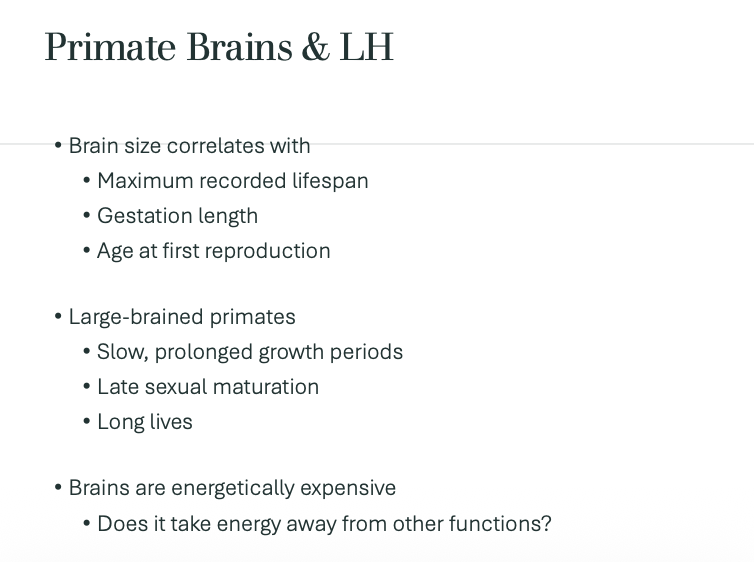
Why are large brains associated with slow life histories?
Larger-brained primates tend to have longer gestation, later first reproduction, prolonged growth, and longer lives.
Large brains develop slowly, require extended learning and parental care, and consume substantial energy, so they are difficult to combine with rapid reproduction.

How could a primate support a larger brain, and what trade-off do the graphs propose?
A species could obtain a larger brain by evolving a larger overall body and energy budget or by reallocating energy among tissues.
The expensive-tissue hypothesis proposes that greater brain investment may be offset by reduced investment in the gut or other costly tissues.
It is an evolutionary energy-allocation trade-off, not an individual’s brain physically shrinking its organs.
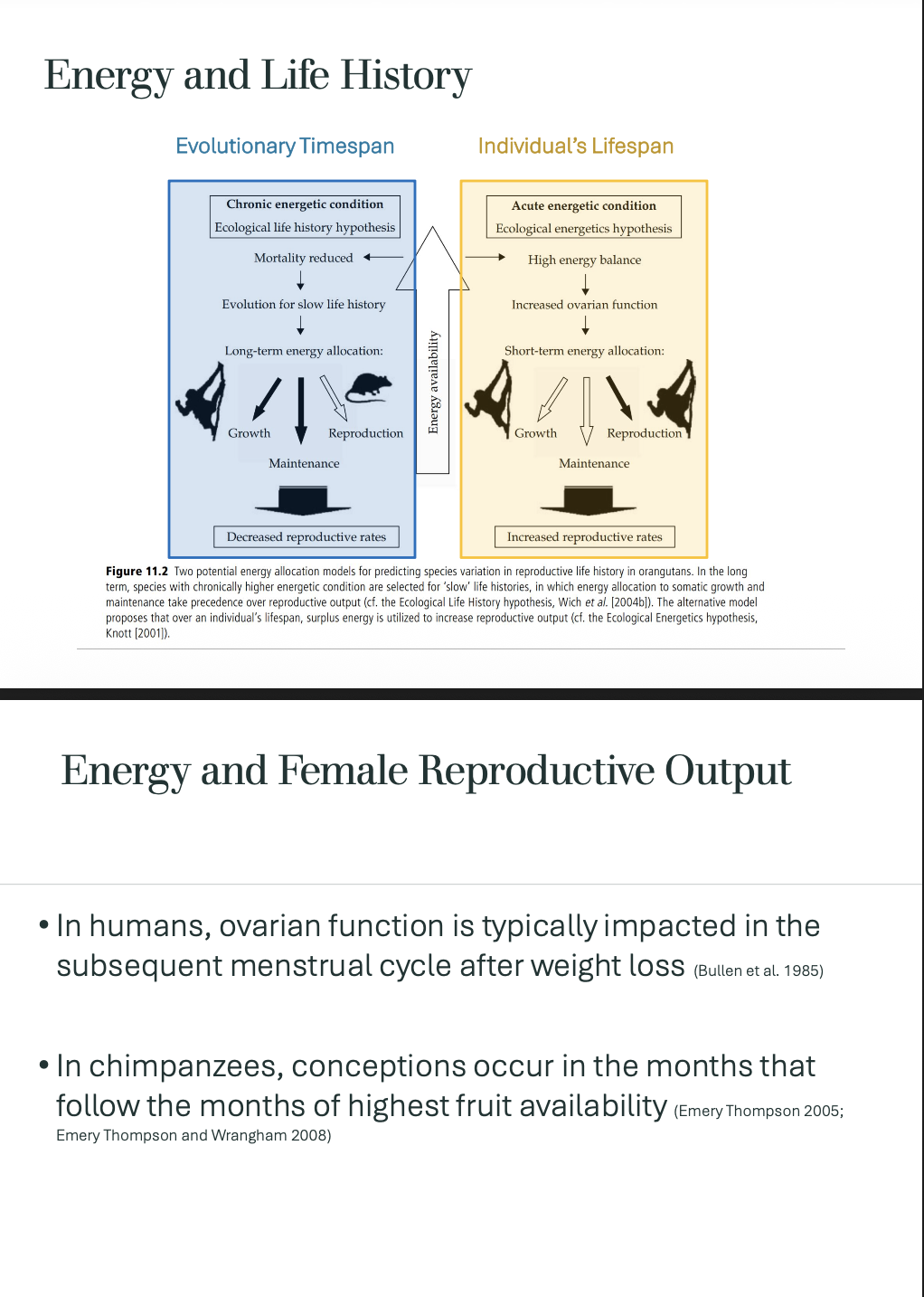
How does energy availability affect life history at evolutionary and individual timescales?
Across generations, consistently lower mortality can favor a slower life history with greater investment in growth and maintenance.
Within an individual’s life, periods of high energy availability can increase reproductive investment.
Human ovarian function may decline following weight loss, while chimpanzee conceptions commonly follow periods of high fruit availability.

Why do orangutans have the longest interbirth interval among the apes?
Orangutan intervals are approximately 6–9 years, compared with about 6 years for chimpanzees, 5 for bonobos, and 4 for mountain gorillas.
Orangutan mothers provide prolonged care to slowly developing offspring while coping with highly variable food and energy availability, making frequent reproduction difficult.
Why can humans have shorter interbirth intervals than orangutans despite having extremely dependent offspring?
Human mothers can receive food, childcare, and protection from fathers, relatives, and other group members.
Food sharing, technology, and environmental buffering allow humans to support multiple dependent children simultaneously.
“Humans control their environment” is therefore a simplified description of a broader cooperative system.
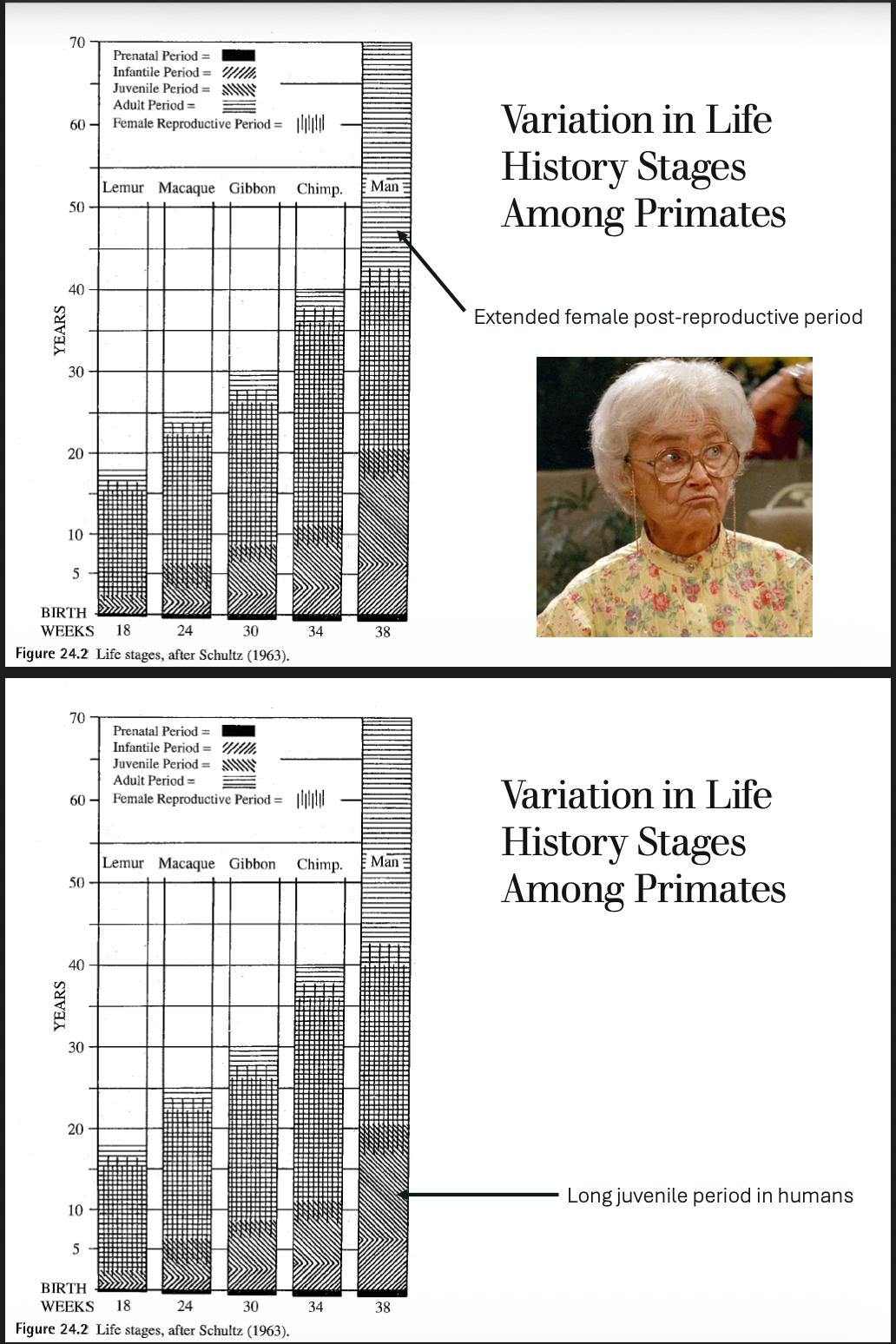
What makes the human life history unusual compared with those of other primates?
Humans combine a very long juvenile learning period, large brains, delayed maturity, long life, and an extended female postreproductive period.
Long human life is not merely a result of modern medicine; survival into the sixth decade occurred long before industrialization.
Why do humans and chimpanzees show similar reproductive senescence but different postreproductive life spans?
Female fertility declines substantially around age 50 in both species, suggesting a reproductive-aging pattern inherited from a shared ancestor.
Humans, however, commonly survive for decades afterward, whereas fewer wild chimpanzees reach or live far beyond that age.
Older humans may continue contributing through knowledge, food production, childcare, and support of descendants.
Why has natural selection not eliminated aging?
Natural selection becomes weaker after the ages when reproduction is most likely.
Antagonistic pleiotropy permits traits that improve early-life fitness despite later costs, while the disposable-soma hypothesis predicts that energy invested in reproduction cannot simultaneously be maximized for lifelong bodily repair.
How does reproductive effort create different costs for females and males?
Female effort includes pregnancy, fetal growth, lactation, and childcare.
Male effort can include competition, mate guarding, sexually dimorphic tissue, and parental care.
Female reproduction is often more energetically constrained, but both sexes face trade-offs between reproduction, maintenance, and survival.
Why do sifakas, lemurs, and some chimpanzee populations complicate simple predictions about life span?
Sifakas and lemurs live unusually long for their body size and may postpone reproduction during unfavorable conditions—a bet-hedging strategy.
Ngogo chimpanzees can survive nearly as well as some human forager populations because favorable local ecology reduces mortality.
These cases show that body size and species identity do not determine life span by themselves; environmental conditions also matter.
Why is menopause a significant life-history question?
Menopause is important because it separates reproductive lifespan from total lifespan: females stop reproducing but may continue living for many years.
Why is menopause an evolutionary puzzle?
Evolutionary fitness normally increases when individuals pass more genes to future generations, so lifelong reproduction might appear advantageous.
Menopause requires an explanation for why stopping reproduction—or living long after reproduction—could still improve genetic success, or why the pattern might occur without being adaptive.
What does the Grandmother Hypothesis propose?
Later in life, a female may gain more inclusive-fitness benefits by helping related younger females reproduce successfully than by producing another child herself.
Grandmother assistance can improve grandchildren’s survival and allow daughters or nieces to reproduce again sooner.
What evidence from the Hadza supports the Grandmother Hypothesis?
Young Hadza children could not gather enough tubers to meet their nutritional needs.
After a mother had another infant, the weight of her weaned children was associated with how much food their grandmother collected, showing how grandmothers could improve descendants’ survival.
How does the discussion point about inexperienced mothers relate to the Grandmother Hypothesis?
The discussion suggested that children of first-time mothers may have lower survival, so assistance from an experienced grandmother could be especially valuable.
This supports the general logic of grandmother help,
How does the Mother Hypothesis differ from the Grandmother Hypothesis?
The Mother Hypothesis says that dangerous late-life pregnancies may threaten both a mother and her already-dependent children, so stopping reproduction and caring for existing offspring can be advantageous.
The Grandmother Hypothesis focuses on helping grandchildren and other younger relatives reproduce.
How does the benefit-versus-cost idea explain the Grandmother Hypothesis?
benefit = reproductive succes, fitness, faster development
cost = time
Why do social structure and dispersal matter when evaluating menopause hypotheses?
Helping behavior produces inclusive-fitness benefits only when older females live near genetic relatives.
Dispersal determines who leaves or joins a group and therefore whether an older female becomes more or less related to the individuals around her.
What does the Reproductive Conflict Hypothesis propose?
When older and younger females compete for food and reproductive opportunities, older females may benefit by stopping reproduction and avoiding the costs of competition.
If the younger females reproduce with the older females’ sons, the older females can still receive inclusive-fitness benefits.
Why can the Reproductive Conflict Hypothesis fit chimpanzees better than the Grandmother Hypothesis?
Female chimpanzees usually disperse at puberty and initially join unrelated groups, but they become more genetically connected to the group as they age and their sons reproduce.
Older females may therefore benefit from reducing reproductive competition even if they do not directly help particular grandchildren.
Why do the two main adaptive hypotheses fit mountain gorillas poorly?
Both male and female gorillas can disperse repeatedly, and females generally do not continue living with their adult sons or daughters.
Older females therefore may not become increasingly related to their group, leaving little opportunity for either grandmother assistance or reproductive-conflict benefits.
What is the nonadaptive explanation for postreproductive life in gorillas?
Historically, most gorillas may have died from disease, predation, or other causes before reaching ovarian exhaustion.
Under safer or protected conditions, some now survive beyond the biological end of reproduction, revealing a postreproductive period that was not originally selected because of a fitness benefit.
How can both the Grandmother and Reproductive Conflict Hypotheses help explain menopause in toothed whales?
Both hypotheses explain different aspects of menopause in toothed whales:
Reproductive Conflict Hypothesis: Explains why older females stop reproducing.
Grandmother Hypothesis: Explains the evolutionary benefits of surviving after reproduction to help descendants.
What is the reading’s best overall answer to “Why did menopause evolve?”
There is probably no single universal cause. Menopause may be multifactorial:
maternal care, grandmother assistance, reproductive conflict, social structure, dispersal, reduced mortality, and nonadaptive survival may matter differently across species.
It may also have evolved independently more than once.
How do researchers distinguish menopause from a temporary absence of births?
Demographic data reveal long postreproductive periods, but hormone measurements provide stronger evidence that ovulation has actually ceased.
In mountain gorillas, long gaps without births strongly suggest menopause, while repeated measurements of progesterone and estradiol would help confirm it.
How do the readings on how habitat and resource availability influence primate behavior connect to the data-collection lecture?
The readings propose that habitat and resource conditions influence primate diet, movement, ranging, activity, social behavior, and life history.
The lecture explains how researchers turn these proposed relationships into testable hypotheses by defining measurable variables and selecting appropriate behavioral and ecological methods.
⬆ This allows researchers to test environmental explanations rather than merely assume that two observed patterns are connected.
How can multiple primate species occupy different niches in the same forest, and what are the effects? Start by explaining what a niche is
A niche is a species’ particular way of using space, time, and resources.
Forest levels differ in food, branch structure, light, temperature, humidity, and predator exposure, so species can specialize in different canopy levels, substrates, diets, or activity periods.
This resource partitioning reduces direct competition and allows multiple species to live sympatrically, meaning in the same geographic area.
How have plants, primates, predators, and prey influenced one another’s evolution?
Plants evolved colorful, nutritious fruits that attract seed dispersers, but also spines, toxins, fiber, and hard coverings that protect leaves and seeds.
Primates evolved sensory, dental, digestive, and foraging adaptations to locate foods and overcome these defenses.
Predators selected for vigilance, grouping, alarm calls, and safer sleeping sites, while different prey types favored specialized hunting and extractive-foraging behaviors.
How does food distribution influence primate ranging and group size?
Food varies in density, patch size, predictability, and seasonal availability.
Evenly distributed foods such as leaves often permit shorter day ranges and smaller home ranges, whereas scattered or seasonal fruits require more travel and spatial knowledge.
Small patches cannot feed many individuals, while large rich patches can support larger groups and may be worth defending.
Why can a fallback food be more evolutionarily important than the food eaten most often?
A fallback food sustains primates when preferred foods are scarce, so it can determine survival during the most limiting season.
Natural selection may (but not always) therefore favor teeth, digestive systems, locomotion, or foraging skills that help primates exploit fallback foods.
A food’s importance consequently depends on when it is needed, not simply how frequently it is eaten.
What are the tradeoffs among diurnal, nocturnal, and cathemeral activity?
Diurnal primates benefit from better visual foraging and communication but may face greater heat, competition, and visibility to predators.
Nocturnal primates gain concealment, reduced heat stress, and sometimes reduced competition, but restricted vision makes feeding and visual communication harder, increasing reliance on smell and sound.
Cathemeral primates are active during both day and night, allowing them to shift their schedules as food, temperature, or seasonal conditions change, but they face exposure to both diurnal and nocturnal predators, changing visibility conditions, and potential competition with both daytime and nighttime species.
How are locomotion and posture connected to habitat and feeding?
Different substrates favor different movements:
Leaping allows primates to cross gaps between disconnected branches to reach food or escape predators.
Quadrupedalism allows primates to travel efficiently on four limbs across continuous branches or the ground while searching for food.
Suspension allows primates to access food on smaller branches by hanging beneath them, rather than simply distributing body weight.
Posture is equally important because a primate may need to cling vertically, balance, or hang below a branch to reach food.
Together, locomotion and posture form positional behavior, and feeding posture can influence anatomy as strongly as travel does.
Why can't social organization, social structure, and mating system be inferred from one another, and what evidence must researchers collect to accurately determine each?
Social organization describes group composition
Social structure describes relationships such as grooming or dominance
and the mating system describes actual reproduction.
These dimensions can vary independently:
a pair-living group may include mating outside the pair, while two one-male groups may contain very different kinship and female relationships.
Researchers therefore need behavioral and genetic evidence rather than relying only on the number of males and females observed.
What are the major benefits and costs of group living?
Benefits include:
detecting or mobbing predators
sharing information
defending food
gaining access to mates
and receiving help with offspring.
Costs include:
greater visibility and increased competition for food and mates
and care.
What is food patchiness, and how does it create a tradeoff in primate group size?
Larger groups can detect predators, share information, and displace smaller groups from valuable food patches.
However, more group members also create greater within-group feeding competition and may exhaust patches faster.
Group size therefore reflects a compromise between being large enough to gain social and defensive advantages but small enough for available patches to support everyone.
Why do male and female reproductive strategies often differ?
Female primates must invest substantial time and energy in pregnancy, lactation, and infant care, so their reproductive success is often limited by food, time, and offspring survival.
Males make a smaller required initial investment and are often more limited by access to fertile females, producing stronger competition, mate guarding, and sometimes sexual dimorphism.
These are general tendencies rather than fixed rules because paternity certainty, male care, ecology, and social relationships can change the benefits of each strategy.
How do primate life histories generally differ from those of similarly sized mammals and why?
Primates generally grow more slowly, mature later, produce smaller litters, care for offspring longer, and have longer adult lifespans than similarly sized mammals.
Even after accounting for body size, they allocate relatively little daily energy to growth and reproduction.
Possible explanations include the energetic cost of large brains, long learning periods, low mortality, and a broader strategy of relatively low energy expenditure.
Why are sympatric-species comparisons valuable to primatologists?
Sympatric species live in the same geographic area and therefore experience many of the same climatic conditions, plants, predators, and competitors.
This functions like a partial natural experiment, helping researchers relate differences in diet, locomotion, or social organization to different ecological strategies.
Researchers must still consider phylogeny and microhabitat because sympatric species do not experience completely identical conditions.
How should behavioral states and events be measured differently?
States last for measurable periods, so they are best represented by total or average duration or by the proportion of observation time spent in the behavior.
Events are brief, countable actions and are therefore best measured by frequency or rate per unit time.
Using the wrong measurement can distort conclusions—for example, counting feeding bouts does not reveal how long an animal actually spent feeding.
How do researchers choose sampling and recording rules?
The research question first determines the sampling rule—who or what is watched and when:
Focal sampling provides detailed data of a individual
scan sampling produces group snapshots
and all-occurrence sampling follows one behavior across the group
Researchers then choose a recording rule:
continuous recording preserves the most detail
while instantaneous and one-zero sampling reduce recording demands but sacrifice information about exact timing, frequency, or duration.
How do ad libitum sampling, all-occurrence sampling, and an ethogram affect data quality?
Ad libitum sampling can reveal rare or unexpected behavior, but it is biased toward noticeable individuals and dramatic events, making precise rates unreliable.
All-occurrence sampling is more systematic because it records every observed instance of one behavior, but that behavior must be obvious and not so frequent that occurrences are missed.
An ethogram improves consistency by giving each behavior an operational definition—a description precise enough for different observers to identify and record it in the same way.
How can behavioral and ecological methods be combined in a primate study, and what ecological data collection tools and methods are used to acomplish this combination?
Behavioral methods measure feeding, traveling, resting, communication, and social interaction, while ecological methods measure the conditions that might explain those behaviors.
Researchers can compare feeding with fruit or young-leaf abundance, ranging with resource distribution, or activity with temperature and rainfall.
Together, they can give you a full picture to why they have their adpatations and theiur behaviors
Transects, camera traps, DBH, tree height, crown estimates, quadrats, compasses, and stride measurements supply environmental context, allowing researchers to test whether behavioral changes correspond with ecological changes.
Why can predation strongly influence primate evolution even when successful attacks are rarely observed?
Natural selection responds to the fitness consequences of being killed, not merely how often researchers witness kills.
Even infrequent attacks can favor vigilance, alarm calling, group living, habitat avoidance, and camouflage when failure has severe consequences.
What determines a primate’s vulnerability to predation?
Vulnerability depends on body size, age, health, sex, rank, position in the group, habitat, locomotion, and predator type.
Smaller, young, injured, isolated, or exposed individuals are often easier targets, but the highest-risk category changes with the predator’s hunting method.
Why is primate predation difficult to study, and how do experimental predator cues help?
Attacks are rare, sample sizes accumulate over years, observers may deter predators, and dense habitats conceal events.
Researchers therefore use predator calls, models, or playbacks to manipulate threat conditions, although these provide controlled evidence about responses rather than direct measurements of natural kill rates.
How should primate antipredator behavior be organized using detection, protection, and evasion?
Detection includes vigilance and alarm calls
Protection includes group living, mobbing, and mixed-species associations
Evasion includes habitat avoidance, crypsis, and altered activity
One behavior may serve multiple functions—for example, an alarm call can detect and communicate danger while also telling the predator it has been seen.
What tradeoff does vigilance create, and why is vigilance unequal within a group?
Time spent scanning cannot simultaneously be used for feeding, resting, or social interaction.
Individuals therefore watch for different amounts of time depending on their vulnerability, nutritional needs, rank, sex, group position, and the benefits they receive from protecting relatives or offspring.
What are the benefits and costs of alarm calling, and why might an individual produce a false alarm?
Alarm calls can protect relatives and group members, improving the survival of individuals who share the caller’s genes
But calling may reveal the caller’s location or consume time and energy.
False alarms may be favored when they help the caller obtain food or another benefit, but repeated deception can make receivers less responsive.
What do the guerezas alarm-call cases demonstrate?
Guerezas produce different alarm-call patterns in response to threats such as leopards and eagles, and listeners adjust their behavior accordingly.
This supports functionally referential communication: the calls convey useful information about predator type without proving human-like language or intentional naming.
How can group living reduce predation risk, and what does the simplified “one-in-ten” dilution example leave out?
Groups can provide more eyes for detection, coordinated defense, and dilution of individual risk.
However, risk is not divided equally because peripheral, young, low-ranking, conspicuous, or unhealthy individuals may be targeted more often, and larger groups also create feeding competition and greater visibility.
More males may improve defense in some species, but they may also increase competition.
What did the Gombe red-colobus case demonstrate about predation?
Red-colobus groups living in the core of chimpanzee hunting areas were substantially smaller than groups on the periphery.
This suggests that repeated chimpanzee predation can change prey-group size and composition, making predation an ecological force rather than merely an isolated event.
What does the capuchin rescue from a boa constrictor show about mobbing and cooperation?
Several capuchins physically attacked the boa and pulled the juvenile free, while other group members vocalized nearby.
Across the reported constrictor encounters, successful rescues generally involved multiple animals physically attacking, suggesting that coordinated action can be more effective than alarm calling alone.
The incident also shows that cooperation cannot always be explained only by close kinship.
Where do mixed-species associations fit in the detection–protection–evasion mental model?
They primarily provide protection through improved detection: different species contribute additional observers and may recognize one another’s alarm calls.
They can also impose feeding competition, and their value depends on whether the species face similar predators and whether their detection abilities complement one another.
How can altered habitat use and nocturnal behavior function as evasion strategies?
Primates may avoid locations where predators hunt or accept poorer food in safer areas, creating a food–safety tradeoff.
Some nocturnal primates forage alone and depend on concealment and reduced detection rather than large-group defense, showing that antipredator strategies depend on ecology and activity pattern.
Why must camouflage be evaluated from the predator’s visual perspective?
A color that appears conspicuous to humans may blend into the habitat for a predator with different color vision, visual acuity, or viewing conditions.
Effective crypsis depends on the interaction among the primate’s coloration, its background, lighting, posture, and the sensory system of the predator.
How is countershading expected to reduce detection, and when should it work best?
Overhead light normally makes an animal’s upper surface brighter and its underside darker, emphasizing its three-dimensional shape.
A dark back and light underside can counteract this gradient and visually flatten the body, especially when the animal is horizontal and viewed from the side.
What did Kamilar and Bradley find about countershading across primates?
Their comparison of 113 species found stronger countershading in smaller and more horizontally postured primates.
Frequent vertical postures predicted weaker or absent countershading because the dark-back/light-belly arrangement is less effective when the body is upright.
Group size was not a strong predictor, showing that posture and body size explained more than sociality.
What did Murphy and colleagues show about blue-monkey alarm calls?
Males generally produced hacks to eagle cues and pyows to leopard cues, while distance and elevation changed the number, timing, and sequencing of calls.
Males sometimes called less when danger was greater, which may reduce exposure.
Thus, call type conveyed predator class while call sequences supplied additional information about threat context, without proving conscious intention.
Why are humans an especially consequential primate predator?
Technology and coordinated hunting allow humans to kill primates faster than populations can reproduce, making hunting unsustainable.
Human predation can cause population bottlenecks, local extinction, and broader ecosystem effects, while bushmeat hunting also creates risks of disease transmission between humans and wildlife.
Why is nutritional ecology important for understanding primate behavior?
Primates need energy for basal metabolism, thermogenesis, growth, and reproduction, so energetic requirements constrain what they can eat and how they must obtain food.
Food quality and distribution therefore help explain feeding anatomy, foraging behavior, daily activity budgets, ranging, population density, and some social behavior.
How does body size affect primate energetic requirements and diet?
Large animals require more total energy, but small animals require more energy per unit body mass.
Under the Jarman-Bell principle, small primates generally need rarer, higher-quality foods such as insects, whereas large primates can obtain enough energy from abundant, lower-quality foods such as leaves.
Frugivores span many sizes(implying other vores usually dont): smaller frugivores tend to supplement fruit with insects, while larger frugivores tend to supplement it with leaves.

How do the six major primate dietary categories differ?
Frugivores rely heavily on fruit
folivores on leaves
insectivores on insects
gummivores on gums or other plant exudates
granivores on grains or seeds
and faunivores on animal prey
These categories describe dietary emphasis rather than perfectly exclusive diets, because most primates combine multiple foods and nearly all obtain most of their energy from plants. Insectivory is one form of faunivory.
How do fruit-based and leaf-based diets produce different ecological strategies (also, which vores are fruit-based and leaf-based)?
Ripe fruit is high quality and readily digested but patchy and competitive, so frugivores generally have longer day ranges, larger home ranges, and lower population densities.
They favor faster gut passage, which is less efficient and requires them to eat more relative to folivores.
Leaves are lower quality and require more processing but are broadly distributed, so folivores can generally have shorter day ranges, smaller home ranges, and higher population densities
Their nutritional limit is extracting nutrients from acquired leaves rather than finding enough leaves.
How can teeth be used to predict a primate’s diet?
Frugivores tend to have broad incisors for biting fruit and rounded molars
Folivores tend to have small incisors and molars with shearing crests for cutting leaves
Insectivores tend to have sharp cusps for puncturing exoskeletons
Gummivores tend to have stout or chisel-like incisors for gouging bark.
These are functional tendencies, not absolute rules.


How can skull and gut anatomy be used to predict a primate’s diet?
Folivores tend to have more robust chewing anatomy and fermentation structures such as a multi-chambered stomach, enlarged caecum, or enlarged colon.
Frugivores tend to emphasize a long small intestine for absorbing readily available nutrients.
Insectivores have short, simple guts because animal tissue is relatively easy to digest
While gummivores often have an enlarged caecum for fermenting complex plant exudates.

Why are cheek pouches useful to many fruit-eating cercopithecines?
Fruit occurs in patchy and competitive feeding sites.
Cheek pouches allow a monkey to collect food quickly, store it temporarily, move away from competitors, and process or eat it later.
What is a microbiome, where can microbiomes occur, and what can they contain?
A microbiome is a community of microscopic organisms within a particular environment.
Microbiomes occur in soil, water, and animal or plant tissues exposed to the external environment, including the skin, mouth, nose, genitals, and gastrointestinal tract.
Bacteria are nucleus-free cells and usually dominate the community
Archaea are also nucleus-free but lack peptidoglycan cell walls
Fungi include heterotrophs such as yeast
Protists are diverse unicellular eukaryotes
Viruses are infectious capsules of RNA or DNA.
How are microbial communities assembled, and why do priority effects matter?
Community assembly depends on microbial dispersal, local adaptation or diversification, available niches, environmental selection, and which organisms arrive first
Priority effects occur when early colonizers change the environment or occupy niches in ways that influence which later microbes can establish and how the community develops.
How do the Hygiene hypothesis and Old Friends hypothesis differ?
The original Hygiene hypothesis proposes that declining childhood infections in highly sanitized settings contribute to increased allergic and inflammatory disease.
The Old Friends hypothesis shifts attention from infections generally to reduced early exposure to microorganisms that historically trained immune tolerance.
Neither hypothesis means that dirt, parasites, or infections are always beneficial.

What did the frog experiment suggest about early microbial exposure and later disease resistance?
Based on the experiment, this supports the idea that early microbial exposure can help train normal immune defenses, but it does not show that every microbial exposure is beneficial.
What major factors create variation in primate gut microbiomes?
Microbiomes are shaped jointly by host evolutionary history and genetics, diet and local environment, physiology and immune function, age and early developmental exposure, and social contact.
Because these factors interact, microbiome similarity cannot automatically be attributed to only one cause.
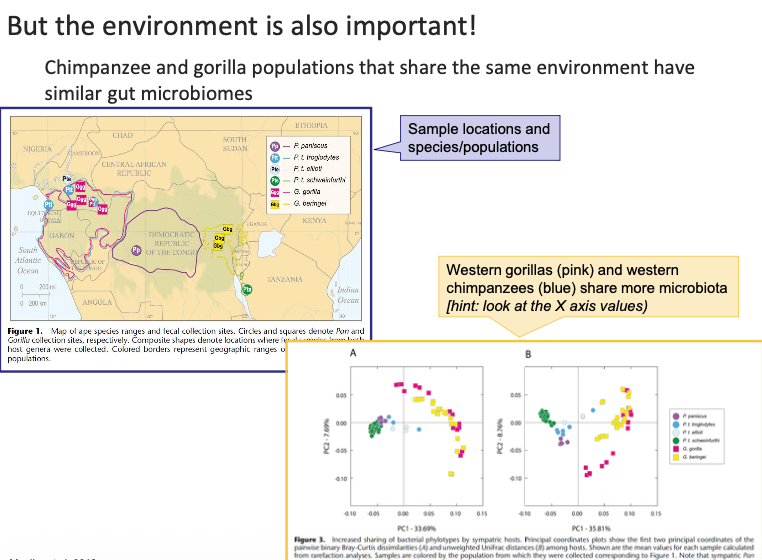
How can both evolutionary history and environment produce microbiome similarity?
Related hosts often share anatomy, physiology, immune regulation, and diet, causing their microbiomes to cluster by species or population.
However, different species living in the same habitat may consume similar foods and encounter similar environmental microbes, making their microbiomes converge.
A clustering pattern therefore supports an association but does not identify its cause by itself.
How do social relationships affect microbiome similarity and diversity?
Strong grooming relationships and small social distances are associated with more similar microbiomes because contact can transmit microbes and social partners may share environments or foods.
Individuals central in a social network may contact more partners and therefore acquire greater microbial diversity. These patterns are associations, not proof that social contact is the only cause.

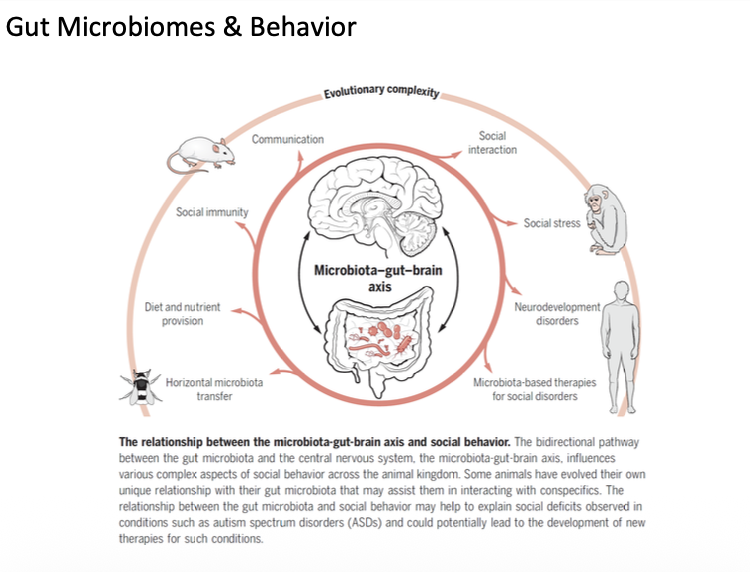
Why is the gut-brain relationship bidirectional?
Gut microbes can affect the brain through microbial metabolites such as SCFAs, neurotransmitter production, vagus-nerve signaling, and immune activity.
The brain and endocrine system can affect the gut through stress hormones, immunity, intestinal movement, and behavior; stress can reduce microbiome diversity.
Causation can therefore operate in both directions.

How should microbiome-behavior results such as the child-language and probiotic studies be interpreted?
One child microbiome cluster had the lowest diversity on four measures but the highest language scores, and probiotic studies reported lower stress-related measures in some subjects.
These results support possible microbiome-behavior connections, but they do not prove that low diversity improves language or that every probiotic changes mood.
Researchers must evaluate effect size, confounders, replication, and causal direction.
How are 16S rRNA sequencing, alpha diversity, and beta diversity used to study microbiomes?
Researchers extract bacterial DNA from a sample, sequence informative regions of the slowly evolving 16S rRNA gene—commonly the V4–V5 regions in this lecture—and compare sequences to identify taxa.
Alpha diversity measures richness and evenness within one sample; beta diversity measures differences in composition between samples.
Similar samples have low beta diversity, while dissimilar samples have high beta diversity.
What is Amato’s central argument about primate ecology and evolution?
Amato argues that the gut microbiota is a missing factor in many models because it can influence diet and nutrition, energetics, disease resistance, cognition, and behavior.
These effects can alter phenotypic plasticity and potentially survival or reproduction, so microbes may contribute to ecological flexibility and evolutionary change.
Direct fitness effects remain insufficiently tested, so mutualism should not be assumed without evidence of reciprocal fitness benefits.
How do diet and gut microbes form a two-way nutritional relationship?
Diet changes which nutrients reach the gut and rapidly selects for microbes capable of using them.
Those microbes change what the host can obtain from food by fermenting otherwise indigestible plant material and resistant starch into absorbable SCFAs and by producing some vitamins.
Diet shapes the microbiota, and the microbiota changes the nutritional value of the diet.
Why are maternal transmission, priority effects, and critical developmental windows important?
Infants acquire microbes from mothers and the environment during and after birth, while breast milk supplies microbes and compounds that favor particular taxa. Early colonizers influence later community assembly.
Because immune and nervous systems are especially sensitive early in life, altered or delayed colonization can have lasting effects even if an adult-like microbiome develops later.
How might gut microbes help primates meet seasonal and life-history energy demands?
Microbiomes can shift rapidly when diet quality or energetic demand changes. Increased fermentation and SCFA production may buffer seasonal food shortages, while efficient energy or vitamin production may help juveniles grow and help females meet the costs of pregnancy and lactation.
These mechanisms are plausible and supported by associations, but their effects on fitness need stronger tests.
How can the gut microbiota affect disease resistance, and why is greater diversity not always automatically better?
A diverse and well-functioning community can resist invasion, strengthen the intestinal barrier, train immune tolerance, and stimulate responses to pathogens.
However, health depends on microbial composition and function as well as diversity; a diverse community can contain harmful organisms, and a less diverse community may still perform necessary functions.
The effect depends on the host and ecological context.
How might gut microbes and primate social behavior influence each other?
Grooming and other social contact can transmit microbes, so behavior shapes microbiomes.
Microbes may also influence stress, anxiety, aggression, and affiliation through immune, endocrine, and neural pathways, so microbiomes could affect behavior.
The relationship may therefore be bidirectional, and either direction could influence social status, mating opportunities, health, and fitness.
How could microbiomes contribute to evolution if microbial communities are strongly affected by the environment?
Natural selection could act on heritable host traits that regulate microbial colonization, immune responses, or microbe-acquiring behaviors such as grooming.
Maternal transmission and priority effects can also create cross-generational similarity.
If microbiome-related differences alter host survival or reproduction, they generate phenotypic variation on which selection may act, even though the full microbial community is not genetically inherited unchanged.
Why do microbiome studies need more than correlations, and what evidence would strengthen causal claims?
Similarity between a microbiome and a host trait does not reveal whether microbes caused the trait, the trait changed the microbes, or a third variable caused both.
Stronger studies collect contextual diet, health, kinship, and behavioral data; measure survival or reproduction; follow subjects over time; use natural or controlled experiments; and test mechanisms through microbiota transfers, animal models, or other functional methods.

How should a tarsier and capuchin differ in relative BMR and diet?
The much smaller tarsier has the higher energy requirement per unit body mass and therefore depends on energy-dense animal prey; it is the clearest highly faunivorous primate.
The larger capuchin uses more total energy but less energy per gram and can maintain a broader omnivorous diet.

How do colobus monkeys and cercopithecines illustrate folivore-frugivore adaptations?
Colobus monkeys are more folivorous and have more robust skulls, stronger chewing anatomy, leaf-shearing teeth, and fermentation adaptations.
Many cercopithecines are more frugivorous, have a relatively smaller chewing apparatus, and use cheek pouches to collect competitive fruit quickly.
Gorillas provide another large-bodied example capable of relying heavily on leaves.
What do black howler monkeys show about microbiomes and seasonal dietary change?
Black howlers can shift dramatically between fruit- and leaf-heavy diets.
Their microbiome composition changes across these periods and appears to produce more SCFAs when host energy intake is lower, potentially buffering seasonal nutritional shortages.
Habitat disturbance can also reduce microbial diversity and SCFA-producing microbes, showing that microbial flexibility may affect ecological resilience.
What do chimpanzees and gorillas living in the same habitat show about microbiome variation?
Sympatric chimpanzee and gorilla populations share more gut microbiota than populations living in different environments.
Because the hosts belong to different species, the result shows that shared habitat and diet can produce microbiome similarity in addition to the effects of evolutionary relatedness.
What do baboon grooming networks show about social behavior and gut microbiomes?
Baboons that groom one another more strongly tend to have more similar gut microbiomes, even when researchers consider other factors such as kinship.
This is consistent with microbial transmission through social contact, but shared diet, space, or behavior may also contribute, so the result is evidence of association rather than proof of a single causal pathway.
What does molecular ecology add to the study of primate behavior and ecology?
It lets researchers answer questions that observation alone cannot answer by using DNA to identify individuals, parents, relatives, populations, migration, adaptations, and evolutionary relationships.
It is especially valuable for primates that are nocturnal, arboreal, unhabituated, rare, or otherwise difficult to observe.
How are DNA, genes, alleles, RNA, proteins, and traits connected?
DNA contains genes, and alleles are alternative versions of a gene.
When a gene is expressed, its DNA sequence is transcribed into RNA; many RNAs are translated into amino-acid chains that form proteins, while other genes make functional noncoding RNAs or regulate other genes.
Those products can influence traits, but possessing an allele does not guarantee a particular phenotype.
Why is phenotype better represented as Genes + Environment + G×E + more, rather than as genes alone?
Genes can influence a trait, environments can influence it, and a gene–environment interaction means the effect of a genotype changes across environments.
Gene regulation, development, epigenetics, maternal effects, learning, and chance can add further variation. The relative contribution of each component differs among traits.

Why must researchers measure gene expression instead of only asking whether a gene is present?
Individuals can share a gene but express it at different times, in different tissues, or at different levels.
A potentially important allele may have little effect if the relevant gene is not expressed in the relevant tissue or situation.
This is why RNA and regulatory data can connect genotype to phenotype more directly than DNA sequence alone.
Why can a genetic difference between species fail to explain variation within a species?
A variant that distinguishes two species may be fixed within each species and therefore cannot explain why individuals of one species differ.
Conversely, alleles responsible for variation within a species may not explain the average difference between species.
The scale of comparison must match the claim.