Bird Lab identification

0.0(0)
Studied by 0 people
call kaiCall Kai
learnLearn
examPractice Test
spaced repetitionSpaced Repetition
heart puzzleMatch
flashcardsFlashcards
GameKnowt Play
Card Sorting

1/26

encourage image

There's no tags or description

Looks like no tags are added yet.

Last updated 6:17 AM on 10/2/26
Name
Mastery
Learn
Test
Matching
Spaced
Call with Kai
Chat

No analytics yet

Send a link to your students to track their progress

27 Terms

1
New cards
<p>Who is this? <span data-name="medium_volumne" data-type="emoji">šŸ”‰</span></p><p>Field Marks</p><p>• Dark grayish-brown upperparts</p><p>• White throat and abdomen with dark ā€œvestā€</p><p>• Indistinct wing bars, but white edge on tertials</p>

Who is this? šŸ”‰

Field Marks

• Dark grayish-brown upperparts

• White throat and abdomen with dark ā€œvestā€

• Indistinct wing bars, but white edge on tertials

Olive-sided Flycatcher

Order: Passeriformes

Family: Tyrannidae

Habitat: Coniferous forests, especially edges

Life history:

Long-distance, neotropical migrant

Dubbed the ā€œPeregrine of flycatchersā€ for its foraging behavior

<p>Olive-sided Flycatcher </p><p>Order: Passeriformes</p><p>Family: Tyrannidae</p><p>Habitat: Coniferous forests, especially edges</p><p>Life history: </p><p>Long-distance, neotropical migrant</p><p>Dubbed the ā€œPeregrine of flycatchersā€ for its foraging behavior</p>
2
New cards
<p>Who is this? <span data-name="medium_volumne" data-type="emoji">šŸ”‰</span></p><p>Field Marks:</p><p>• Small, uniformly dark grayish-brown</p><p>• No eye ring</p><p>• Long primary projection</p><p>• Indistinct pale wing bars and tertial edges</p>

Who is this? šŸ”‰

Field Marks:

• Small, uniformly dark grayish-brown

• No eye ring

• Long primary projection

• Indistinct pale wing bars and tertial edges

Western Wood-Pewee

Order: Passeriformes

Family: Tyrannidae

Habitat: Woodlands and forests, especially edges

Life history:

Long-distance, neotropical migrant

<p>Western Wood-Pewee </p><p>Order: Passeriformes</p><p>Family: Tyrannidae</p><p>Habitat: Woodlands and forests, especially edges</p><p>Life history:</p><p>Long-distance, neotropical migrant</p>
3
New cards
<p>Who is this? (WHW)</p><p>Field Marks:</p><p>• Drab olive with whitish gray wing bars</p><p>• Very reduced or absent eye-ring</p><p>• Bill is broad and pale underneath</p><p>• Grayish breast and abdomen</p>

Who is this? (WHW)

Field Marks:

• Drab olive with whitish gray wing bars

• Very reduced or absent eye-ring

• Bill is broad and pale underneath

• Grayish breast and abdomen

Willow Flycatcher

Order: Passeriformes

Family: Tyrannidae

Habitat: Riparian woodlands

Life History:

Long-distance, neotropical migrant

Conservation:

CA Endangered Species – all subspecies

Causes include loss of habitat due to overgrazing by livestock and cowbird parasitism.

SWFL: complications from non-native tamarisk
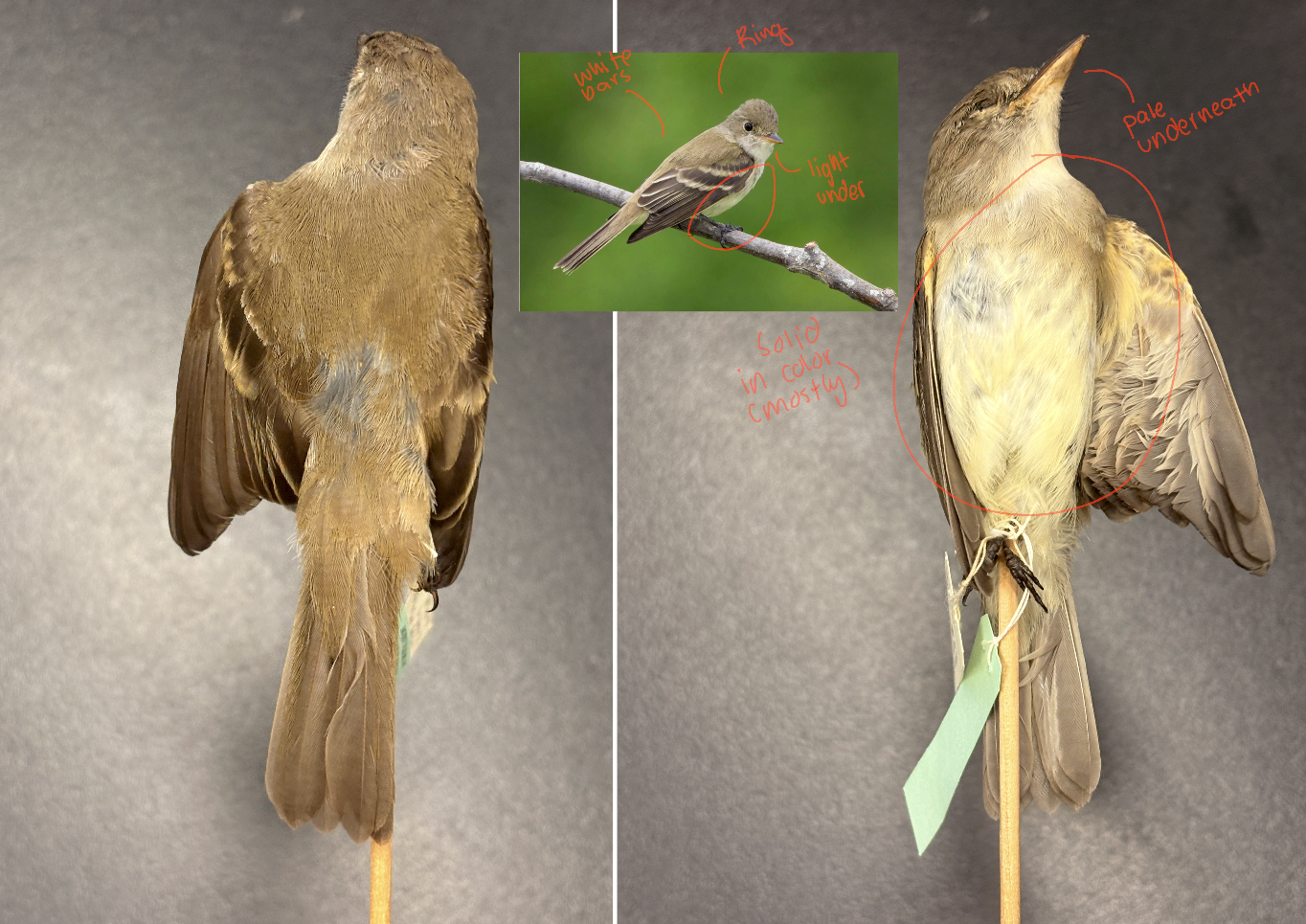
<p>Willow Flycatcher</p><p>Order: Passeriformes</p><p>Family: Tyrannidae</p><p>Habitat: Riparian woodlands</p><p>Life History:</p><p>Long-distance, neotropical migrant</p><p>Conservation:</p><p>CA Endangered Species – all subspecies</p><p>Causes include loss of habitat due to overgrazing by livestock and cowbird parasitism.</p><p>SWFL: complications from non-native tamarisk</p>
4
New cards
<p>Who is this? (WHW)</p><p>Field Marks:</p><p>• Grayish olive-green (head especially gray)</p><p>• Whitish wing bars</p><p>• Whitish eye ring</p><p>• Relatively short, narrow, dark bill</p><p>• Notched tail</p><p>• Long primary projection</p>

Who is this? (WHW)

Field Marks:

• Grayish olive-green (head especially gray)

• Whitish wing bars

• Whitish eye ring

• Relatively short, narrow, dark bill

• Notched tail

• Long primary projection

Hammond’s Flycatcher

Order: Passeriformes

Family: Tyrannidae

Habitat: Coniferous forest

Life History:

Neotropical migrant
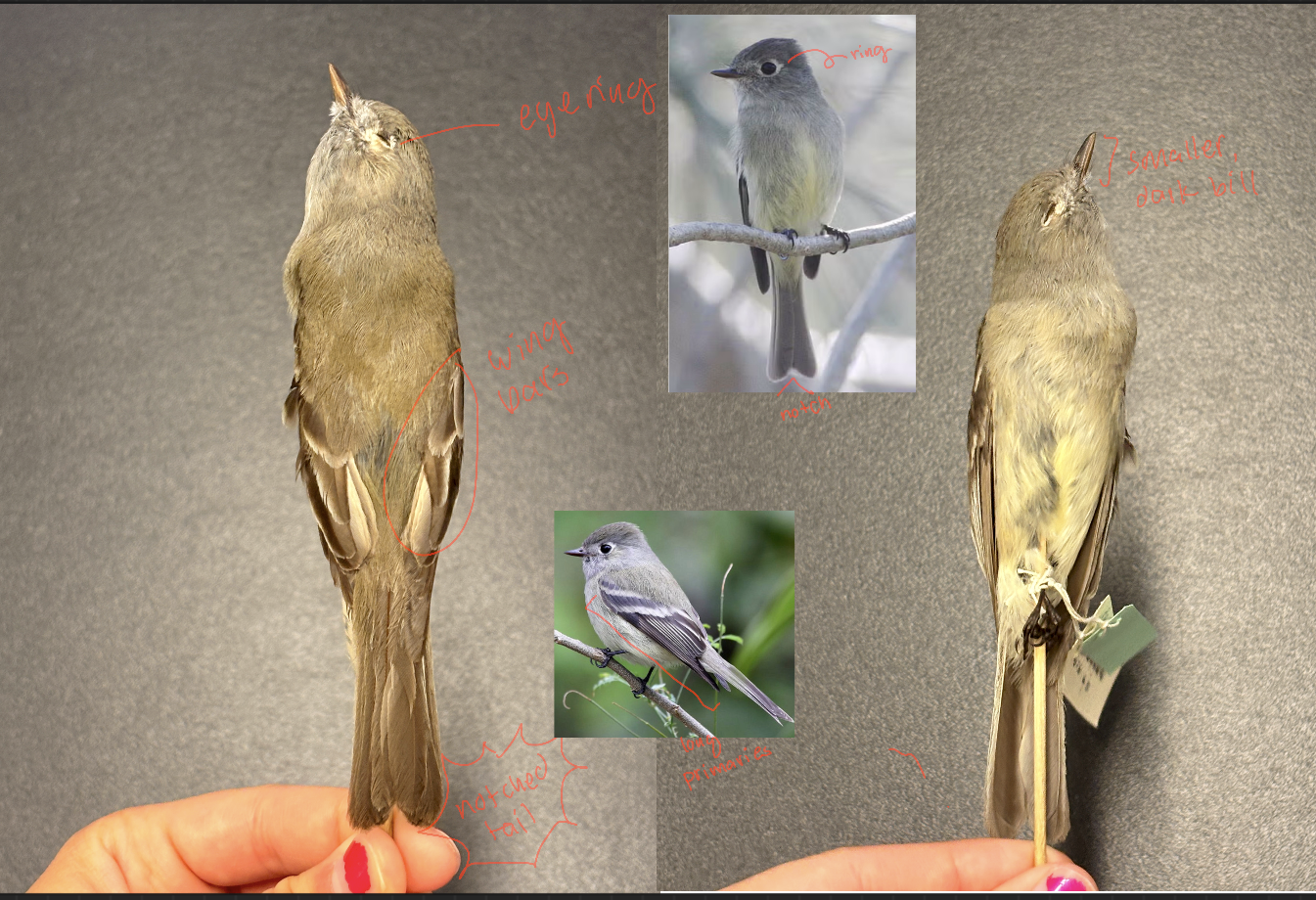
<p>Hammond’s Flycatcher</p><p>Order: Passeriformes</p><p>Family: Tyrannidae</p><p>Habitat: Coniferous forest</p><p>Life History:</p><p>Neotropical migrant</p>
5
New cards
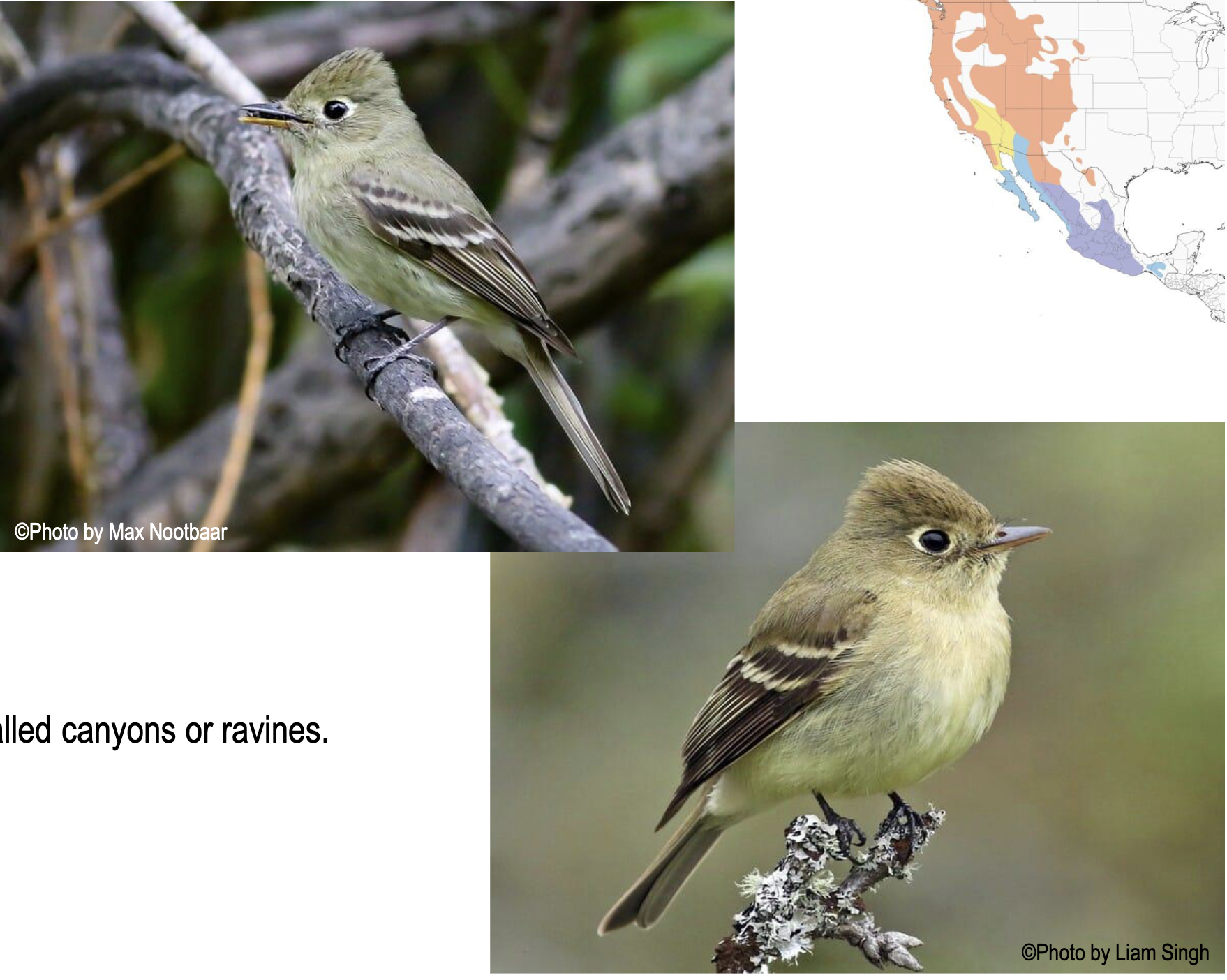
<p>Who is this? (WHW)</p><p>• Olive-green with yellow to white wing bars</p><p>• Pale, teardrop-shaped eye ring</p><p>• Bill is broad and pale underneath</p><p>• Dull yellow breast and abdomen</p><p>• Head appears to have a short peak</p>

Who is this? (WHW)

• Olive-green with yellow to white wing bars

• Pale, teardrop-shaped eye ring

• Bill is broad and pale underneath

• Dull yellow breast and abdomen

• Head appears to have a short peak

Western Flycatcher

Order: Passeriformes

Family: Tyrannidae

Habitat: Woodlands and forests, especially with steep-walled canyons or ravines.

Life History:

Neotropical migrant
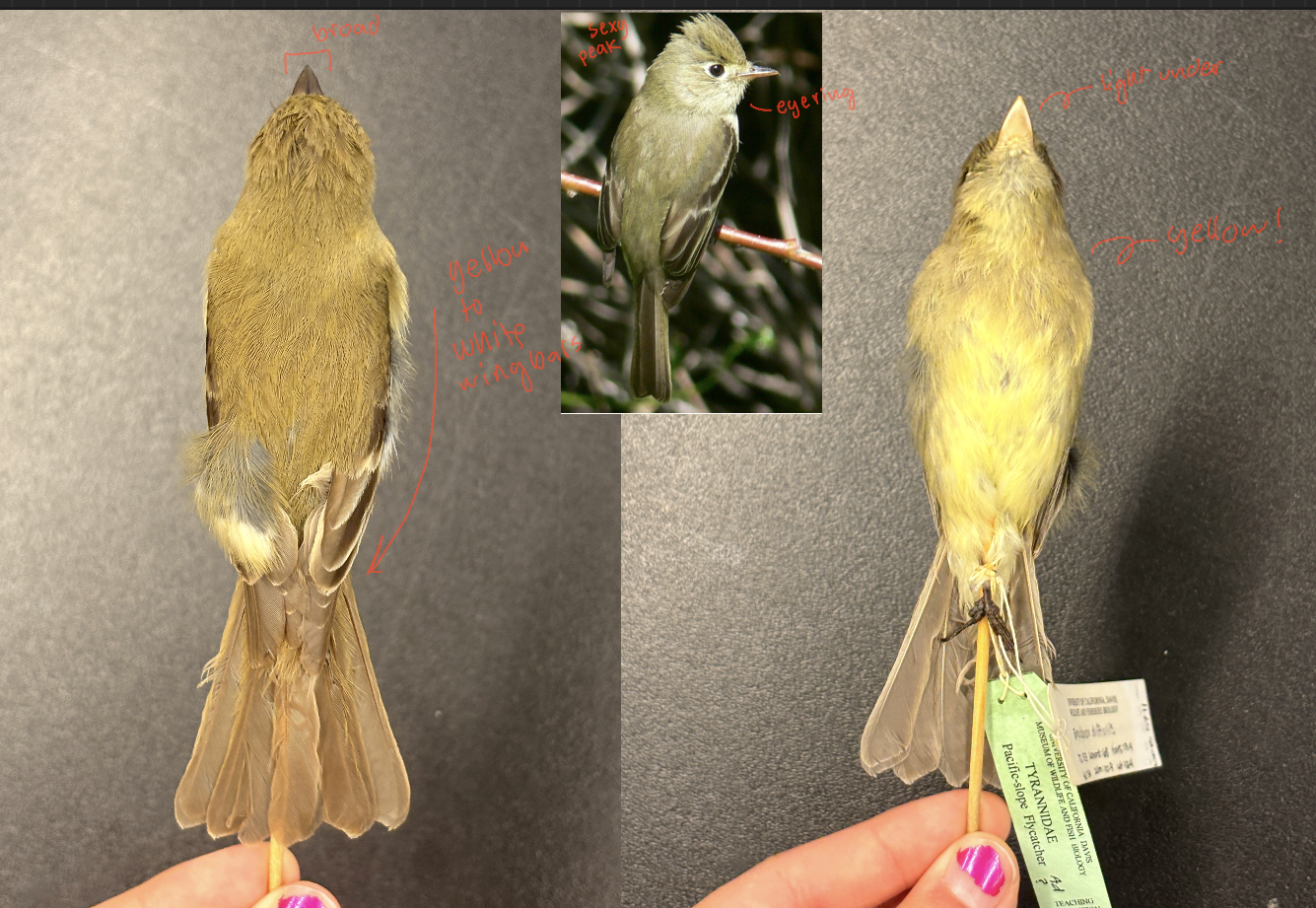
<p>Western Flycatcher</p><p>Order: Passeriformes</p><p>Family: Tyrannidae</p><p>Habitat: Woodlands and forests, especially with steep-walled canyons or ravines.</p><p>Life History:</p><p>Neotropical migrant</p>
6
New cards
<p>Who is this? <span data-name="medium_volumne" data-type="emoji">šŸ”‰</span></p><p>• Black with white abdomen</p><p>• Wags tail while perching and singing</p>

Who is this? šŸ”‰

• Black with white abdomen

• Wags tail while perching and singing

Black Phoebe

Order: Passeriformes

Family: Tyrannidae

Habitat: Riparian woodlands

Life History:

Occurs year-round

Builds mud nests lined with plant fibers, over water and plastered to a vertical wall

<p>Black Phoebe </p><p>Order: Passeriformes</p><p>Family: Tyrannidae</p><p>Habitat: Riparian woodlands</p><p>Life History:</p><p>Occurs year-round</p><p>Builds mud nests lined with plant fibers, over water and plastered to a vertical wall</p>
7
New cards
<p>Who is this?</p><p>• Brownish gray with pale rusty abdomen and undertail coverts</p><p>• Black tail</p><p>• Wags tail when perched</p>

Who is this?

• Brownish gray with pale rusty abdomen and undertail coverts

• Black tail

• Wags tail when perched

Say’s Phoebe

Habitat: Grasslands, desert scrub, agricultural fields

Life History:

Occurs year-round, but some populations migratory.

<p>Say’s Phoebe</p><p>Habitat: Grasslands, desert scrub, agricultural fields</p><p>Life History:</p><p>Occurs year-round, but some populations migratory.</p>
8
New cards
<p>Who is this? <span data-name="medium_volumne" data-type="emoji">šŸ”‰</span></p><p>Field Marks:</p><p>• Brownish gray upperparts, with pale gray throat and breast</p><p>• Very pale yellow abdomen and undertail coverts</p><p>• Underside of tail reddish with dark tips</p><p>• Short bushy crest</p><p>• Long, wide, black bill with slight hook</p>

Who is this? šŸ”‰

Field Marks:

• Brownish gray upperparts, with pale gray throat and breast

• Very pale yellow abdomen and undertail coverts

• Underside of tail reddish with dark tips

• Short bushy crest

• Long, wide, black bill with slight hook

Ash-throated Flycatcher

Order: Passeriformes

Family: Tyrannidae

Habitat: Dry scrub habitats, pinyon-juniper woodlands

Life History:

Neotropical migrant

Tolerant of high temperatures, and do not need to drink water, so able to breed even in deserts as long as food and nest cavities are available

<p>Ash-throated Flycatcher</p><p>Order: Passeriformes</p><p>Family: Tyrannidae</p><p>Habitat: Dry scrub habitats, pinyon-juniper woodlands</p><p>Life History:</p><p>Neotropical migrant</p><p>Tolerant of high temperatures, and do not need to drink water, so able to breed even in deserts as long as food and nest cavities are available</p>
9
New cards
<p>Who is this?</p><p>Field Marks:</p><p>• Dark gray head and breast with sharply contrasting white chin</p><p>• Yellow abdomen</p><p>• Black tail with pale tips</p><p>• Pale edging on wing coverts</p>

Who is this?

Field Marks:

• Dark gray head and breast with sharply contrasting white chin

• Yellow abdomen

• Black tail with pale tips

• Pale edging on wing coverts

Cassin’s Kingbird

Order: Passeriformes

Family: Tyrannidae

Habitat: Oak savannas, grasslands, scrubland, agricultural fields

Life History:

Short-distance neotropical migrant

<p>Cassin’s Kingbird</p><p>Order: Passeriformes</p><p>Family: Tyrannidae</p><p>Habitat: Oak savannas, grasslands, scrubland, agricultural fields</p><p>Life History:</p><p>Short-distance neotropical migrant</p>
10
New cards
<p>Who is this? <span data-name="medium_volumne" data-type="emoji">šŸ”‰</span></p><p>Field Marks:</p><p>• Pale gray breast and head with less contrasting white chin</p><p>• Yellow abdomen</p><p>• Black tail with white edges on outermost feathers</p><p>• No pale edging on wing coverts</p>

Who is this? šŸ”‰

Field Marks:

• Pale gray breast and head with less contrasting white chin

• Yellow abdomen

• Black tail with white edges on outermost feathers

• No pale edging on wing coverts

Western Kingbird

Habitat: Grasslands, desert scrub, agricultural fields

Life History:

Neotropical migrant

<p>Western Kingbird</p><p>Habitat: Grasslands, desert scrub, agricultural fields</p><p>Life History:</p><p>Neotropical migrant</p>
11
New cards
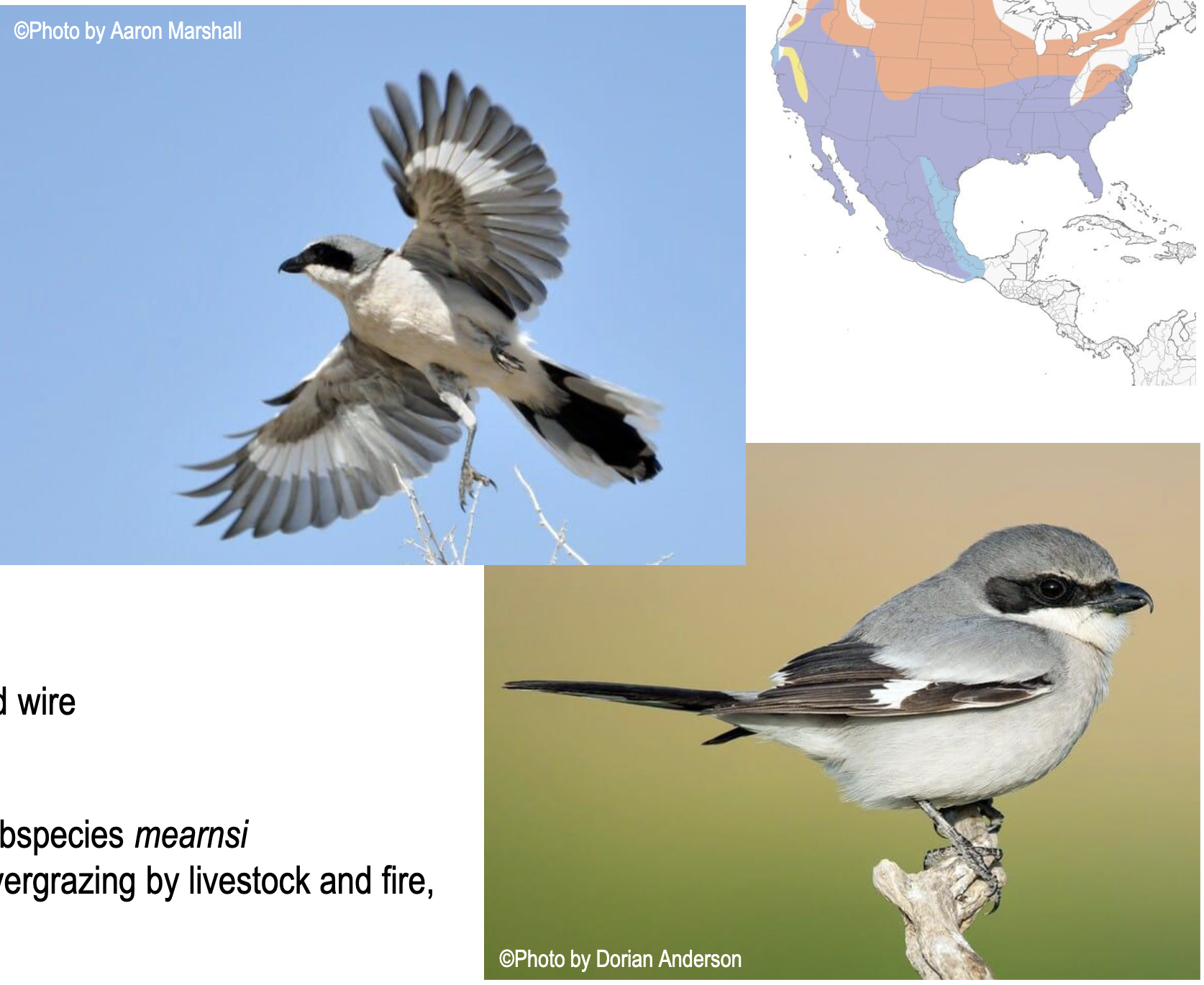
<p>Who is this?</p><p>Field Marks:</p><p>• Gray above and white below</p><p>• Black facial mask</p><p>• Small, black bill with short hook and tomial teeth</p>

Who is this?

Field Marks:

• Gray above and white below

• Black facial mask

• Small, black bill with short hook and tomial teeth

Loggerhead Shrike

Order: Passeriformes

Family: Laniidae

Habitat: Grasslands, desert scrub, agricultural fields

Life History:

Occurs year round, but some populations migratory

Predatory passerine; impales prey on thorns or barbed wire

Conservation:

Federal Endangered Species – only San Clemente subspecies mearnsi

Causes include loss of breeding habitat due to land overgrazing by livestock and fire, as well as consumption of pesticide-laced prey

<p>Loggerhead Shrike </p><p>Order: Passeriformes</p><p>Family: Laniidae</p><p>Habitat: Grasslands, desert scrub, agricultural fields</p><p>Life History:</p><p>Occurs year round, but some populations migratory</p><p>Predatory passerine; impales prey on thorns or barbed wire</p><p>Conservation:</p><p>Federal Endangered Species – only San Clemente subspecies mearnsi</p><p>Causes include loss of breeding habitat due to land overgrazing by livestock and fire, as well as consumption of pesticide-laced prey</p>
12
New cards
<p>Who is this?</p><p>Field Marks:</p><p>• Dull gray to yellowish gray overall, lighter below</p><p>• Weak, broken eye ring</p><p>• Two wing bars, lower wing bar brightest</p><p>• Bi-colored bill (gray above, horn below)</p>

Who is this?

Field Marks:

• Dull gray to yellowish gray overall, lighter below

• Weak, broken eye ring

• Two wing bars, lower wing bar brightest

• Bi-colored bill (gray above, horn below)

Bell’s Vireo

Order: Passeriformes

Family: Vireonidae

Habitat: Riparian woodland, early successional

Life History:

Short distance neotropical migrant

Conservation:

Least Bell’s Vireo (V. bellii pusillus), the Coastal CA Subspecies, is Federally Endangered

<p>Bell’s Vireo</p><p>Order: Passeriformes</p><p>Family: Vireonidae</p><p>Habitat: Riparian woodland, early successional</p><p>Life History:</p><p>Short distance neotropical migrant</p><p>Conservation:</p><p>Least Bell’s Vireo (V. bellii pusillus), the Coastal CA Subspecies, is Federally Endangered</p>
13
New cards
<p>Who is this?</p><p>Field Marks:</p><p>• Greenish olive upper parts with dull yellow underparts</p><p>• Two yellow to white wing bars, with darkest part of wing between them</p><p>• Incomplete, yellow to white eye ring</p><p>• Thick, hooked bill</p><p>• Blue-gray legs</p>

Who is this?

Field Marks:

• Greenish olive upper parts with dull yellow underparts

• Two yellow to white wing bars, with darkest part of wing between them

• Incomplete, yellow to white eye ring

• Thick, hooked bill

• Blue-gray legs

Hutton’s Vireo

Order: Passeriformes

Family: Vireonidae

Habitat: Oak woodlands

Life History:

Occurs year round
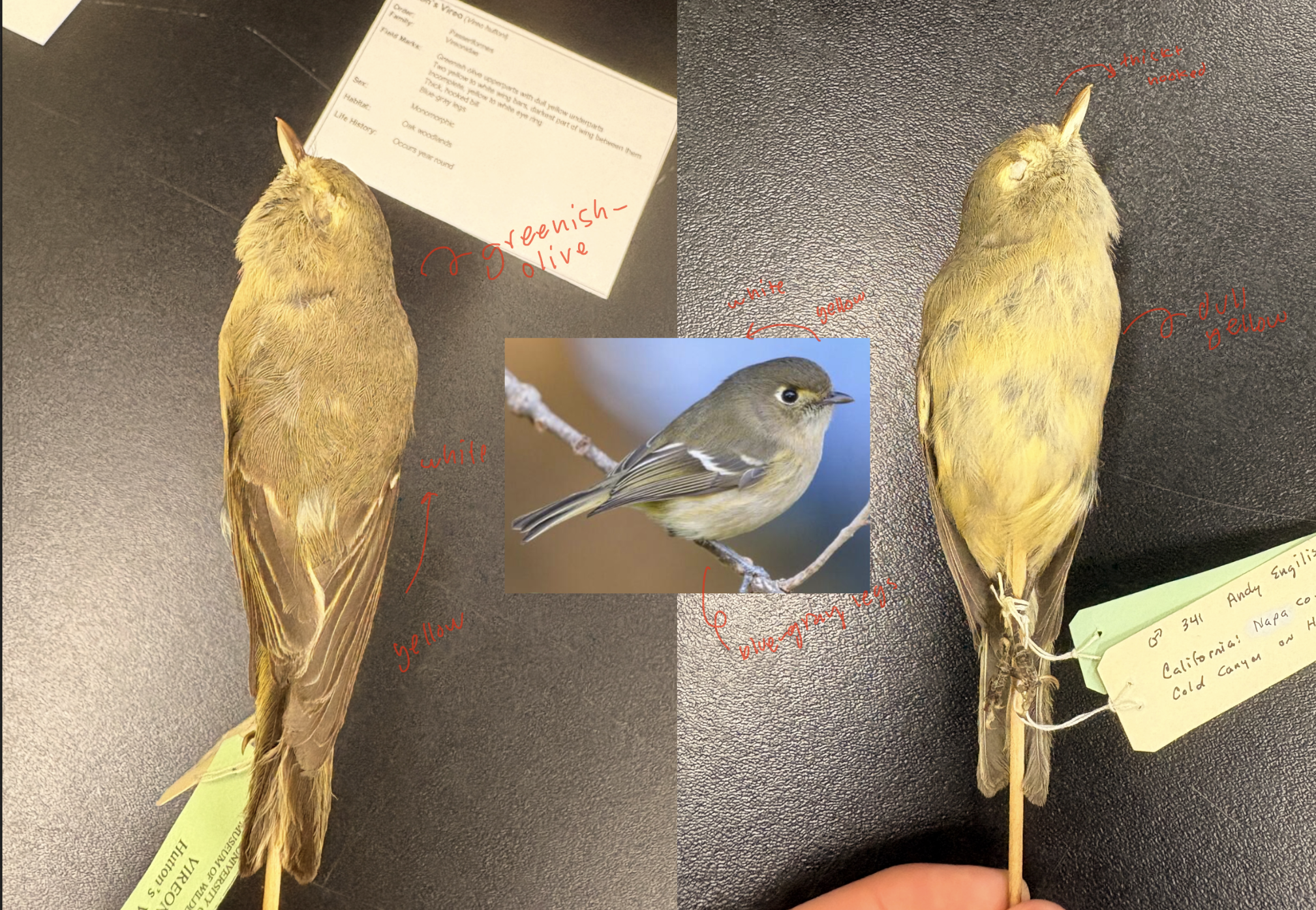
<p>Hutton’s Vireo </p><p>Order: Passeriformes</p><p>Family: Vireonidae</p><p>Habitat: Oak woodlands</p><p>Life History:</p><p>Occurs year round</p>
14
New cards
<p>Who is this? </p><p>Field Marks:</p><p>• Dull olive-green upperparts, with grayer crown, whitish underparts</p><p>• Two yellow to white wing bars</p><p>• Bold white "spectacles" over eyes</p>

Who is this?

Field Marks:

• Dull olive-green upperparts, with grayer crown, whitish underparts

• Two yellow to white wing bars

• Bold white "spectacles" over eyes

Cassin’s Vireo

Order: Passeriformes

Family: Vireonidae

Habitat: Coniferous, deciduous, and mixed forests.

Life History:

Short distance neotropical migrant

<p>Cassin’s Vireo </p><p>Order: Passeriformes</p><p>Family: Vireonidae</p><p>Habitat: Coniferous, deciduous, and mixed forests.</p><p>Life History:</p><p>Short distance neotropical migrant</p>
15
New cards
<p>Who is this? <span data-name="medium_volumne" data-type="emoji">šŸ”‰</span></p><p>Field Marks:</p><p>• Grayish-olive upperparts, with whitish underparts</p><p>• No wingbars</p><p>• Whitish supercilium (ā€œeyebrowā€)</p>

Who is this? šŸ”‰

Field Marks:

• Grayish-olive upperparts, with whitish underparts

• No wingbars

• Whitish supercilium (ā€œeyebrowā€)

Western Warbling-Vireo

Order: Passeriformes

Family: Vireonidae

Life History:

Medium to long-distance neotropical migrant

Conservation:

No special status, but CA populations declining, probably due to loss of riparian habitat and cowbird parasitism

<p>Western Warbling-Vireo</p><p>Order: Passeriformes</p><p>Family: Vireonidae</p><p>Life History:</p><p>Medium to long-distance neotropical migrant</p><p>Conservation:</p><p>No special status, but CA populations declining, probably due to loss of riparian habitat and cowbird parasitism</p>
16
New cards
<p>Who is this?</p><p>Field Marks:</p><p>• Dark gray upperparts, with pale gray to white underparts</p><p>• Whitish throat, often extending to a collar around neck</p><p>• White head with black crown patch, varying in size, but no crest</p><p>• Flight feathers sometimes tipped white</p>

Who is this?

Field Marks:

• Dark gray upperparts, with pale gray to white underparts

• Whitish throat, often extending to a collar around neck

• White head with black crown patch, varying in size, but no crest

• Flight feathers sometimes tipped white

Canada Jay

Order: Passeriformes

Family: Corvidae

Habitat: Coniferous forests

Life History:

Occurs year-round in northwestern CA

Copious sticky saliva from enlarged salivary glands is used to fasten food items in trees for use throughout the winter
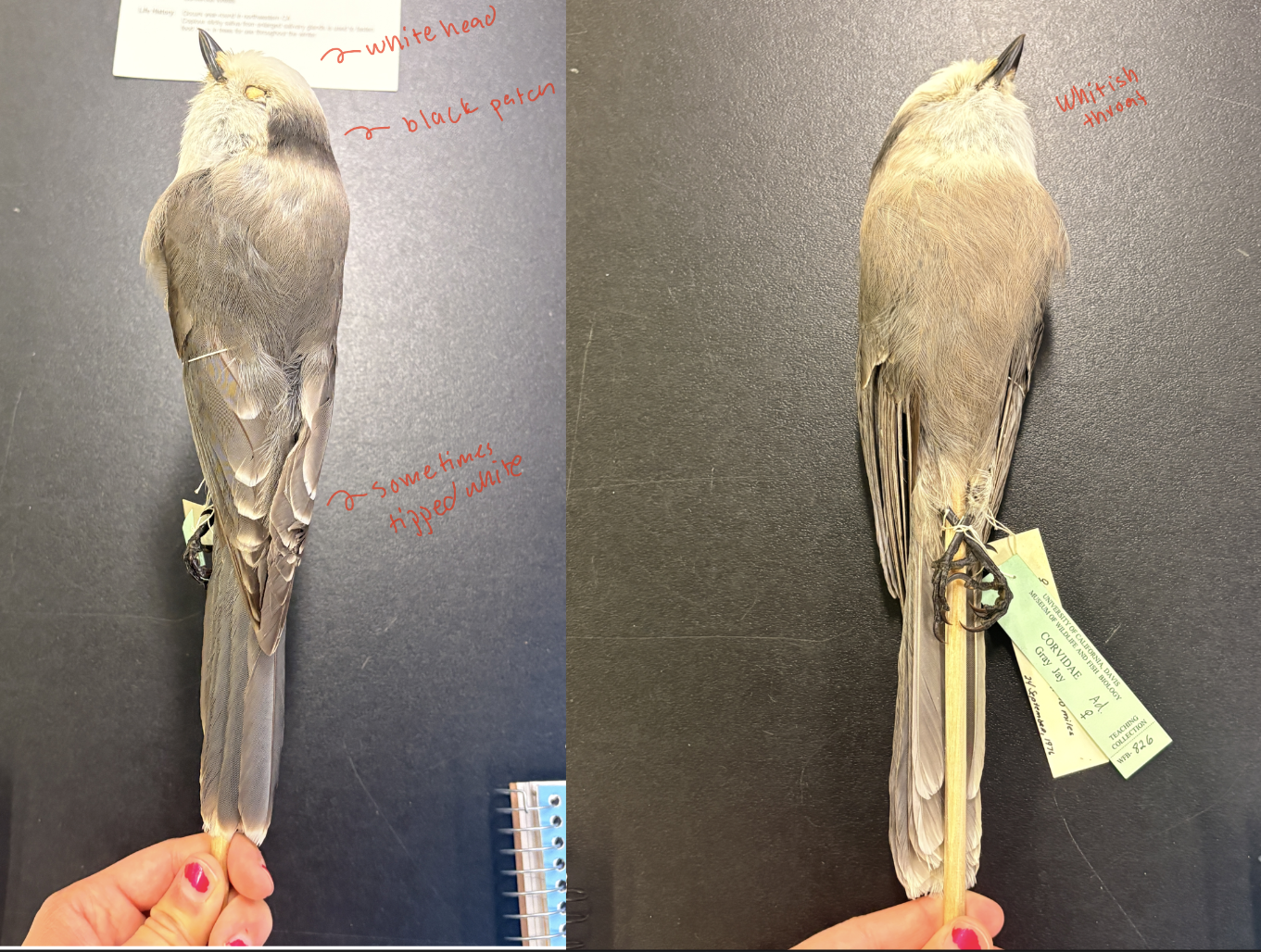
<p>Canada Jay</p><p>Order: Passeriformes</p><p>Family: Corvidae</p><p>Habitat: Coniferous forests</p><p>Life History:</p><p>Occurs year-round in northwestern CA</p><p>Copious sticky saliva from enlarged salivary glands is used to fasten food items in trees for use throughout the winter</p>
17
New cards
<p>Who is this?</p><p>Field Marks:</p><p>• Dull blue overall, with chin and throat streaked whitish</p><p>• No crest</p><p>• Sharp-pointed bill</p><p>• Short-tailed</p>

Who is this?

Field Marks:

• Dull blue overall, with chin and throat streaked whitish

• No crest

• Sharp-pointed bill

• Short-tailed

Pinyon Jay

Order: Passeriformes

Family: Corvidae

Habitat: Pinyon-juniper woodland

Life History:

Occurs year-round

Highly social, cooperative breeder

Excellent spatial memory, capable of digging up stored seeds months later, even through snow

<p>Pinyon Jay</p><p>Order: Passeriformes</p><p>Family: Corvidae</p><p>Habitat: Pinyon-juniper woodland</p><p>Life History:</p><p>Occurs year-round</p><p>Highly social, cooperative breeder</p><p>Excellent spatial memory, capable of digging up stored seeds months later, even through snow</p>
18
New cards
<p>Who is this? <span data-name="medium_volumne" data-type="emoji">šŸ”‰</span></p><p>Field Marks:</p><p>• Dark blue with black crest</p><p>• Blue streaks on forehead</p><p>• Grayish throat patch</p>

Who is this? šŸ”‰

Field Marks:

• Dark blue with black crest

• Blue streaks on forehead

• Grayish throat patch

Steller’s jay

Order: Passeriformes

Family: Corvidae

Habitat: Coniferous forests

Life History:

Occurs year round

Form monogamous, long-term pair bonds

<p>Steller’s jay </p><p>Order: Passeriformes</p><p>Family: Corvidae</p><p>Habitat: Coniferous forests</p><p>Life History:</p><p>Occurs year round</p><p>Form monogamous, long-term pair bonds</p>
19
New cards
<p>Who is this?</p><p>Field Marks:</p><p>• Deep blue upper parts with whitish underparts</p><p>• Dark gray/brown back (compare CASJ)</p><p>• Blackish lores extend across crown</p><p>• Relatively massive bill</p>

Who is this?

Field Marks:

• Deep blue upper parts with whitish underparts

• Dark gray/brown back (compare CASJ)

• Blackish lores extend across crown

• Relatively massive bill

Island Scrub-Jay

Order: Passeriformes

Family: Corvidae

Habitat: Scrub habitats and woodlands

Life History:

Occurs ONLY on Santa Cruz Island

Endemic to California (never recorded in any other country or state)

Heavy bill for dispatching island’s thick acorns

<p>Island Scrub-Jay</p><p>Order: Passeriformes</p><p>Family: Corvidae</p><p>Habitat: Scrub habitats and woodlands</p><p>Life History:</p><p>Occurs ONLY on Santa Cruz Island</p><p>Endemic to California (never recorded in any other country or state)</p><p>Heavy bill for dispatching island’s thick acorns</p>
20
New cards
<p>Who is this? <span data-name="medium_volumne" data-type="emoji">šŸ”‰</span></p><p>Field Marks:</p><p>• Blue upper parts with whitish underparts</p><p>• Dark cheeks and whitish supercilium (ā€œeyebrowā€), but no crest</p><p>• Presence of blue, streaky ā€œnecklaceā€ varies</p>

Who is this? šŸ”‰

Field Marks:

• Blue upper parts with whitish underparts

• Dark cheeks and whitish supercilium (ā€œeyebrowā€), but no crest

• Presence of blue, streaky ā€œnecklaceā€ varies

California Scrub-Jay

Order: Passeriformes

Family: Corvidae

Habitat: Scrub habitats, oak woodlands

Life History:

Occurs year-round

Omnivorous, opportunistic, and a known nest predator.

<p>California Scrub-Jay</p><p>Order: Passeriformes</p><p>Family: Corvidae</p><p>Habitat: Scrub habitats, oak woodlands</p><p>Life History:</p><p>Occurs year-round</p><p>Omnivorous, opportunistic, and a known nest predator.</p>
21
New cards
<p>Who is this?</p><p>Field Marks:</p><p>• Blue upper parts with grayish underparts– Blues and whites less bright than CASJ</p><p>• Dark cheeks and whitish supercilium (ā€œeyebrowā€), but no crest supercilium may be less distinct than CASJ, but unreliable.</p><p>• Blue necklace can be weakly present, but less distinct than CASJ</p>

Who is this?

Field Marks:

• Blue upper parts with grayish underparts– Blues and whites less bright than CASJ

• Dark cheeks and whitish supercilium (ā€œeyebrowā€), but no crest supercilium may be less distinct than CASJ, but unreliable.

• Blue necklace can be weakly present, but less distinct than CASJ

Woodhouse’s Scrub-Jay

Order: Passeriformes

Family: Corvidae

Habitat: Open scrub habitats, pinyon woodlands of the intermountain West

Life History:

Occurs year-round

Omnivorous, opportunistic, and a known nest predator.

<p>Woodhouse’s Scrub-Jay</p><p>Order: Passeriformes</p><p>Family: Corvidae</p><p>Habitat: Open scrub habitats, pinyon woodlands of the intermountain West</p><p>Life History:</p><p>Occurs year-round</p><p>Omnivorous, opportunistic, and a known nest predator.</p>
22
New cards
<p>Who is this?</p><p>Field Marks:</p><p>• Light gray with white on forehead, chin, and undertail</p><p>• Central rectrices black, and outer rectrices white</p><p>• Wings black, with white-tipped secondaries visible in flight</p><p>• Long, pointed black bill</p>

Who is this?

Field Marks:

• Light gray with white on forehead, chin, and undertail

• Central rectrices black, and outer rectrices white

• Wings black, with white-tipped secondaries visible in flight

• Long, pointed black bill

Clark’s Nutcracker

Order: Passeriformes

Family: Corvidae

Habitat: Subalpine coniferous forests

Life History:

Occurs year round, with seasonal altitudinal migration

Sublingual pouch for transporting seeds to cache sites

Excellent spatial memory for locating hidden seeds

Both males and females incubate eggs

<p>Clark’s Nutcracker </p><p>Order: Passeriformes</p><p>Family: Corvidae</p><p>Habitat: Subalpine coniferous forests</p><p>Life History:</p><p>Occurs year round, with seasonal altitudinal migration</p><p>Sublingual pouch for transporting seeds to cache sites</p><p>Excellent spatial memory for locating hidden seeds</p><p>Both males and females incubate eggs</p>
23
New cards
<p>Who is this?</p><p>Field Marks:</p><p>• Primarily black with white scapulars and abdomen</p><p>• Wings and tail iridescent blue-green</p><p>• White marks on primaries form patch visible in flight</p><p>• Black bill</p>

Who is this?

Field Marks:

• Primarily black with white scapulars and abdomen

• Wings and tail iridescent blue-green

• White marks on primaries form patch visible in flight

• Black bill

Black-billed Magpie

Order: Passeriformes

Family: Corvidae

Habitat: Riparian woodlands, especially near grasslands and meadows

Life History:

Occurs year-round in extreme eastern CA
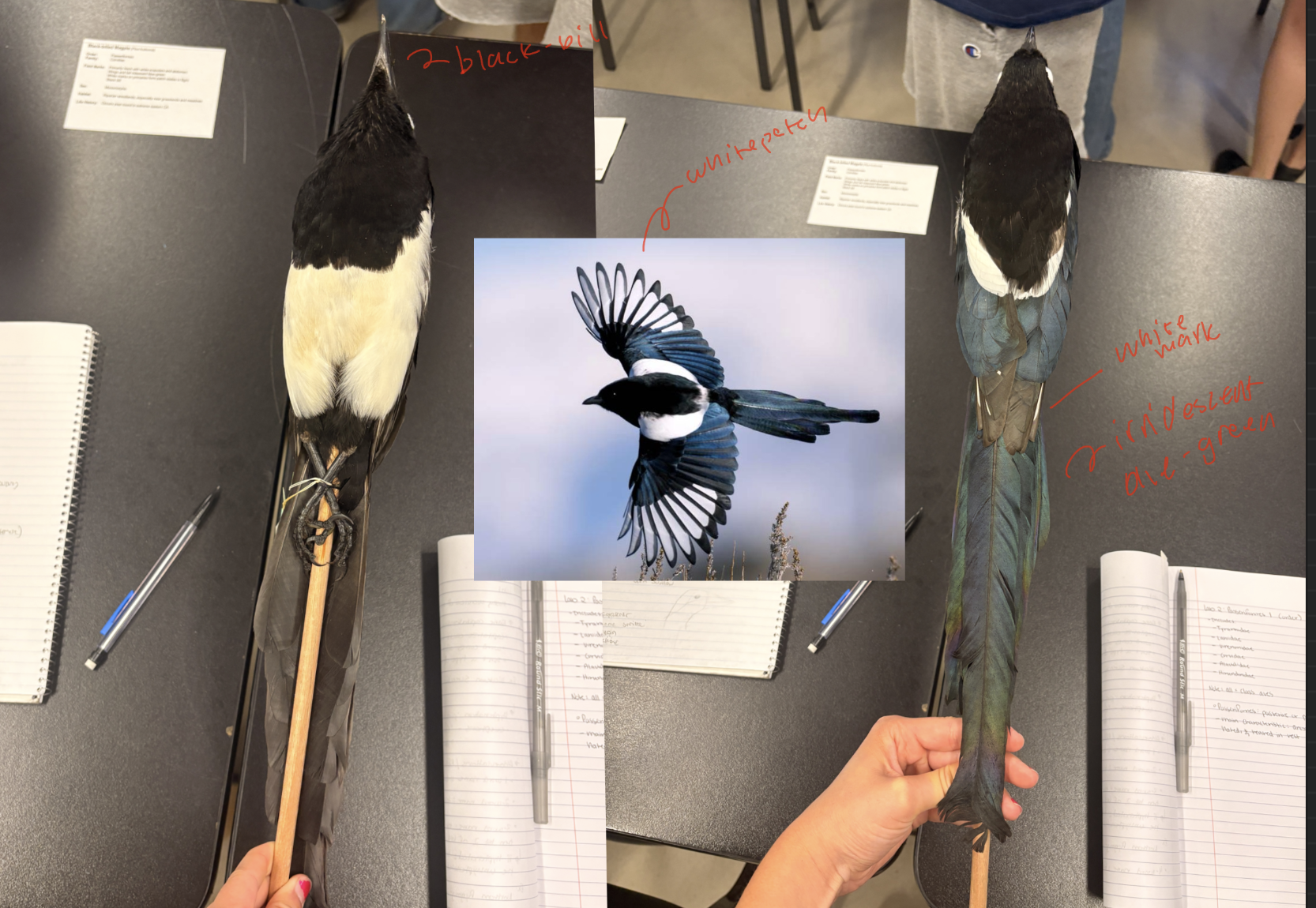
<p>Black-billed Magpie</p><p>Order: Passeriformes</p><p>Family: Corvidae</p><p>Habitat: Riparian woodlands, especially near grasslands and meadows</p><p>Life History:</p><p>Occurs year-round in extreme eastern CA</p>
24
New cards
<p>Who is this? </p><p>Field Marks:</p><p>• Primarily black with white scapulars and abdomen</p><p>• Wings and tail iridescent blue-green</p><p>• White marks on primaries form patch visible in flight</p><p>• Yellow bill</p>

Who is this?

Field Marks:

• Primarily black with white scapulars and abdomen

• Wings and tail iridescent blue-green

• White marks on primaries form patch visible in flight

• Yellow bill

Yellow-billed Magpie

Habitat: Oak woodlands

Life History:

Endemic to CA, occurs year-round in the central valley

Nests in loose colonies, in large domed stick nests

<p>Yellow-billed Magpie</p><p>Habitat: Oak woodlands</p><p>Life History:</p><p>Endemic to CA, occurs year-round in the central valley</p><p>Nests in loose colonies, in large domed stick nests</p>
25
New cards
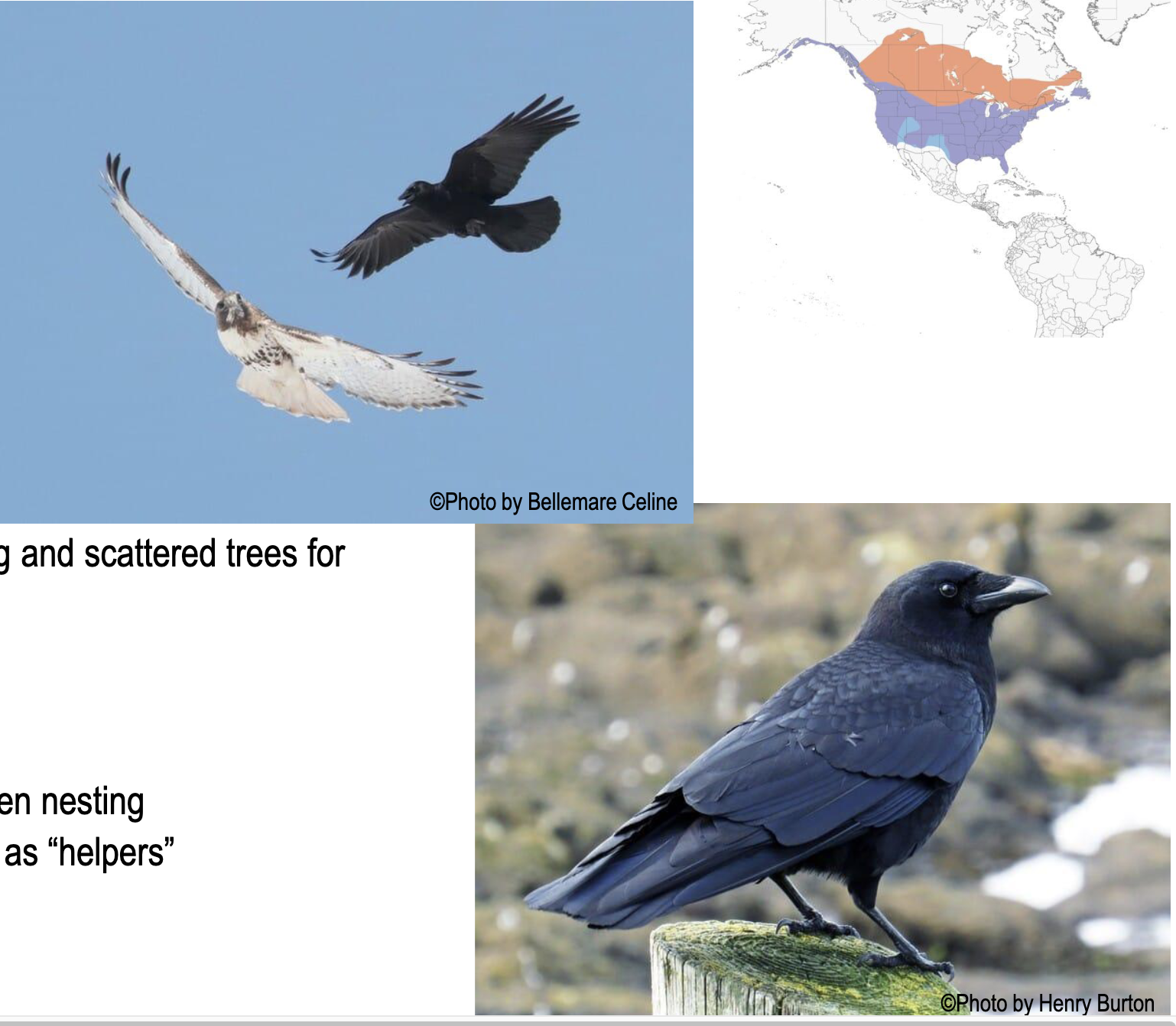
<p>Who is this?</p><p>• All black with stout glossy black bill</p><p>• Short and rounded or square-shaped tail</p><p>• Tips of folded wings often do not reach tail</p>

Who is this?

• All black with stout glossy black bill

• Short and rounded or square-shaped tail

• Tips of folded wings often do not reach tail

American Crow

Order: Passeriformes

Family: Corvidae

Habitat: Habitat generalist, requiring open ground for feeding and scattered trees for nesting

Life History:

Occurs year-round

Roosts communally in large numbers, but less social when nesting

Some populations breed cooperatively, with young birds as ā€œhelpersā€

<p>American Crow </p><p>Order: Passeriformes</p><p>Family: Corvidae</p><p>Habitat: Habitat generalist, requiring open ground for feeding and scattered trees for nesting</p><p>Life History:</p><p>Occurs year-round</p><p>Roosts communally in large numbers, but less social when nesting</p><p>Some populations breed cooperatively, with young birds as ā€œhelpersā€</p>
26
New cards
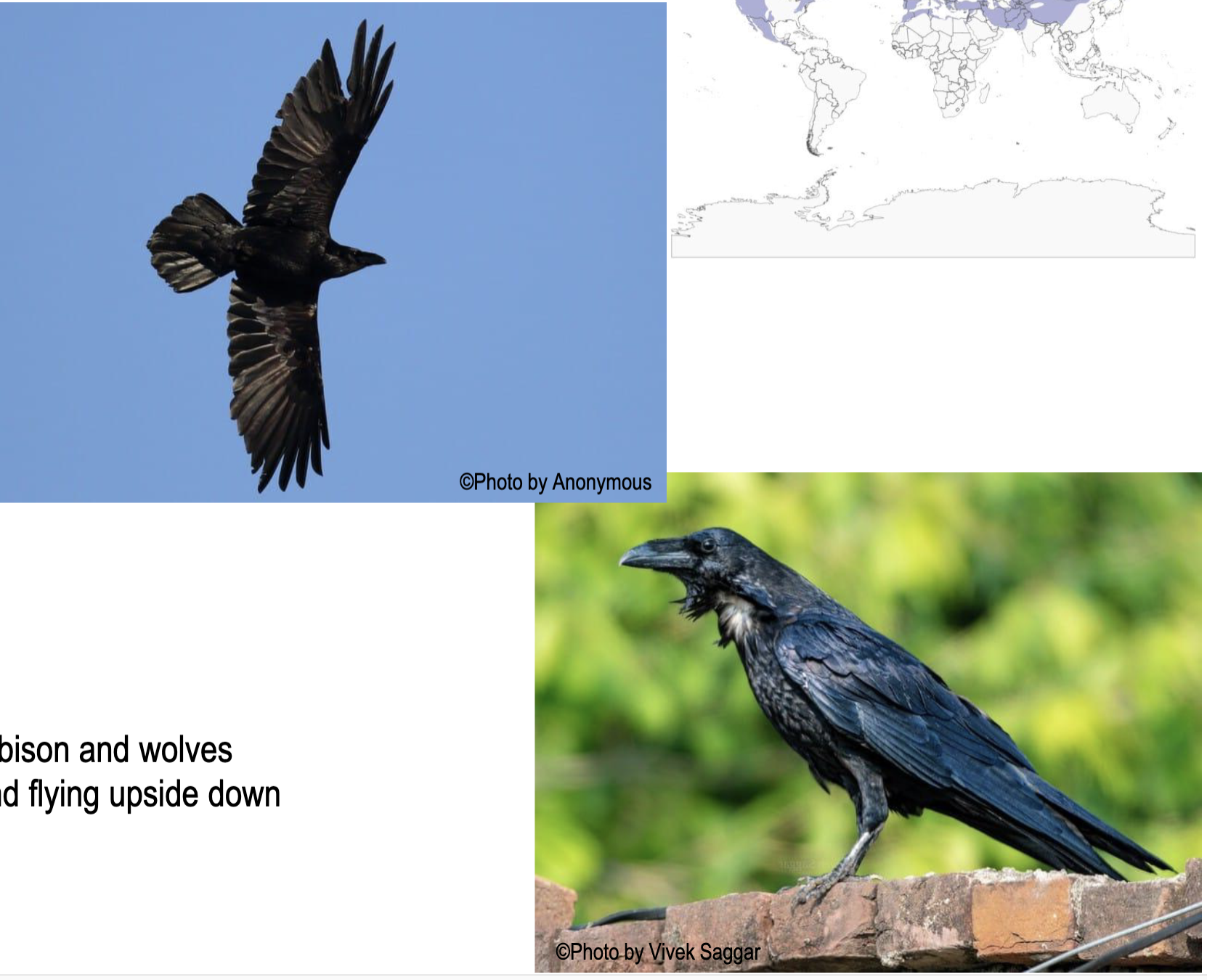
<p>Who is this?</p><p>Field Marks:</p><p>• Very large, glossy black, with heavy black bill</p><p>• Wedge-shaped tail</p><p>• Elongated throat feathers, called ā€œhacklesā€</p><p>• Long, tapered wings reach tail tips</p>

Who is this?

Field Marks:

• Very large, glossy black, with heavy black bill

• Wedge-shaped tail

• Elongated throat feathers, called ā€œhacklesā€

• Long, tapered wings reach tail tips

Common Raven

Order: Passeriformes

Family: Corvidae

Habitat: Habitat generalist

Life History:

Occurs year round

Largest bodied passerine

Historically occurred in association with American bison and wolves

An acrobatic flier, it is often seen somersaulting and flying upside down

<p>Common Raven</p><p>Order: Passeriformes</p><p>Family: Corvidae</p><p>Habitat: Habitat generalist</p><p>Life History:</p><p>Occurs year round</p><p>Largest bodied passerine</p><p>Historically occurred in association with American bison and wolves</p><p>An acrobatic flier, it is often seen somersaulting and flying upside down</p>
27
New cards
<p>Who is this?</p><p>Field Marks:</p><p>• Brown to black upperparts with cinnamon to white underparts</p><p>• Black mask, breast band, and occipital feather tufts (ā€œhornsā€ – not always visible)</p><p>• Contrasting yellow supercilium (ā€œeyebrowā€) and throat</p><p>• Outermost tail feathers edged white</p>

Who is this?

Field Marks:

• Brown to black upperparts with cinnamon to white underparts

• Black mask, breast band, and occipital feather tufts (ā€œhornsā€ – not always visible)

• Contrasting yellow supercilium (ā€œeyebrowā€) and throat

• Outermost tail feathers edged white

Horned Lark

Order: Passeriformes

Family: Alaudidae

Habitat: Grasslands, desert scrub, agricultural fields

Life History:

Occurs year-round in CA

Only member of family native to North America

Ground-dwelling

<p>Horned Lark</p><p>Order: Passeriformes</p><p>Family: Alaudidae</p><p>Habitat: Grasslands, desert scrub, agricultural fields</p><p>Life History:</p><p>Occurs year-round in CA</p><p>Only member of family native to North America</p><p>Ground-dwelling</p>