15, 16, 17 Genetic analyses intro, transposons, and double mutants
 Call Kai
 Learn
 Practice Test
 Spaced Repetition
 Match
 Flashcards
 Knowt Play
1/22

There's no tags or description
Looks like no tags are added yet.
23 Terms
What can we learn from studying mutants?
gene regulation
members of pathways
function of RNAs and proteins
identify important domains in RNA/proteins
etc+
What could classical/forward genetics tell you and what does it look like?
Identify in a screen 4 mutants —> identify mutation in each of the mutants—> predict effect
It can show you which regions of the gene affect the trait you are identifying
You can identify these sites to understand their function by analyzing the effects of mutations genetically and biochemically. Things like regulatory elements in 5-UTR of mRNA, and the domains that are important for the function of proteins (or RNAs)

What is important in understanding pathways when implimenting mutations?
You have to know the typical structure of a pathways (where the promotor, protein, stop codon would be). Then you can possible figure out which regions affect which phenotypes (binding, structure, etc.)

What are the effects of mutations on the function of a protein?
Neutral - the shape of the protein changes but not the function
Loss of function
total LOF - protein can’t fold correctly or interact with functional partners
Partical LOF - protein is somewhat unstable
Gain of function - can be used for previous function AND another, OR looses the original function but GAINS a different function, this leazds to the evolution of paralogs (gene related to another gene by duplication in a genome)
what is the complementation test, what does it tell?
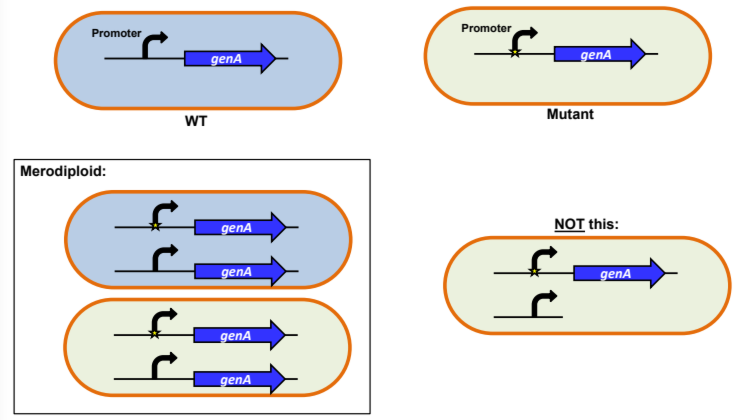
It shows whether a mutant allele is recessive or dominant with respect to the WT
Mutant cell with mutant allele —> add WT allele into mutant cell, resulting in a merodiploid (partial diploid) strain with WT and mutant alleles —> does the merodiploid cell behave like the mutant or WT?
If the mutant allele is dominant, then the mutant allele will be expressed in the merodiploid cell.

What are trans and cis in terms of a promoter? Why is it important to the complementation tests?
cis - works close to a gene
trans - works far away from gene
You need to include promoters, regulator-binding sites, and SD sequences that work in cis to ensure the test goes correctly
What are dominant and recessive alleles mutations typically?
TYPICALLY
Recessive - loss of function mutations
Dominant - gain of function mutations
Both (changing respects) - gaining a new function and losing an old one. With respect to the old function, it would be a recessive mutation, but in respect to the new function it is a dominant allele.
What is a dominant negative allele? How would it work?
A loss of function allele that is dominant over the wild type
dominant neggative effect in homoeric complexes, non functional subunit kills the function of the complex (similar to MO in hemoglobin)

How are transposons engineered in labs?
They have inverted repeats for the target WT DNA. The gene (with promotor) encodes a factor taht convfers resistance to an antibiotic; allowing you to select. Tn doesn’t have the gene for transposase to prevent jumping around; the transposase gene is encoded outside the Tn on the donor DNA so it is only able to jump to the host DNA and not continue moving.
How does the lab engineered tranposon work?
It has antibiotic resistance, so it screens for cells that sucessfully encorperated the transposon. Then you have to select from the screen for desired phenotype.
What are disadvantages of using transposon mutation process?
only one type of mutant (insertions)
insertions in some genes are lethal
Multiple effects (insertion site + downstream/upstream)
How can you tell if the phenotype is caused by the loss of expression of a gene?
Utilizing a merodiploid. If the cell maintains the mutation after the merodiploid, then it means that the mutation was from the transposon. However, if not, then the mutation was likely from the transposon.
how do you know how many tn mutants to make?
Depends on the size of the gene
What do you call the effect if the effect of mutation 1 and mutation 2 = the sum of both effects? What does this mean?
Additive
It means that they are independent pathways
What are synthetic genetic interactions?
when 1+1 doesn’t = 2. The phenotype of the double mutant is unexpected, one that is not predicted from the phenotypes of the single mutants alone. This means taht theyre is a synthetic genetic interaction between 2 alleles.
What are the two types of synthetic genetic interactions?
Negative
negative synergy - a function stops working
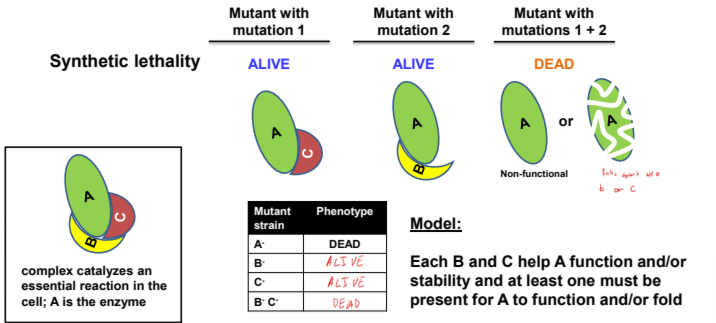
synthetic lethality - the mutant dies
Positive
supression - a function works as it used to, or better

What can negative synergy synthetic interactions reveal?
Either redundancy or a functional/physical interaction between the two mutation/factors/domains

What does synthetic lethality reveal?
Either
factors altered by mutations are redundant for essential function
Factors altered by mutations are nonessential members of a complex that performs an essential function in the cell; the complex can tolerate the loss of 1, but not 2 factors
What is the two general outcomes of supression?
true reversion
WT, ~wt, or improved phenotype
What are extragenic and intragenic?
Extrageneic - two different locations
Intrageneic - the same gene/element
What is an example of extragenic supressor that restores an interaction?

What’s an example of a intragenetic supressor?
What are the 3 types of suppressions?
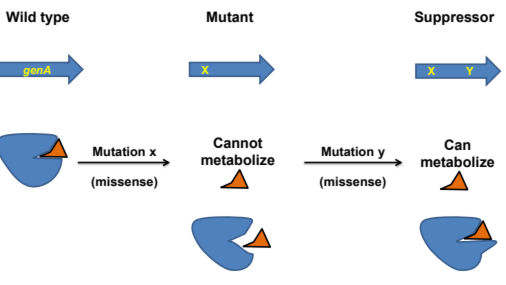
Conformational - restores physical interaction; usually very specific to a particular mutation/change. Directly relates to previous mutations (aka allelic-specific) ex. (amino acid changes) EK(wt), mutant 1 EE, suppressor KE or RE
Bypass - overrides the need for a particular gene; suppresses the phenotypes caused by many different mutations in one gene or in the same pathway ex. WT stops LamB from taking up MalE; suppressor changes OmpC to take up MalE
Bypass suppressors can be specific for a particular pathway, but NOT gene/allele-specific
informational - changes how mRNAs are read (mutations in tRNA and genes associated with the ribosome) so that stop codons can now encode for an amino acid
Typically a repressor for nonsense mutations