ENDOCRINE DISEASE III
 Call Kai
 Learn
 Practice Test
 Spaced Repetition
 Match
 Flashcards
 Knowt Play
1/59

Earn XP
Description and Tags
hypocalcaemia and hypercalcaemia
60 Terms
how much calcium does the average person have
the average person has 1kg of calcium
99% in the skeleton
<1% ionised calcium in ECF
cofactor in coagulation
skeletal mineralisation
membrane stabilisation (neuronal conduction)
which organs does calcium homeostasis rely on
intestine (small) - absorbs dietary Ca
kidney - adjusts how much Ca is excreted/ reabsorbed
bone - primary Ca reservoir in the form of hydroxyapatite
if serum calcium decreases, how are normal Ca levels restored
decreased in sCa2+ » parathyroid gland secretes PTH » increase in PTH »
↑ bone resorption
↑ Ca reabsorption in kidneys
↑ Ca absorption in intestines
what are the other actions of parathyroid hormone in the kidneys
INCREASES Ca REABSORPTION » serum Ca increases
decreases phosphate reabsorption » lowers serum phosphate levels
increases 1-alpha hydroxylation of vitamin D » increases levels of active form of vitamin D
what are the other actions of parathyroid hormone in the bones
there is an immediate release of calcium and later release of calcium by an increase in bone resorption relative to bone formation
i.e. increase in bone remodelling
what are the other actions of parathyroid hormone in the intestines
no direct effect
increased 1,25-(OH)2 vitamin D (active form of vitamin D) » increased calcium absorption
calcium homeostasis is an example of… and returns serum ionised Ca back to the set point of about…
calcium homeostasis is an example of negative feedback and returns erum ionised Ca back to the set point of about 1.1mmol/L
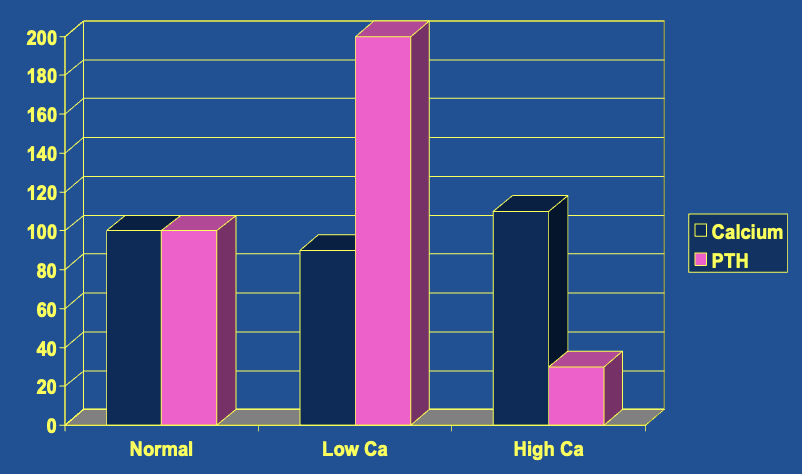
graph showing relationship between serum calcium and PTH
small changes in serum Ca results in big changes in PTH
PTH abnormalities can be categorised as…
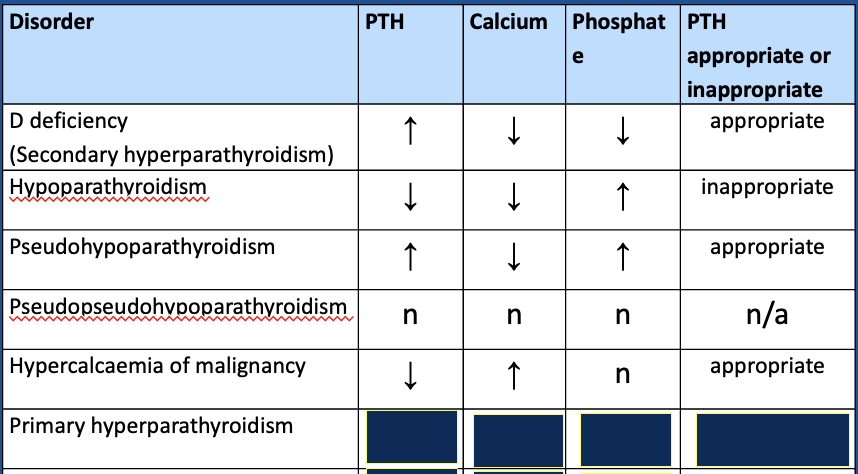
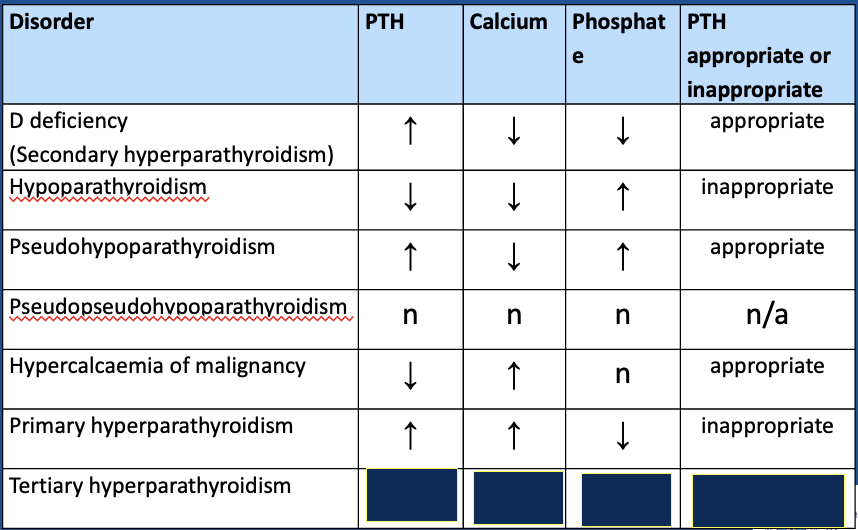
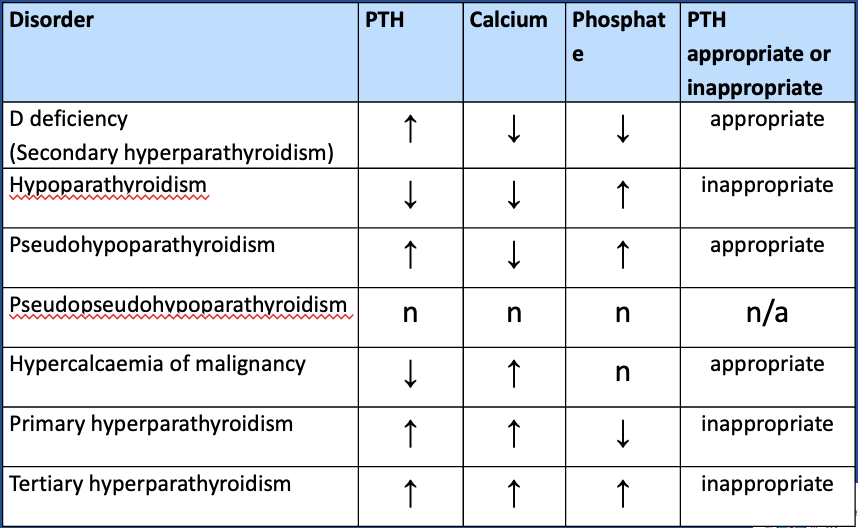
APPROPRIATE
maintains calcium balance
INAPPROPRIATE
causes a calcium imbalance
what is hypocalcaemia
a medical condition where the concentration of calcium in the blood serum drops below the normal range
low serum albumin causes…
low total serum calcium
but
not a low ionised calcium
corrected calcium = ?
corrected calcium = total serum calcium + 0.02 (40 - serum albumin)
state causes of hypocalcaemia (7)
vitamin D deficiency/ osteomalacia
hypoparathyroidism
chronic renal failure
magnesium deficiency
pseudohypoparathyroidism
acute pancreatitis
multiple citrated blood transfusions

what can cause hypoparathyroidism (which causes hypocalcaemia)
post surgery, radiation, autoimmune disease
hereditary (autosomal dominant hypocalcaemia)
syndromes (Di George, HDR)
infiltration (Wilson’s disease, haemochromatosis)
what are the consequences of hypocalcaemia (7)
parasthesia
muscle spasm (hands and feet, larynx, premature labour)
Trousseau’s sign
Chvostek’s sign
seizures
basal ganglia calcification
cataracts
ECG abnormalities
dental hypoplasia
muscle spasms: outline Chvostek’s sign


muscle spasms: outline Trousseau’s sign


how would an ECG of a patient with hypocalcaemia look like
long QT interval

what are some signs/ clues that a patient may have hypocalcaemia (7)
history of neck surgery
presence of other autoimmune conditions
history of congenital defects and immunodeficiency
family history to suggest genetic cause
drug history e.g. anti-epileptics
neck scar, candidiasis, vitiligo, generalised bronzing
growth failure, hearing loss
what does decreased PTH cause (4)

what are the signs of pseudopseudohypoparathyroidism (PPHP) (7)
short stature
obesity
round face
mild learning difficulties
subcutaneous ossification
short fourth metacarpals
other hormone resistance
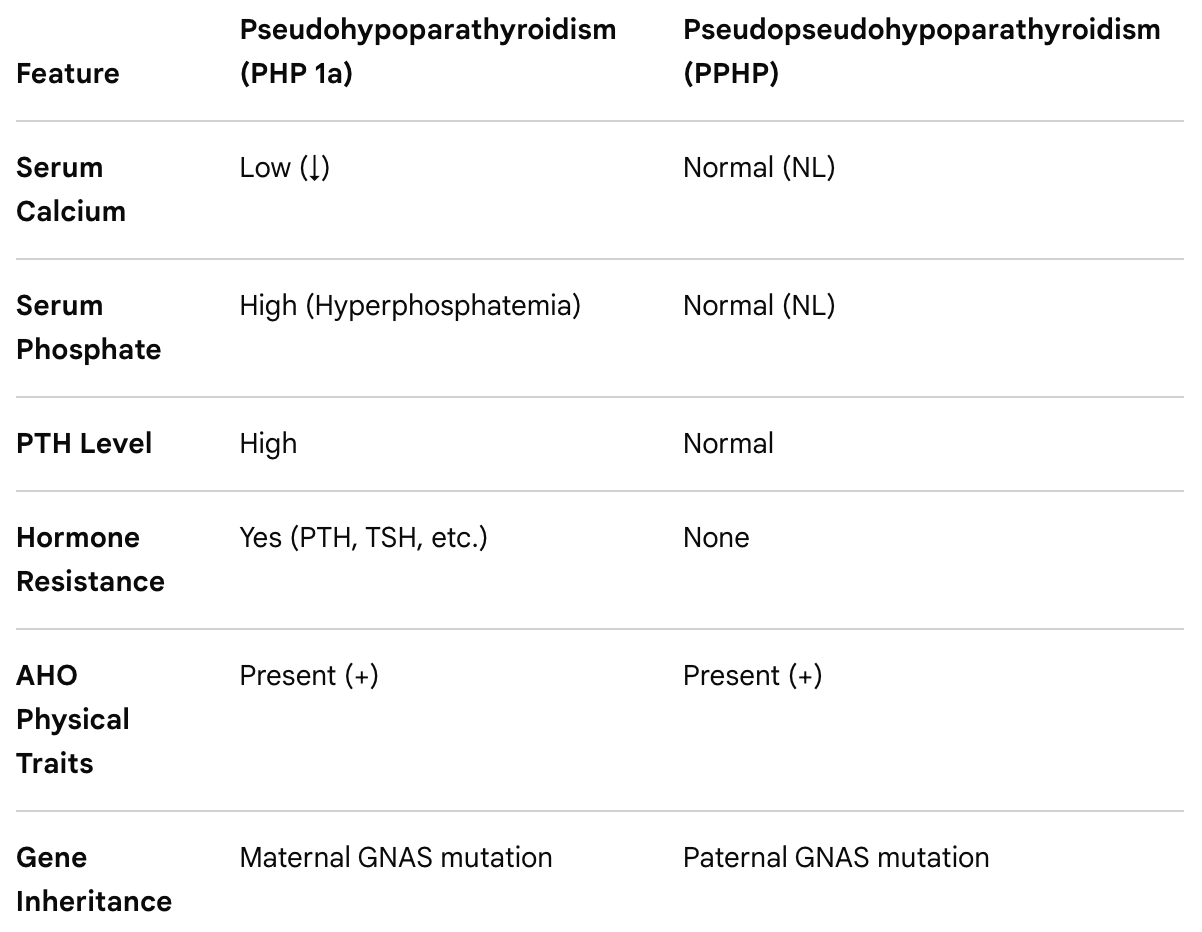
PPHP vs PHP table
pseudopseudohypoparathyroidism = normal Ca metabolism
mild VS severe hypocalcaemia
mild hypocalcaemia
asymptomatic
calcium concentration > 1.9mmol/L
severe hypocalcaemia
symptomatic
calcium concentration <1.9mmol/L
outline the treatment for mild hypocalcaemia
commence oral calcium supplements (AdCal 3 tablets BD)
post-thyroidectomy » Ca supplements and consider adding 1-alphacalcidol (0.25mcg/ day)
if vitamin D deficiency » load with cholecalciferol for 12wks
if hypomagnesaemia » replace Mg
outline the treatment for severe hypocalcaemia
10-20mls of 10% Ca gluconate over 10mins (in 50-100mls of 5% dextrose)
dilute 100mls of 10% Ca gluconate in 1L of normal saline (at 50-100mls/h)
post-operative hypocalcaemia/ hypoparathyroidism » 1-alphacalcidol 0.25mcg/ day
what should always be done when managing abnormal calcium levels
monitor adjusted calcium levels closely
what are differential diagnoses for hypercalcaemia (3)
is it really hypercalcaemia?
tourniquet on for too long
old sample and haemolysed
recheck
what are the main causes of hypercalcaemia (10)
malignancy - bone metastases, myeloma, PTHrP, lymphoma
primary hyperparathyroidism
thiazides
thyrotoxicosis
sarcoidosis
familial hypocalciuric/ benign hypercalcaemia
immobilisation
milk-alkali
adrenal insufficiency
phaeochromocytoma
which two causes of hypercalcaemia are responsible for 90% of hypercalcaemia diagnoses
malignancy: bone metastases, myeloma, PTHrP, lymphoma
primary hyperparathyroidism
what is primary hyperparathyroidism

what are the symptoms of hypercalcaemia
thirst, polyuria
nausea
constipation
confusion coma
what are the consequences of hypercalcaemia
pancreatitis
gastric ulcer
renal stones
ECG abnormalities (short QT interval)

what are the signs of hypercalcaemia (5)
confusion, hypotonia, hyporeflexic (absent muscle reflexes)
dehydration
signs of malignancy
faecal impaction
irregular pulse (arrhythmia, thyrotoxicosis)
give examples of signs of malignancy (5)
enlarged liver
clubbing
thyroid mass
breast lump
lymph nodes
how should you approach identifying/ diagnosing hypercalcaemia (3° hyperparathyroidism)
identify any drugs that may cause hypercalcaemia (thiazides, lithium vitamin D)
identify whether renal failure is present » tertiary hyperparathyroidism
how should hypercalcaemia be investigated
check serum PTH and if normal/ high » perform fractional calcium excretion
if a fractional calcium excretion test is done and the result is over 0.01mmol/L what does this indicate
if PTH normal/ high and fractional calcium excretion > 0.01mmol/L » primary hyperparathyroidism
if a fractional calcium excretion test is done and the result is under 0.01mmol/L what does this indicate
PTH normal/ high and fractional calcium excretion < 0.01mmol/L » familial hypocalciuric hypercalcaemia (FHH)
if serum PTH is low or suppressed, how should this be approached
exclude:
malignancy
hyperthyroidism
Addison’s
sarcoidosis
granulomatous disorders
how do the bones, intestines and kidneys respond to PTH in malignancy
‘hypercalcaemia of malignancy’ = patients with cancer develop high calcium levels in the blood

how common is hypercalcaemia of malignancy and outline it
‘hypercalcaemia of malignancy’ = patients with cancer develop high calcium levels in the blood
≈ 20-30% of patients with cancer develop hypercalcaemia of malignancy
80% of those are due to bony metastases (from breast, thyroid, kidney, lung, prostate cancers)
20% of those are due to PTHrP release (others secrete vitamin D, ectopic PTH)
what other type of hypercalcaemia can occur in malignancy
osteoclastic hypercalcaemia
what is the most common cause of primary hyperparathyroidism
80% are due to a single benign adenoma
15-20% are due to four gland hyperplasia (all 4 parathyroid glands in the neck become large and overactive » excess PTH)
may be part of MEN I or MEN II
<0.5% are malignant
what are consequences of primary hyperparathyroidism
bones
osteitis fibrosa cystica (bone cysts)
osteoporosis
kidney stones
psychic groans
confusion
abdominal moans
constipation
acute pancreatitis
what are the effects of increased PTH in 1° hyperparathyroidism

how is primary hyperparathyroidism managed
surgery

what are indications for surgery to treat primary hyperparathyroidism (6)
serum calcium > 0.25mmol/L from upper limit
creatinine clearance < 60ml/min
T-score < -2.5 at any site
and/ or previous fragility fracture at spine, hip, radius, femoral neck
24h urine calcium > 400mg/day (>10mmol/day)
nephrocalcinosis or nephrolithiasis
< 50yo
what is secondary hyperparathyroidism
a condition where the parathyroid glands produce too much PTH in response to low blood calcium i.e. hypocalcaemia
not due to a tumour like 1° hyperparathyroidism
what is tertiary hyperparathyroidism
a condition where the parathyroid glands become overactive and produce excess PTH which increases blood calcium levels » hypercalcaemia
typically persisting after the underlying cause of 2° hyperparathyroidism e.g. chronic kidney disease has been addressed
what does 3° hyperparathyroidism lead to
nodular hyperplasia: benign overgrowth of normal thyroid cells
nodular autonomy: thyroid lump that produces T3 and T4 independent of the pituitary gland’s secretion of TSH

how is hypercalcaemia managed (6)

summary