Cloning Vectors and Suicide Plasmids
 Call Kai
 Learn
 Practice Test
 Spaced Repetition
 Match
 Flashcards
 Knowt Play
1/23

Earn XP
Description and Tags
Vocabulary practice flashcards covering plasmid cloning vectors, blue-white screening mechanisms, suicide plasmids, and allelic exchange methods for gene knockouts.
24 Terms
Multiple Cloning Site (MCS)
A short region in a cloning vector containing multiple unique restriction enzyme cleavage sites, allowing foreign DNA fragments to be inserted.
pUC18
A 2.686 kb plasmid cloning vector that features an ampicillin resistance gene (amp), a pMB1 origin of replication, and a multiple cloning site embedded within the lacZ\alpha gene.
steps to creating a cloning vector
origin of replication
selection marker
no need for partitioning events
unique restriction sites (multiple cloning sites)
screening of mechanisms (eg. LacZ)
optional - origin of transfer (enables plasmid conjugation)

Plasmid Cloning Vector
think of it as 2 part
1. Plasmid
2. Cloning vector
MCS is embedded in the LacZ region of the plasmid.
If something is inserted in the MCS, it abolishes the function of the LacZ , enabling identification of cloning
Blue-white screening
A screening technique where DNA insertion into a multiple cloning site disrupts lacZ\alpha, causing recombinant colonies to appear white and non-recombinant colonies to appear blue on indicator plates.
Lac operon
with lactose:
trasncription of LacZYA
Lacl is inhibited
no lactose:
no transcription
\alpha-complementation
The reconstitution of functional β-galactosidase enzymatic activity when a plasmid-encoded α-domain complements a chromosomally encoded mutant β-domain in the same cell.
\beta-galactosidase - encoded by the lacZ gene
An enzyme encoded by lacZ that:
cleaves lactose into glucose and galactose
cleaves the chromogenic substrate X-Gal to produce a blue color.
lacI
A regulatory gene encoding the repressor of the lac operon that acts in trans to repress transcription in the absence of lactose.
represseor of lac operon when lcatose is absent
lacY
A structural gene of the lac operon that encodes β-galactoside (lactose) permease.
lacA
A structural gene of the lac operon that encodes β-galactoside (lactose) transacetylase.
IPTG (Isopropyl \beta-D-1-thiogalactopyranoside)
an inducer by binding and de-repressing LacI, enabling transcription of lacZ.
X-Gal
A lactose analogue substrate that turns blue when cleaved by functional beta-galactosidase.
Use of Lac in cloning vectors (picture)
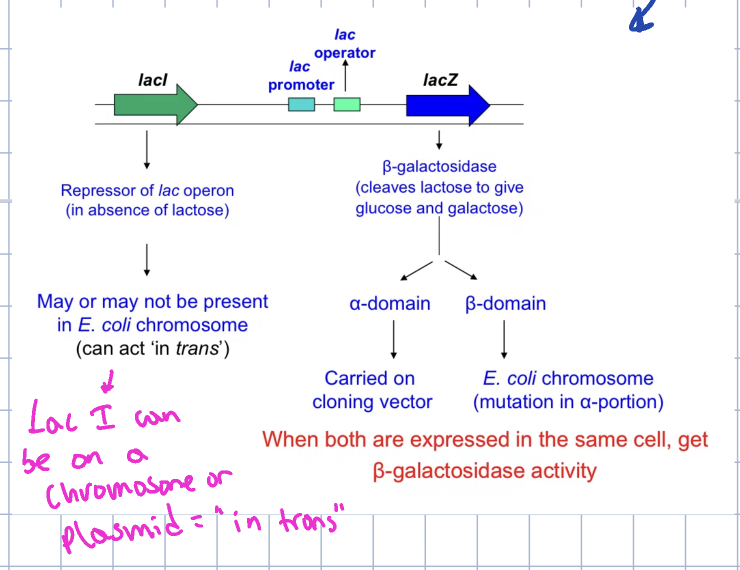
Lacl may or may not be present (acts in trans) in E.coli chromosomes
Lacl can be on a chromosome or plasmid = in trans
Origin of transfer (oriT)
An optional plasmid feature that enables plasmid mobilization and transfer via bacterial conjugation.
Successful vs unsuccessful cloning (picture example)

Suicide plasmid
A plasmid cloning vector with a conditionally defective origin of replication that fails to replicate under specific conditions, used to force chromosomal recombination.
to create a suicide vector/plasmid
no origin of replication —> replication must be conditional
selection marker
no need for partitioning factors
unique restriction sites (multiple cloning sites)
optional - origin of transfer
Allelic exchange
A genetic technique where a chromosomal target gene is replaced by an engineered construct, such as an antibiotic resistance cassette, through homologous recombination.
Null mutant
A mutated strain or cell line created by knocking out and replacing a functional gene of interest with an antibiotic resistance cassette.
Single (1\degree) crossover
The first homologous recombination step during allelic exchange where the entire suicide plasmid integrates into the chromosome, yielding an intermediate that is KanR and AmpR.
Secondary (2\degree) crossover
The second homologous recombination step that excises the integrated plasmid backbone, generating either the desired gene replacement (KanR,AmpS) or a wild-type revertant.
Counter-selectable marker
A gene on a vector whose expression product is toxic or lethal under particular growth conditions, allowing direct positive selection for cells that have lost the plasmid.
sacB
A counter-selectable marker gene whose protein product converts sucrose into a toxic metabolite in Gram-negative bacteria, killing cells that retain the plasmid when grown on 5% sucrose.