Sect. 8.1 - Acid/Base Balance and Buffers
 Call Kai
 Learn
 Practice Test
 Spaced Repetition
 Match
 Flashcards
 Knowt Play
1/71

There's no tags or description
Looks like no tags are added yet.
72 Terms
Acid
a chemical that can donate a H+ ion in solution; proton donor
or a hydronium ion (H3O+) may also accept a pair of electrons
strong acid
has low affinity for H+ and therefore readily dissociates in water to give up H+
Hydrochloric acid (HCl) and Sulfuric acid (H2SO4)
2 examples of strong acids
weak acid
has high affinity for H+ and therefore releases its H+ ion less readily in solution
Acetic acid (CH3COOH) and Ammonium ion (NH4+)
2 examples of weak acids
base
a chemical that can accept a H+ ion; proton acceptor
or a hydroxyl group (OH-) may be formed by donating a pair of electrons
conjugate base
the product of an acid that can react with water
- it can accept H+ ions and act as a base
strong base
readily dissociated to give up hydroxyl ions (OH-)
weak base
has high affinity for OH-
pH
hydrogen ion activity expressed as a negative log of the activity of the solution
7.35 - 7.45
pH reference range
7.4
optimal pH
acidic pH
high concentration of H+
pH < 7..35
basic/alkaline pH
low concentration of H+
pH > 7.45
acid-base balance
the maintenance of homeostasis of the H+ ion concentration of body fluids
buffer
a solution that protects the body by minimizing changes in pH and is the body's first line of defense when body's pH deviates form normal (pH 7.4)
1. bind H+ ions in acidic solutions
2. donate/release H+ ions in basic solutions
What two functions can a buffer perform to maintain the body's pH?
HCO3-
Bicarbonate
H2CO3
Carbonic Acid
CO2
Carbon Dioxide
Bicarbonate buffer system
Hemoglobin buffer system
Phosphate buffer system
Protein buffer system
Four types of buffer systems
Bicarbonate buffer system
Out of the 4 buffer systems, which is the most important?
Bicarbonate-Carbonic acid buffer system
Bicarbonate buffer system is also known as:
Bicarbonate buffer system
this buffer system accounts for the majority of the total buffering capacity in the extracellular spaces of the body
has low buffering capacity, but is the most important
bicarbonate (HCO3-)
Conjugate base in the bicarbonate buffer system
carbonic acid (H2CO3)
Weak acid in the bicarbonate buffer system
Respiratory and Metabolic
2 components of the Bicarbonate buffer system
Respiratory Component
plays a role in CO2 exchange between the blood and the lungs by controlling respiratory rate
helps regulate Carbonic acid (H2CO3)
Metabolic Component
kidneys alter the HCO3- concentration with the amount of substances that are reabsorbed or filtered through renal tubules
immediate, but not sustainable
Regulation of CO2/H2CO3 (carbonic acid) is under the control of the pulmonary system (lungs)
This control is _______________
**hint: can't hyperventilate or decreased breathing forever
slow, but more sustainable
Regulation of HCO3- (bicarb) is under the control of the kidneys.
This control is _______________
faster breathing
How do the lungs get rid of CO2 to balance pH?
slower breathing
How do the lungs retain CO2 to balance pH?
filtered through the renal tubules
How do the kidneys get rid of HCO3- to balance pH?
reabsorbed through renal tubules
How do the kidneys retain HCO3- to balance pH?
20:1
What is the ratio of bicarbonate to carbonic acid when the body pH is normal?
need much more due to high production of CO2 as a by-product through various cellular functions
Why do we need more bicarbonate (20) compared to carbonic acid (1)?
dissolved CO2 (dCO2)
carbonic acid (H2CO3)
bicarbonate (H2CO3-)
hydrogen (H+)
the concentration of total CO2 (tCO2) is made up of (4):
dCO2
more concentrated in the tissues & easily diffuses out into plasma & RBCs
pulmonary system
In the plasma, the regulation of H2CO3 (carbonic acid) is under the control of which system?
kidneys
Plasma HCO3 (bicarb) is under the control of which organ?
Henderson-Hasselbalch equation
important in understanding how bicarb-carbonic acid buffer system regulates acid-base balance

pKa: equilibrium constant
What does pKa represent in the Henderson-Hasselbalch equation?
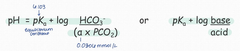
6.103
What is pKa (equilibrium constant)?
a x PCO2: concentration of carbonic acid (H2CO3)
What does a x PCO2 represent in the Henderson-Hasselbalch equation?

PCO2: partial pressure of CO2 in the plasma when it is in a gaseous state
What does PCO2 represent in the Henderson-Hasselbalch equation?

a: solubility constant
What does a represent in the Henderson-Hasselbalch equation?

0.0306 mmol/L Hg
What is a (constant)?
Hemoglobin buffer system
this buffer system is an internal mechanism in RBC that helps keep blood pH stable by reversibly binding or releasing H+ ions
allows for large amounts of CO2 without changing pH
carbonic anhydrase found in RBC membrane
What is the enzyme responsible for the conversion of PCO2 and water to form carbonic acid in the RBC, and the location of this enzyme?
H+ and HCO3-
Once inside the RBC, the majority of PCO2 forms H2CO3 and then quickly dissociates to:
H+ out (a build-up would increase acidity)
What is the isohydric shift of the hemoglobin buffer system?
HCO3- out, chloride in (a build-up would increase alkalinity)
What is the chloride shift of the hemoglobin buffer system?
carbaminohemoglobin
PCO2 that does not get converted to H2CO3 will attach to the amino acid chains of hemoglobin forming
Phosphate buffer system
this system is important in order to maintain the equilibrium between concentration of H+ ion and OH- (hydroxide) ions within RBCs
internal fluid of all cells
Where does the phosphate buffer system operates?
Dihydrogen phosphate (H2PO4-)
What is the chemical buffer of the phosphate buffer system?
Proteins
make excellent buffers
typically has hundreds of amino acids with functional side groups which allows them to act as buffers
intracellular buffers
The majority of protein buffers are _________ buffers, with a small percentage occuring in the plasma
terminal groups of amino acids
The buffering capacity of proteins comes from
Carboxyl and Amino groups
What are the 2 terminal groups of amino acids found on proteins that allows them to act as buffers?
carboxyl group (O=C-OH)
weak acid of protein buffer system
amino group (NH2)
weak base of protein buffer system
the amino group (NH2) will bind H+ in order to raise pH
How does the protein buffer system respond to an acidic (low pH) environment?
the carboxyl group (O=C-OH) will dissociate to release H+ in otder to lower pH
How does the protein buffer system respond to an basic/alkaline (high pH) environment?
albumin
protein that contributes the majority of the protein buffering capability
albumin has 16 side groups
Why is albumin a great buffer?
CO2
major source of acid in the body
HCO3- (bicarb) will accept H+ to form H2CO3 (carbonic acid) (left shift)
What occurs when acid is added to the body?
To compensate, the body will try to balance acidity by donating H+ ions (right shift)
What is the compensation if body fluid becomes too acidic (low pH)?
H2CO3 (carbonic acid) will donate H+ to form HCO3- (bicarb) (right shift)
What occurs when base is added to the body?
To compensate, the body will try to balance alkalinity accepting H+ (left shift)
What is the compensation if body fluid becomes too basic (high pH)?