Ch 22 Physiology- Yui Hisanaga
 Call Kai
 Learn
 Practice Test
 Spaced Repetition
 Match
 Flashcards
 Knowt Play
1/30

There's no tags or description
Looks like no tags are added yet.
31 Terms

What is the primary function of the digestive system? What is the other name for it?
The primary function of the digestive system is to move nutrients, H2O, electrolytes, from the external environment to the internal environment.
The other name for it is the gastrointestinal system or GI tract.

The major organs of the GI system include the oral cavity and salivary glands, esophagus, stomach and pyloric valve, small intestine, and large intestine. What purposes do they all serve?
Oral Cavity and Salivary Glands: this is where mechanical and chemical digestion begin, and involves secretion (saliva being secreted by saliva glands)
Esophagus: muscular oral tube that connects to the stomach
Stomach and Pyloric Valve: a place for mechanical and chemical digestion. Creates chyme (pulpy mass of partially digested food) and regulate entry into small intestine (spynchter).
Small Intestine: includes the duodenum, jejunum, and ileum. Receives secretions from accessory organs (liver and pancreas). Carries out most of the digestion and absorption.
Large Intestine: absorb H2O and electrolytes, which convert chyme into feces. Then, feces is passed from the rectum through anus. (final checkpoint)

What are the 4 layers of the GI tract wall (from lumen to out)? Include some of their main functions/features as well.
Mucosa: secretes mucus, enzymes and hormones. This absorbs end products of digestion- takes it through bloodstream or lymphatic system to nourish your body.
Submucosa: rich blood supply of blood vessels, lymphatic vessels and nerve fibers.
Muscularis Externa: inner circular layer and outer longitudinal layer of smooth muscle. (many different shapes and layers of muscle). Responsible for segmentation and peristalsis. This layer also contains additional nerve fibers from enteric nervous system.
Serosa: aka visceral peritoneum


What are the 4 main patterns of muscle contraction in the GI tract? What is the function of each?
Migrating Motor Complex (MMC): “House keeping”. Moving and sweeping content that’s been left behind. Occurs every 1½ hours-2 hrs. This proces only occurs during fasting.
Peristalsis: Series of wave-like muscle contractions that moves food and chyme along your gastrointestinal tract. In one direction.
Segmentation: Mixing food content. Little or no net forward movement. Largely in small intestine.
Tonic Contraction: Continuous, steady low level muscle contraction. Used by sphincters, maintain a constant squeeze to keep passage closed until a way of peristalsis tells them to relax and let food pass through.

What are slow wave potentials? Some of it’s characteristics?
What are modified smooth muscle cells called?
How are the strength and duration of smooth muscle contractions modulated in the GI tract? They are under graded potentials?
Relationship between action potentials and contractions?
Slow Wave Potentials: spontaneous cycles of smooth muscle contraction/relaxation. Action potentials only fire when slow wave potentials exceed it’s threshold.
Modified smooth muscle cells: interstitial cells of cajal (ICC)
Kind of autorhythmic cells on heart
The strength and duration of smooth muscle contractions are under neural, hormonal, and local control. Or, muscle contraction is graded based on intracellular Ca2+ levels.
More action potentials, more stronger contractions of duration.

What is the deglutition reflex?
What are 3 steps to it?
What triggers the reflex?
What neurons cause the elevation of nasopharynx and larynx and relaxation of upper esophageal sphincter?
What moves bolus down?
How does food move through the esophagus?
What structure allows food to enter the stomach?
Deglutition: swallowing reflex
The tongue pushed bolus against soft palate and back of mouth, which triggers the swallow reflex
Breathing is inhibited as the bolus passes the closed airway. The airway is closed because the epiglottis
Food moves downward into the esophagus, propelled by peristaltic waves and aided by gravity.
Food moves through the esophagus to the stomach by peristalsis
The gastroesophageal sphincter opens, and food enters the stomach
Trigger: The pressure of bolus against soft palate activates sensory neurons
Somatic motor neurons cause elevation of nasopharynx and larynx and relaxation of upper esophageal sphincter
Bolus moves into esophagus and is pushed toward the stomach by peristaltic contractions

What are the 3 steps in food being digested in the stomach?
What is the superior half and inferior half of the stomach?
What is enhanced gastric motility stimulated by?
Propulsion: Peristaltic waves moves from the fundus toward the pylorus
Grinding: The most vigorous peristalsis and mixing action occur close to the pylorus
Retropulsion: The pyloric end of the stomach acts as a pump, which delivers small amounts of chyme into the duodenum, simultaneously forcing most of its contained material backward into the stomach
Superior Half: temporarily stores food
Inferior Half: works to break down food and mix with enzymes and acid
Enhanced gastric motility is stimulated by stomach distension and is under neural control

How is food moved through the small intestine?
What happens in segmentation and peristalsis? What is motlin? MMC?
What valve opens in response to stomach movement?
Food is moved through segmentation and peristalsis. Segmentation is much more common, and peristalsis only begins after sufficient absorption.
Segmentation:
Spread chyme to allow for more effective absorption
Pace of interstitial cells of cajal is faster than in the stomach (12 waves/min)
Intensity of waves is regulated by the parasympathetic nervous system
Peristalsis:
Occurs in response to release of motlin (hormone that triggers MMC) by dudoenum. motlin (house keeping signal that triggers wave of muscular activity to sweep leftover food) and MMC is the actual migrating motor complex that perform housekeeping contractions.)
Waves occur every 90 mins
Long distance peristaltic waves would cause diarrhea- if powerful long distance peristaltic wave forcefully sweeps everything through then there would not be absorption: so water and unabsorbed material will be dumped to large intestine- resulting in watery stool.
Ileocecal valve relaxes and opens in response to stomach activity

Is the musculature of large intestine typically active?
What does the presence of chyme trigger? What does it do?
What are mass movements and how often does it occur?
What initiates the defecation reflex?
Roughly, what are the 3 steps in the defecation reflex and how it has to do with the spinal reflexes?
No, usually it is inactive
Chyme triggers haustral contractions (slow, rhytmic segmenting movements that occur in the large intestine)
Mass movements (peristalsis) occurs through colon 3-4 times a day
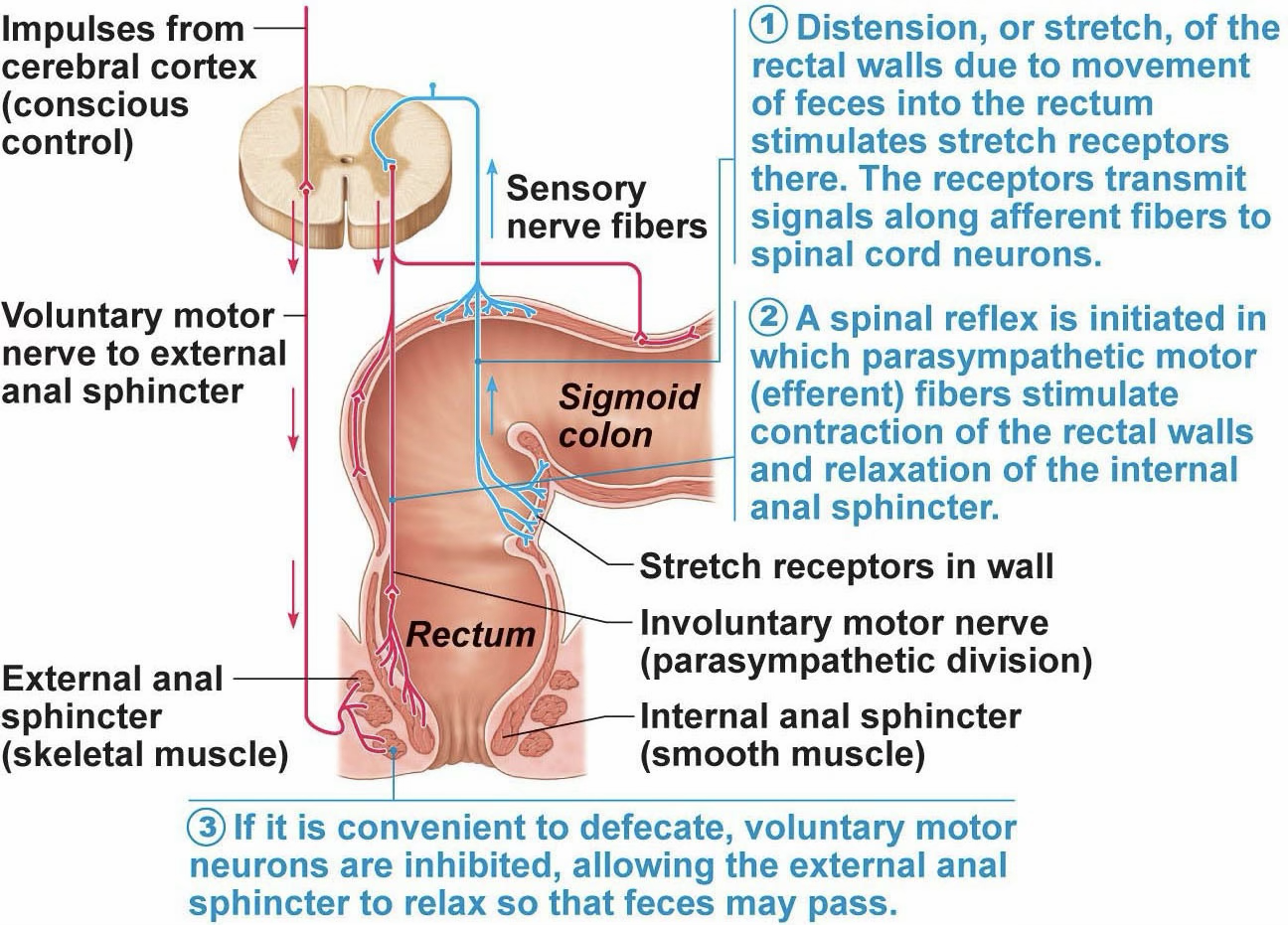
Stretching of rectal wall initiates defection reflex.
Distension, or stretch, of the rectal walls due to movement of feces into the rectum stimulate stretch receptors there. These transmit signals along afferent fibers to spinal cord neurons.
A spinal reflex is intiated in which parasympathetic (efferent) fibers stimulate contraction of rectal walls and relaxation of the internal anal sphincter
If it is convenient to defecate, voluntary motor neurons are inhibited, allowing the external anal sphincter to relax so that feces may pass
What secretes saliva? What are some of it’s functions?
What does it mean that saliva is hyposmotic? What are the 2 enzymes in your saliva?
How is salivation controlled? What can trigger it?
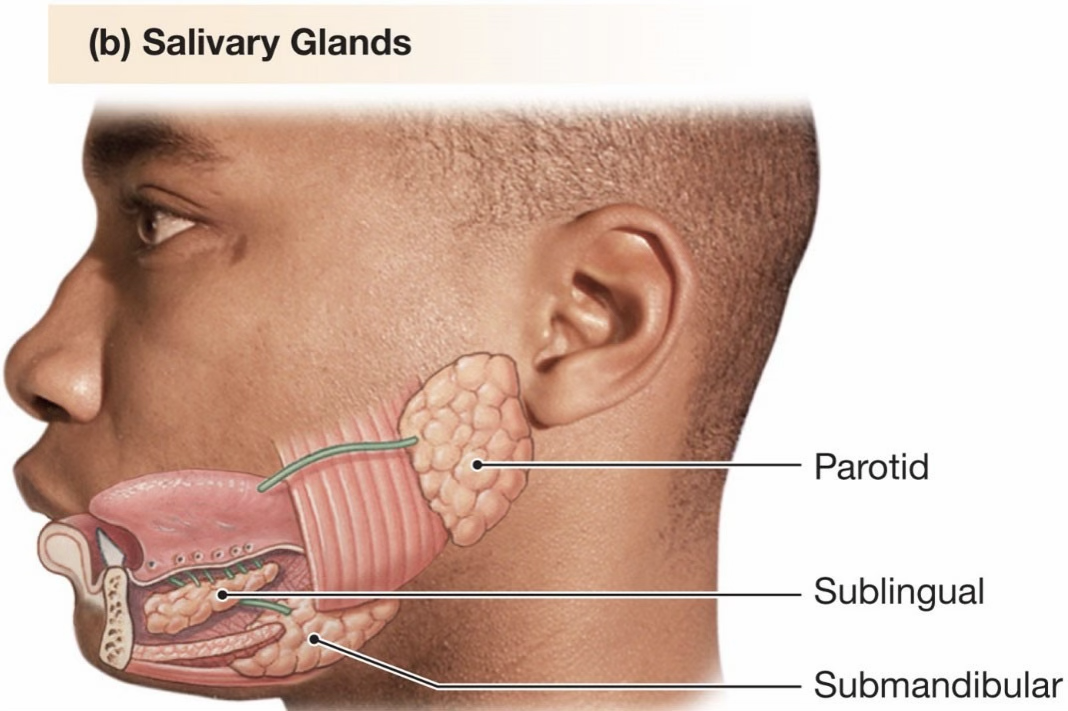
Salivary glands secrete saliva
Functions: cleanses mouth, dissolves tastant molecules, moistens food to aid in bolus production, and begins chemical digestion
Salivation is a complex hypoosmotic fluid because saliva has a lower concentration of solutes compared to your body’s blood and ECF. Diluted and watery compared to blood.
97-98.5 water, electrolytes, mucus, metabolic wastes (urea) antibodies, and enzymes (salivary amylase (digest carbohydrates) and lingual lipase (absorb fat))
Controlled by autonomic nervous system. ie. parasympathetic for digesting and sympathetic (dry mouth which decreases saliva)
Can be triggered by sight/smell of food (food-forward response)
What are the 4 cells that play a part of the “gastric pit?”
And what they each produce?
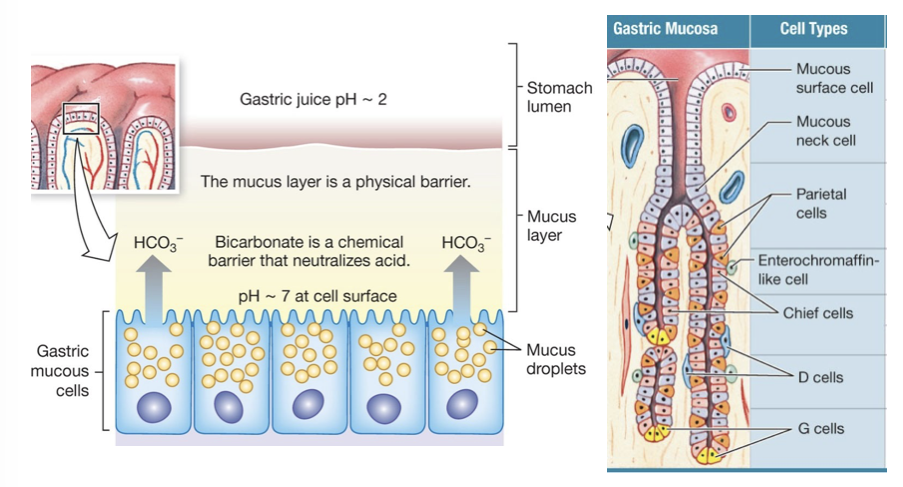
G (enteroendocrine) Cells: produce gastrin into the blood, which stimulate acid production.
Parietal Cells: secrete hydrochloric acid (HCl) into the lumen of the stomach. Cuts and activates pepsinogen, denatures proteins, and kills microbes.
Chief Cells: released pepsinogen which is convert into pepsin by H+. (targets and breaks down long protein chains like meats, eggs, beans)
Mucous Cells: secrete mucus and HCO3- over the surface of the mucosa to protect it from acid and pepsin, because the gastric juices are so acidic.
What do crypt cells and HCO3- secretion do?
Crypt Cells: small and large intestines secrete an isotonic solution of NaCl which mixes up with mucus for lubrication. This allows for a smoother passage and aids in absorption
HCO3- secretion from duodenal cells and pancreas neutralizes acid entering from stomach.
What do pancreatic duct cells secrete into the common bile duct?
What does secretin do?
What do pancreatic acinar cells secrete? And in response to what?
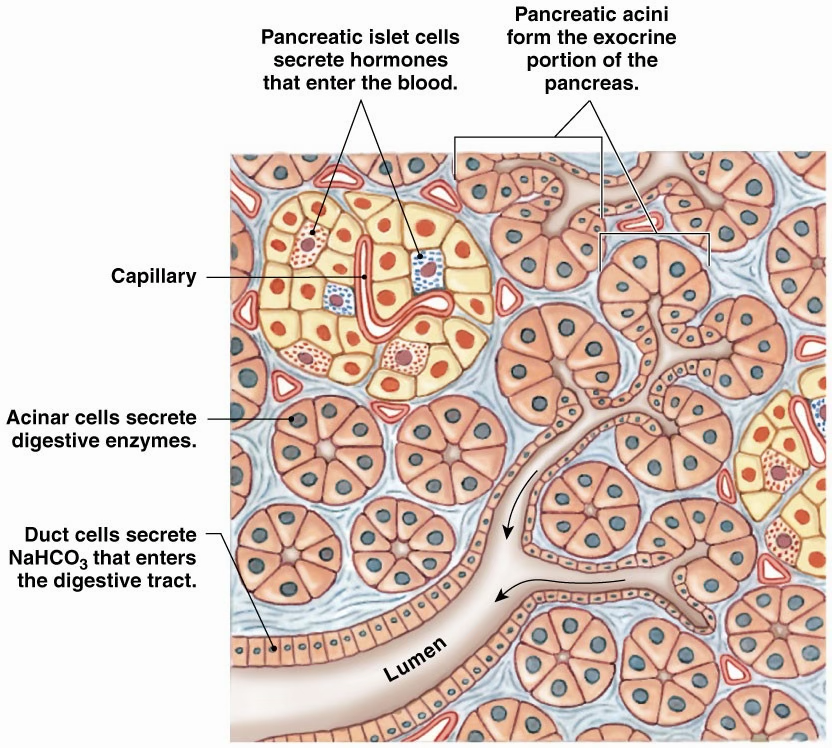
Pancreatic duct cells secrete NaHCO3 into common bile duct (neutralize harsh stomach acid and protect small intestine lining from getting burned)
Acidic chyme hits the duodenum, and EEC cells secrete secretin into the blood, in which the pancreas secretes HCO3- (neutralizes the acid)
Pancreatic acinar cells secrete digestive enzymes in response to cholecystokinin (CKK). These are triggered by fats and proteins in your chyme.
The presence of peptides or fats in the dudoenum leads to EEC cells secreting CCK into the blood, in which in response the pancrease secretes enzymes
Enzymes are secreted into the common bile duct as inactive forms (later activated in dudodeum)
What is the activated from of trypsinogen? What activates it?
What is the “brush border”?
Trypsinogen becomes trypsin. This is activated by enteropeptidase.
Once trypsin is turned on, it acts like a domino effect which activates all the other digestive enzymes.
Brush border: microvilli that is physically anchored onto cell membrane which makes sure your body is ready to absorb the nutrients.

What are hepatocytes? What do they produce? What are the parts of bile?
Where is bile secreted into? What stimulates the contraction of the gallbladder?
Hepatocytes: are in the liver and produce bile.
Bile Salts: facilitate fat digestion
Bile Pigments like billirubin, cholesterol, drugs, are waste products your liver has filtered out.
Bile is secreted into the common bile duct.
Bile is collected in gallbladder between meals. The CKK stimulates the contraction of the gallbladder, which empties into the duodenum.

In summary, what is the whole process of digestion? (6 parts)
GO OVER THIS WITH CHARLES
Chyme enters the duodenum. This causes the release of CCK and secretin from duodenal enteroendocrine cells.
CCK and secretin enter the blood stream
CCK induces secretion of enzyme rich pancreatic juice. Secretin causes secretion of HCO3 rich pancreatic juice.
Bile salts to a lesser extent, secretin is transported via bloodstream, and stimulate liver to produce bile more rapidly.
CCK (through the bloodstream) causes the gallbladder to contract and the hepatopancreatic sphincter to relax, and bile enters the duodenum.
During cephalic and gastric phases, vagal nerve stimulation causes weak contractions of gallbladder.

What kinds of things are absorbed in the small intestine?
What is a brush border and structures that make it up? What’s it’s function?
How are non polar and polar substances absorbed?
How are fats absorbed? What about most nutrients?
Most water, virtually all macronutrients, 80% of electrolytes
A brush border contains villi. This greatly increases the surface area ad increases absorption.
Nonpolar substances can just diffuse passively across the lipid bilayer, but polar substances must be absorbed via carrier proteins
Within villi, most nutrients will enter capillaries. And, fats will enter through lacteals.

How does chemical digestion of lipids begin?
What happens in the mouth?
What structure in bile helps this?
What enzyme helps displace bile salts?
Chemical digestion of lipids begin in the oral cavity by lingual lipase which starts the digestion of fats.
Bile Salts: which are amphipathic (fat loving and water loving) surround the lipid and break them into more droplets. This will allow lipase to easily latch on and digest the fats, because without the bile salts, lipase are water soluble.
Lipases cannot access lipids unless co-lipase displaces some of bile salts. Colipase is a co-enzyme that will push aside (displace) the surrounding bile salts which creates a small opening for the colipase to start breaking down the fats.

How are lipids absorbed?
What are micelles?
What are chylomicrons?
Lipids are absorbed by:
Bile salts from liver coating fat droplets
Lipase and co-lipase breaking down fats into monoglycerides and fatty acids, forming a micelle.
They move out of micelles and enter cells through diffusion
Cholesterol now transported into cells
Then, chylomicron is formed by combining cholestrol with proteins
They are removed by going into lacteals (part of the lymphatic system)
Micelles: associations of bile salts that contain various lipids (eg. fatty acids, cholestrol)
Chylomicrons: formed inside of cells, that combines cholesterol and triglycerides with protein- which are absorbed into lacteals.

How are carbohydrates chemically digested? What is the flow of glucose polymers to disaccharides?
What 2 carbs are not digestible?
Glucose Polymers: Starch and Glycogen get broken down by amylase (coming from salivary glands and pancreas). These disaccharides travel through the brush border of small intestine.
Then, Disaccharides:
Maltose: get broken down into 2 glucose by maltase.
Sucrose: gets broken down into 1 glucose and 1 fructose by sucrase.
Lactose: gets broken down into 1 glucose and 1 galactose by lactase.
The 2 carbs that are not digestible are cellulose and sucralose.

How are carbohydrates absorbed?
ie. How are glucose and galactose absorbed?
How is fructose absorbed?
Glucose and galactose enter epithelial cells via co-transport with Na+ and exit epithelial cells via facilitated diffusion.
Fructose enters and exits epithelial cells via facilitated diffusion.

How are proteins chemically digested?
What is the difference between endopeptidases and exopeptidase?
What are some examples of each?
Proteins are chemically digested by peptidases which are enzymes that break down proteins by cleaving peptide bonds.
Endopeptidases: Digest internal peptide bonds. They cut peptide bonds in the middle of a protein or polypeptide chain. They act as “choppers” that take down long, bulky protein chains and chop them into smaller, more manageable peptide fragments.
Pepsin (stomach)
Trypsin (small intestine)
Chymotrypsin (small intestine)
Exopeptidases: Digest terminal peptide bonds to release amino acids. at the very beginning or the very end.
Aminopeptidase (small intestine)
Carboxypeptidase (small intestine)

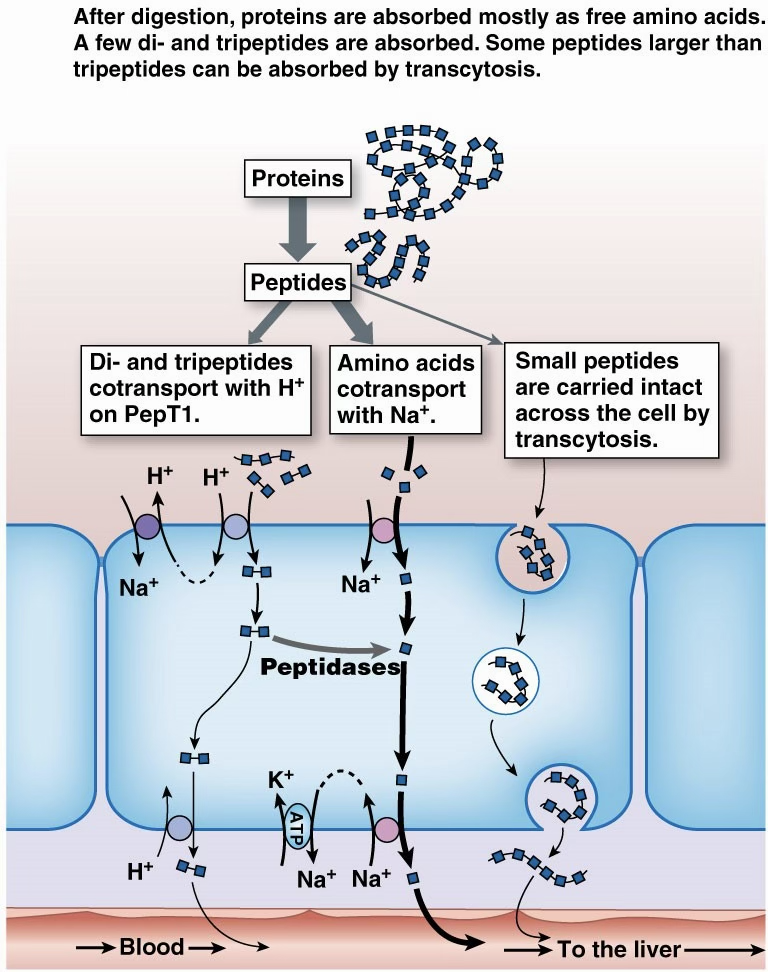
How are proteins absorbed?
What about Di- and tripeptides?
How do amino acid exit?
What about larger peptides?
Proteins are absorbed mostly as amino acids, through co-transport with Na+.
Di- and tripeptides may be absorbed via co-transport with H+.
Amino acids can also exit via co-transport or facilitated diffusion with Na+
Larger peptides may be carried across the cell via transcytosis.
How are vitamins and minerals absorbed?
How are fat-soluble vitamins absorbed? What are they?
What about water-soluble vitamins? What are they?
What about vitamin B12?
What’s special about iron and calcium?
Fat soluble vitamins (A,D,E,K) are absorbed in small intestine, along with fats
Waters soluble vitamins (C and mostly B) are absorbed by mediated transport
Vitamin B12 is absorbed in ileum, but only if bound to intrinsic factor (which are secreted by parietal cells. This intrinsic factor protects B12 as it travels down the digestive track so that B12 won’t get destroyed by digestive enzymes or simply pass right through your system unabsorbed.)
Iron and calcium are 2 of the few substances whose intestinal absorption is actively regulated- meaning your body can intelligently control how much of them lets in, based on what you currently need.

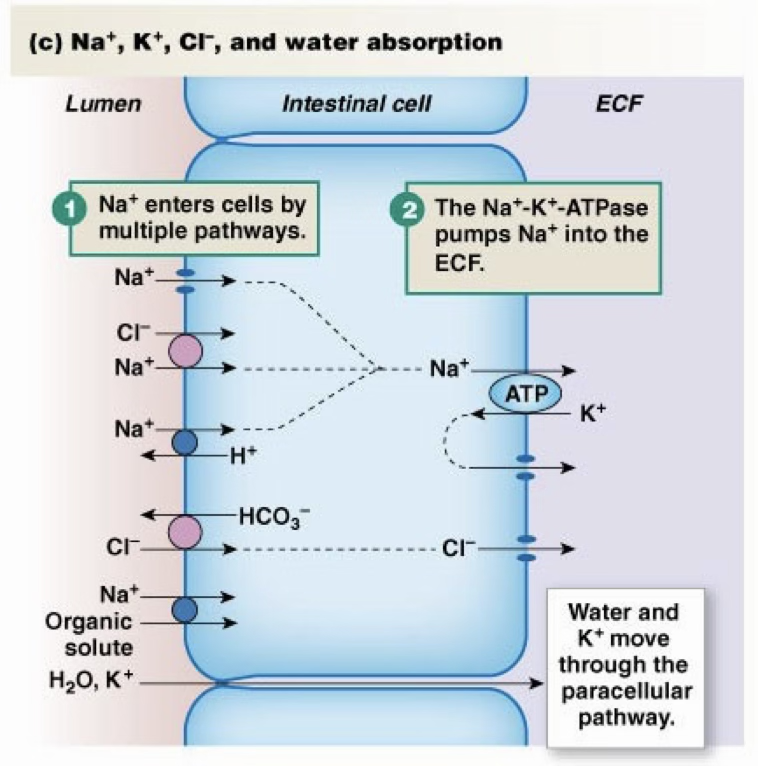
How are ions and water absorbed?
Where in the body is most H2O absorbed?
What movement does water follow?
What is the movement of Na+ and water?
Most H2O are absorbed in small intestine. (additional 0.5 L/day absorbed in colon)
H2O typically follows osmotic gradient, that’s created by solute movement
Na+ is transported into the cell by multiple channel, which then causes Na+ to be transported into the ECF by the Na+-K+ pump, which then H2O follows through the paracellular pathway (tiny spaces between cells)
What is the Cephalic Phase (1st phase of digestion)?
It activates neurons but where?
What 3 things does it stimulate?
Cephalic Phase: triggered by sight, smell, or thought of food (feed-forward response)
Stimuli activate neurons in hypothalamus and medulla oblongata
It stimulates the…
secretion of saliva
contraction of muscles in stomach
some secretion of HCl in stomach.

What is the Gastric Phase (2nd phase of digestion)?
What is distension of stomach and presence of peptides and low acidity (what’s being secreted here)?
What is the gastroileal reflex?
Gastric Phase: 2nd phase of digestion that takes place in the stomach.
This starts by stimuli of 2 events:
Distension of stomach: activation of stretch receptors, which increase gastric motility and secretion of HCl (activates pepsinogen)
Presence of peptides and low acidity: G cells that are secreting gastrin, which promote acid HCl release by parietal cells (which promote pepsinogen release. - which become pepsin later)
Gastroileal Reflex: ileum undergoing peristalsis, which moves contents into colon.
ie. sends signal to ileum to relax and increase its motility. clear out end of small intestine to make “room” for incoming food that’s currently being digested higher up in stomach.
What is the Intestinal Phase? (3rd phase of digestion)?
What is the enterogastric reflex?
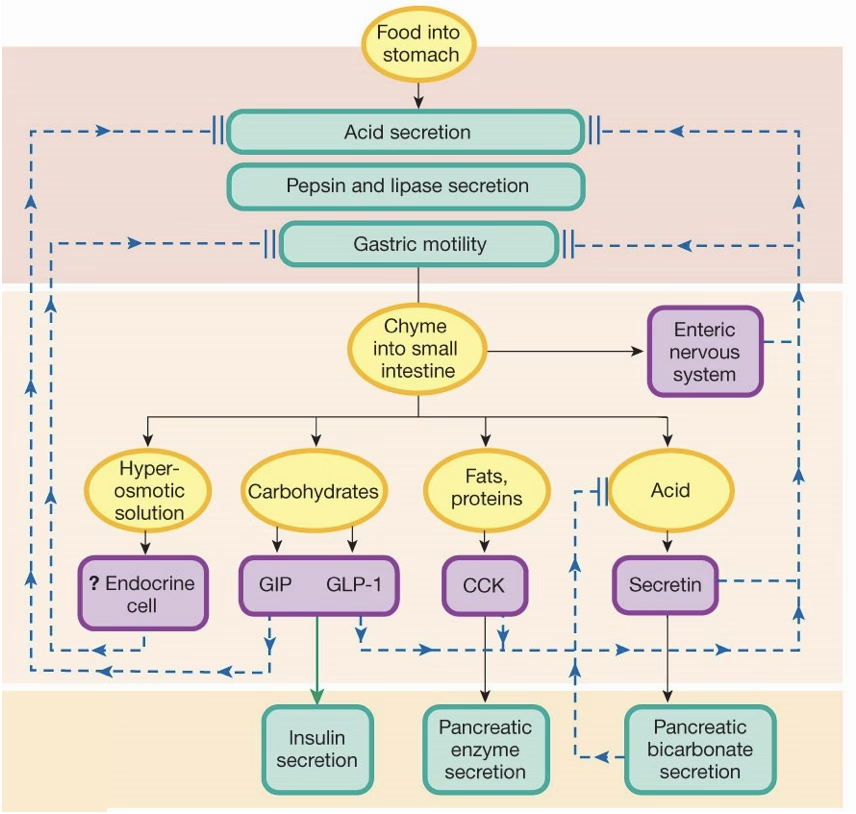
Intestinal Phase: triggered by distension of duodenum and presence of acidic chyme.
Stimulate continued secretory activity in stomach (but only briefly)
Stimulate pancreatic secretion of HCO3- (through secretin from G cells)
Stimulate pancreatic secretion of enzymes (via CCK from G cells)
Stimulate contraction of the gallbladder and release of bile
Enterogastric Reflex: inhibits gastric motility. send message back up to the stomach to slow down gastric emptying. acting like a brake system; ensuring that your small intestine isn’t flooded with too much acid or too much food at once.
What are the 2 ways that the GI tract helps with immune functions?
What are Peyer’s Patches?
The GI tract has immune functions because the GI tract is constantly exposed to potential pathogens.
Physiological defenses: like mucus, digestive enzymes, and acid.
White blood cells that are in the GI tract prevents pathogens from entering body through absorption.
Peyer’s Patches: scattered throughout the small intestine, but most concentrated in ileum. They provide information about contents of lumen to immune cells.
Allows immune system to mount a defense against harmful pathogens, before they can cross the intestinal lining and enter your bloodstream.
ie. large, organized clusters of lymphoid tissue. Serving as a “security checkpoint.”

What is emesis?
What is it caused by?
What’s it’s function?
What could it cause?
What is diarrhea? What is it caused by?
Emesis: forceful expulsion of gastric (and sometimes duodenal) contents from the mouth.
Caused: by extreme stomach/duodenal distension or irritants.
Function: remove toxic material from GI tract, before it can be absorbed
Can Cause: dehydration or metabolic alkalosis (due to loss of acid)
Diarrhea: watery stools, that are caused when intestinal secretion is not balanced by absorption.
What is “our resident flora?”
What are the 5 things that these bacteria do?
How are they kept in check so that they remain in the colon? What is IBD?
The bacterial flora: of large intestine includes about 1,000 discrete types of bacteria.
Metabolize some host-derived molecules
Ferment some indigestible carbohydrates (eg. cellulose)
Release irritating acids and odorous gases
Synthesize B complex vitamins and most of the vitamin K that’s needed by the liver to synthesize clotting proteins (eg: vitamin K shot)
Modulate mood
Most enteric bacteria are harmless if they remain in the colon.
Kept in check by antibody-mediated response restricted to gut lumen.
IBD: is inflammatory bowel disease. This is an abnormal immune/inflammatory response to bacteria, that would normally occur in intestines.
