Evolution exam three
 Call Kai
 Learn
 Practice Test
 Spaced Repetition
 Match
 Flashcards
 Knowt Play
1/58

There's no tags or description
Looks like no tags are added yet.
59 Terms
proximate vs ultimate
proximate —> mechanistic, “how”
ultimate —> evolutionary, “why”
explanation cascade
ultimate cause —> proximate cuase —> observation
ex. selection of beetle horn —> development of beetle horn —> beetle horn
what is development, what does development generate, and what does development underlie
development is a process that enables and constrains evolution
changes in development generate new phenotypes on which selection can act
development generates phenotypes
a process that converts single cell into an organism with differentiated cells
every cell has essentially the same genome, differences in cells are due to what genes are being expressed
development underlies diversity
do species look more similar early on in development or later?
most species’ specific differences happen later in development (all look like little blobs at the start)
allometry
same physical body parts but with different proportions
also describes when different parts of the body grow at different rates (i.e a babies head and brain dont get much bigger compared to their limbs)
this is cuz development often involves variations of the same processes
heterchrony
the same parts in an ancestor and a descendent grow at different rates proportional to their bodies
Instead of evolving entirely new genes or body parts from scratch, organisms achieve dramatic new adult shapes simply by shifting when existing developmental processes start, how fast they run, or when they stop.
what is development driven by?
development is driven by gene expression differences in different cells
cells have same blueprint but certain parts get turned on or off which make them different from eachother
homeotic genes
transcription factors that drive expression of different genes during development
conserved across species (ex if the gene that controls head development in a mouse gets replaced with the gene that controls head development in a fly, the mouse head will still develop normally cuz the genes are “universal”)
Hox are a subset of homeotic genes
when homeotic genes are expressed and the wrong place during development some weird morphologies happen (leg in wrong spot of double set of wings in insects)
effect of mutation on a homoeotic gene vs mutation in enhancer sequence
mutation in homeotic genes block (or causes) the binding to a “master” transcription factor which then blocks expression of multiple at once genes
mutations in enhancer sequence cause a change (block or bind to) in a single DNA binding site and causes a change in expression in only the gene related to that enhancer
correlation of traits
development can generate correlations between traits (size of top and bottom jaw)
correlation can increase evolvability —> one mutation changes all the correlated traits (one mutation changes both the top and bottom jaw)
correlation can also decrease evolvability —> tradeoffs
whrter traits are developmentally correlated can evolve/change
phenotypic plasticity
trait varies as a result of the environment
ex —> turtle sex (male vs female) is temperature dependent
blue lines

canalization
trait is constant across the environment (environment doesn’t change trait)
red line

discrete vs continuous traits
discrete —> Traits that fall into distinct, separate categories with no intermediate or blending forms. You either have a specific phenotype or you do not.
yellow or green pea, smooth or wrinkly pea, purple or yellow flower
continuous —> Traits that form a smooth spectrum or continuum of small variations from one extreme to another
skin color
why are some traits more variable than others?
the genotype could depend on alleles at many different loci (polygenic, which mean they have a large number of possible allele combinations)
the number of possible phenotypes increases with the number of loci
for each genotype, the phenotype is influenced by the environment which overall creates many phenotypes
does quantitative genetics predict the evolution of discrete or continuous traits?
continuous traits!
continuous traits = lots of loci + environmental factors
what do these equations and variables represent: P = G + E and Vp = Vg + VE
P = phenotype
G = genotype
E = environment
use this equation to figure out how much of a population's trait variation is due to inherited genes versus local environmental conditions
Vp = variance of phenotype
VG = variance of genotype
VE = variance of environment
use this equation to help solve the broad and narrow sense heritability equations
broad sense heritability
helps to determine how much variation in a trait is from genetic variation
H2 = VG / VP
additive genetic variance (Va)
portion of genetic variation that is transmitted from parents to offspring
VG = VA + VNA
VNA = non addititve
Narrow sense heritability
used to predict how traits are passed from parents to offspring and how a population will respond to selective breeding
h2 = VA / VP

breeders equation
used to predict the response to artificial or natural selection
R = h2 S
R = response to selection
h2 = heritability
S = selection differential
selection differential (S)
the difference between the average trait value of the individuals selected as parents and the average trait value of the entire starting population

Fill in the blalnk: Selection ____________(reduces/increases) genetic variation for a trait, ___________(reducing/increasing) heritability over time
reduces, reducing
two ways to calculate h2
slope of regression of mid-parent vs offspring
selection response/selection differential
properties of h2
IF h2 IS ZERO/LOW —> all the variance is due to env
IF h2 IS HIGH—> all the variance is due to genotype
its not a property of an individual —> property of a population in a specific env
h2 is not fixed and neither are allele frequencies
depends on allele frequencies and the env
what do we use to predict evolutionary change in complex traits?
quantitative genetics
how do correlated vs non correlated traits relate to selection?
correlated traits causes a correlated response to selection
if trait are not correlated, selection on one trait does not impact the other
constraints of correlated response to selection
physical constraints —> physical limits or resource limitation
ex. strong bones are correlated with heavy bones, cant make bones stronger without making animal heavier
genetic constraints
pleiotropy —> one locus affects multiple traits
linkage disequilibrium —> alleles at different loci are statistically associated
linkage disequilibrium (LD)
a statistically association between alleles (alleles are inherited together more or less than what is expected by chance)
can cause genetic hitchhiking and reduce genetic diversity
high recombination breaks the connections and makes the alleles more independent (helps reduce LD)
can slow the rate of adaptation

LD equation and interpretation of equation
D = p(A1B1) - p(A1)p(B1)
p(A1B1) —> what you observed
p(A1)p(B1) —> what you expected
D = 0 —> not in LD —> A1B1 as much as expected
D > 0 —> in LD —> A1B1 more than expected
D < 0 —> in LD —> A1B1 less than expected
genetic hitchhiking
occurs when a neutral or slightly harmful gene variant changes frequency in a population because it sits near a beneficial variant undergoing positive selection
LD can cause allele frequency to move in the “wrong” direction
can cause deleterious mutations to fix


which graph shows high LD and which graph shows no LD?

what CAN causes LD
physical proximity in a genome —> alleles at loci next to each other on the same chromosome are likely to be inherited together
selection
epistasis —> is a genetic interaction where the effect of one gene depends on the presence or absence of alleles at one or more other genes. When natural selection favors specific combinations of these interacting genes, it creates linkage disequilibrium (LD)
mutation
migration
non-random mating
drift
linkage causes:
genetic hitchhiking —> based off of physical proximity
selective sweeps —> an evolutionary process in which a beneficial mutation rapidly increases in frequency—often reaching fixation (100% frequency)—in a population due to strong positive natural selection, pulling nearby linked DNA variants along with it and reducing local genetic diversity
clonal interference —> Clonal interference is an evolutionary competition between different beneficial mutations that arise independently in an asexually reproducing population. Because these organisms do not recombine their genes, beneficial mutations cannot merge into a single superior genome and must instead compete until one drives the others to extinction
sex is a combination of what three processes
recombination
gamete production
gamete fusion
in this class gametes are defined by size, what is a female and what is a male?
females are egg producing individuals (eggs are much larger than sperm)
males are sperm producing individuals
is sex common?
sex is common in eukaryotes but eukaryotes are rare compared to the whole tree of life
due to the fact that sex is costly —> disease transfer, being eaten after mating, spikey penis, fighting for a female, disease transfer
the two fold cost of sex (also called the cost of producing males)
asexually reproducing females have 2 times as many daughters compared to asexually reproduction. Females can produce offspring —> with both asexual sexual you get two offspring but asexual you get 2 females which they can both produce 2 more females which is more than sexual reproduction —> so A mutation causing asexual reproduction should spread rapidly cuz its beneficial.
why is sexual reproduction so common if it has so many drawbacks? and what are those drawbacks
drawbacks
the production of half as many daughters
increased risk of infection
added cost of obtaining a mate
energy costs in searching for a mate
energy costs in courting
fitness cost if death occurs before obtaining a mate
why?
sex creates genetically variable offspring!!!!!
genetic material from mother and father
recombination allows alleles to transmit independently
mullers ratchet
an evolutionary process where asexual populations—or non-recombining parts of genomes—irreversibly accumulate harmful (deleterious) mutations over time. it describes a one-way "clicking" decline in fitness when there is no genetic recombination to purge bad mutations
essentially every time you reproduce you increase # of mutations —> overtime can only accumulate mutations
mutational meltdown
if the mullers ratchet process continuous, deleterious mutations can accumulate until the population dies out
how do you avoid mullers ratchet and mutational meltdowns?
sex!
can generate individuals with genomes that have fewer mutations
does sexual reproduction fix good alleles faster?
yes

bet hedging
lowers variation in reproductive success over time at the cost of a lower average payoff. In unpredictable environments, it increases long-term survival (geometric mean fitness) even when a specialist strategy yields a higher average in good years (higher arithmetic mean fitness).
Sexual reproduction allows bet-hedging by generating diverse offspring with varied trait combinations, reducing the risk that an entire lineage fails when environments shift unpredictably.
red queen hypothesis
species must constantly adapt, evolve, and proliferate not to gain a permanent advantage, but simply to survive and avoid extinction while competing against co-evolving opposing species
parasites favor rapid evolution —> evolve by this idea
3 modes of reproduction we are focusing on in this class
recombination
gamete production
gamete fusion
anisogamy
a form of sexual reproduction in which two fusing gametes differ in size and/or form
small gamete = sperm = male
big gamete = egg = female
most often this type but still lots of other mating types
from an evolutionary perspective, failing to mate is the same as what?
failing to mate is the same as dying young
sexual selection
variation in reproductive success among genotypes due to variation in obtaining or choosing mates
if there is genetic variation in a trait that improves mat acquisition, then that trait will increase in frequency over time because fitness id determined at least in part by success in mate acquisition
components of sexual selection example
beta fish with variation in color
the color is heritable
not all individuals are successful —> not all males get to mate
the blue ones weren’t successful —> orange fish are more likely to be selected by females as mating partners
population evolves —> higher allele frequency of orange alleles
why is there sexual dimorphism (differences in male vs females)
cost of gametes
cost of parental care
the sex with the lower cost = more competitive —>compete for opportunities to mate
the sex with the higher cost = more choosy —> selective about with whom they will mate
two ways sexual selection occurs
intrasexual competition (competition within species)
mate choice
components of intrasexual selection
combat or intimidate
alternative mating strategies —> When dominant or aggressive competition is costly or out of reach, individuals in many species use alternative mating strategies to gain access to mates.
- ex: two beetles facing off of horn size, the male with the big horn blocks/guards the burrow with the female inside and the male with no/a small horn finds another way to mate with the female —> it sneaks and digs a tunnel around the guarding male to get to the female.sperm competition —> sperm number correlates with testes size and ejaculate size —> big balled squirrels get bitches OR some species have mechanisms of removing/blocking the sperm of other males so when they mate their sperm fertilizes the egg
infanticide —> occurs when an individual kills conspecific young (babies of same species) to gain a reproductive advantage over same-sex rivals —> brings the mother “back in the reproductive phase/mood” —> results in the male being able to potentially mate with the female and have it be his offspring
components of partner choice
direct benefits
resource acquisition —> chose the mate that provides the parent the best resources (nuptial gifts, food, or protection etc)
pleiotropic selection —> occurs when the genes that drive mate choice or cooperative partner selection simultaneously influence other unrelated traits—such as survival, fertility, metabolism, or the preferences of the opposite sex. In evolutionary biology, pleiotropy occurs when one genetic or biological trait affects multiple traits or behaviors at the same time. Because an animal uses the same sensory and neural systems across different parts of life, selection on one function can create bias on another trait that carries over into mate choice
- on a tree, a preference will diverge first and then the trait will evolve
indirect benefits
good genes —> choose the mate that improves offspring fitness (ex. long frog calls are “more fit” so females will mate with males with longer call —> males with long call produce more offspring)
sexy sons —> FEMALE chooses the mate that improves offspring fitness —> a female who mates with a less attractive male with have sons that live as long as female who mates with a more attractive male, but the sons of the attractive male will be more attractive and get more mates. Attractiveness has no benefit besides being attractive.
tragedy of the commons
suggests that cooperation is unlikely to evolve because cooperation can be disrupted by cheating
what are the two ways cooperation can evolve?
kin selection and reciprocity
kin selection
selection favors genes that spread through their effect on their bearer (direct effects), as well as on relatives that may posses the same allele
selection on alleles that increase indirect fitness
mechanism: cooperate with relatives
reciprocity
cooperation can be favored when cooperators can interact with other cooperators
mechanisms: reciprocal altruism, reputation, green beards, vertical transmission, sanctions
2 key parts:
partner choice —> if indivudals chose to cooperate and mate with others who cooperate —> prevents the selfish ones from mating and eventually eliminates the selfish genotypes
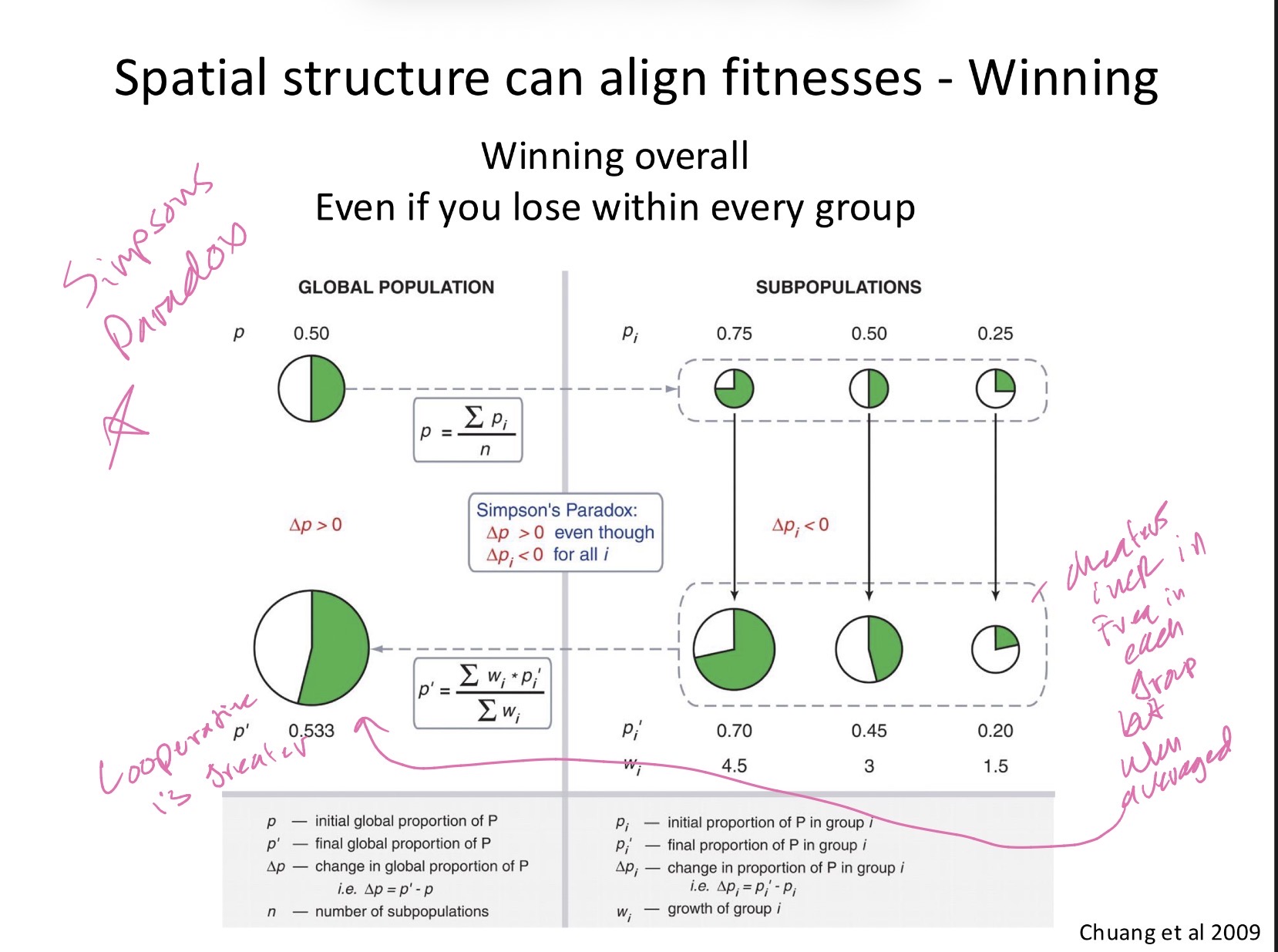
fitness alignment (via spatial structure) —> fewer selfish individuals is good
hamiltons rule and relatedness
altruism can evolve when rb-c > 0 —> simplified —> rb < c
b = direct fitness benefit to recipient
r = coefficient of relatedness
c = direct fitness cost to actor
relatedness —> probability that the homologous alleles in two individuals are indentical by descent (or percent of alleles you share with another individual on average)
hamiltons rule suggest that kin selection can result in altruism when:
relatedness is high —> r = 1
direct fitness benefits to recipient are high —> r or b high
direct fitness costs to actor are low —> c low
does cooperation and costs/benefits change through time?
yes!
example —> long tailed tits are more likely to aid siblings later in the season as individual chances of reproduction decrease
in spring they don’t help siblings cuz focused on themselves reproducing/finding a mate but as the season progresses and they don’t have a mate yet they start helping siblings more because there is a low chance that they will find a mate and pass on their genes but they can still pass on their genes through their sibling, which is why they help
simpson’s paradox