[1B] Assessing the Nutritional Content of Foods & Diets
 Call Kai
 Learn
 Practice Test
 Spaced Repetition
 Match
 Flashcards
 Knowt Play
1/25

There's no tags or description
Looks like no tags are added yet.
26 Terms
serving size
represents the amount of food typically
eaten by consumers in a single sitting based on a
reference amount by Health Canada
provided in household
measurements (e.g., cups, teaspoons, number of
pieces, or a fraction of the whole) followed by the
metric equivalent of that measurement (g or mL)
Calories AKA
kilocalories (kcal)
Recommended daily value of average person Calories (kilocalories)
~2000
how to convert between kilocalories/Calories, joules, kilojoules, and calories
calories > kcal/Cal (/1000)
kcal/Cal > KJ (x4.1)
KJ > J (x1000)

main macronutrients in food (3)
Carbohydrates, lipids, proteins
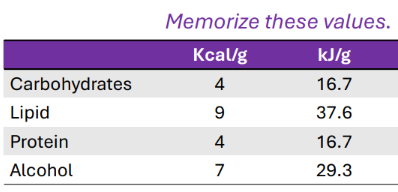
kcal/g and kJ/g of carbs, lipids, protein, alcohol energy densities
How to calculate servings total
Divide total amount made or consumed by serving size (make sure same metrics)
Acceptable Macronutrient Distribution Range (AMDR)
proportion of energy from each macronutrient where nutritional needs are likely to be met for health and function
AMDRs for Carbohydrates, Lipids, and Proteins
Carbohydrates = 45% to 65%
Lipids = 20% to 35%
Protein = 10% to 35%
DV values
<5% of DV is a little, >15% of DV is a lot
Dietary Reference Intakes (DRIs)
are reference values that are quantitative estimates of nutrient intakes used for planning and assessing diets for healthy people.
estimated based upon the needs of a healthy population of a specific demographic.
DRIs help determine…
At what intake level…
Ø Does the risk of a chronic disease significantly increase or decrease?
ØDo we see an uptick in confirmed cases of toxicity or deficiency?
ØDoes a typical person have sufficient metabolite levels?
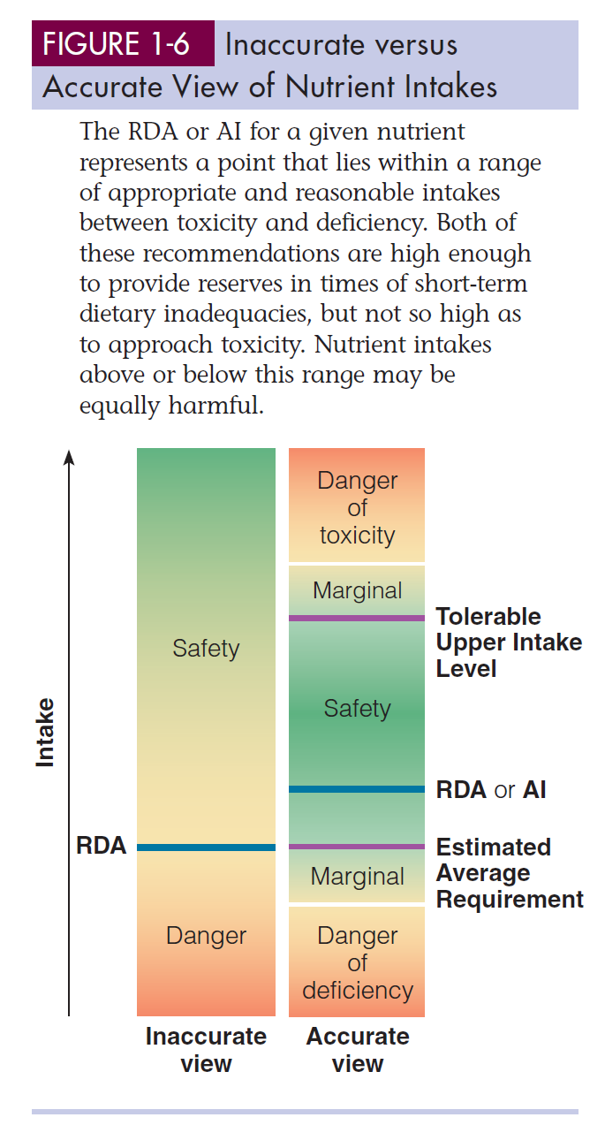
Estimated Average Requirement (EAR)
amount of a nutrient that meets needs of 50% of the population (of a given gender, life stage, etc.). (i.e. median)
useful at population level NOT individuals
Recommended Dietary Allowance (RDA)
amount of nutrient intake that meets the needs of most healthy individuals in the population
BEST number especially for inviduals
Someone consuming their RDA means what
they are highly unlikely to have a deficiency
Daily Value (DV) calculated how
with RDA
100% DV = RDA
Adequate Intake (AI)
When RDA not known or can’t be determined because deficiency is rare
Substitute for RDA for individual recommendations (can be same or diff as RDA)
Tolerable Upper Intake Level (UL)
threshold amount (maximum) of a nutrient that can be consumed without significant risk of adverse health effects (toxicity).
Many nutrients do not have a UL (“ND”) because it is too high or too rare to accurately determine at the population level.
Where is a good spot to be for an individual for intake
Above RDA under UL
Protein DRIs are based on, protein/day calculation
body weight
protein/day = kg x (_g/kg)
=_g/day
How to calculate BMI
wt / (ht²)
BMI categories
underweight <18.5
healthy weight 18.5-24.9
overweight 25.0-29.9
obese >30
How to calculate total kcal
sum of all kcal sources
CHO intake x 4 + protein intake x 4 + lipid intake x 9 + _kcal + alcohol intake x7
How to calculate AMDRs
find total caloric intake
find calorie from macronutrient (consumed(g) x 4(or 9,7)) (kcalCHO)
(kcalCHO / kcal total) x 100
% compare to each range for the macronutrients
How to go from kcals of a macronutrient to grams, rule to remember
kcals / 4(or 9 or 7) = grams
Grams > kcal = multiply
kcal > grams = divide
How to find grams when given AMDR %
find calories from CHO and convert % to decimal
kcal x %
divide that by 4 (or 9 or 7)(aka kcal/gram) = grams
(total kcal x decimal percent / kcal/g)