plant cells
 Call Kai
 Learn
 Practice Test
 Spaced Repetition
 Match
 Flashcards
 Knowt Play
1/11

There's no tags or description
Looks like no tags are added yet.
12 Terms
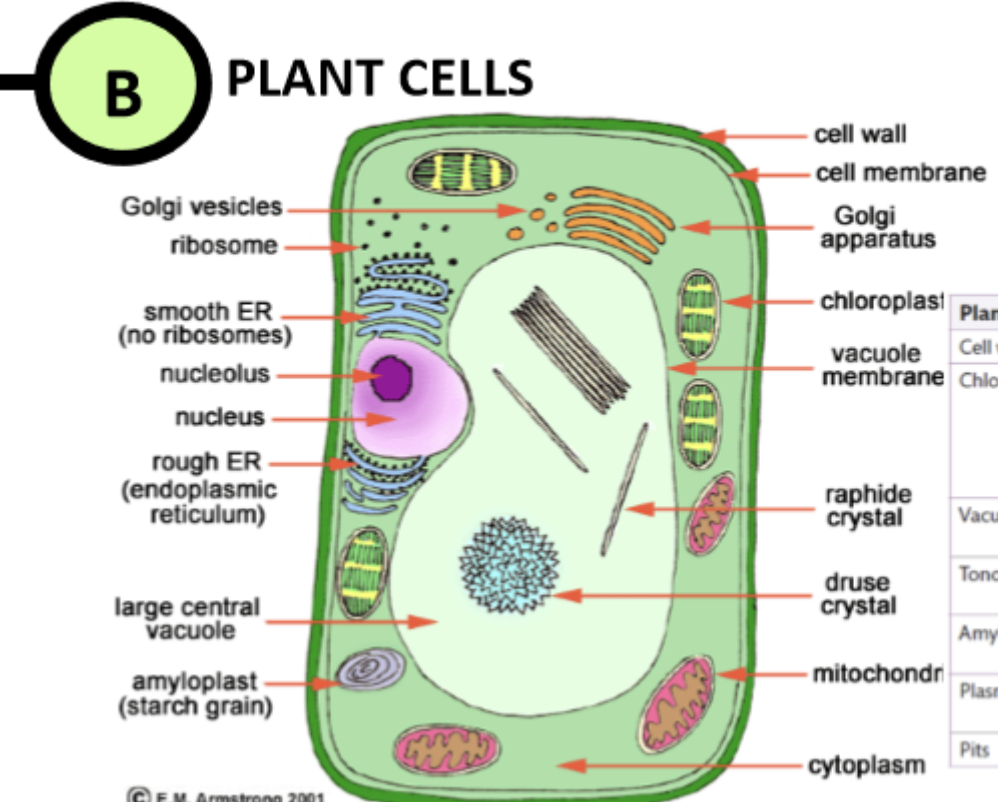
organelles in a plant cell
cell wall
cell membrane
Golgi apparatus
chloroplast
vacuole membrane
rawhide crystal
druse crystal
mitochondria
cytoplasm
amylobplast
large central vacuole
rough endoplasmic reticulum
nucleus
nucleolus
smooth endoplasmic reticulum
ribosome
Golgi vesicles.
cell wall (structure)
made up of cellulose
cell wall (function)
protects and supports each cell and the whole plant.
chloroplast (structure)
has a double membrane and is filled with a type of fluid called stroma. The inner membrane has a continuous network of flattened sacs called thylakoids. A stack of thylakoids is called a granum, the granum contains chlorophyll pigments.
vacuole (structure)
membrane bound sac in the cytoplasm that contains cell sap
vacuole (function)
site of photosynthesis, where the light energy is trapped by the chlorophyll and is used to produce carbohydrate molecules from water and carbon dioxide
tonoplast (structure)
partially permeable membrane of the vacuole
tonoplast (function)
part of vacuole that is permeable allow small molecules to pass through
amyloplast (structure)
double membrane sac containing starch granules
amyloplast (function)
responsible for synthesis and storage of starch granules
plasmodesmata (structure)
microscopic channels which cross the cell walls of the plant cells.
plasmodestmata (function)
enable transport and communication between individual plant cells.
