Ch 7 - Motivation
 Call Kai
 Learn
 Practice Test
 Spaced Repetition
 Match
 Flashcards
 Knowt Play
1/45

There's no tags or description
Looks like no tags are added yet.
46 Terms
motivation
the force that energizes (causes ppl to act), directs behavior toward attainment of specific goals, and sustains behavior (effort expended)
energizes, directs, and sustains behavior
needs
physiological or psychological deficiencies that an organism is compelled to fulfill
need theories
propose that motivation is process of interaction among various needs and drives to satisfy those needs
basic need theories
need hierarchy theory
ERG theory
McClelland’s achievement motivation theory
Need Hierarchy Theory
a motivation theory proposed by Maslow that arranges needs in a hierarchy from lower, more basic needs to higher-order needs
deficiency needs
1. physiological needs
2. safety needs
3. social needs
higher order needs
4. esteem needs
5. self-actualization needs
ERG Theory
Alderfer’s (1972) motivation model that categorizes needs into existence, relatedness, and growth needs
3 need categories
1. existence needs → basic physiological and safety
2. relatedness needs → social
3. growth needs → full develop and reach potential
Achievement Motivation Theory
McClelland’s model of motivation that emphasizes the importance of three needs (achievement, power, affiliation) in determining worker motivation
needs (order differs based on individual)
achievement
compelling drive to succeed and get job done; those who love challenge of work
power
need to direct and control activities of others and be influential; gain influence and prestige
2 sides of power → personal power used toward personal ends OR institutional power oriented toward organizational objectives
affiliation
desire to be liked and accepted by others; strive for friendship; prefer working w/ others; motivated by cooperative work
used TAT variation to assess
Thematic Apperception Test (TAT)
projective test that uses ambiguous pictures to assess psychological motivation
study ambiguous pictures, write a story it suggests, and scored using standardized procedure that measures presence of three basic needs; obtains “motivational profile”
used by McClelland for his Achievement Motivation Theory
behavior-based theories of motivation
focus on behavioral outcomes as critical to affecting work motivation
reinforcement theory
extrinsic vs intrinsic motivation
self-determination theory
goal-setting theory
reinforcement theory
theory that behavior is motivated by its consequences; draws from operant conditioning
argues that reinforcement better than punishment (designed to strengthen motivation to perform particular desired behavior)
positive reinforcers
desirable events that strengthen tendency to respond
add something; behavior increases
negative reinforcers
events that strengthen a behavior through the avoidance of an existing negative state
take away something; increases behavior
punishment
unpleasant consequences that reduce the tendency to respond
poor managerial strategy
schedules of reinforcement
in work settings, typically thought of as representing different schedules of pay
4 types
fixed-interval
variable-interval
fixed-ratio
variable-ratio
ratio schedules result in higher levels of motivation than fixed-interval
fixed-interval
reinforcement that follows passage of a specified amount of time; fixed amount of time
ex: employees paid on hourly or daily wage / weekly or monthly salary
variable-interval schedule
reinforcement that follows the passage of a specified amount of time, w/ exact time of reinforcement varying; variable amount of time
ex: worker for small business paid average of once a month, but exact time depends when owner does payroll
fixed-ratio schedule
reinforcement that is contingent on performance of a fixed number of behaviors; fixed #
ex: workers paid for number of components assembled, baskets of fruit picked, or reports written
variable-ratio schedule
reinforcement that depends on performance of a specified but varying number of behaviors; variable #
ex: sales-person on commission; gambling
high levels of motivation
organizational behavior modification
the application of conditioning principles to obtain certain work outcomes
used when reinforcement theory is applied formally as a program to increase worker motivation
certain target behaviors are specified, measured, and rewarded
intrinsic motivation
the notion that ppl are motivated by internal rewards
ppl often motivated by this
derived from sense of accomplishment and competence at performing and mastering work tasks
things organizations can do to support intrinsic motivation
create challenging and interesting opportunities for employees to leverage skills and abilities
remove bureaucracy, poorly designed processes, and other institutional barriers that stand in way
empower employees to devise new ways of working based on their unique differences and perspectives
encourage managers to recognize employees who go above and beyond
self-determination theory
a motivational theory that focuses on the conditions and processes that lead to self-motivation and growth on the job
3 factors critical for motivation
autonomy → options/choices
competence → sense of mastery and skill
relatedness → feeling of social connections
goal-setting theory
the motivational theory that emphasizes the setting of specific and challenging performance goals
Edwin Locke (1968)
goals must be clear, specific, attainable, and quantified (when possible)
employees should be committed to goals to be motivated
job design theories of motivation
stress structure and design of jobs as key factors in motivating workers
Hertzberg’s two factor theory
job characterstics model
two-factor theory
Herzberg’s motivational theory that proposes that two factors (motivators and hygienes) are important in determining worker satisfaction and motivation
to eliminate job dissatisfaction, basic hygienes must be present
to motivate effort and energy, motivators must be present
motivators
elements related to job content that, when present, lead to job satisfaction
inherent in the work itself
ex: type of work, level of responsibility, and chances for advancement, recognition, and personal achievement
ex: responsibility, achievement, recognition, content of work, advancement, growth on job
ex: teacher and paramedic → high in these
hygienes
elements related to job context that, when absent, cause job dissatisfaction
related to context in which ppl perform their jobs
ex: benefits, working conditions (physical and social), type of supervision, base salary, company policies
ex: company policy and administration, supervision, interpersonal, working, salary
ex: teacher and paramedics → low in these (low pay)
job enrichment
innovative strategy used to increase worker motivation inspired by Herzberg’s two-factor theory
job characteristics model
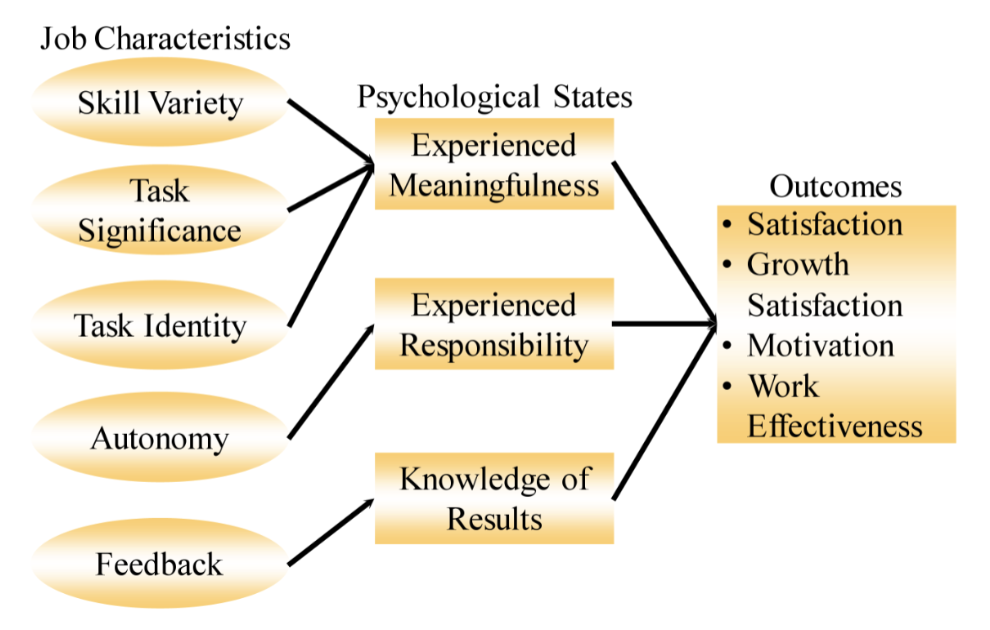
a theory that emphasizes the the role that certain aspects of jobs play in influencing work motivation (Hackman and Oldham)
3 important psychological states in order to be motivated
must perceive work as meaningful
associate sense of responsibility w/ job
have some knowledge of results of efforts
5 core job characteristics that contribute to the 3 psychological states
1. skill variety
2. task identity
3. task significance
4. autonomy
5. feedback
5 core job characteristics (job characteristic model)
5 core job characteristics that contribute to the 3 psychological states
experience of meaningfulness in work
1. skill variety → degree to which job requires workers to use variety of abilities/skills
2. task identity → degree to which job requires completion of entire job/function (worker needs to see observable outcome/product of efforts)
3. task significance → degree to which job has substantial impact on other ppl within the organization (e.g., coworkers, consumers)
sense of responsibility
4. autonomy → degree to which job gives worker freedom and independence to choose how to schedule and carry out necessary tasks
experience of work results
5. feedback → degree to which job allows worker to receive direct and clear info a/b effectiveness of performance
growth need strength
a moderator that can affect success of the job characteristics model in predicting worker motivation
the need and desire for personal growth on the job
job diagnostic survey (JDS)
a questionnaire designed by Hackman and Oldham (1975) that measures the 5 core job characteristics
job enrichment
a motivational program that involves redesigning jobs to give workers a greater role in the planning, execution, and evaluation of their work
developed from Herzberg’s theory and job characteristics model
raises level of responsibility associated w/ job
includes…
increasing level of responsibility, sense of freedom, and independence
allowing workers to complete entire task or function
providing feedback so that workers can learn to improve their own performance
encouraging workers to learn on job by taking on additional, more challenging tasks and by improving their expertise in jobs they perform
cognitive theories of motivation
assume individuals constantly aware of important elements in work environment, and that motivation is determined by conscious processing of info received
equity theory
expectancy theory
equity theory
a theory that workers are motivated to reduce perceived inequities between work inputs and outcomes; motivated by desire to be treated equitably or fairly
Stacey Adams (1965)
worker brings inputs to job and expects to receive certain outcomes
determines if situation equitable by making social comparisons between input-outcome ratio of themselves and comparison others
based on workers’ perceptions of equity/inequity
lack of motivation caused by 2 types of perceived inequity
1. underpayment inequity
2. overpayment inequity
difficulty predicting behavior when ppl act irrationally
inputs
elements that a worker invests in a job, such as experience and effort
ex: experience, education and qualifications, energy, effort
outcomes
those things that a worker expects to receive from a job, such as pay and recognition
ex: pay, fringe benefits, recognition, interesting and challenging work
comparison others
persons used as basis for comparison in making judgements of equity/inequity
ex: coworkers, ppl w/ similar job or occupation, workers’ own experiences
underpayment inequity
worker’s perception that inputs are greater than outcomes
results when workers feel they are receiving fewer outcomes from job in ratio to inputs
motivated to try to balance situation by one of the following…
increasing outcomes
decreasing inputs
changing comparison other
leaving situation
overpayment inequity
worker’s perception that outcomes are greater than inputs
motivated to try to balance situation by one of the following…
increasing inputs
decreasing outcomes
changing comparison other
distorting situation
moderators of equity
equity sensitivity
individuals vary in concern over equity of input-outcome ratios
3 types of individuals
benevolents → “givers”; altruistic and content w/ receiving lower outcomes for inputs
entitleds → “takers”; concerned w/ high outcomes, regardless of level of inputs
equity sensitives → adhere to notions of equity; become distressed when feeling underpayment inequity and feel guilt when overrewarded
expectancy (VIE) theory of motivation
a cognitive theory of motivation that states that workers weigh expected costs and benefits of particular courses before they are motivated to take action (Vroom, 1964)
3 components
1. valence
2. instrumentality
3. expectancy

valence
the desirability (or undesirability) of an outcome to an individual
→ whether the outcome of the behavior is desirable
how outcomes serve to satisfy individual goals
instrumentality
the perceived relationship between the performance of a particular behavior and the likelihood of receiving a particular outcome
link between one outcome (worker’s behavior) and another outcome (obtaining recognition or pay raise)
ex: “if I complete Y amount of work, I will likely get promoted”
→ whether the performance of the behavior will lead to the expected outcome
link between performance and outcomes
expectancy
the perceived relationship between the individual’s effort and performance of a behavior
ex: “if I expend X amount of effort, I will probably complete Y amount of work”
→ whether the individual has the ability, skills, or energy to get the job done
link between effort and performance
application/suggestions for leaders in applying expectancy theory
managers/leaders should…
define work outcomes (potential rewards and costs associated w/ performance) clearly to all workers
relationship between performance and rewards should be made clear (if workers achieve certain goals, rewards sure to follow)
any performance-related goal should be within reach of employee involved
other variables that can affect productivity
systems and technology variables
ex: inadequate work systems, procedures, tools, equipment
individual difference variables
variety of factors within individual, regardless of motivation
ex: lacking basic skills or talents
group dynamics variables
individual efforts must be coordinated for group to be efficient/productive
organizational variables
concerted/coordinated efforts of number of work units (ex: different inputs/outputs of different departments)