L12-enzyme-substrate interactions
 Call Kai
 Learn
 Practice Test
 Spaced Repetition
 Match
 Flashcards
 Knowt Play
1/8

There's no tags or description
Looks like no tags are added yet.
9 Terms
what is enzyme kinetics
it tells us how fast a reaction occurs which is helpful when understanding disease processes
it also describes absorbance of drugs into cells by active transport
many clinical test also depend on measuring the activity of enzymes
we can also determine the potency of drug we come across
what is catalysis
the process/ steps between the forming of an enzyme- substrate complex and enzyme- product complex
after the product is made and released what does the enyme do
it can either just go on to bind with more substrates, or the active sites residues ionisation state needs to be changed or the enzyme needs to go through a large conformational change
what assumptions are made in the simple models of enzyme behaviour
one molecule of one substrate binds to the enzyme ( which is usually rare )
the enzyme and substrate form an enzyme-substrate complex which is the rate limiting step
enzymes convert substrate to product and the is product released fast
products bind weakly to the enzyme
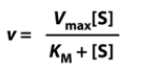
what is the michaelis menton equation
at low substrate concentration the rate increases with increasing substrate rate ( first order
at high substrate concentrations the rate doesn’t increase with further increases in substrate concentration ( zero order )
what are the assumptions made in the steady-state model
the concertation of the enzyme is less than the substrate
that the substrate concentration remains constant ( initial rate )
that the enzyme- substrate concentration remains the same throughout the reaction ( theres a balance between the making the ES and the enzyme-substrate and breaking)
product binds weakly to the enzyme
there’s no backwards reaction
what is Km
the substrate concentration when the enzyme is working at half its maximum speed/ 0.5 vmax
its often used as a measure of how tightly an enzyme binds with the substrate
low km= enzyme bins tightly ( high affinity )
high km= enzyme binds loosely to the substrate low affinity
its a measure of efficiency
what does kcat mean
this tells us how many substrate molecules one enzyme molecule can convert ito a product per second when its working at full speed
the formula is kcat= vmax/enzyme concentration
its a measure of efficiency
what is the way of measuring efficiency of an enzyme
kcat/vmax