Lec 17 Gas exchange in lungs and tissues, gas transport, ventilation regulation
 Call Kai
 Learn
 Practice Test
 Spaced Repetition
 Match
 Flashcards
 Knowt Play
1/17

There's no tags or description
Looks like no tags are added yet.
18 Terms

solubility, what does it refer to fro O2 vs CO2 in blood?
. Solubility
What it is & General Function: The property determining how easily and how much of a specific gas can dissolve into a liquid at a given partial pressure and temperature.
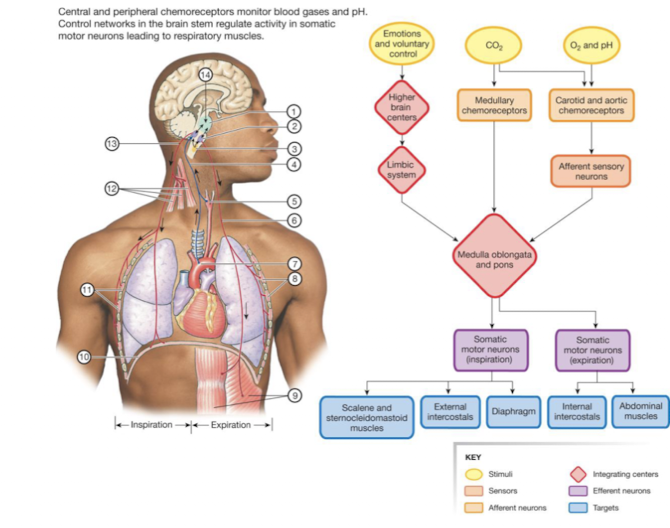
what is the path and overall regulating mechanism/reflex control of ventilation? what are the stimulus


which main afferent neurons control inspiration (breathing in) by stimulating muscles of inhalation VS Responsible for forced breathing (active expiration and greater-than-normal inspiration)? what is PRG
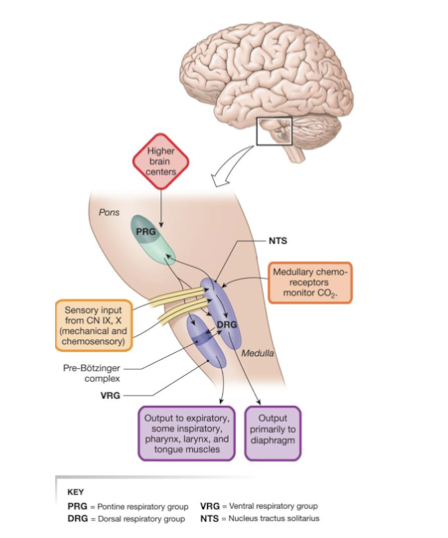
Dorsal Respiratory Group (DRG):
Location: Nucleus tractus solitarius (NTS) in the medulla.
Function: Controls inspiration (breathing in) by stimulating muscles of inhalation.
Nerves involved: Sends signals via the phrenic nerve to the diaphragm and intercostal nerves to the intercostal muscles. It receives sensory input from chemo- and mechanoreceptors, this input travels to the pons/medulla via the vagus nerve (CN X) and glossopharyngeal nerve (CN IX)
Ventral Respiratory Group (VRG):
Responsible for forced breathing (active expiration and greater-than-normal inspiration) as well as innervating the muscles of the larynx, pharynx, and tongue.
Pacemaker: Contains the Pre-Bötzinger complex, which provides basic pacemaker activity for respiratory rhythm


how do peripheral chemoreceptors differ from central chemoreceptors ? location,

what else may control breathing patterns? what has the upmost control in the end?

what is mass/bulk flow vs dissuasion? what does ventlation vs gas exhcnge pair with
bulk flow = The bulk movement of substances (such as air or blood) together as a mass down a pressure gradient.

what is the CO output equation for
An equation used to estimate total body oxygen consumption based on cardiac output and the arteriovenous oxygen difference (Oxygen Consumption=CO×(Arterial [O2]−Venous [O2])
oxyhemoglobin means what is bound?
Hemoglobin bound reversibly to oxygen molecules, transporting the vast majority of oxygen through the circulatory system.
what is bohr effect?
= reduction in hemoglobin's binding affinity for oxygen caused by an increase in PCO2or H+ (lower pH), which actively promotes oxygen release into active tissues.
General Location: Systemic capillaries near metabolically active tissues.
how do 2-3BPG,tempreature, pH, Pco2 affect oxygen binding?

carbonic anhydrase vs carbonic acid
Carbonic Anhydrase (CA)
What it is & General Function:in RBC An enzyme that rapidly catalyzes the reversible conversion of carbon dioxide and water into carbonic acid (H2O+CO2⇌H2CO3)
Carbonic Acid (H2CO3)
What it is & General Function: An unstable intermediate acid formed by combining carbon dioxide and water, which quickly dissociates into hydrogen ions and bicarbonate.
What is the purpose of chloride shift?
=A transport process where bicarbonate (HCO3− is exchanged for chloride (Cl− across the red blood cell membrane to maintain electrical neutrality during gas transport.
what is Haldane Effect?
Haldane Effect
= property where deoxygenated hemoglobin binds carbon dioxide and hydrogen ions more readily than oxygenated hemoglobin, facilitating CO2 loading at tissues and unloading at the lungs.
what is Dorsal respiratory group? what does it control and through what nerve? what about pontine respiratory group
ventral resppiratory group and what do they work with
Dorsal respiratroy group= neural network located in the nucleus tractus solitarius (NTS) that controls muscles of inspiration via the phrenic and intercostal nerves.
pontine respiratory group=Neural groups that integrate sensory information and interact with medullary neurons to fine-tune and smooth out the respiratory rhyth
ventral resppiratory group=neural network containing the Pre-Bötzinger pacemaker complex and areas controlling active expiration and accessory upper airway muscles (larynx, pharynx, tongue
what are peripheral chemoreceotors role, vs central chemoreceptors
Specialized sensory receptors outside the brain that monitor changes in arterial blood PO2, pH, and PCO2
Central Chemoreceptors= Specialized sensors in the central nervous system that respond indirectly to changes in brain extracellular fluid PCO2 by detecting resulting H+ ion changes.
what are carotid bodies
Specialized clusters of glomus cells acting as peripheral chemoreceptors that sense sharp drops in blood PO2P (below 60 mm Hg), pH drops, or increases in PCO2

what are Irritant Receptors and bronchoconstrictors?
:Irritant Receptors Sensory receptors in airway mucosa that detect physical injury, noxious gases, or dust particles and trigger protective reflexes like coughing or sneezing.
bronchocontrictors= The narrowing of bronchiolar airways caused by smooth muscle contraction to protect lungs from irritants.

what is Hering-Breuer Inflation Reflex
protective reflex triggered by pulmonary stretch receptors that prevents over-inflation of the lungs by inhibiting inspiratory neurons