Child Growth and Development
 Call Kai
 Learn
 Practice Test
 Spaced Repetition
 Match
 Flashcards
 Knowt Play
1/11

There's no tags or description
Looks like no tags are added yet.
12 Terms
What are the divisons of childhood?
Neonate: First 28 days of life
Infant: 1 month–1 year
Toddler: 1–3 years
Preschooler: 3–5 years
School-aged child: 6–12 years
Adolescent: 13–17 years
Late adolescent: 18–21 years
What are the theories of development- stages of childhood?
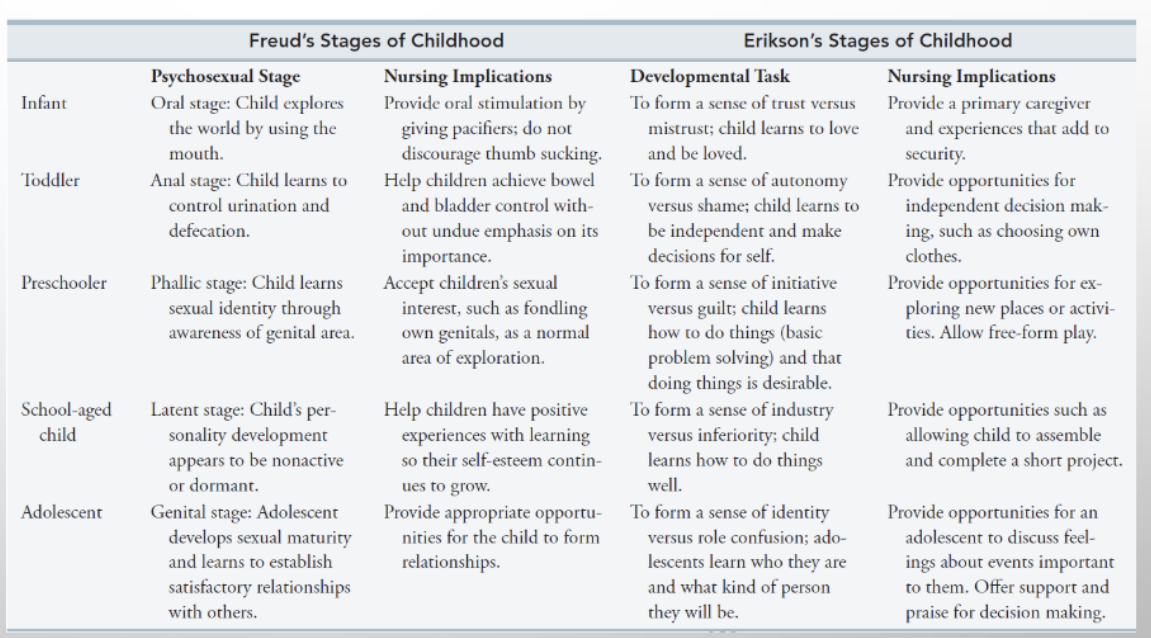
How is famliy centered care done?
****Family is whoever the patient feels their family is
Family dynamics are observed by the behaviors between the child and parent
Important to establish a good rapport with the parent by asking open questions
Conduct interview in a comfortable room with available seating for the parent
What are the environmental influence onna child?
Social Determinants of Health
Parent–child relationship
Sibling socialization and relationship
Physical activity and health
Nutrition
Physical growth
Health maintenance
Cognitive development

What are the nursing prorities for growth & development?
Delayed growth and development risk related to lack of age-appropriate activities
Readiness for enhanced family coping related to caregivers seeking information about a child’s growth and development
Malnutrition related to parental knowledge deficit
FTT- Failure to thrive
What is the purpose of health assessment?
To gather information that will direct physical or laboratory examinations to complete a thorough health evaluation
To elicit facts such as parental problems in childrearing or detection of future health problems
To lay the foundation for health education and health promotion
Provides anticipatory guidance to caregivers
What are the techniques for health interview?
Child Health Interviewing
Young children: Interview the child’s parents
Adolescents or preadolescents: Choice of interview with or without parents present
Important Principles of Child Health Interviewing
Establishing a conducive interview setting
Formulating the right types of questions
Organizing information collected
What are the cultural considerations for health assessment?
Health assessment findings can vary by racial, ethnic, and cultural factors.
Eye contact expectations differ across cultures; lack of eye contact may be respectful, not evasive.
Some cultures view touching a child’s head as harmful; ask permission before examining sensitive areas.
Standard height/weight growth charts may not reflect growth patterns of all children.
Build rapport by recognizing that families may have different expectations, values, and practices.
Immunization beliefs and acceptance vary by culture and community.
Immunization decisions may also be influenced by cost, convenience, religion, and safety concerns.
Use assessment findings to tailor health education and surveillance to the child/caregiver’s cultural perspective.
How should the health interview contain?
Introduction and explanation
Demographic data
Chief concern
Exactly as stated
History of chief concern
Duration; intensity
Frequency; description
Associated symptoms; actions taken
Health and family profile
Day history
Play
Sleep
Hygiene
Nutrition
Including signs of adequate nutrition and risk factors
Kid need routine so want to poerserve thier usual routine as much as possible
Past health history
Including pregnancy history → do you have any other kids?
Family health history
Review of Systems
Parents are caregivers so its important to incorporate them in care
What are the physical signs of adequete nutrition?
Overall impression: Alert, with good energy level; positive mood.
Hair: Shiny, strong.
Eyes: Good eyesight, particularly at night; conjunctiva moist and not pale.
Mouth: No cavities in teeth; no swollen or inflamed gingivae; no cracks or fissures at corners of mouth; mucous membrane moist and pink; tongue smooth and nontender.
Neck: Normal contour of thyroid gland.
Skin: Smooth; normal color and turgor; no ecchymotic or petechial areas present.
Extremities: Normal muscle mass and circumference; normal strength and mobility; normal reflexes; legs not bowed; no tender joints or edema present.
Gastrointestinal: No diarrhea or constipation present.
Finger and toenails: Smooth, pink; not cracked or broken.
Height and weight: Within normal limits on growth chart and body mass index.
Blood pressure: Normal for age.
How is physical exam done?
Want to do least invasive thing first so they get comfortable?
Body Measurements
Weight
Plot infant growth on WHO charts (birth–2 years) when appropriate.
BMI is often computed/used in older children.
huge indicator of growth in kids
Height: if not getting enough nutrition bones won’t grow
Head circumference
Should correlate with the height or length of the child.
Assessments
Skin
Ensure adequate lighting and use resources across skin tones.
skin disorders can indicate a immune issue
Head
Odors
Pain → FACES, FLAC, NIPS
Eyes
Conjunctivitis
Ptosis
Avoid misinterpreting scleral coloration.
Normal variation can occur. Assess in good lighting and consider overall findings before concluding jaundice/cyanosis.
Nose
Ears
Alignment
Otoscopic exam:
Ear canal
Malleus of the inner ear
Tympanic membrane
Signs of infection
Eardrum mobility may be assessed with a pneumatic attachment.
Tympanogram may assess fluid.
Mouth
Appearance, including symmetry and color of lips
Number and condition of teeth
Condition of gums, tongue, uvula, epiglottis, and tonsils
Do not depress the tongue if epiglottitis is suspected.
Neck; Lymph nodes
Heart
PMI
Heart sounds
Identify extra heart sounds: S3 may be normal in children. S4 is abnormal and requires follow-up. → can be normal when young for heart to skip a beat when breaking
Rhythm
Sinus arrhythmia: An irregular rhythm that varies with the breathing pattern can be a normal finding in children/adolescents.
Abdomen
Newborn and infant
Preschooler and school-aged child
Genitorectal Area
Female genitalia
Male genitalia
Inguinal hernia
Age Considerations
Adolescent: Ensure modesty and provide privacy, Use drapes., Explain each step. Offer a chaperone.
Extremities: unkempt nails, bruising (nonaccidental trauma), injured extremities can indicate abuse
Back
Neurologic Function
Reflexes
Motor and sensory
Vision, hearing, and speech screening
Safety Screening
Signs of self-harm
What are the immunizations give to kids and general time line?
Diphtheria, Tetanus, Pertussis (DTaP)
Polio
Measles, Mumps, Rubella (MMR)
Hepatitis B (HBV)
Hepatitis A
Rotavirus
H. influenzae Type B (Hib)
Varicella
Pneumococcal Pneumonia
Human Papillomavirus (HPV)
Meningococcal Vaccine
Influenza
COVID-19
