Chapter 3: Game Theory
 Call Kai
 Learn
Learn Practice Test
 Spaced Repetition
 Match
Match Flashcards
 Knowt Play
1/81

There's no tags or description
Looks like no tags are added yet.
Name | Mastery | Learn | Test | Matching | Spaced | Call with Kai | Chat |
|---|
No analytics yet
Send a link to your students to track their progress
82 Terms
When is an activity worth doing?
If benefit > cost
External benefit
A benefit received by people other than those directly involved in the activity
External cost
A cost imposed on people other than those directly involved in the activity
How does the existence of external benefits + costs influence the logic of “do an activity benefits > costs”
Means private benefit > private costs doesn’t always mean an activity is socially desirable
Game
A set of players, a list of possible strategies and the payoffs that correspond to each combination of strategies
Strategic situations where your outcome depends partly on what others do
What can the theory of games model?
The interdependency between individuals, firms + government
3 elements common to all games
Players (ie who makes the decisions)
Strategies (ie possible actions each player can choose)
Payoffs (ie the outcome / cost associated w each combo of strats)
Dominant strategy
The strategy in a game that produces better results regardless of the strategy chosen by one's opponent
Do optimal individual decisions always lead to the best collective outcome?
No
Social dilemma
Type of game where individual incentives conflict with efficiency
Eg prisoners dilemma
ie individual rational decisions lead to a collectively worse outcome
Individual + collective interests don’t coincide!!
Issue with the dominant strategy
Dominant strat is individually best
But if all players follow it → leaves everyone worse off
Individuals incentives conflict w Pareto efficiency!!!
What do individuals incentives conflict with?
Pareto efficiency
Cooperate + defect strategy in a social dilemma
Cooperate strat- do what is in the collective interest
Defect strat- do what is in a person’s individual interest
What strategy does pareto efficiency require all players to choose + what is the issue with this?
PE- all players should cooperate
But each individual has an incentive to defect
Does each player have a dominant strategy to defect or cooperate?
Defect
BUT this leads to a Pareto inefficient outcome (so welfare isn’t maximised)
What would increase everyone's payoff?
If every player were to cooperate
When all players use their dominant strategy, the outcome is not…?
Pareto efficient
Commitment problems
When people would be better off if they collectivelly commit themselves to behaviour that is against their future self-interest
(inconsistent with their own material interests)

Example of commitment problem?
Social dilemmas eg prisoner’s dilemma
Players in a social dilemma would do better if they…?
Cooperate
Despite the incentive to defect
Commitment device
A device that commits a person to behave in a certain way in the future, even though they may wish to behave otherwise when the time comes.
Ie something that changes incentives to make someone keep a promise
Eg rules, fines, blackmail
Examples of social dilemmas
The prisoner's dilemma
Public good game
What is the key conflict in a social dilemma?
Individual incentives vs collective wellbeing
How can commitment solve a social dilemma?
It changes incentives so people have a reason to cooperate rather than defect
Makes cooperation credible
Gives people reason to follow thru on promises

What is the invisible hand?
Acting w self-interest can unintentionally produce socially beneficial outcomes
In competitive markets
Example of the invisible hand in competitive markets
Firms compete to make better / cheaper products → consumers benefit
Higher profits enjoyed by firms temporarily → other firms copy product / new tech → puts downward pressure on price
Ultimately consumers benefit by firms acting in self interest (max profit)
What can free markets result in?
Pareto efficiency
Key assumption of the invisible hand
Assumes buyers + sellers are price takers
Only works when this is satisfied
Price taker
No individual buyer / seller can influence price
They take the market price
Eg individual supermarket customer → can’t negotiate the price
Does the invisible hand always work?
No
It can fail
When can the invisible hand go awry?
When external effects exist
+ people can influence others’ outcomes
Influence → external effects → strategic interdependence
(don’t need to know this right now- will go into more detail in a later chapter)

Influence vs external effect (dw abt remembering this)
Influence: The ability of one person's actions to affect the price/cost faced by others.
EE: your action affects someone else
Strategic interdependence
Your best action depends on what other people are likely to do
What happens when external effects create strategic interdependence?
Self-interest may not produce Pareto efficiency
What do social dilemmas show about the invisible hand?
Individual self-interest (rational choices) can produce a collectively worse outcome
Aka pareto inefficient outcome
Effect of non-selfish motives (don’t focus on this, this is explained in a later chapter)
Can improve efficiency
Encourage cooperation
Help solve commitment problems (bc people more willing to cooperate / keep promises)
Align individual interests w collective interests
Is there a restriction on no. of players in a social dilemma?
No
What condition makes it possible to sustain cooperation in a social dilemma?
If an interaction is repeated an indefinite number of times
Why do repeated games encourage cooperation?
Defection can lead to future punishment
So cooperation = worthwhile
But in 1-time social dilemmas, it is hard to punish defection
Tit for tat strategy
Strategy to:
Cooperate at first
And then do whatever the other player did in the previous interaction
Eg if they defect → you defect next time

Effective strategies to sustain cooperation
Tit for tat
Bc it punishes defection
3 characteristics of tit for tat
Nice → starts by cooperating.
Tough → punishes defection.
Forgiving → returns to cooperation when the other player cooperates.
What makes tit for tat a forgiving strategy?
A player is willing to cooperate w a former defector
Once they show evidence of willingness to cooperate
Grim trigger
A strategy to cooperate unless the other player defects
BUT defect for ever more if the other player defects
Ie
Cooperate initially
Continue cooperating, unless the other player ever defects
Once they defect → defect forever
Grim trigger vs tit for tat
Tit for tat is forgiving
Grim trigger = single defection → no chance of mutual cooperation
What conditions help tit-for-tat succeed (ie repeated game cooperation)?
Players are stable/recognisable.
They remember past behaviour
They expect future interactions
Future outcomes matter enough that punishment is costly (ie they have a significant stake in what happens in the future)
What happens when future interaction is unlikely?
There is little reason to cooperate
Bc threat of future punishment loses its force
How can repeated games encourage business cooperation?
Firms cooperate bc they need future relationships with suppliers/customers
Eg firms pay suppliers on time bc they need future shipments
If interaction will be repeated a known number of times…
Cooperation is harder to sustain
Repeated interaction →
Cooperation
Bc threat of future punishment
In a game, if every player has a dominant strategy, which strategy would you expect them to use?
Their dominant strat
So easy to derive an equilibrium prediction
Nash equilibrium
The combination of strategies in a game such that neither player has any incentive to change strategies given the strategy of his opponent.
(in simple terms- each player is doing the best they can given others' choices)
How to identify if a situation is in Nash equilibrium?
Ask: “Does either player have an incentive to change their strategy, assuming the other player stays the same?”
If neither wants to change → Nash equilibrium
If at least one wants to change → not a Nash equilibrium.
When is a combination NOT a Nash equilibrium?
When at least one player would benefit from changing strategy.
Best response function
Says what strategy a player should choose (to maximise their payoff) conditional on the strategy of other players
In simple terms- the strategy that gives a player the highest payoff given what the other player does
Example of payoff matrix

Best response function table

How do you find Nash equilibrium using best responses?
Where both players are chosing their best response SIMULTANEOUSLY
(in a table- find the cell w all players best responses)
(where best function responses of ALL players coincide)
In a social dilemma, what happens if every player follows their dominant strategy (given each player has a dominant strat)?
The outcome is a Nash equilibrium
Is every Nash equilibrium Pareto efficient?
No
Nash equilibrium does NOT = pareto efficiency
Does Nash equilibrium require dominant strategies?
No
Can exist w/o dominant strategies
What does Nash equilibrium predict?
What players will do when they act in their own interests
It does NOT necessarily give the best collective outcome → hence can be pareto inefficient
How many Nash equilibria can where be in a game?
1 or many
Coordination game
A game where players need to coordinate their choices to achieve a good outcome
Is Nash equilibrium a recommendation for collective welfare?
No
It predicts individual-interest behaviour, not collective-interest behaviour
Why can coordination be difficult?
Players may want different coordinated outcomes
Or may not trust others to coordinate
What is the Battle of the Sexes? (idts u need to know this- skip)
A coordination game where both want to coordinate but prefer different outcomes.
Distinguish betw these 6 concepts
Dominant strategy
Best response
Nash equilibrium
Pareto efficient
Social dilemma
Coordination game
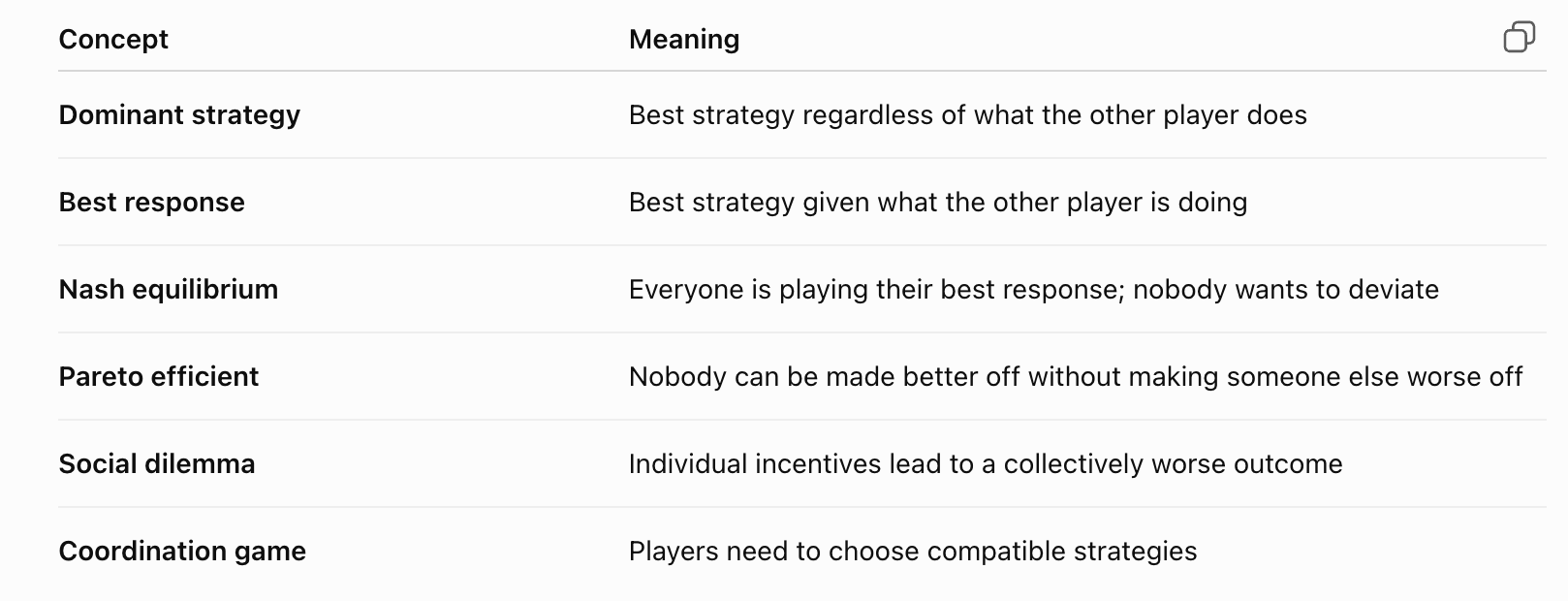
Most common equilibrium concept used in game theory
Nash equilibrium
But there are others (eg maximin)
Maximin strategy
Choosing the strategy that maximises the lowest possible value of their own payoff
Ie makes the lowest payoff one can receive as large as possible
Easy way to remember what maximum means
Maximises ur minimum payoff
How do you find a maximin strategy?
Look at the worst payoff from each strategy
Then choose the highest of those
Choose strat w highest minimum payoff
When is maximin useful?
When there is strategic uncertainty (u dk what other player will do)
If you don’t have a dominant strat → need to predict what other player will do
If u r uncertain → maximin gives a safe strat
Strategic uncertainty
Uncertainty about what other players will choose
(if u don’t have a dominant strat)
Cons of maximin
Might miss the opportunity to earn a much higher payoff
Bc it is a v cautious strat (protects u from worst ourcome)
Maximin vs Nash equilibrium
2 diff ways of deciding what to do in a game
Maximin: protects against the worst case
Nash: is optimal given others' strategies.
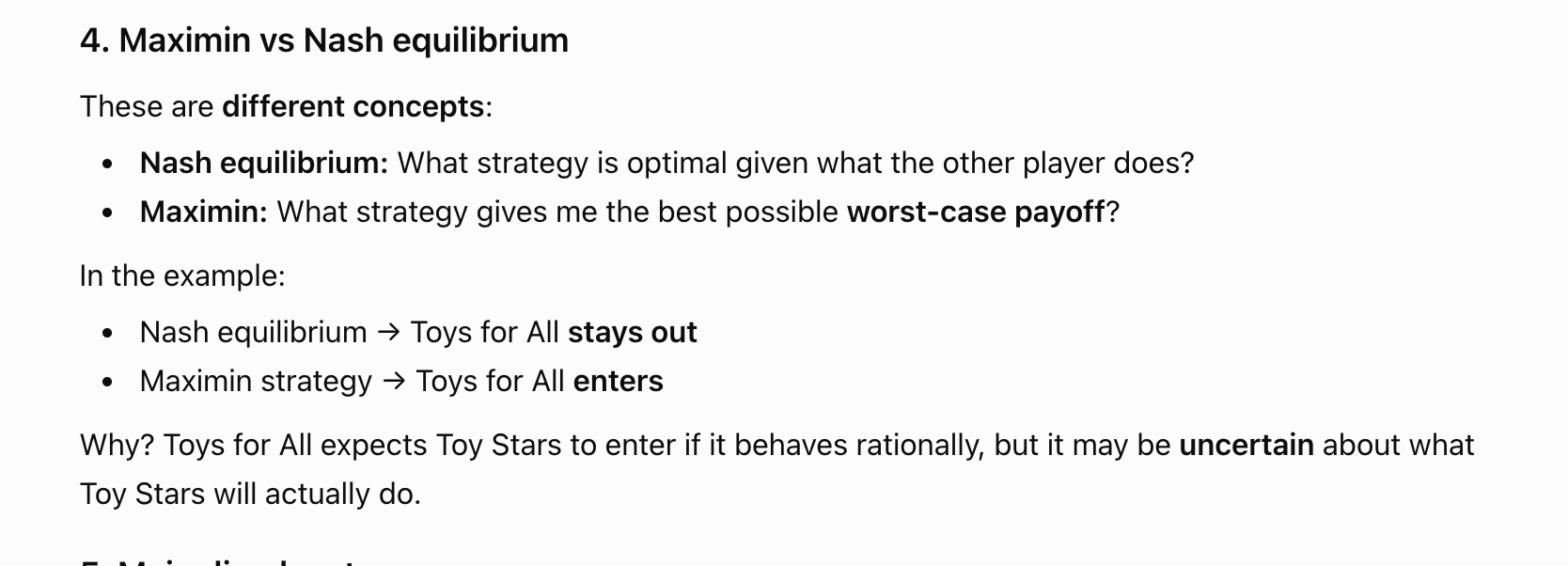

Alternatives to Nash equilibrium
Playing the maximin strategy
Eg if unsure abt if opponent will act rationally


(get more clarity on this)
Firm 2 has a dominant strategy to stay out. I
If firm 2 stays out then firm 1 does best to enter.
So, firm 1 enter and firm 2 stay out is the Nash equilibrium.
The maximin strategy of firm 1, however, is to stay out.
But, note this only guarantees the relatively low payoff of 10.