Normal Gait
 Call Kai
 Learn
 Practice Test
 Spaced Repetition
 Match
 Flashcards
 Knowt Play
1/94

There's no tags or description
Looks like no tags are added yet.
95 Terms
The PT uses gait, locomotion, & balance tests & measures to investigate disturbances, which frequently lead to ...
decreased mobility, decreased functional independence, increased risk of falls, increased fear of falling
what is walking gait?
advancement of entire body resulting from coordinated movements of body segments
T or F: in walking gait ground contact is always present
TRUE
T or F: gait is very sensitive to injury & disease despite having an engrained highly efficient & robust movement pattern
TRUE
If we are unable to compensate for injury/disease to produce a gait pattern, what might occur? (3)
-lose ability to produce gait pattern
-use assisted devices to enable gait
-use interventions to restore gait
T or F: the goal of gait is to efficiently move from one point to another
FALSE; the goal of gait is to move the body, not to do so efficiently
what is meant by "normal gait"?
within a person, highly repeatable pattern or sequence of limb motions with very little stride-to-stride and day-to-day variability
(highly individualized)
Across normal individuals variability (increases/decreases). What are ~some~ factors affect normal gait?
increases; height, weight, age, sex, cadence
explain the normal gait cycle.. what are the 2 phases?
- Cycle = heel strike to next ipsilateral heel strike
- Stance = period of limb ground contract, 60% of gait cycle
- Swing = period of no-limb ground contact, 40% of gait cycle
____ stride(s) = 1 gait cycle
1 stride (remember 1 stride = 2 steps)

what are the positions of the stance phase?
Heel-Strike/Initial Contact, Foot-Flat/Loading Response, Midstance, Terminal Stance/Heel-Off, Contralateral Heel-Strike, Toe-Off

____ begins the gait cycle and is the point at which the heel makes contact with the ground. There is very little loading through the leg at this time.
Heel-Strike (HS)/Initial Contact (IC)

_____ is the point at which the foot is flat on the ground and a rapid transfer of bodyweight to the outstretched limb occurs.
Foot-Flat/Loading Response (LR)

______ is the point at which the body progresses over a single, stable, fully loaded limb
Midstance (MSt)

_____ is the point at which bodyweight is shifted to the forefoot and progression over the stance limb continues to prepare for single limb support.
Heel-Off/Terminal Stance (TSt)
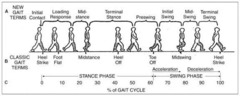
______ is the point at which the ipsilateral MTP break is maximized before the toe leaves the ground and bodyweight is transferred to the contralateral limb
Toe-Off

what are positions of the swing phase?
Initial Swing, Mid-Swing, Terminal Swing

what parts of the gait cycle occur in a closed kinetic chain? open kinetic chain?
closed = STANCE (IC, LR, MSt, TSt, TO)
open = SWING (ISw, MSw, TSw)
_____ is the point at which the thigh advances as the foot comes off the ground, ending at max knee flexion
Initial Swing (ISw)

_____ is the point at which the thigh continues advancing as the knee begins to extend and foot clears the ground
Mid-Swing (MSw)

_____ is the point at which the knee extends and the limb decelerates to prepare for heel-strike
Terminal Swing (TSw)

______ includes movement of both limbs during a gait cycle. How many steps does this contain?
stride; 2 steps
describe stride length; What are the average measures for men and women?
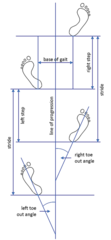
the distance from heel strike of one foot to the next heel strike of that same foot.
men = 1.48 m, women = 1.30 m (avg = 1.40 m)

what is a step?
the movement of one limb from heel strike to the heel strike of the contralateral limb

describe step lenght; What is the average measure?
the distance from heel strike of one foot to heel strike of the contralateral foot. ; 0.70 m

_____ is the perpendicular distance between midpoint of the heel on one foot to the same point on the other foot. What is the average measure?
step width/walking base width; 8 cm
how is foot angle/toe-out measured? What is the average measure?
the angle between the long axis of the foot and the line of forward progression; 8°
______ is the time from heel strike of one foot to the next heel strike of the same foot
stride time
____ is the rate of forward linear motion. What are the average measures for men and women?
walking velocity; men = 1.37 m/s, women = 1.28 m/s (avg = 1.3 m/s)
____ is the number of steps per unit time. What are the average measures for men and women?
cadence; men = 110 steps/min, women = 118 steps/min (avg = 112 steps/min)
_____ is the time the foot is on the ground in a gait cycle. ____ is the time the foot is off the ground in a gait cycle.
Stance time; Swing time
____ is the time that one foot is in contact with the ground during a gait cycle. ____ is the time that two feet are in contact with the ground.
Single support time; Double support time
T or F: swing time will increase and stance time will decrease on the ipsilateral limb of an injury
TRUE (compensation to not have to bear weight on injured limb)
what are the 3 functional phases of gait?
Weight Acceptance (WA), Single Limb Support (SLS), Swing Limb Advancement (SLA)
what are the 5 functional tasks of gait?
generate mechanical energy. absorb mechanical energy, maintain support of HAT, maintain upright posture, control foot trajectory
what influences walking speed? (4)
task, emotional state, physiological state, culture/society
what is walking speed clinically a measure of?
health
explain the impact aging has on normal gait (what factors increase? decrease?)
- DECREASED speed, step & stride length, muscle power of hip extensors and ankle PF
- INCREASED cadence & double support time
T or F: walking speed alters normal gait pattern
TRUE faster/slower changes in GRF, muscle activation, and mechanics all change gait pattern as a result of modulating walking speeds
explain what is meant when we say normal gait is "robust"
walking gait can be accomplished in many ways because the control system is highly flexible and adaptable
common purpose of walking
move body safely and efficiently across ground
explain weight acceptance and the functional tasks that occur during this phase
period of double limb support (includes HS and FF)
Functional tasks = absorb ground impact force & maintain HAT/upright posture while body continues forward path

explain single limb support and the functional tasks that occur during this phase
2nd half of stance -> period of single limb support in which the heel comes off the ground (includes MSt & HO)
Functional tasks = body progresses over single, stable, fully loaded limb (generate mechanical energy).. body weight transferred to met-heads via MTP break to maintain HAT/upright posture

explain swing limb advancement and the functional tasks that occur during this phase
limb is moved from behind the body to in front of the body (includes TO & all of swing)
Functional tasks = limb is unloaded and foot comes off ground, foot trajectory is controlled as foot moves from behind body to in front of body reaching for next step

_____ are the specific joint positions or motions that contribute to accomplishing the 3 functional phases and 5 gait cycle tasks
critical events
T or F: each phase of gait has 1 or more critical events at the ankle, knee, or hip in the sagittal plane
TRUE
in what plane is most of an observational gait analysis conducted?
sagittal plane
explain the 4 descriptors of critical events
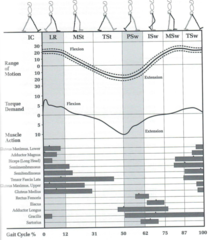
ROM, external torque demand (stability response to LoG position), muscle action, functional significance
______ is the external torque moments applied to the body during the different phases of gait. _____ is the internal torque moments created by the body in response.
torque demands; muscle action
where in gait does the biggest torque demand occur out of all the joints? 2nd biggest?
- largest: plantarflexion torque (internal moment) during TSt/HO
- 2nd largest: hip flexion during LR

what is the ROM, TD, MA, and FS at the ankle during heel-strike/initial contact (weight acceptance)?
ROM = neutral
TD = PF torque
MA = tibilais anterior & 1st digit extensors, eccentric
FS = position the foot for loading, heel rocker

what is the ROM, TD, MA, and FS at the ankle during loading response (WA)?
ROM = 5° PF (rapid)
TD = PF torque (rapid foot to floor)
MA = pretibials, eccentric (control) + soleus/gastroc late
FS = creates heel rocker action & pulls tibia forward to create forward momentum/flex knee

what muscle(s) peak during LR?
tibialis anterior, gluteus maximus, gluteus medius, vastus medialis, vastus lateralis, vastus intermedius, TFL

what muscle(s) peak during TSt/HO?
soleus, gastroc, tibialis posterior, peroneus longus, peroneus brevis, short head biceps femoris

what muscle(s) peak during PSw?
rectus femoris

what muscle(s) peak during ISw?
Ext digitorum longus, Ext hallucis longus, short head biceps femoris, gracilis, sartorius, iliopsoas

what muscle(s) peak during TSw?
long head biceps femoris, semimembranosus, semitendinosus

what is the ROM, TD, MA, and FS at the ankle during midstance (SLS)?
ROM = 5° DF
TD = DF torque
MA = soleus/gastroc, eccentric
FS = muscle activity controls tibial advancement, forward momentum is maintained by ankle rocker as foot goes into 5° DF

what is the ROM, TD, MA, and FS at the ankle during terminal stance/heel-off (SLS)?
- ROM = 10° DF & 30° MTP hyperextension
- TD = increased external DF torque (this is where PF is MAXED)
- MA = gastroc/soleus (heel to rise in SLS)
- FS = calf allows max forward progression, controls DF & forefoot rocker

what is the ROM, TD, MA, and FS at the ankle during toe-off/pre-swing (SLA)?
- ROM = 15° PF & 60° MTP hyperextension
- TD = decreased DF torque
- MA = PF achieved by residual PF activity and passive tension, pretibials late to prepare for DF
- FS = forefoot remains on ground for balance & PF makes foot rigid to assist with knee flexion & SLA
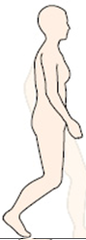
what is the ROM, TD, MA, and FS at the ankle during initial swing (SLA)?
- ROM = 5° PF
- TD = low PF torque
- MA = pretibials (initiate DF); ext hallucis longus and digitorum longus peak in activity
- FS = DF to shorten limb and clear foot (neutral not achieved in this phase)

what is the ROM, TD, MA, and FS at the ankle during mid-swing & terminal swing (SLA)?
ROM = neutral
TD = low PF torque
MA = pretibials, concentric
FS = foot clears ground by 1 cm & neutral position assures heel contact for HS
**foot clears ground by 1cm

what is the ROM, TD, MA, and FS at the subtalar joint during Weight acceptance?
WA = HS and FF
ROM = 5° calcaneal EV (pronation)
TD = external eversion torque
MA = anterior and posterior tibialis, eccentric
FS = pronation unlocks midtarsal joint & assists in shock absorption
what causes the EV torque at the subtalar joint during WA?
calcaneus is lateral to the weightbearing axis of the tibia causing eversion

what is the ROM, TD, MA, and FS at the subtalar joint during SLS?
- ROM = progressive reduction of EV until ~2°
- TD = decreased EV torque in midstance, increased inversion torque in terminal stance
- MA = tibialis posterior, soleus, & peroneals, eccentric then concentric
- FS = moving from EV to INV creates rigid forefoot lever & promotes forefoot rocker

what is the ROM, TD, MA, and FS at the subtalar joint during SLA?
ROM = INV at TO then rapidly back to neutral
TD = decreased INV torque
MA = pretibials, concentric
FS = foot clears ground and becomes neutral for HS
what is the ROM, TD, MA, and FS at the knee during initial contact (WA)?
ROM = neutral to ~5° flex
TD = rapid, brief knee ext torque
MA = quads prepare for loading, hamstrings counter KE
FS = KE stabilizes the knee

what is the ROM, TD, MA, and FS at the knee during loading response (WA)?
ROM = 15° flex
TD = rapid external knee flex torque
MA = quads, eccentric
FS = shock absorbed and limb stability maintained while forward progression continues
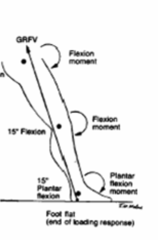
what causes the rapid knee flexion torque during loading response?
heel rocker & position of body behind the foot

what causes the knee extension torque during midstance?
forward momentum from contralateral swing limb, allows quads to turn off
what is the ROM, TD, MA, and FS at the knee during midstance (SLS)?
- ROM = ~5° flex (appears neutral)
- TD = external knee ext torque (quads turn off)
- MA = quads until knee ext torque.. calf then indirectly stabilizes knee
- FS = knee stability maintained by knee ext torque and calf activity to allow femur to advance faster than tibia
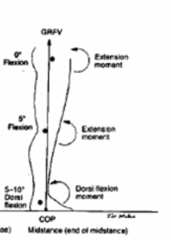
what is the ROM, TD, MA, and FS at the knee during terminal stance/heel-off (SLS)?
ROM = unchanged from midstance (~5° flex)
TD = knee ext torque peaks and diminishes
MA = no muscle activity at knee
FS = joint stability maintained during forward progression
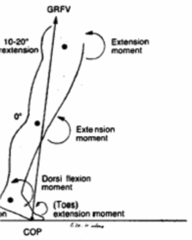
during what phase is there no muscle activity at the knee? what is firing to stabilize the knee?
terminal stance/heel-off; calf restrains tibia & short head of biceps femoris prevents hyperextension
what is the ROM, TD, MA, and FS at the knee during toe-off/pre-swing (SLA)?
ROM = rapid flex to 40°
TD = residual PF at ankle generates knee flexion torque
MA = rectus femoris restrains rapid passive KF, gracilis minimally active to flex knee
FS = pre-swing knee flexion adds to knee flexion needed for limb clearance

T or F: pre-swing knee flexion accounts for more than half of the knee flexion required in swing
TRUE; this is why toe-off is in SLA despite the foot being in contact with the ground
what is the ROM, TD, MA, and FS at the knee during initial swing (SLA)?
ROM = rapid flex to 60°
TD = knee flexion torque
MA = short head biceps femoris, sartorius, gracilis (knee flexion aided by hip flexion)
FS = foot clears ground as thigh advances
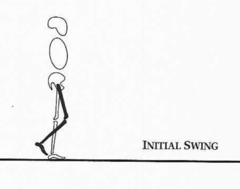
what causes the knee flexion torque during initial swing?
thigh advancement from active hip flexion & tibial inertia
what is the ROM, TD, MA, and FS at the knee during mid-swing (SLA)?
- ROM = extends to 25° flex, tibia is vertical
- TD = knee extension torque
- MA = short head biceps femoris, hamstrings eccentric late in phase
- FS = knee ext to prepare for next HS & optimize step length

what causes knee extension torque during mid-swing & terminal swing?
tibial momentum towards vertical position
what is the ROM, TD, MA, and FS at the knee during terminal swing (SLA)?
- ROM = extends to neutral (may do ~5° flexion)
- TD = knee extension torque from rapidly advancing tibia
- MA = quads concentric to insure full knee extension, hamstrings eccentric to decelerate
- FS = knee ext to prepare for next HS, optimize step length by leg reaching out

what is the ROM, TD, MA, and FS at the hip during initial contact/heel-strike (WA)?
- ROM = 20° flex & 5° forward rotation
- TD = rapid, high intensity external hip flex torque begins
- MA = hip extensors to stabilize thigh for loading; semimembranosus & long head biceps femoris reduced
- FS = hip & pelvis in position of forward reach

what is the ROM, TD, MA, and FS at the hip during loading response (WA)?
- ROM = unchanged (20° flex & 5° forward rotation)
- TD: rapid, high intensity external hip flex torque + add torque begins
- MA = gluteus maximus, adductor magnus, hamstrings, TFL, gluteus medius
- FS = counter hip flex torque to stabilize thigh and stabilize pelvis in frontal plane during shock absorption
what joint action is the primary shock absorber in gait? primary limb advancer?
shock absorber: knee flexion
limb advancer: hip flexion
what is the ROM, TD, MA, and FS at the hip during midstance (SLS)?
- ROM = extend & backward rotation to neutral
- TD = external hip ext torque & hip add torque
- MA = hip abductors stabilize
- FS = stability achieved without hip extensors; pelvis stabilized to prevent hip drop

during what phase is there no sagittal plane muscle activity at the hip? what is firing to stabilize the hip?
midstance; hip abductors
what is the ROM, TD, MA, and FS at the hip during terminal stance (SLS)?
ROM = 20° hyperext & 5° backward pelvis rotation
TD = external hip ext torque... external hip add torque ends
MA = anterior TFL during late stance
FS = body advances past foot, limb is stable, HAT & upright posture maintained

what is the ROM, TD, MA, and FS at the hip during toe-off/pre-swing (SLA)?
- ROM = 10° hyperext & 5° backward rotation
- TD = external hip ext torque diminishes to 0
- MA = adductor longus for femur flexing forward, some rectus femoris
- FS = limb advancement begins; hip flexion adds to knee flexion

what is the ROM, TD, MA, and FS at the hip during initial swing (SLA)?
- ROM = 15° flex & 5° backward rotation
- TD = external hip ext torque diminishes by end
- MA = iliopsoas, gracilis, sartorius peak (some from adductor longus activity)
- FS = limb advancement continues

what is the ROM, TD, MA, and FS at the hip during mid-swing (SLA)?
- ROM = 25° flexion & neutral pelvic rotation
- TD = external hip flex torque increases
- MA = hamstrings
- FS = limb advancement slows, body moves past stance limb

what is the ROM, TD, MA, and FS at the hip during terminal swing (SLA)?
- ROM = 20° flex & 5° forward rotation
- TD = hip flex torque diminishes
- MA = hamstrings peak to decelerate; gluteus maximus, adductor magnus, TFL, gluteus medius prepare to stabilize hip
- FS = limb positioned for heel-strike (forward rotation of pelvis contributes to step length)

explain the ROM value of the trunk during gait.. what does this rotation cause at shoulders/arms?
trunk rotates ~5°, causing shoulder rotation opposite pelvic rotation, causing contralateral arm swing
explain the MA of the trunk during gait
-bilateral trunk extensors and rotators active to stabilize trunk during loading when flexion torque is greatest
-ipsilateral erector spinae active during pre-swing as contralateral limb is loaded
during weight acceptance, (concentric/eccentric) muscle activity controls and absorbs shock/load
eccentric
during SLS, (concentric/eccentric) PF propels the body forward
concentric
**largest torque demand (foot)
**pelvic stabilization (no hip and knee activity)
during SLA, (concentric/eccentric) MA clears the limb from the ground
concentric
**hip extension decelerates leg... position leg for heel strike