Neuroscience: Introduction Chemical Senses: Unit 2: lecture 1
 Call Kai
 Learn
Learn Practice Test
 Spaced Repetition
 Match
Match Flashcards
 Knowt Play
1/33

There's no tags or description
Looks like no tags are added yet.
Name | Mastery | Learn | Test | Matching | Spaced | Call with Kai | Chat |
|---|
No analytics yet
Send a link to your students to track their progress
34 Terms
The Chemical Senses:Chemoreceptors
sensory receptor selective for chemicals:
The Chemical Senses:Gustation (taste)
detects environmental chemicals
The Chemical Senses:Olfaction (smell)
detects environmental chemicals
Both gustation and olfaction…
Strong and direct connections with our internal needs (thirst, hunger, emotion, and certain forms of memory)
But their chemoreceptors differ structurally and mechanistically
Basic Tastes:
saltiness, sourness, sweetness, bitterness and umami
The traditional "tongue map" is a persistent scientific misconception
All basic tastes can be detected across all regions of the tongue where taste buds are present
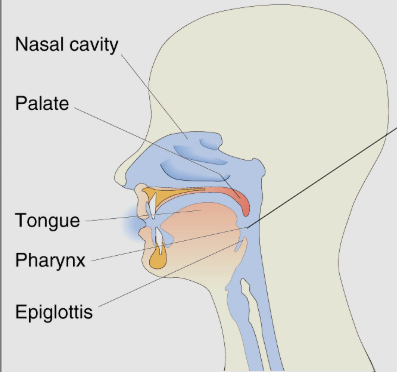
Organs of taste and smell:
The anatomical structures we use to detect chemicals by smell and taste are physically connected
Pharynx
connects the mouth with the nasal passages allowing exchange of chemicals from food
Tongue
is a sensory organ for both chemo-sensation and somato-sensation
Filiform papillae do not contain taste buds
🡺 Food grip and texture
Foliate papillae
Fungiform papillae taste buds
Circumvallate papillae
A taste bud:
cluster of taste cells (receptor cells)
1 taste buds =50 - 200 taste receptor cells
1 papillae = 1-100 taste buds
Taste receptor cells
Small opening
The taste cell is exposed to the contents of the mouth
Chemicals cause the taste cells to change their membrane potential and the sensory neuron to fire action potentials
Most taste receptors respond to 1 taste
NaCl: Salty
Quinine: Bitter
HCl: Sour
Sucrose: Sweet

Mechanism of Taste Transduction
Transduction – process of environmental stimuli causing an electrical response in a sensory receptor
Taste Transduction: Tastants may
(1) Directly pass through ion channels (salt and sour)
(2) Bind to and block ion channels (sour)
(3) Bind to G-protein-coupled receptors in the membrane 🡪 activate secondary messengers 🡪 open ion channels (bitter, sweet, umami)
Taste Selectivity and Concentration: Threshold concentration
The lowest concentration of a chemical (tastant) that can reliably evoke a taste response
Taste Selectivity and Concentration: Near threshold
Taste receptor cells and fibers may show relatively selective responses to particular tastes
Taste Selectivity and Concentration: Above threshold
Increasing the concentration recruits more taste receptor cells and fibers, producing broader and more overlapping responses
Overall: Taste coding is not strictly one receptor/one taste. Instead, it relies on overlapping population coding, with different taste receptor cells and neural fibers responding preferentially to different Tastants
Important: A papilla is not dedicated to a single taste; each papilla contains multiple taste buds, and taste buds contain different types of taste receptor cells
Taste stimuli that directly pass through ion channels:
SALT AND SOUR

Transduction: Bitter, Sweet, Umami
Two families of genes:
T1R – taste receptor protein
T2R – taste receptor protein
G-protein

Taste stimuli via G-protein receptors:

Central Taste Pathway
TASTE BUDS 🡪 GUSTATORY AXONS 🡪 MEDULLA🡪 THALAMUS 🡪 CEREBRAL CORTEX
Anterior tongue 🡪 cranial nerve VII (7) (facial nerve)
Posterior tongue 🡪 IX (9) (glossopharyngeal)
Throat (glottis, epiglottis, pharynx) 🡪 X (10) (vagus nerve)
3 cranial nerves carry gustatory axons to the MEDULLA (in the brain stem)
GUSTATORY NUCLEUS (NTS)
🡪 diverges into parallel pathways that process:
conscious perception (Thalamocortical Pathway)
autonomic responses (Hypothalamic Pathway)
emotional associations with food (Limbic / Amygdala Pathway)

Vagus Nerve (CN X) Innervation:
Taste buds are located on the posterior wall of the pharynx and epiglottis
Thalamocortical pathway
conscious taste perception
NTS → VPM nucleus of thalamus → primary gustatory cortex (insula/frontal operculum)
Allows you to consciously perceive: “This is sweet,” “This is bitter,” etc
Hypothalamic pathway
autonomic responses
NTS → hypothalamus and autonomic centers
Produces physiological responses associated with eating, such as salivation, digestive responses, and changes in appetite
Limbic/amygdala pathway
emotional/reward associations
Taste information reaches limbic structures, including the amygdala
Contributes to emotional/behavioral responses to food, such as food preference, aversion, and reward
Neuronal Coding of Taste
Why don’t we have very specific taste receptors?
(1) need a lot of receptors
(2) couldn’t taste new things
How do we get around that?
Population Coding – response of a large number of broadly tuned neurons, rather than a small number of precisely tuned neurons, are used to specify the properties of a particular stimuli
Olfaction
The sense of smell
Why do we smell?
Helps us identify foods
Increasing or decreasing their enjoyment
Complements the information from the sense of taste
Warns us of potential dangers: smoke, spoiled food, etc
Out of several hundred of thousands of molecules only 20% are pleasant
Mode of communication: reproductive behavior (pheromones), mark territory, identify individuals, indicate aggression, or submission
The Organs of Smell
Olfactory epithelium – small, thin sheet of cells lining part of the nasal passages that contains olfactory receptor neurons
3 main cell types:
OLFACTORY RECEPTOR – sight of transduction
Actual neuron
One of the few that are regularly replaced throughout life
Supporting cells – helps produce mucus
Similar to glia
Odorants (chemical stimuli in the air) – dissolve in the mucus before reach receptor
Basal Cells – source of new receptor cell growth
Every 4 to 8 weeks
Olfactory receptor during stimulation
wo depolarizing events in the cilia:
Receptor potential
fCa²⁺-activated Cl⁻ current
Olfactory Response may terminate for several reasons:
Olfactory Adaptation (Sensory Fatigue)
Clearance of Odorant Molecules
Pathological or Physiological Damage
OLFACTORY ADAPTATION
If you are exposed to a smell long enough, you stop smelling it!
Olfactory Receptor Proteins
1000s of them
350 of them
They are G-protein-coupled receptors
Typically, each odorant receptor cell expresses only 1 receptor type
Population Coding
Each receptor binds different odorants with less or more affinity, so each receptor is less or more sensitive to those odors:
Broadly tuned
Population Coding:
Central olfactory pathways decode the information from the whole neuronal population
Activity distributed over a large number of neurons
Glomeruli
cluster of neurons in the olfactory bulb that receive input from olfactory receptor neurons
First synapse occurs in the glomeruli of the olfactory bulb
Ratio: 25,000 axons synapse onto 100 2nd order neurons
CONVERGENCE
Receptor axons of cells expressing the same odorant receptors project to the same glomeruli:
🡺 spatial odorant maps
"This particular combination of locations is associated with this odor."
Temporal Coding in the Olfactory System
Temporal coding – depends on the timing of spikes
For smell – encode quality of odors
Pathways

Olfactory summary
Each odor is represented by the activity of a large population of neurons
The neurons responsive to particular odors may be organized into spatial maps
Timing of action potentials may be an essential code for particular odors
Test yourself
What are the 5 flavors? What purpose does each serve?
What is the mechanism of sensory transduction for each flavor? What could block tasting each?
Why have so many subtypes of bitter receptor?
What is the anatomy of the olfaction circuit?
What is adaptation?
Compare & contrast the labeled-line hypothesis with population coding.
What is spatial coding? Temporal coding?