EASC 3210: ORE MICROSCOPY
 Call Kai
 Learn
 Practice Test
 Spaced Repetition
 Match
 Flashcards
 Knowt Play
1/31

Earn XP
Description and Tags
LECTURE 2, LECTURE 3
32 Terms
properties observed under crossed polars
anisotropism
internal reflections
covellite
blue, intensely pleochroic

gold
yellow, very high reflectance, very soft
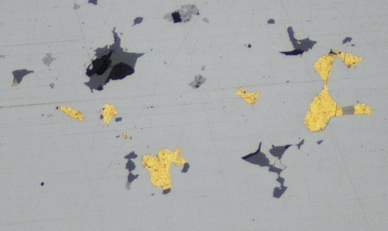
chalcopyrite
yellow, very weak anisotrophy
bornite
(red) brown, weakly anisotropic

copper
(red) brown, high reflectance, very soft
reflectance
The percentage of light incident on the polished surface of a mineral that is reflected back through the microscope objective, to the observer
bireflectance
change in reflectance when rotated under ppl
reflection pleochroism
change in colour when rotated under ppl
cubic minerals generally do not show these properties
bireflectance and reflection pleochroism
strongly bireflectant mimnerals
graphite, molybdenite, covellite, stibnite
moderately bireflectant minerals
marcasite, hematite, pyrrhotite, cubanite, niccolite
weakly bireflectant minerals
arsenopyrite, ilmenite, enargite
BIREFLECTANCE and REFLECTION PLEOCHROISM are a function of…
the Crystallographic Orientation of the grain relative to the incident polarized light
anisotropism
Cubic (Isometric) minerals remain uniform in appearance when the stage is rotated, although not necessarily completely dark
exception is weak anomalous anisotropy in pyrite
The maxima and minima of these anisotropic effects will each occur…
four times in a 360º rotation, offset 45º from each other
false anisotropy can be introduced by …
fine parallel scratches
marcasite
has distinct deep blue/green/yellow anisotropic colours
internal reflections
generated by light reflected back to the surface from subsurface cracks or flaws in the grains of a non-opaque mineral
view under crossed polars with brightness increased
ex. quartz
sphalerite
shows yellow, brown, green or red internal reflections
internal reflections useful in identifying…
quartz, sphalerite, cassiterite, hematite, wolframite, and chromite
hardness
harder minerals stand out (positive relief) from softer minerals
due to polishing relief
kalb light line test
Focus on a clear boundary line between two mineral grains
Lower the stage to defocus the sample
Observe a “Becke-like” line of light, which will move into the softer mineral

which mineral is harder?
Ttr
pyrite
very hard mineral that retains diagnostic deep scratches from initial prep
gold, silver, molybdenite, graphite
very soft minerals that almost always retained a scratched or dimpled appearance after polishing
framboidal/spheroidal
common in shale-hosted pyrite, is a product of bacterial activity that precipitates iron sulphides

galena
has triangular pitting due to cubic cleavage that causes plucking features during polishing
marcasite
irregular longitudinal fractures

molybdenite
basal cleavage/lath shape

chalcopyrite disease
sphalerite from VMS (or others) with small inclusions of chalcopyrite
oriented along crystal planes
are a later hydrothermal replacement feature

paragenesis
the time sequence of formation of mineral phases
shown from the textural relationships of minerals in thin or polished sections