A&P skeletal system lecture exam
 Call Kai
 Learn
 Practice Test
 Spaced Repetition
 Match
 Flashcards
 Knowt Play
1/92

There's no tags or description
Looks like no tags are added yet.
93 Terms
What are the different shapes of bones?
long, short, flat, and irregular
Examples of long bones
femur, radius, ulna
Examples of short bones
talus and carpal
Examples of flat bones
scapula and sternum
Examples of irregular bones
sphenoid and vertebre
Functions of the skeletal system
Support, protection, movement, electrolyte balance, acid-base balance, blood cell production
Osteogenic cells
Continuously multiply, develop from the embryonic fibroblasts, some go on to become osteoblasts, stem cell
Osteoblasts
synthesize the soft organic matter of the bone matrix to form/build a new bone, forms bone matrix
Osteocytes
former osteoblasts that have been trapped in the matrix they deposited, cells in lacunae connected by gap junctions inside canaliculi, maintains bone tissue
Osteoclasts
develop in the bone marrow and are bone-dissolving, dissolve and reabsorb old/damaged bone tissue
Ossification
the process of bone formation during the 6th-7th week of embryonic life
Red bone marrow
hemopoietic (produces blood cells), has stem cells that create RBC, WBC, and platelets
Yellow bone marrow
fatty marrow of long bones in adults, serves as an energy reserve, can turn into red bone marrow if body needs more blood cells
Intramembranous ossification
bone formation of flat bones such as mostly the cranial and facial bones
Endochondral ossification
bone formation of long bones and the bones that aren’t intramembranous, preformed in hyaline cartilage
Appositional growth
bones increasing in width
Wolff’s law of bone
architecture of bone determined by mechanical stresses
Hypocalcemia
deficiency of blood calcium which causes excitability if nervous system is too low, can cause muscle spasms, tremors, or tetany
Hypercalcemia
excess blood calcium which causes a depressed nervous system, muscle weakness and sluggish reflexes
Rickets
a childhood bone disorder that causes bones to become soft, weak, and prone to skeletal deformaties
Osteomalacia
adult bones become softened and weak because they lack minerals to harden properly, also not enough vitamin D
Calcitonin
a peptide hormone made by the C-cells in your thyroid gland that helps lower calcium levels in your blood, can reduce osteoclast activity by 70%, reduces bone loss in osteoporosis
Function of the parathyroid hormone
raises calcium blood level
Who is at greatest risk for osteoporosis?
postmenopausal white women
Osteoporosis
bone lose mass and become brittle, weak, bone density loss, higher risk to fractures and health complications
Ways to prevent osteoporosis
weight-bearing exercises, eating enough calcium, vitamin D, avoid smoking + heavy drinking
How many bones are in the typical adult skeleton?
206
How many bones do we start with at birth?
270, but they decrease with fusion
Axial skeleton
central axis/core of human body—skull, vertebral column, ribs, sternum, and sacrum

Appendicular skeleton
upper and lower limbs, and the pectoral and pelvic girdles

Trochanter
a very large, massive bump — ex: on femur

Tubercle
a relatively small bump on a bone — ex: on humerous
Tuberosity
a relatively large, rough area on a bone
Fossa
a shallow depression in a bone
Sinus
a cavity
Facet
a smooth, flat face
Suture
an immovable joint found only between skull bones
Fissure
a narrow, slit-like opening
Condyle
A rounded articular projection that forms a joint
Meatus
Canal-like passage
Process
A raised area or projection
Foramen
Round or oval opening in a bone
How does articular cartilage receive nutrients?
synovial fluid
Which area of the humerus articulates with the ulna?
the trochlea
Difference between the male and female pelvis?
Male - 90 degrees, heart shaped
Female - roughly 120 degrees and wider for childbirth
What are the parts of the sternum?
jugular notch, manubrium, body, xiphoid process
Sequence of a fracture repair
hematoma forms, internal and external callus forms, cartilage callus replaced by trabecular bone, remodeling (longest stage)
What is a displaced fracture?
when a broken bone separates and moves out of its normal alignment
What is a nondisplaced fracture?
occurs when the bone cracks or breaks but stays properly aligned

What type of fracture is this?
Open, displaced

What type of fracture is this?
Greenstick

What type of fracture is this?
Comminuted

What type of fracture is this?
Oblique, nondisplaced

What type of fracture is this?
Transverse, nondisplaced
Synostosis
bony joint, abnormal or normal fusion of 2 or more bones
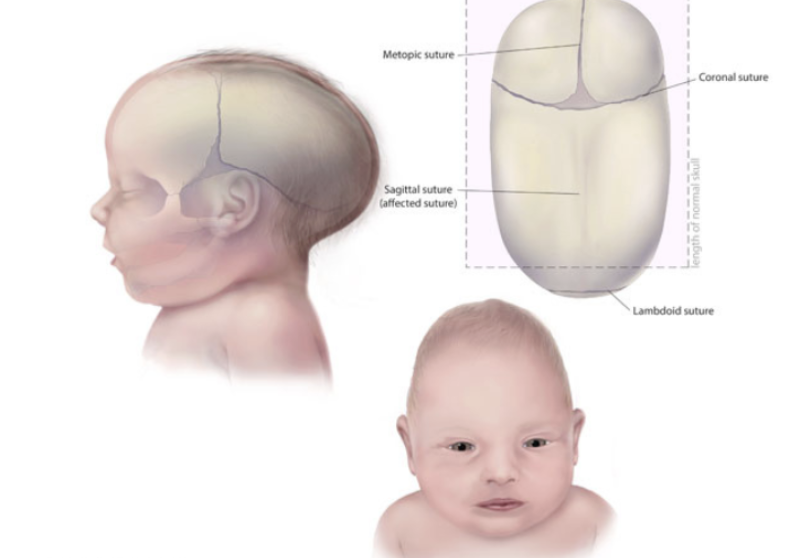
Syndesmosis
2 bones bound by a ligament, either fibrous tissue or interosseous membrane

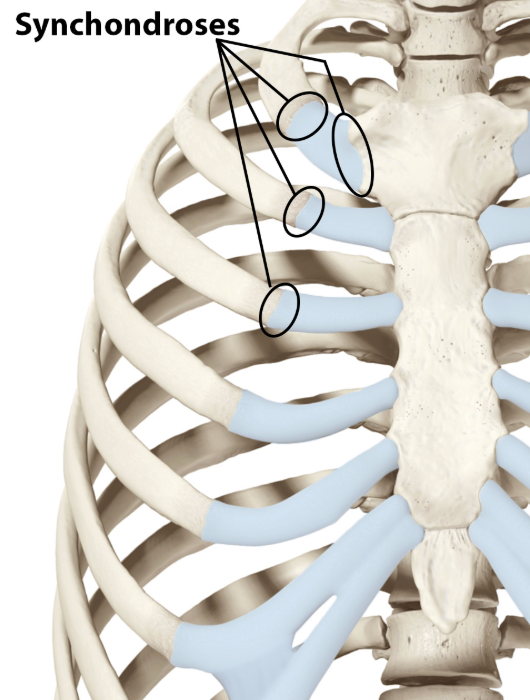
Synchondrosis
Bones joint by hyaline cartilage
Synovial joint
2 bones are separated by a space called a joint cavity, most common and freely movable

How many bones are in the spine?
33 individual bones, but 26 distinct bones because of fusion
How many bones are in the wrist?
8 bones
How many bones are in the anke?
7 bones
How many bones are in the face?
14 bones
Which bones contain the paranasal sinuses?
Sphenoid, frontal, ethmoid, and maxillary
What is the pectoral girdle made up of?
Clavicle and scapula
What is the pelvic girdle made up of?
Pelvis: ilium, ischium, and pubis
Sacrum and coccyx
Which lower limb is medial and the body?
The tibia
What bones comprise the cheek bone?
the zygomatic, which connects to the maxilla
Function of calcitriol
raises calcium levels
Ball and socket joint examples
hip joint: femur into pelvis
shoulder joint: humerus and scapula
Saddle joint examples
trapeziometacarpal joint at the base of the thumb
Hinge joint examples
ulna and humerus at elbow joint, femur and tibia at the knee joint
Abduction
movement of a part away from the midline
Adduction
the movement towards the midline
Circumduction
movement in which one end of an appendage remains stationary while the other end makes a circular motion
Supination
rotation of forearm so that the palm faces forward
Pronation
rotation of forearm so the palm faces to the rear
Dorsiflexion
raising of the toes when you swing the foot forward to take a step

The brain and spinal cord are connected through this opening in the skull
Foramen magnum
How many cervical vertebrae are there?
7
How many thoracic vertebrae are there?
12
How many lumbar vertebrae are there?
5

Which type of vertebrae is this?
Cervical

Which type of vertebrae is this?
Thoracic
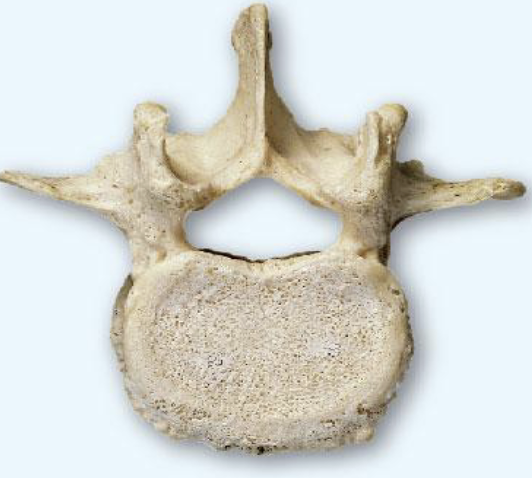
Which type of vertebrae is this?
Lumbar
Another name for the dens of the vertebrae
odontoid process
How many true ribs are there?
7
How many false ribs are there?
3
How many floating ribs are there?
2
Primary ossification center
diaphysis
Secondary ossification center
epiphyses
What type of tissue is in the pubic symphysis
hyaline and fibrocartilage
Where is the olecrannon process?
the proximal (upper) and posterior (back) end of the ulna
In hyaline cartilage, the cells that produce new matrix are called this
chondroblasts