Week 10: Avalanche
0.0(0)
Studied by 1 person Call Kai
 Learn
Learn Practice Test
 Spaced Repetition
 Match
Match Flashcards
 Knowt Play
Card Sorting
1/40

Earn XP
Description and Tags
Last updated 12:10 PM on 10/11/26
Name | Mastery | Learn | Test | Matching | Spaced | Call with Kai | Chat |
|---|
No analytics yet
Send a link to your students to track their progress
41 Terms
1
New cards
Snow Avalanche
**Definition**
* A mass of snow many cubic meters in volume that separtaes from a snowpack and flows downslope
\
Rocks, soil, ice, and debris can travel in a similar motion; however, the term *avalanche* is generally reserved for snow.
\
The intensity of the hazard is dependent on slope steepness, snowpack stability and weather
* A mass of snow many cubic meters in volume that separtaes from a snowpack and flows downslope
\
Rocks, soil, ice, and debris can travel in a similar motion; however, the term *avalanche* is generally reserved for snow.
\
The intensity of the hazard is dependent on slope steepness, snowpack stability and weather
2
New cards
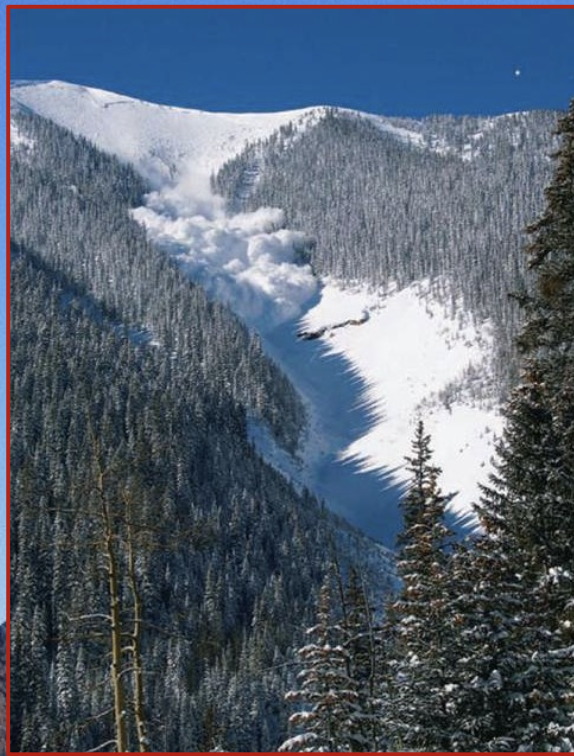
There are 2 types of snow avalanche
1. An avalanche travelling as a coherent block
2. An avalanche that becomes wider as it travels downslope
\
It is estimated that over 99% of avalanches are not seen by anyone
\
It is likely that over 1 million avalanches large enough to kill a person occur annually in Western Canada alone.
3
New cards
Snow climatology
Snowfall accumulation depends on latitude, altitude, and proximity to bodies of water.
\
Temperature decreases with altitude therefore high mountains have permanent snow cover.
\
Snow accumulates on mountain slopes that are at angles less than 60 degrees
\
Temperature decreases with altitude therefore high mountains have permanent snow cover.
\
Snow accumulates on mountain slopes that are at angles less than 60 degrees
4
New cards
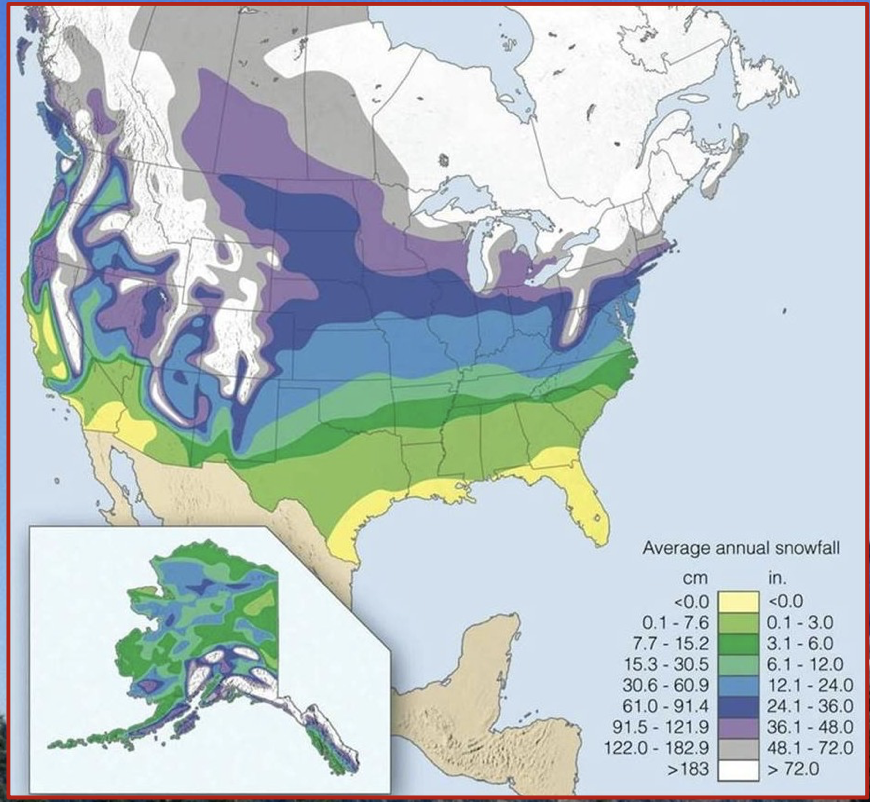
Snowfall in North America
Rockies = most snow
5
New cards
Snow Cover
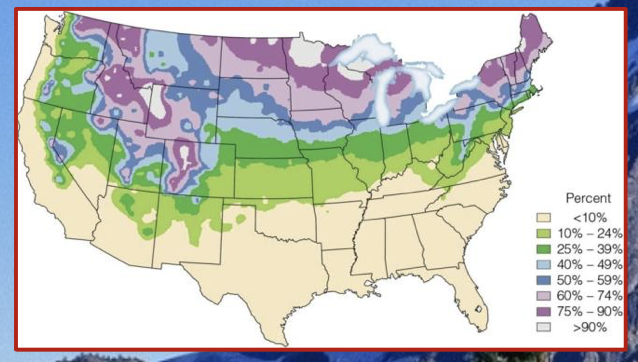
The probability of a White Christmas considers the probability of snow cover on Dec. 25th
* see image
\
Snow cover maps are updated daily.
* see image
\
Snow cover maps are updated daily.
6
New cards
Point-release avalanches
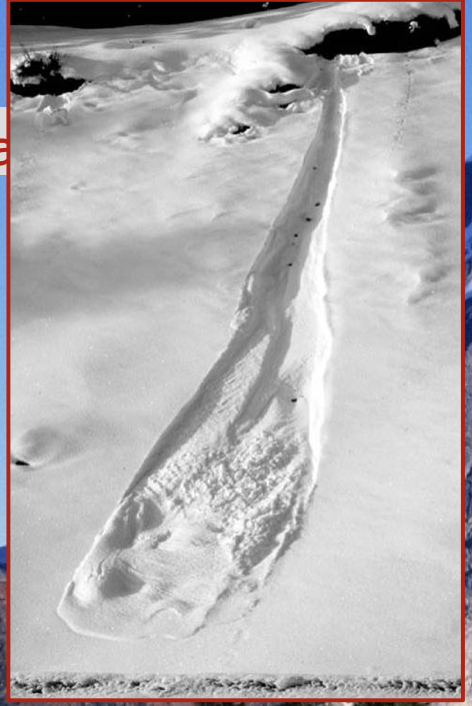
These begin as an initial failure after a heavy snowfall.
\
The sliding snow then causes more failures in the adjacent snowpack causing the trough to widen
\
The sliding snow then causes more failures in the adjacent snowpack causing the trough to widen
7
New cards
Slab avalanches
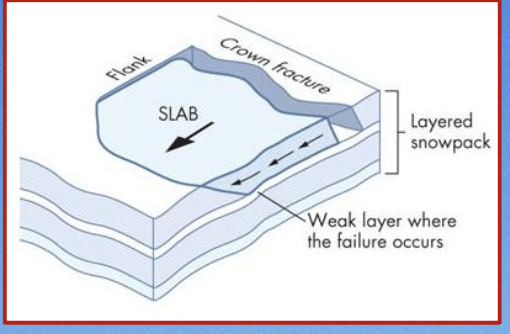
These occur when a snowpack fractures along a weak layer parallel to the surface
\
These avalanches move as cohesive blocks leaving behind a scarp
\
These are the most dangerous avalanches
\
These avalanches move as cohesive blocks leaving behind a scarp
\
These are the most dangerous avalanches
8
New cards
Avalanche potential
New snow that has not been able to bond to the layer below is susceptible to sliding.
\
Wet, compacted snow is less likely to slide than dry, powdery snow.
\
A mass of snow that is above the vegetation level and above large boulders is more likely to slide
\
Wet, compacted snow is less likely to slide than dry, powdery snow.
\
A mass of snow that is above the vegetation level and above large boulders is more likely to slide
9
New cards
Weak layers
Slab avalanches require a buried weak layer. Such a layer can form from wind or from *hoar*.
10
New cards
hoar
Layers composed of hoar have less strength than the rest of the snowpack.
\
Hour can form deep in the snowpack (in air pockets) on the snow surface
\
Hoar changes little over time; therefore, overlying snow can leave the buried hoar as a weak layer.
\
Hour can form deep in the snowpack (in air pockets) on the snow surface
\
Hoar changes little over time; therefore, overlying snow can leave the buried hoar as a weak layer.
11
New cards
wind
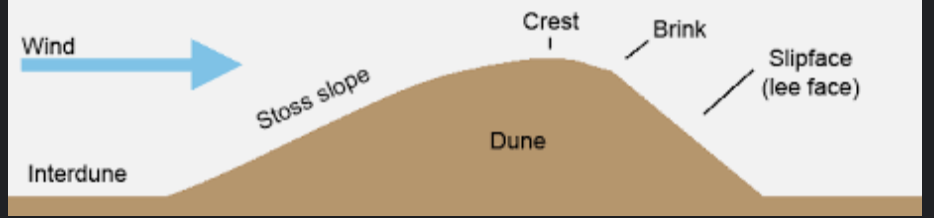
Blowing snow can accumulate on the *lee* slope of mountains.
\
Wind can deposit a layer of light ice crystals on a layer of more compact snow
\
The boundary between two layers could become a horizon along which failure could occur
\
Wind can deposit a layer of light ice crystals on a layer of more compact snow
\
The boundary between two layers could become a horizon along which failure could occur
12
New cards
lee slope
downwind slope
\
\
13
New cards
Avalanche motion
\
Rapidly moving avalanches (**i.e., speeds of over 35 km/h**) often generate clouds of powdered snow.
\
Fastest avalanches have been measured at speeds of 200km/h
\
Some are powerful enough to climb opposing slopes
Rapidly moving avalanches (**i.e., speeds of over 35 km/h**) often generate clouds of powdered snow.
\
Fastest avalanches have been measured at speeds of 200km/h
\
Some are powerful enough to climb opposing slopes
14
New cards
Avalanche triggers
Most avalanches occur soon after snowstorms.
\
Some may occur when daytime heating from the Sun warms the upper part of the snowpack.
\
Avalanches that cause injuries or fatalities are often triggered by people
\
Some avalanches are triggered intentionally with explosives
\
Some may occur when daytime heating from the Sun warms the upper part of the snowpack.
\
Avalanches that cause injuries or fatalities are often triggered by people
\
Some avalanches are triggered intentionally with explosives
15
New cards
Avalanche paths
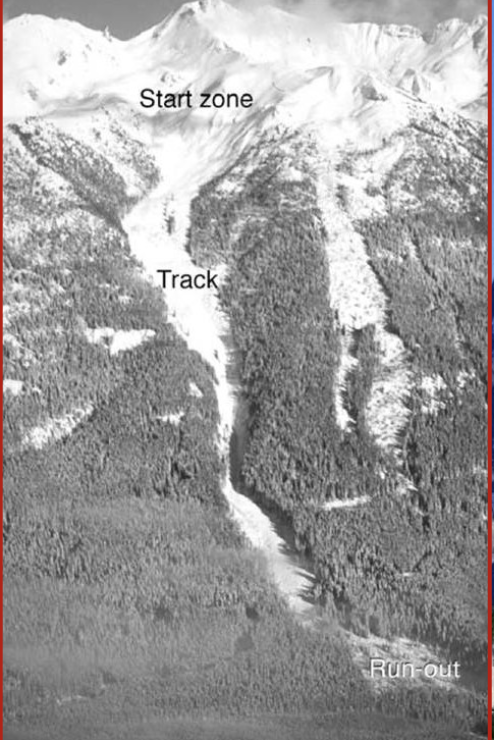
__**Start Zone**__
* The area where the snowpack first fails.
\
__**Track**__
* The area along which the avalanche accelerates and reaches maximum velocity
\
__**Run-out Zone**__
* The area of deceleration and snow deposition
* The area where the snowpack first fails.
\
__**Track**__
* The area along which the avalanche accelerates and reaches maximum velocity
\
__**Run-out Zone**__
* The area of deceleration and snow deposition
16
New cards
Terrain Factors
The slope angle is the most important terrain factor for avalanche formation.
\
\
most avalanches occur at slope angles between 25° and 60°
\
At angles 25°, snow does not easily slide
\
At angles above 60°, little snow accumulates on the slope.
\
\
most avalanches occur at slope angles between 25° and 60°
\
At angles 25°, snow does not easily slide
\
At angles above 60°, little snow accumulates on the slope.
17
New cards
Terrain factors cont.
The orientation of the slop can also be a factor
\
Deposits of snow on leeward slopes can consist of interlayered strong and weak layers.
\
Slopes facing the Sun are more prone to daytime avalanches during clear weather.
\
Other factors include the smoothness of the slope, the amount of vegetation, and the topography of the slope itself
\
Deposits of snow on leeward slopes can consist of interlayered strong and weak layers.
\
Slopes facing the Sun are more prone to daytime avalanches during clear weather.
\
Other factors include the smoothness of the slope, the amount of vegetation, and the topography of the slope itself
18
New cards
Orientation
The direction the slope faces
19
New cards
In North America on which side of a slope is an avalanche most likely?
SouthEast
20
New cards
Regions at risk
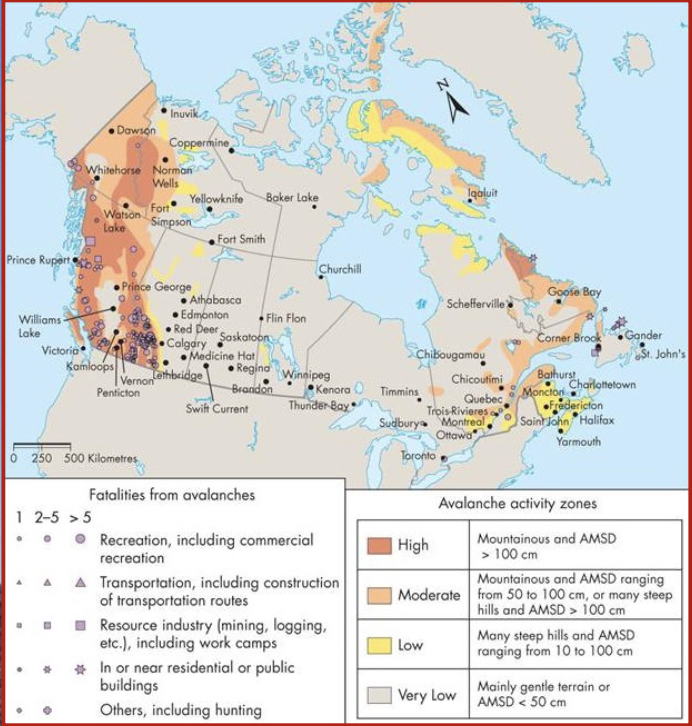
In North America, deep snowpacks are most common in the Rocky Mountains
21
New cards
For an avalanche to form, a snowpack of at least __cm is typically required.
50cm
22
New cards
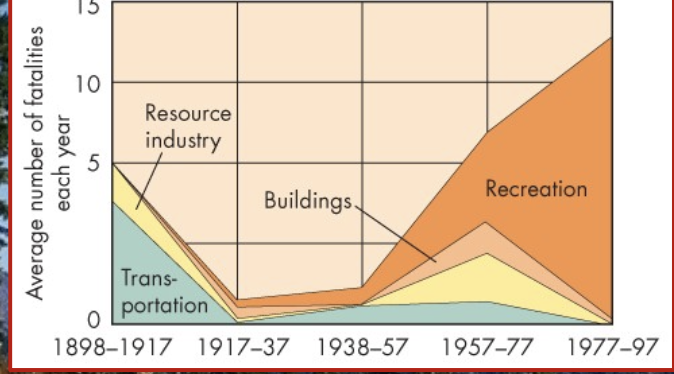
Effects of avalanches
In Canadian history, most avalanche deaths occurred in the late 1800s and early 1900s.
\
In total, over 600 people have died from avalanches in Canada
\
Avalanches cause millions of dollars in economic losses in B.C. each year due to closed highways.
\
Damage to forests is evident each year but property damage is relatively minor
\
In total, over 600 people have died from avalanches in Canada
\
Avalanches cause millions of dollars in economic losses in B.C. each year due to closed highways.
\
Damage to forests is evident each year but property damage is relatively minor
23
New cards
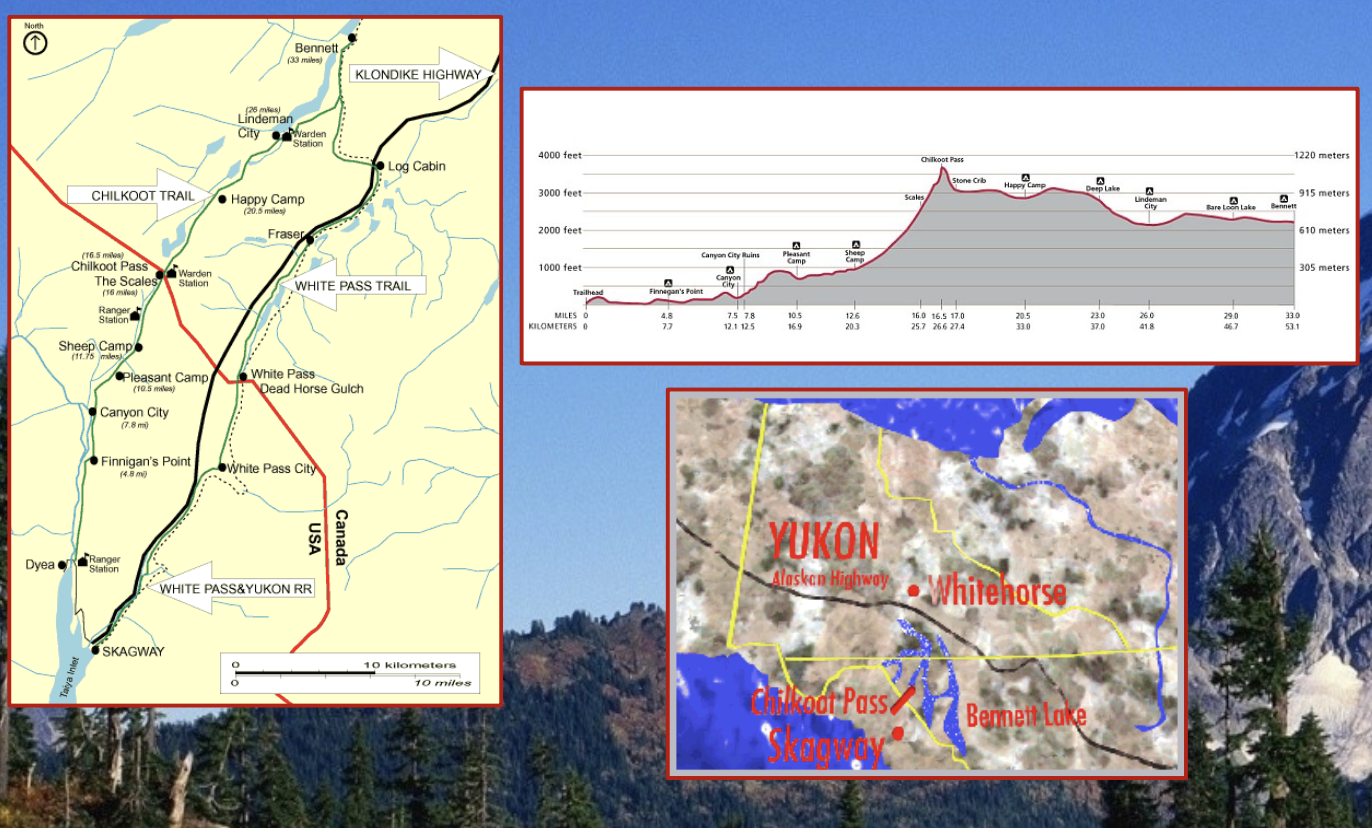
Chilkoot avalanche
This disaster occurred in 1898 and remains one of the worst avalanches in North American history.
* An avalanche spread over the Chilkoot trail causing 60 deaths
* The trail was heavily used at that time during the Klondike Gold Rush.
* The Chilkoot trail extends from Alaska to BC and is the easiest route through the mountains
* An avalanche spread over the Chilkoot trail causing 60 deaths
* The trail was heavily used at that time during the Klondike Gold Rush.
* The Chilkoot trail extends from Alaska to BC and is the easiest route through the mountains
24
New cards
Chilkoot trail
25
New cards
Linkages to other natural hazards
Avalanches can be caused by earthquakes.
\
Climate change may increase winter snowfall in some areas and increase severity of winter storms.
\
Some areas will experience more thaws in winter enhancing the instability of the slope
\
Climate change may increase winter snowfall in some areas and increase severity of winter storms.
\
Some areas will experience more thaws in winter enhancing the instability of the slope
26
New cards
Natural service functions
Like landslides, avalanches act as an ecological disturbance.
\
This may increase local plant and animal diversity
\
Avalanches maintain open areas in otherwise forested regions
\
This can serve as an important habitat zone for certain plants and animals
\
This may increase local plant and animal diversity
\
Avalanches maintain open areas in otherwise forested regions
\
This can serve as an important habitat zone for certain plants and animals
27
New cards
Human interaction with avalanches
Avalanches only become a hazard when humans encroach on areas that are prone to them
\
As tourism and recreation have increased in the Rockies and the Alps, deaths from avalanches have increased.
\
As tourism and recreation have increased in the Rockies and the Alps, deaths from avalanches have increased.
28
New cards
Minimizing avalanche risk
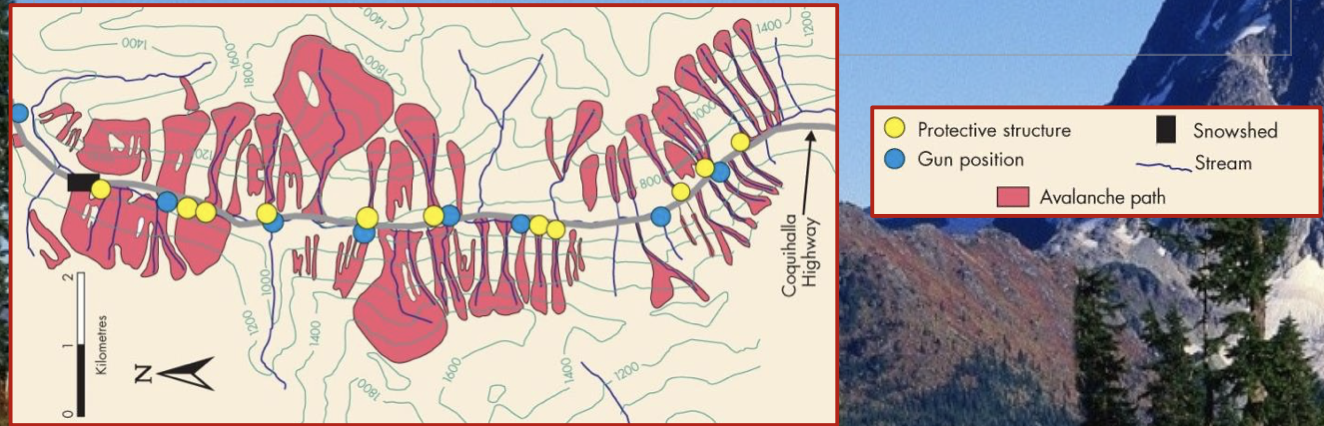
Risk is greatly reduced when buildings, roads, and other infrastructure are located outside dangerous areas.
\
Hazard maps provide planners with the locations of these areas
\
Hazard maps provide planners with the locations of these areas
29
New cards
Minimizing avalanche risk
Buildings in hazardous areas within a specific recurrence interval may require special engineering.
\
This may include reinforced walls or deflection structures.
\
In avalanche start zones, fences or nets can be installed to support the snowpack
\
This may include reinforced walls or deflection structures.
\
In avalanche start zones, fences or nets can be installed to support the snowpack
30
New cards
mounds and berms
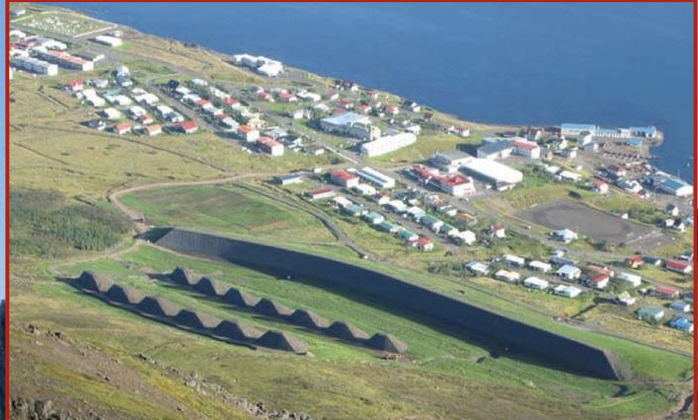
Mounds and berms can be used to slow and deflect avalanches away from populated areas.
\
Splitting wedges on the sides of buildings can force an avalanches around the structure
\
Splitting wedges on the sides of buildings can force an avalanches around the structure
31
New cards
Splitting wedge
A wall that is built at an angle (point) so the avalanche is broken into 2 smaller avalanches and protects a building
32
New cards
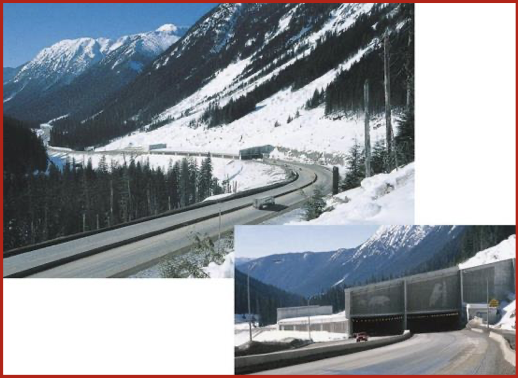
Avalanche sheds
Avalanche sheds allow avalanches to travel over roads or railways without disruption to traffic.
\
\
\
\
\
\
\
\
This is performed using explosives.
\
Controlled triggers are used to force avalanches to occur in order to prevent build up of the snowpack
\
\
\
\
\
\
\
\
This is performed using explosives.
\
Controlled triggers are used to force avalanches to occur in order to prevent build up of the snowpack
33
New cards
avalanche forecasting
forecasting is based on:
* occurrences of avalanches in the oast
* strength and stability test s
* snowpack observations
* weather
* occurrences of avalanches in the oast
* strength and stability test s
* snowpack observations
* weather
34
New cards
Strength and stability tests
There are 3 major tests used to
assess a snowpack.
\
assess a snowpack.
\
35
New cards
Compression Test
A vertical force is placed on the top of the snowpack to detect weak layers.
36
New cards
Shovel test
It assesses the strength by isolating a column of snow and applying force on the uphill side
37
New cards
Rutschblock test
A skier pushes and jumps on a column of snow to detect cohesion of the snowpack
38
New cards
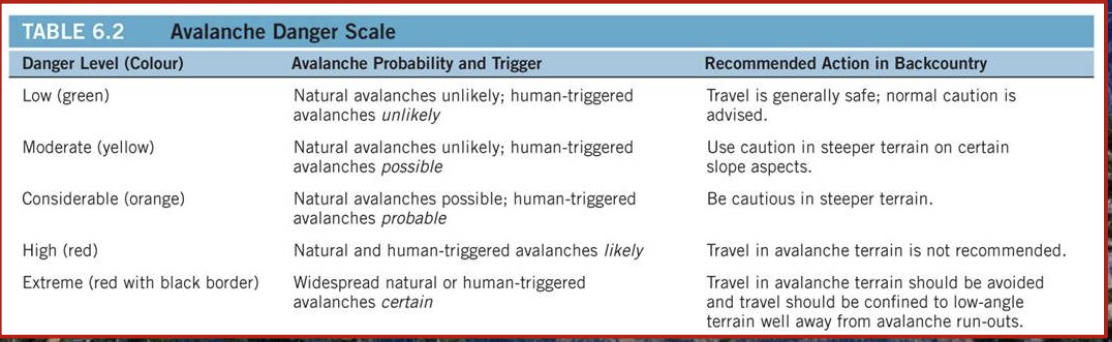
Avalanche safety
Before travelling in avalanche prone areas, it is important to check for any public bulletins as well as the current danger level.
\
Knowledge of slope angles and the terrain is also necessary.
\
Knowledge of slope angles and the terrain is also necessary.
39
New cards
Avaluator
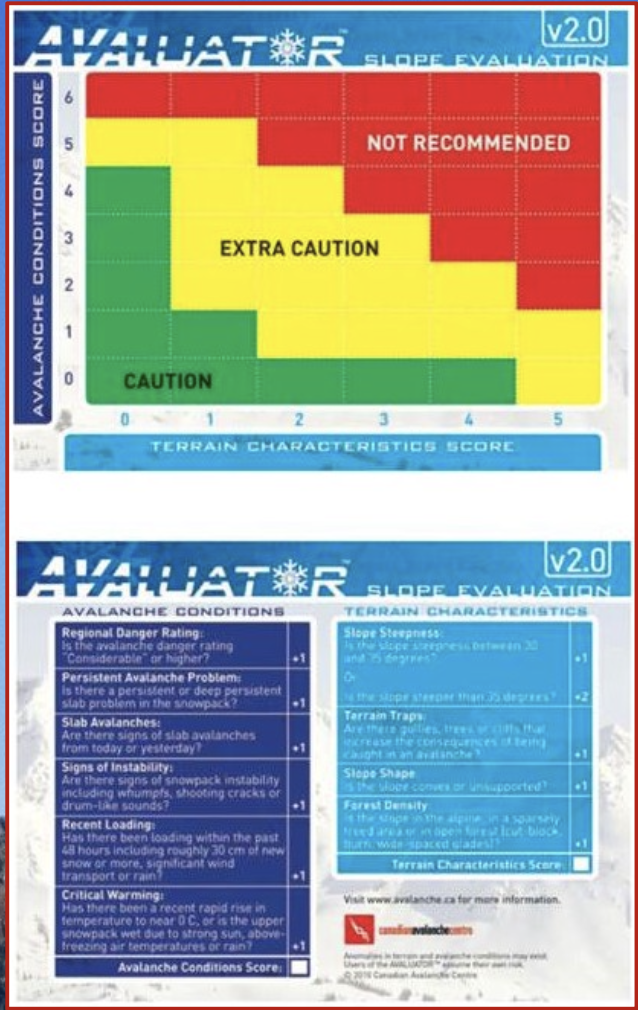
The Canadian Avalanche Centre has developed the Avaluator.
\
This is a chart designed to warn travellers of the risk of an avalanche in an area
\
This is a chart designed to warn travellers of the risk of an avalanche in an area
40
New cards
Avalanche rescue
The motion of the snow itself kills about 25% of avalanche victims.
\
Survival depends on the length of time the person is buried and the burial depth. 🥶
* over 90% survive if rescued with 15 mins
* 30% in 35 mins
* 0% in 2 hours
\
Buried victims doe of a combination of suffocation an hypothermia
\
less than 10% victims survive burial in more than 1.5m in snow
\
The best chance of survival depends on an effective search by other members of the group rather than waiting for help.
\
Chances of finding a buried victim increase when everyone in the group carries standard avalanche survival aids.
\
Survival depends on the length of time the person is buried and the burial depth. 🥶
* over 90% survive if rescued with 15 mins
* 30% in 35 mins
* 0% in 2 hours
\
Buried victims doe of a combination of suffocation an hypothermia
\
less than 10% victims survive burial in more than 1.5m in snow
\
The best chance of survival depends on an effective search by other members of the group rather than waiting for help.
\
Chances of finding a buried victim increase when everyone in the group carries standard avalanche survival aids.
41
New cards
Avalanche survival aids
***Avalanche Cord***
* A 10m rope that drags behind a person while skiing, snowboarding, or snowshoeing
\
***Avalanche Transceiver***
* A portable device that emits a radio signal to assist in finding the location of a victim
\
***Avalanche Dogs***
* They can detect human scent rising though the snow and can quickly cover large areas
* A 10m rope that drags behind a person while skiing, snowboarding, or snowshoeing
\
***Avalanche Transceiver***
* A portable device that emits a radio signal to assist in finding the location of a victim
\
***Avalanche Dogs***
* They can detect human scent rising though the snow and can quickly cover large areas