biochem citric acid cycle E3L3
 Call Kai
 Learn
 Practice Test
 Spaced Repetition
 Match
 Flashcards
 Knowt Play
1/11

There's no tags or description
Looks like no tags are added yet.
12 Terms
citric acid cycle outputs:
for one acetyl-CoA
3 NADH, 1 FADH2, 1 GTP
2 acetyl CoAs enter from 1 glucose → glycolysis → respiration → 2 acytyl
so 6 NADH, 2 FADH2 and 2 GTP total
types of reactions:
condensation =
dehydration =
hydration =
oxidative decarboxylation
decarboxylation =
oxidative =
substrate level phosphorylation
dehydrogenation reaction
condensation = combining 2 mCs
removing water mC
add water
decarboxylation = remove CO2
oxidative = LEO loss of e-
substrate level phosphorylation = add Pi to ADP or GDP → ATP or GTP
dehydrogenation = removing e- w/ different carrier, hydration/dehydro steps
citric acid cycle:
amphibolic =
what enters
how many e- leave
how many decarboxylation rxns
how many substrate level phosphorylations
how many H20 are consumed
amphibolic = used in both anabolic and catabolic processes
intermediates can enter/leave at different points

8 CAC steps
what to know for each
incoming substrate/exiting products
name of enzyme
type of reaction
know the pointed out structures in the lecture
FOLLOW THE CARBONS
condensation
isomerization
oxidative decarboxylation
oxidative decarboxylation
substrate level phosphorylation (GTP)
oxidation/dehydrogenation (FADH2. all others NADH)
hydration
oxidation/dehydrogenation
CAC step 1:
what is it
what is regenerated
reversible?
oxaloacetate (OAA) substrate level/why?
how is rxn pushed forward if [OAA] is low
why?
pic
CoA is regenerated and recycled
irreversible
OAA = substrate in 1st rxn that is constantly consumed by the CAC
so, rxn concentration is low
driven forward by thioester hydrolysis
recall acetyl CoA is an

citrate synthase (enzyme for CAC step 1: acetyl-CoA + OAA):
special function?
how does its structure ensure that it does that?
2 conformations
when binding allowed?
thioester hydrolysis = ___
why is that a problem?
how doe citrate synthase ensure acetyl-CoA transfers acetyl group to the correct place instead o?
prevents premature hydrolysis of acetyl-CoA
dimer with open and closed conformations
open = can bind acetyl-CoA
closed = cannot bind acetyl- CoA
has to bind OAA before it will enter closed conformation
ensures acetyl group acceptor OAA is already in active site before it binds acetyl-CoA
thioester hydrolysis = release a lot of free E, (unstable (high G) bc no resonation)
problem = acetyl CoA wants to give up acetyl group to anything even water
solved by OAA binding conformation change of citrate synthase
CAC Step 2:
reaction (shown as 2 step, but memorize it as 1 step)
why is the purpose of this step?
DG’0 for this reaction?
how driven forward?
d
why = convert citrate to better substrate for oxidation (the goal of CAC)
citrate = tertiary alcohol (bad oxidation substrate)
isocitrate = secondary alcohol (good oxidation substrate)
high DG but driven forward by rapid product removal in step 3

aconitase:
special structure
what’s the purpose
iron sulfur cluster = Fe-S crystal lactic w/ Cys residues in enzyme active site
purpose:
allows e- to be taken 1 at a time
Fe-S center center position reactants and enable removal/addition of water

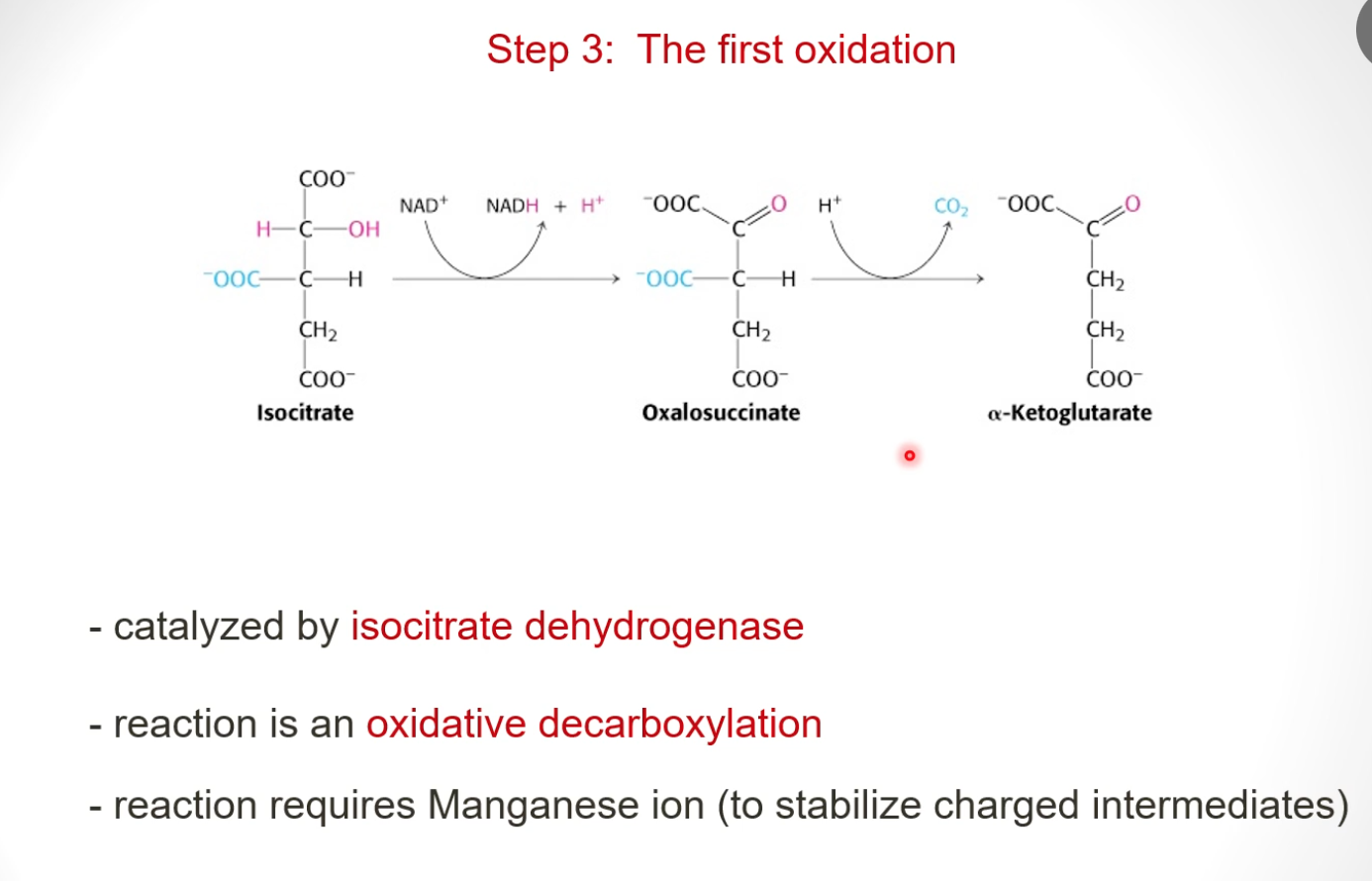
CAC step 3:
rxn (drawn as 2 step memorize/structures as 1 step)
reaction
what is the strategy
why notable
structures remember necessary for all runs
d
notable = first oxidation
oxidative decarboxylation
2 step = oxidation then decarboxylation
strategy = generate unstable intermediate that readily loses CO2
CAC step 4:
reaction?
why notable/ 2 important things this reaction does
what is a-ketoglutarate
what do we know about oxidative decarboxylation of a-ketoacids
where is CO2 leaving from?
oxidative decarboxylation
2nd oxidation
transfers e- to NAD+
sets up reaction 5 by forming thioester (high group transfer potential)
a-keto acid
similar to PDH pyruvate dehydrogenase complex
CO2 leaving from C4

a-ketoglutarate dehydrogenase complex (a-KDH):
4 ways how similar to PDH
a-KDH is similar to PDH
same structure
E3 is identical
same 5 cofactors
NAD+ TPP lipoate FAD+, CoA-SH
same type of reaction (oxidative decarboxylation of a-keto acid)
EXACT SAME MECHANISM ALL STEPPS AS PDH
