neuronal communications
 Call Kai
 Learn
 Practice Test
 Spaced Repetition
 Match
 Flashcards
 Knowt Play
1/70

There's no tags or description
Looks like no tags are added yet.
71 Terms
what do all sensory receptors act as?
transducers to convert a stimulus into a nerve impulse
what are receptor cells specific to?
single type of stimulus
e.g light, chemical, pressure/movement, heat
how do ears acts as receptors?
ear drum detects vibrations
in cochlea the vibrations cause fluid to ripple and tiny hairs pick this up
auditory nerves carry an electrical signal to the brain
what does chemoreceptors detect?
chemicals
what are examples of chemoreceptors?
olfactory receptors
what are a sense organ example of a chemoreceptor?
nose
what do photoreceptors detect?
light
what are receptor examples of photoreceptors?
rod and cone cells on retina
what is a sense organ example of photoreceptor?
eye
what do thermoreceptors detect?
heat
what is receptor example of thermoreceptor?
end-bulbs of Krause
what is a sense organ example of a thermoreceptor?
tongue
what do mechanoreceptor detect?
pressure and movement
what is a receptor example of a mechanoreceptor?
Pacinian corpuscle
what is a sense organ example of a mechanoreceptor?
skin
what is the structure of a pacinian corpuscle?
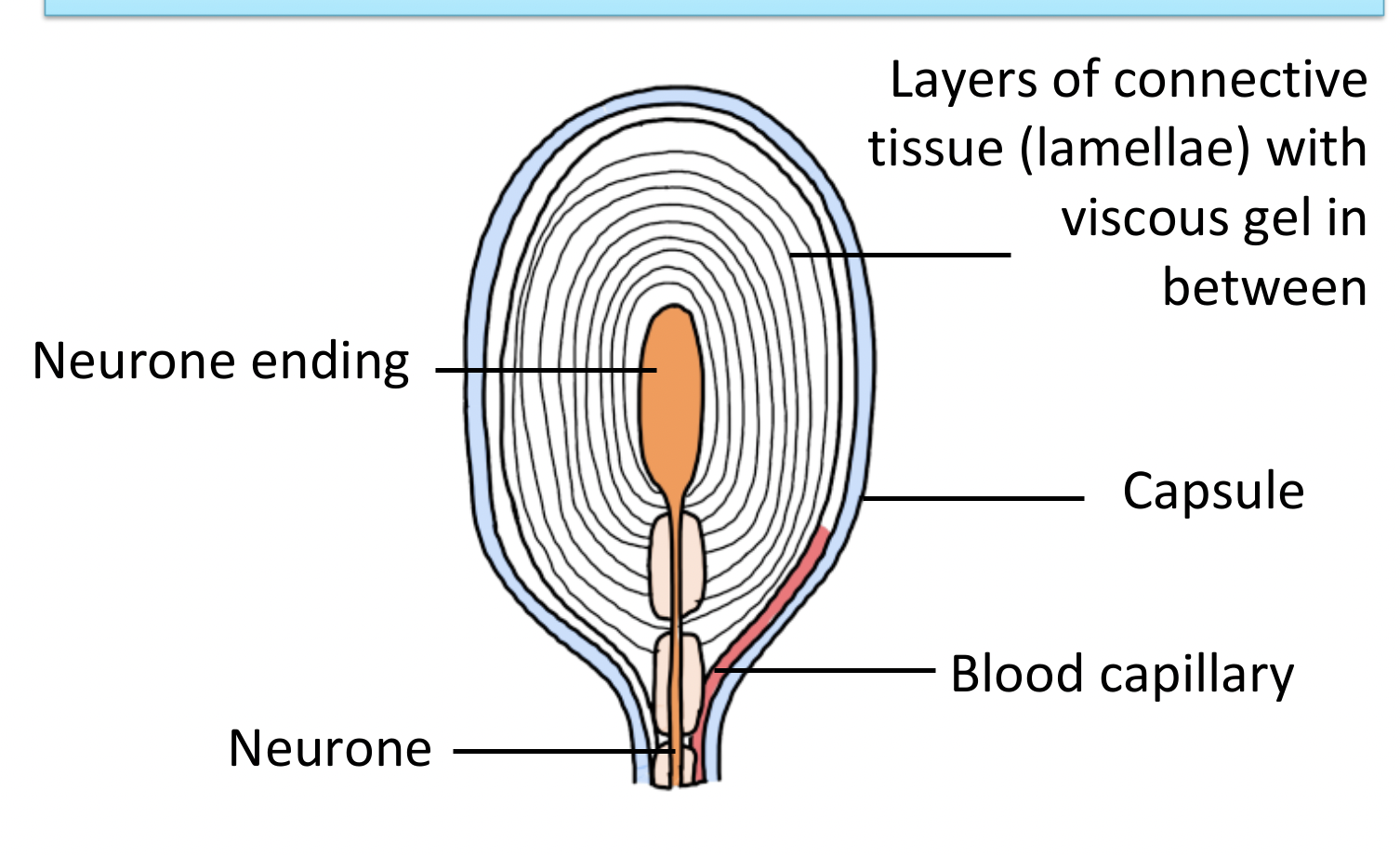
how does the pacinian corpuscle work?
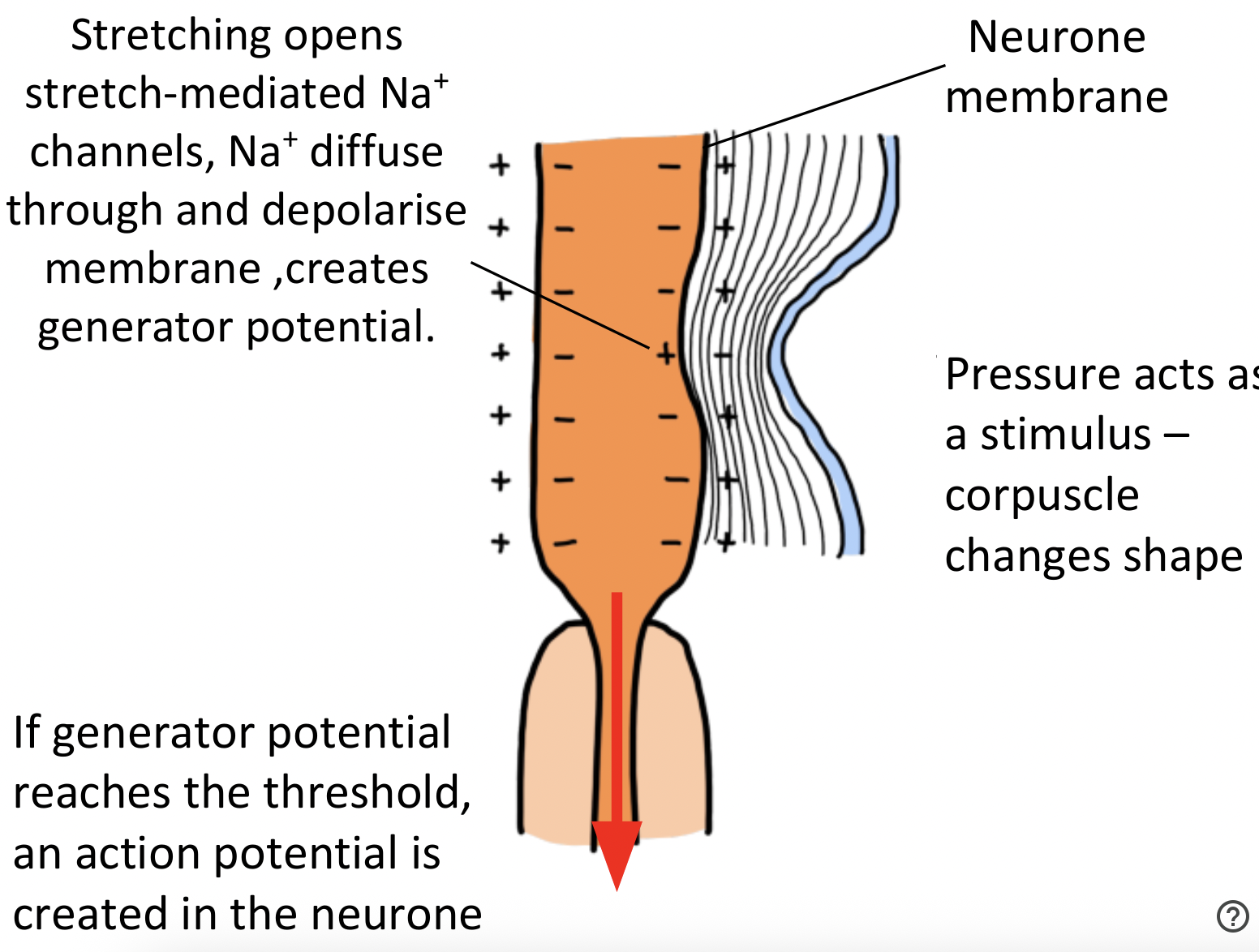
what happens to the Na+ channels at rest?
no pressure so not stretched
what happens to Na+ channels when pressure is exerted?
membrane stretched at excited section
what is adaptation?

how can adaptation be explained with pacinian corpusle?

what does a dendrite do as part of a neurone?
transmits electrical impulses towards the cell body
what does the cell body do as part of a neurone?
contains the nucleus and produces neurotransmitters
what does the axon do as part of a neurone?
transmits impulses away from the cell body
what does the sheath do as part of a neurone?
made of myelin, insulates the electrical signal for rapid signalling
what does the axon terminal do as part of a neurone?
synapse to transmit message to next neurone/cell
how is the motor neurone specialised for rapid signalling?
long as carry signals across long distances
branched as can connect to lots of other nerve cells
sheath which insulates the electrical signal for rapid signalling
what are features of the sensory neurone?
transmit impulses from sensory receptor cell to a relay or motor neurone
one dendron which carries impulses to the cell body
one axon which carries the impulse away from the cell body
how does a sensory neurone look like?

what are features of a relay neurone?
transmit impulses between neurones
many short dendrites coming into the cell body from lots of other neurones
axon tend to be short and non-myelinated, short-distance messages
how does a relay neurone look?

what are features of a motor neurone?
transmit impulses from a relay neurone or sensory neurone to an effector such as muscle of a gland
one long axon and many short dendrites
how does a motor neurone look like?

what is the myelin sheath made up of?
Schwann cells with Nodes of Ranvier between
what is the point of node of ranvier between Schwann cells?
allows impulse to be transmitted a lot quicker as it jumps from one node to another
what is the speed of transmission affected by?
myelin sheath
axon diameter
temperature
explain about the myelin sheath affecting speed of transmission?

why are unmyelinated neurons slower that myelinated neurons?
no nodes of ranvier
shorter and more local circuits
whole axon needs to be depolarised
how does axon diameter affect speed of transmission?

how does temperature affect speed of transmission?
the higher the temperature, the faster the nerve impulse
ions diffuse at higher temperatures
however only occurs up to 40 degrees as higher temperature cause proteins to denature
what is multiple sclerosis?

what is the resting potential?
when a neurone is not being stimulated so at rest
the outside membrane is positively charged compared to the inside
the resting potential is created and maintained by sodium-potassium pumps and potassium ion channels
explain the steps for resting potential?
sodium-potassium pumps use active transport to move 3 Na+ ions out of the neurone for every 2 K+ that moves in
potassium ion channels use facilitated diffusion out of the neurone down their concentration gradient
membrane is less permeable to Na+, voltage-gated Na+ channels close so fewer Na+ can diffuse back
the membrane is ‘polarised’ and the voltage across it is -70mV when it is at rest called the resting potential
how would you create an action potential?
when a neurone is stimulated, Na+ channels in cell membrane opens
if signal is big enough (reaches the threshold) the membrane will become depolarised
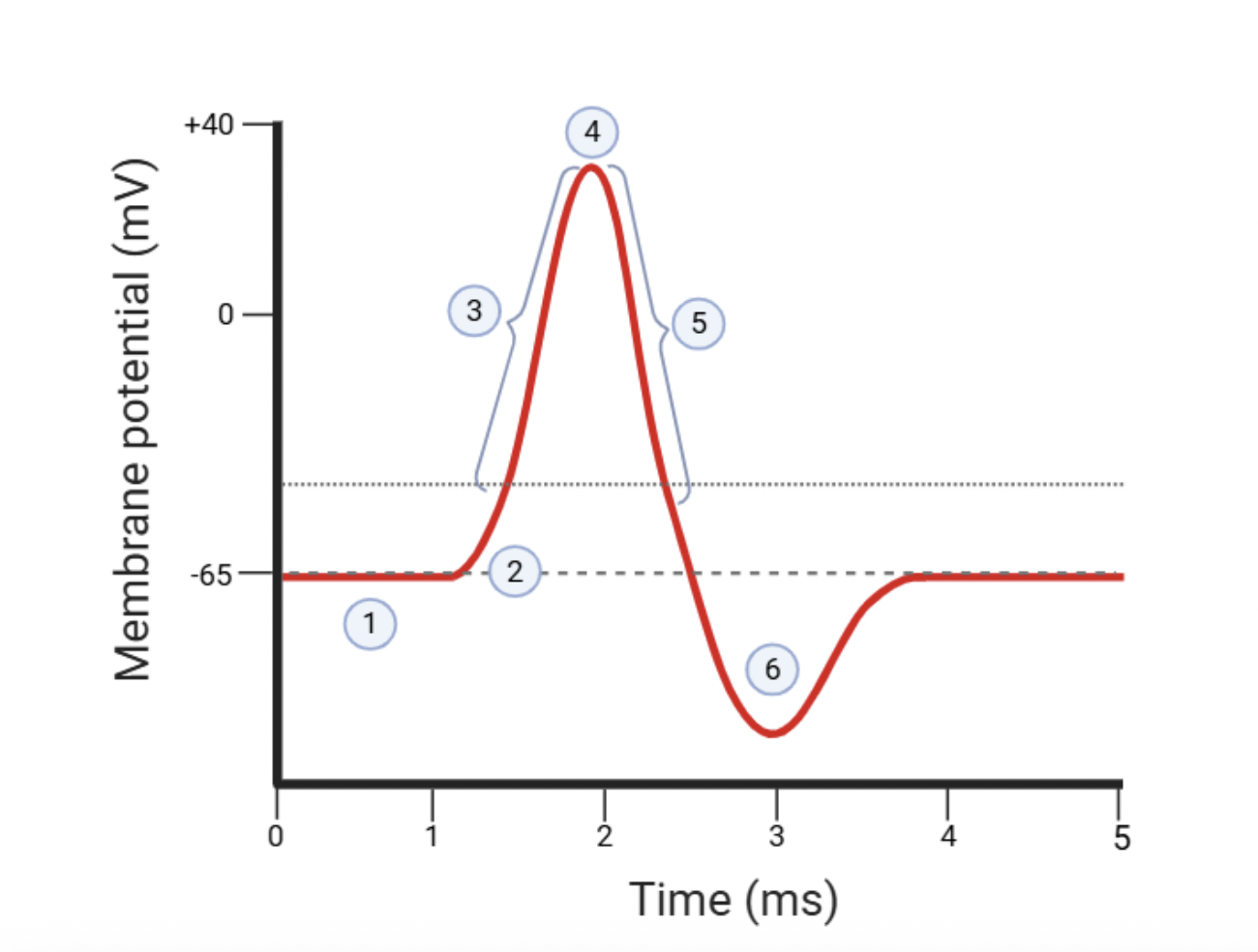
label the 1 step on this graph


label the 2 step on this graph


label the 3 step on this graph

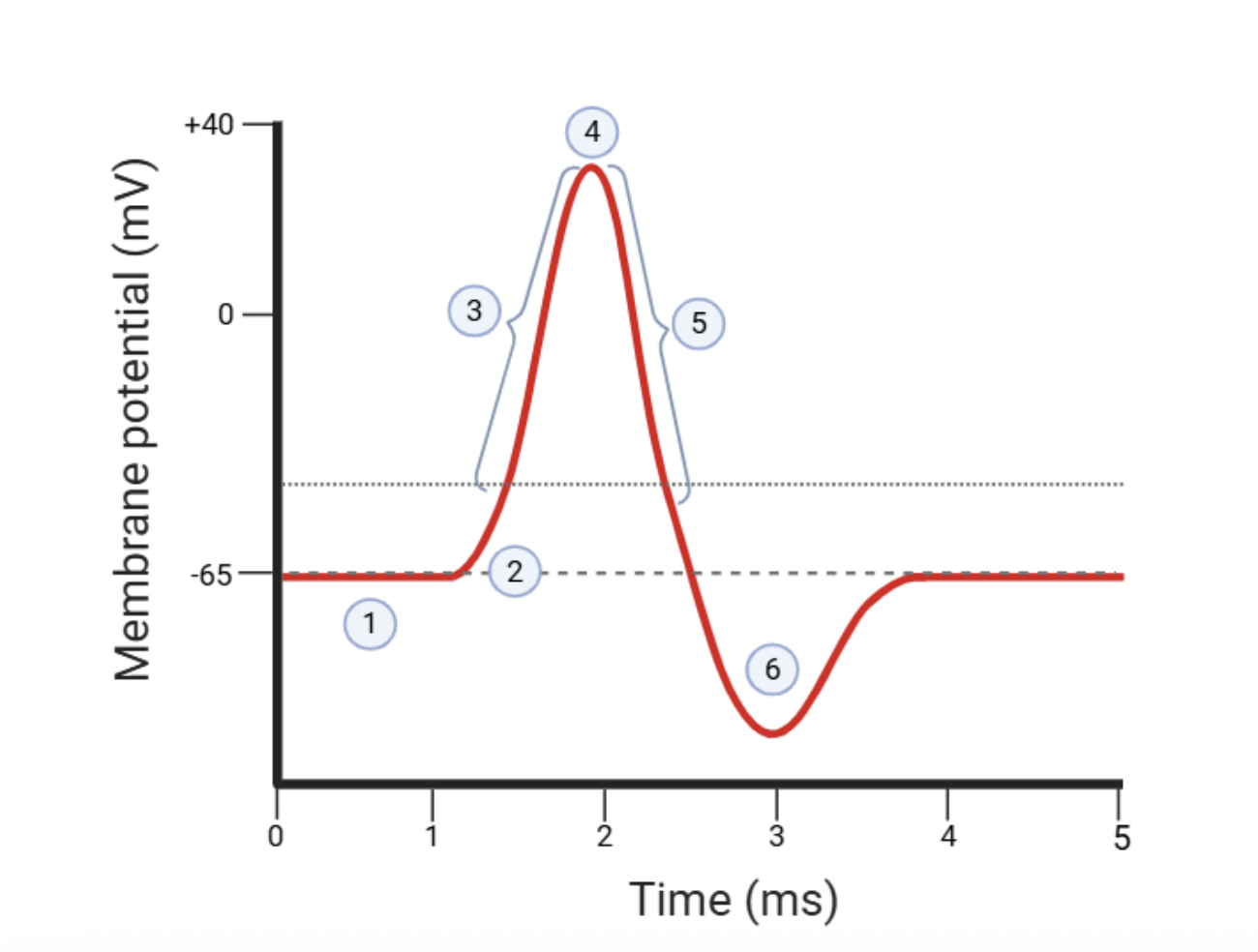
label the 4 step on this graph
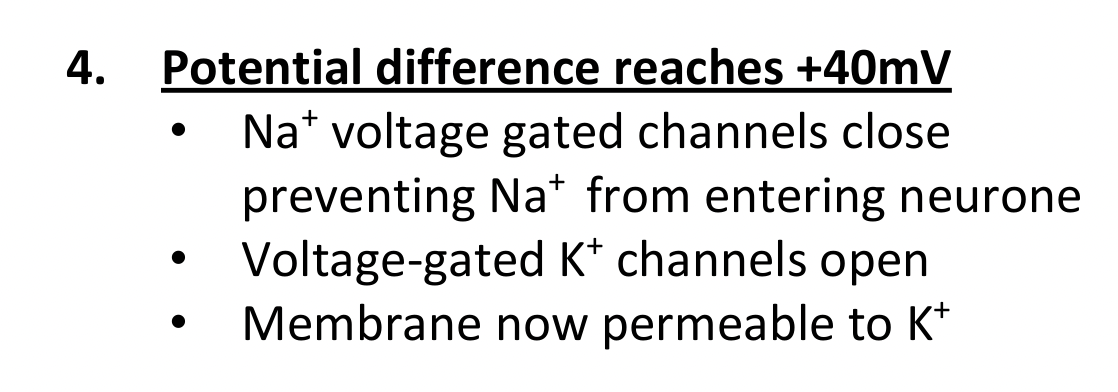

label 5 step on this graph


label 6 step on this graph

what is refractory period?

what and where is absolute refractory period and relative refractory period?
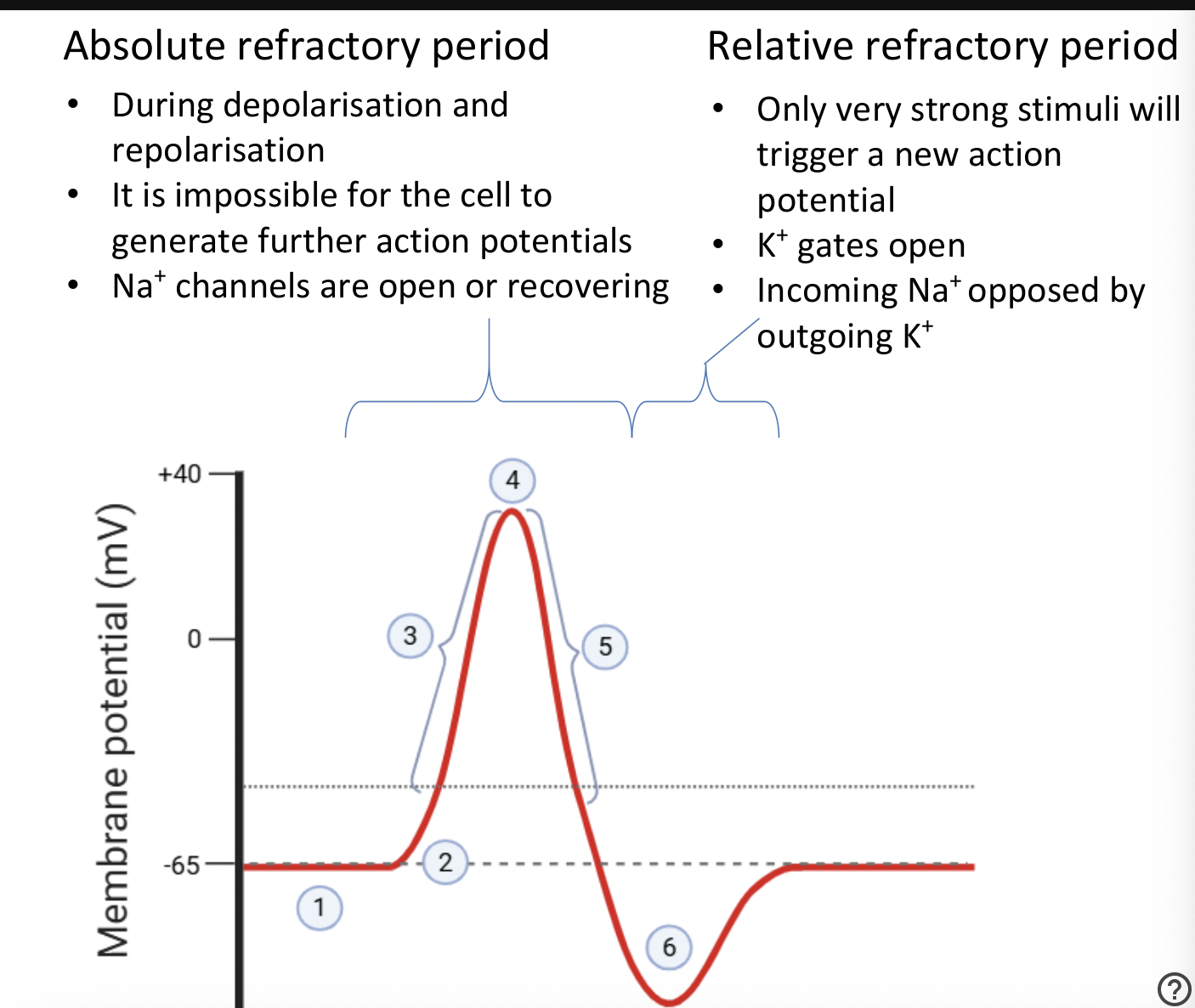
what is significance of refractory period?

what is all or nothing law?

how do neurons work together?
pressure detected by Pacinian corpuscle
electrical impulses sent along sensory neuron
chemical messages diffuse across synapse
electrical messages sent along relay neuron
chemical message diffuses across the synapse
electrical message sent along motor neurone
chemical message diffuses across the neuromuscular junction
where are synapses found?
synapse is junction between 2 neurons or a neuron and an effector (muscle/gland)
how does a synapse pass on a message?
action potential arrives at axon terminal
depolarisation causes voltage-gated Ca2+ channels to open and Ca 2+ enters cell
Ca2+ signals to vesicles to move and fuse with presynaptic membrane
vesicles release ACh into the synaptic cleft by exocytosis
ACh diffuses across the synaptic cleft and bind to specific cholinergic receptors
Na+ channels open and Na+ diffuse in
Action potential continues
After an impulse, enzymes (acetylcholinesterase) digest neurotransmitters and products are transported back to presynaptic knob to recycle the neurotransmitter and rpevent the response happening again
what is the importance of a synapse?
ensure the impulses travel in one direction and neurotransmitter receptors are only on the post synaptic membrane
what is convergence?
allows impulses from more than one neuron to be passed to a single neuron
what is divergence?
allow impulses from a single neuron to be passed to more than one neuron
what is summation?
when enough neurotransmitter builds up and action potential is able to continue
what is 2 types of summation?
spatial summation
temporal summation
what is spatial summation?
when 2 or more presynaptic neurons converge to one post synaptic neuron
each release a small amount of neurotransmitter but together is enough to stimulate an action potential
what is temperal summation?
where 2 or more impulses arrive in quick succession from same presynaptic neuron
the quantity of neurotransmitter in a short period of time is enough to trigger and action potential
what are features of excitatory synapses?
have receptors that are Na+ channels
when open, Na+ ions diffuse in
causes a local depolarisation and makes an action potential more likely
neurotransmitters such as acetylcholine, glutamate, aspartate
what are features of inhibitory synapses?
have receptors that make membrane potential more negative
causes hyper polarisation and makes action potential less likely
impulse in one neurone can inhibit an impulse in next
neurotransmitters like GABA and glycine
what are some effects of drugs on synapses as they use chemical communication?
mimicking
inhibiting neurotransmitters
inhibiting enzymes
blocking
what is mimicking?
mimicking the shape of the neurotransmitter
e.g nicotine is similar shape to acetylcholine and binds to cholinergic receptors
what is inhibiting neurotransmitters?
some chemicals inhibit the release of neurotransmitters from presynaptic neurone
fewer receptors are activated
e.g opioids block Ca2_ channels so fewer vesicles fuse with membrane and less neurotransmitters is released
what is inhibiting enzymes?
some chemicals inhibit the enzyme that digests neurotransmitter so they are left in the synaptic cleft for longer
e.g nerve gases (Sarin) inhibits enzymes and reduce muscle control
what is blocking?
some chemicals block receptors so they can’t be activated by neurotransmitters
e.g Curare blocks the effects of acetylcholine by blocking cholinergic receptors at neuromuscular junctions so muscle cells not stimulated, muscle is paralysed