Chaper 10: Carbohydrates and Glycoproteins
 Call Kai
 Learn
 Practice Test
 Spaced Repetition
 Match
 Flashcards
 Knowt Play
1/66

There's no tags or description
Looks like no tags are added yet.
67 Terms
carbohydate
polyhydroxy (2 or more OH groups) aldehydes and ketones, and their derivatives
hydrophilliv
aldehydes vs ketones
both types of carbonyls (C=O)
aldehyde → end of molecule; R-C(=O)-H
ketone → middle of molecules; R-C(=O)-R

monosaccharides
simplest carbs → called sugars
3C→7C length
aldehyde (aldose) or ketone (ketose) with 2 or more alchohol groups
complex carbohydrates
polysaccharides → 2 or more monosaccharides (monomers)
nomenclature of monosaccharides
ketose → has a ketone
aldose → has an aldhedye
#-ose → number of carbons
triose (3), pentose (6)
2 main types of isomers
constitutional and stereoisomers
2 main types of isomers: constitutional
same chemical formula with different bonding order
2 main types of isomers: stereoisomers
same bonding order but different spatial arrangment
enantiomers → non superimposable mirror images (L and D)
diastereoisomers → non mirror images
epimer
anomer
number of possible stereoisomers for a monosaccharide
2n → n is the number of non symmetric C
D and L isomer enantiomers
configuration of asymmetric C atom farthest from the aldehyde or keto group
denotes OH → L for left and D for right
which enantiomer form are most monosaccharides in
D → OH on the right of the last asymmetric C
6 common monosaccharides
all D form
2 pentoses of nucleic acids → ribose and deoxyribose
4 hexoses
3 aldoses: glucose, mannose, galactose
1 ketose: fructose
why do many monosaccharides cyclise
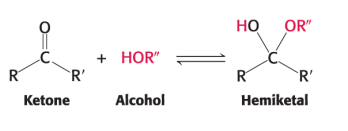
their OH groups react with their aldehydes/ketones → form hemiacetals and hemiketals
hemiacetals
product of OH + aldehyde → forms pyranose (6 sided ring resembling pyran)

hemiketals
product of OH + ketone → forms furanose (5 sided ring resmbling furan)
anomers
type of diasteroisomers → isomers formed by asymmetric C in cyclic form
α → OH below plane of the ring
β → OH above plane of the ring
anomeric carbon atom → C where α/β OH is
which is the anomeric carbon in aldoses
C1
which is the anomeric carbon in ketoses
C2
anomer equilibrium of glucose
99% pyranose (forms from hemiacetal)
1/3 α anomer
2/3 β anomer
<1% open chain
mutarotation
constant interconvertion of anomers by opening to linear stucture and reclosing again
fast
anomer equilibrium of fructose
exists as a fructofuranose (5C ring) or fructopyranose (6C ring)
predominately pyranose → less steric clashing
furanose only predominates if more groups attach and disfavor/prevent pyranose
reducing sugars
sugar w free aldehyde → gets oxidixed, thus reduces another compound
all monosaccharide that can access linear stucture → includes ketoses (can breifly become aldoses)
glycation
spantaneous addition of a carb to another molecule
glycosylation
enzymatically catalized addition of a carb to another molecule
oxidixed form of glucose
gluconic acid → aldehyde group becomes a carboxyl
reduced form of glucose
sorbitol
glucose and glycation
unlikely to glycate proteins
when glucose high and protein high, like with glucose and hemoglobin in blood, glycation occurs
called glycated hemoglobin (hemoglobin A1c or A1c)
marker of blood glucose control
common reactants for monosaccharide modification
alcohols, amines, and phosphates
glycosidic linkage
covalent linked anomeric carbon to O of an alchohol
specifxally called O-glycosidic linkage
N-glycosidic linkage
colavently linked anomeric carbon to to N of amine
linkage in nucleosides
which 2 bonds link sugars to proteins
O-glycosidic and N-glycosidic links
why is phosphorylation of sugars useful
good in metabolic pathways
turns sugar anionic → dont cross bilayer, dont get transported
blocks alternate ring from forming → phosphylation of fructofuranose prevents both anomers of fructopyranose
makes reactive interediates
oligosaccharide
2 or more monosaccharides linked by O-glycosidic bond
directionality of an oligosaccharide
reducing end → end with the free anomeric carbon
still called reducing end even if it is bound to another molecule
common disaccharides
sucrose, maltose, lactose
monomers of sucrose and its enzyme
a-gluctose + b-fructose
sucrase
why isn’t sucrose a reducing sugar
both anomeric carbons are involved in the glycosidic linkage
maltose and its enzyme
α-glucose + α-glucose
maltase
lactose and its enzyme
α-glucose + b-galactose
lactase
polysaccharide
aka glycans. polymers of monosaccharides
carb homopolymer
all the same monomers
glycogen
homopolymer of glucose in animals
large and branched
glucose links by α-1,4-glycosidic linkages
branching links by α-1,6-glycosidic linkages
starch
homopolymer of glucose in plants
amylose (unbranched) or amylopectin (branched)
starch: amylose
unbranched → glucose bonds by α-1,4 glycosidic linkages
starch: amylopectin
branched → one α-1,6 linkage per 30 α-1,4 linkages; less branched version of glycogen
what hydrolyses amylopectin, amylose and glycogen
α-amylase
celluloe
polysaccharide of glucose in plants for structure
unbranched
β-1,4 linkages → long straight chains, forms rigid H-bonded fibrils
insoluable and indigestable
chitin
homopolymer of β-1,4 linked N-acetylglucosamine
fibers cross link → rigid and strong
cell wall of fungi and exoskeletons of animals
glycoprotein
carbohydrate covalently attached to protein
3 clasess: glycoproteins, preoteoglycans, mucins
glycoprotein: class glycoprotein
cell membrane components or secreted
protein part heavier than carb part
eg erythropoietin (EPO)
glycoprotein: class proteoglycan
polysaccharide is glycosamineglycan
carb is heavier than the protein
structural and lubricant capabilities
glycoprotein: class mucins/mucoproteins
carb is heavier than the protein
Acetylgalactosamine is usually the carb
component of mucus
lubricants
linkages in mucins
protein glycosylated at serine or threonine with by N-acetylgalactosamine
variable number of tandem repeats (VNTR) in mucins
rich in O-glycosylated ser and thr residues
erythropoietin
(EPO) glycoprotein hormone in blood serum → stimulates rbc production in bone marrow
where is erythropoietin produced
kidneys
linkages in EPO
glycosylation enhaces stability in blood → doesnt get filtered by kidneys like unglycosylated EPO
N-glycosylated at three asparagine residues
O-glycosylated on a serine residue
40% carb by weight
why is the function of the carbs attacthed on EPO
glycosylation (enzymed mediated)
how is EPO used as a drug
increases RBC count → increases oxygen-carrying capacity
athletes use it
treats anemia
glycosaminoglycan
repeating unit of disaccharides with an amino sugar (glucosamine or galactosamine → at least 1 of 2 sugars is -
aggrecan
proteoglycan → contains charged glycosaminoglycan
shock absorber for cartilage → water binds to glycosaminoglycan and allows “spring back” effect on impact
lectin
glycan binding protein → recognize specific carbs on neighboring cells
facilitate cell-cell contact → 2 or more carb binding sites, carb and lectin interact by weak bonds
which cell-surface carb structure does the influenza virus
sialic acid on galactose residues
which viral surface protein of influenza recognize and bind host cell
hemagglutinin → acts as a lectin to bind sailic acid-galactose complex
what happens when influenza’s hemagglutinin binds to target cell surface
virus englufed → virus replicates → viral particle buds from the cell
what happens when influenza is finished spreading its virus on a target cell
neuraminidase (another viral protein) hydrolyses glcosidic bonds of sialic acid to galactose → new virons are free to leave without getting stuck
anti influenza agents
tamiflu and relenza