Accounting Ch 8 & 9
 Call Kai
 Learn
 Practice Test
 Spaced Repetition
 Match
 Flashcards
 Knowt Play
1/76

There's no tags or description
Looks like no tags are added yet.
77 Terms
What are some pros and cons of extending credit?
Advantage is that increase sellers’ revenues
Disadvantages are:
Increased wage costs
We need people to evaluate customer credit worthiness, track amounts owed and follow up to collect recievables
Bad debt costs
delayed reciept of cash
What is the direct write off method and is it GAAP?
basically when we wait to record the bad debt until it is known, then we record expense after the Financial statement date, Not GAAP because the company would not be in compliance with the matching principle
What is the allowance method?
method of accounting that reduces accounts receivable and net income for an estimate of uncollectible accounts(bad debts)
2 step process of recording estimated bad debts using an end of period adjustment
then remove specific customer balances when they’re known to be uncollectible
When accounting for A/R and Bad debts what are the objectives?
Report accounts receivable at the amount the company expects to collect (Net accounts receivable)
Match the cost of bad debts to the accounting period in which related credit sales are made
What do you credit/debit when recording estimates of bad debts
Debit bad debt expense and credit allowance for doubtful accounts
How do we record write off of bad debt?
** Write off is when we know for sure a customer can’t pay
Debit allowance for doubtful accounts and credit accounts receivable
no income statement accounts affected
Effects on Balance sheet before and after write off
A/R: decreases after write off
AFDA: decreases after write off
Net A/R: no change
How do we estimate bad debts?
2 ways: Percentage of credit sales method and aging of accounts recievable method
uses more detailed data so more accurate
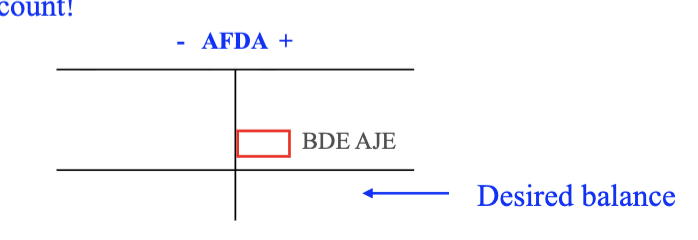
as soon as you see aging in a problem, draw AFDA t account
What is the percentage of sales method
Income statement approach
We multiply credit sales in the month by the bad debt loss rate to get the bad debt expense for the month
then debit bad debt expense and credit AFDA
How do we get bad debt loss rate?
this rate is based on the historical percentage of credit sales that lead to bad debt losses
% of credit sales method estimates Bad Debt expense (so it’s referred as income statement approach)
What is the aging of accounts receivable method- balance sheet approach
Estimates ending balance in the allowance for doubtful accounts
3 steps:
Prepapre an aged listing of accounts recievable
estimate bad debt loss percentages for each category
compute the total estimated balance needed in AFDA
estimated balance doesn’t go to AJE right away!
As the number of days unpaid increases what happens to the estimated uncollectible %
increases because less likely to collect the farther past the due date
First multiply the totals of A/R for each number of days period by the estimated uncollectible %
Then add up all the estimated uncollectibles to get total ADFA —> this doesn’t go on AJE, this is the “desired balance”
Then subtract the unadjusted balance from the adjusted balance to get the AJE amount
subtract AFDA from A/R to get net A/R
For journal entry debit bad debt expense and credit allowance for doubtful
Other issues with estimating
Bad debt estimates often differ somewhat from the actual bad debt amounts, which are later written off. To ensure bad debts and the allowance for doubtful accounts do not become materially misstated over time, companies lower estimates in the current period to correct overestimates of prior periods, or they raise estimates in the current period to correct underestimates of prior periods.
What are account recoveries?
collection of a previously written off account is a recovery and is accounted for in 2 ways:
first put recievable back on books by recording of the opposite of the write off
Second, record the collection of the account
To reverse write off: debit accounts recievable and credit AFDA
To record collection: Dr. Cash and credit AR
Notes Receivable vs Accounts receivable
company reports notes receivable if it uses a promissory note to document its right to collect money from another party
1) loan money to employees or businesses
2) sell expensive items for which customers require extended payment period
3) Convert A/R —> N/R for extended payment period
Unlike accounts recievable which are generally interest free, notes receivable charge interest from the day their are created to their maturity date
If interest payments are generally received once or twice per year that means you need ________
accrual
How do we calculate interest?
Interest (I) = Principal (P) Interest Rate (R) * Time (T)
Principal: amount of the note receivablle
Interest Rate: annual interest rate charged on the note
time is time period for interest calculation
** Interest rates are always stated as annual percentage
4 key events that occur with any note recievable:
1) Note created
2) Year-end (record AJE) —> accrue interest earned
3) Interest Payment Received —> recording interest received
4) Principal Payment Received —> recording principal received
How do we establish the note receivable?
Debit notes receivable and credit cash
No interest recorded yet
How do we record accrue interest earned
Year end:
say time period was 2 months and the principal was 100,000
You would do 100,000 × 6%(interest) * (2/12) = 1,000
Accrued Revenue
Debit interest receivable 1000 and credit interest revenue 1000
How do accrue the interest earned at year-end?
Dr. Interest receivable and credit interest revenue
interest receivable is an asset and interest revenue is a temp account affecting NI
How do we record interest received?
1) Record Interest received at maturity
say Oct 31st was when the interest was recieved
100,000 × 6% * 12/12 = 6000
but remember that 2 of those months happened in the previous year from november 1st to december 31st
Debit cash full amount so 6000 and credit interst recieveable for the preivous year accrued amount
How do we record principal received?
Debit cash by principal and credit notes recieveable by principal
this reverses the “Establish the N/R journal entry
What does the receivables turnover ratio indicate?
indicates how many times on average, this process of selling and collecting on account is repeated during the period
higher the ratio, the faster the collection of recievables
Low A/R turnover is a warning sign
Formula for receivable turnover ratio
Net sales revenue/average net receivables
want high numbers
Formula for days to collect
365/receivables turnover ratio
want this number to be low
By comparing ______ to collect to the ________, you can get a sense of whether customers are complying with the stated policy
number of days, length of credit period
2 ways to speed up collections
Factoring receivables
sell outstanding amounts receivable which is a factor
Your company receives cash for the receivables it sells to the factor minus the factoring fee
Credit Card Sales
allowing customers to pay for goods through credit cards or using PayPal
this also reduces losses from customers writing bad checks
credit card companies charge a fee for their service
What are long lived assets?
assets that can use used over 1 or more years and are not intended for sale
What are tangible assets
physical substance:
land(includes land imporvements), buildings, machinery, vehicles, office equipment, furniture and fixtures
subject to depreciation (except for land)
Grouped into one line item on balance sheet, PPE or Fixed Assets
What are intangible assets
no physical substance, value represented by rights that produce benefits
What are some examples of intangible assets that are subject to amortizartion?
patents and copyright
subject to amortization when life of asset is limited
What are some examples of intangible assets that are not amortized?
goodwill and trademarks
What are productive assets?
they produce goods or services sold to customers
What does the acquisition cost of tangible assets include?
Purchase price and all reasonable and necessary expenditures needed to prepare the asset for its intended use
What does it mean to capitalize the costs and which statements are affected
recording costs as assets
involves a lot of judgement
both B/S and I/S are impacted

How does the cost of the acquisition of tangible assets in a basket purchase work?
they’re allocated in proportion to their relative market values
If a company purchased land and a hotel for 10M and 40% of the cost was for land and 60% for hotel
4M land is not depreciated
6M buildings depreciated over useful life
What are the journal entries for an acquisition for new equipment on account with transportation and installation costs?
Debit Equipment, Credit Cash and notes payable
how do we get the total cost for the new equipment?
List Price - discount = Net invoice price
Net Invoice Price + Transportation Costs + Installation Costs = Total cost
What are the characteristics of ordinary repairs and maintenance and how do we account for it?
Relatively small, recurring expenditures that maintain
normal operating condition.
2. Do not increase productivity.
3. Do not extend life beyond original estimate.
Treat it as Expense
What are the characteristics of extraordinary repairs, replacements, and additions, and how do we account for it?
1. Relatively large, infrequent expenditures such as major
overhauls or replacements of major components.
2. May extend useful life.
3. May increase productivity or efficiency.
Treat it as capitalization
What is a depreciation Expense
cost allocation process that matches costs of long lived productive assets with period benefitted by their use
Acquisition Cost (B/S) —→ Expense(I/S) : this process is cost allocation
Periodic (annual depreciation)
Dpreciation Expense goes on I/S
Accumulated Depreciation which is a contra-asset and is the total of depreciation to-date for an asset goes to the B/S
What are the 3 things we need for depreciatation calculations
Acquisition cost, estimated useful life, estimated residual life
What is the asset cost?
not an estimate
includes all of the asset’s capitalized costs like purchase costs, sals tax, legal fees, and other costs needed to acquire and prepare the asset for use
What is useful life?
estimate of the asset’s useful economic life to the company *expressed in terms of years or units of capacity (such as miles)
estimate
What is residual (or salvage) value
estimate of the amount the company will reiceve when it disposes of asset
estimate
Formula for depreciable cost
asset cost - residual value = amount to be allocated over the estimated useful life
How do we record the depreciation expense
Debit depreciation expense
Credit accumulated depreciation
What is depreciation?
process of allocating the cost of buildings, equipment, and other similar long lived “productive” assets over their estimated useful lives using a systematic and rational method of allocation
What is the net book value/carrying value
acquisition cost of asset - accumulated depreciation
/When do we use straight line method of depreciation
when usage is same each period
What is the straight line formula?
Cost - Residual Value * 1/Useful life = Depreciation Expense
**Cost-Residual value is the depreciable cost
1/useful life is the depreciation rate
What happens to dep expense, acc. depr, and NBV when using straight line methodf
depreciation expense is same each year
Acc. Depr. increases by Depr. Exp each year
NBV decreases by Depr. Exp each year
When is units of production used?
when usage varies each period
What is the formula for units of production?

What is another formula for units of production

formula for double declining balance
use book value not depreciable cost

When to use double declining balance
when asset generates more revenue in early yeas but less so over time
What are the differences in depreication expense by method?

How is depreciation calculated when a long lived asset is acquired during the year?
calculated for the fraction of the year the asset is owned
under straight line and declining balance methods, annual depreication is multiplied by the fraction of the year for which depreiciation is being calculated
these partial year modifications not required in units of production method because that method is based on actual production for the period
What is asset impariment losses?
when events or changed circumstances interfere with a company’s ability to recover the value of the asset through future operations
Casualty
Obsolescence
Lack of demand
How is Asset Impairment accounted for?
1) Eliminate the asset’s accumulated depreciation against the asset account
2) Write down asset to its fair value( what it is worth)
JE for Asset Impairment Loss
Debit Accumulated depreciation and credit equipment
Then, Debit Impairment loss(expense) and credit equipment
How do we account for disposal of tangible assets?
1. Update depreciation to date of disposal (since last AJE).
Dr. Depreciation Expense
Cr. Accumulated Depreciation
2. Record the disposal by accounting for:
1. The book value of the items given up
2. The value of the items received on disposal (usually cash)
3. Any difference between these two amounts which results in gain or loss on disposal
How do we detemine if its a gain or loss?
If proceeds> book value it’s a gain
If proceeds < book value it’s a loss
What are intangible assets?
non current assets without physical substance
often provide exclusive rights or privileges'
useful life is often difficult to determine
usually acquired for operatiional use
How do we account for intangible asset when we purchased it for initial accounting?
Capitalize at current cash equivalent cost, including purchase price, legal fees, and
filing fees if the intangible asset is being purchased
Record at cost
How do we record internally developed intangible assets?
Expense as research and development expenses if the intangible asset is being self-
constructed or internally developed (except technology assets).
Generally expense as R&D as incurred; certain software costs are exceptions
If the intangible asset has a limited useful life, how do we account for it
amortize intangibles with limited lives over their economic lives using the straight line method
How do we account if indefinite life for intangible asset
ex: goodwill not amortized, instead tested for impairment
How do we report the assets on B/S
at book value
Summary of Intangible Assets- Copyrights, patents, tech, licensing rights, franchises, trademarks, goodwill

What is goodwill?
occurs when one company buys another company
** IF purchase price > fair market value of net assets acquired
not amortied
impairment tested and may be written down
How do we account for good will?
Dr Asset Acquired
Dr. Goodwill
Credit liabilities acwuired
Cr Cash
How do we record amortization of limited life intangible assets
Debit Amortization expense and credit accumulated amoritization
Formula for fixed asset turnover
Net Revenue/average net fixed assets
What does fixed asset turnover measure?
measures sales dollars generated by each dollar invested in fixed assets