Materials processing 1
 Call Kai
 Learn
Learn Practice Test
 Spaced Repetition
 Match
Match Flashcards
 Knowt Play
1/41

There's no tags or description
Looks like no tags are added yet.
Name | Mastery | Learn | Test | Matching | Spaced | Call with Kai | Chat |
|---|
No analytics yet
Send a link to your students to track their progress
42 Terms
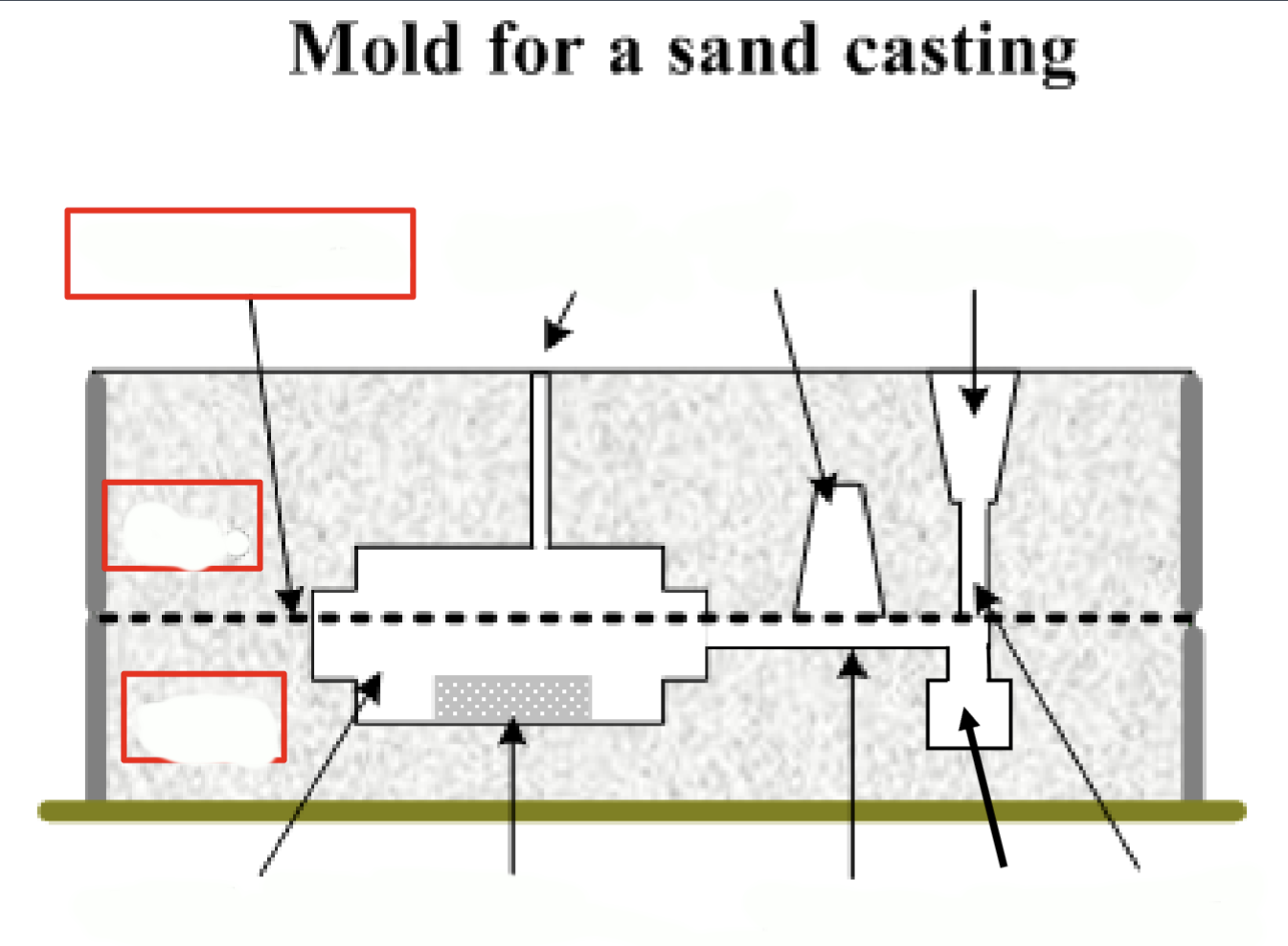
Label this
Did you get it right?

Advantages of Sand Casting
Part scalability
Versatile material selection
Cost-effective (for low-volume production)
Design freedom
Disadvantages of Sand Casting
Poor surface finish
Reduced precision
Slow production yield
Defect risk
Slower cooling
Shell-Mold Casting
Form Shell
Combine Shells
Permanent mold Pros
reusable, better finish, faster cooling, finer grains, stronger parts.
Permanent mold cons
Permanent molds require:
Machined steel/iron molds
Precision gating and cooling channels
Heat‑resistant materials
expensive
Limited Geometric Complexity
Higher Risk of Mold Wear and Thermal Fatigue
Slower Setup for Low‑Volume Production
Smaller sizes
Potential for Higher Internal Stresses
Because permanent molds cool metal quickly, they can create:
Higher thermal gradients
Residual stresses
Increased risk of cracking in some alloys
Re
Laminar Flow Required
Laminar: re < 2000
Turbulent: re > 4000
Turbulence → erosion, porosity, oxide inclusions
Aspiration
casting defect where air is sucked into the molten metal as it flows down the sprue when fast‑moving liquid metal creates a low‑pressure zone, similar to how a vacuum forms.
Tapering
Prevents aspiration
tapered sprue gets narrower toward the bottom so Velocity ↑, Cross‑sectional area ↓
Sprue
avoids defects like aspiration, turbulence, and oxide entrapment when metal touches walls
Bernoulli’s Equation → Velocity Increases with Height
Area Must Decrease as Velocity Increases to keep the sprue completely full of metal and touch walls
Chill Zone Grains
metal first touches the cold wall, heat is extracted extremely fast = many nucleation sites → very small grains
Random orientation
High strength (Hall–Petch)
High hardness
Lower ductility
outer surface of castings is usually stronger and harder than the interior.
Fine grains resist crack initiation → better fatigue resistance.
Random grain orientation
isotropic properties = same mechanical behavior in all directions
Grain Size & Strength — Hall–Petch Relationship
Smaller d → higher yield strength
Grain boundaries block dislocation motion
More boundaries = harder for dislocations to move = stronger metal
Grain Structure Before Forging
Random, cast grains
Possible porosity
Columnar grains from solidification
Forged parts
Have superior mechanical properties
Show directional grain flow that improves fatigue resistance
Are stronger than cast parts
During forging
Grains elongate and align with the direction of deformation
Porosity collapses
Defects weld shut
Grain flow improves mechanical properties
After hot forging
Recrystallization forms new equiaxed grains
Grain refinement → higher strength + toughness
Grain structure in rolling
Breaks up cast grains
Produces elongated grains
Cold rolling increases strength via strain hardening
Grain structure in heat treatment
Can grow or refine grains
Controls strength, hardness, ductility
Open‑Die Forging
Upsetting (making thicker and shorter) between flat dies.
Friction → barreling.
Reduce barreling with lubrication or heated dies.
barreling
thicker in the middle and thinner near the die surfaces.
Cold Forging
higher forces, strain hardening, better finish.
Hot forging
Hot forging: lower forces, recrystallization, grain refinement.
Slab Method
A forging analysis technique that accounts for friction and geometry to estimate forging pressure and force
The slab method relies on:
Plane strain (no deformation in the length direction)
Constant volume
Rigid‑perfectly‑plastic material
Coulomb friction:
τf=μσ
Small or negligible barreling
Symmetry
Slab Method Key steps:
Compute new height from reduction
Use volume constancy to find new width
Compute average pressure
Multiply by contact area to get force
Impression‑Die Forging
A forging process where heated metal is squeezed between two dies that contain shaped cavities. Excess metal flows out into a thin gap, forming flash.
Impression Pros
Good for moderate complexity parts.
Dies are simpler and cheaper than precision forging dies.
Dimensional accuracy is good, but not perfect.
good for high‑volume production.
Strong parts due to controlled grain flow
Lower tooling cost than precision forging
Impression Disadvantages
Flash removal required
More material waste
Less dimensional accuracy
More machining needed afterward (Requires trimming after forging.)
Precision‑Die Forging
A forging process where the dies fully enclose the metal, producing a near‑net‑shape part with little or no flash.
Dies are heated and controlled carefully (sometimes isothermal).
Precision Pros
Extremely accurate dimensions
Very smooth surface finish
Minimal material waste
Excellent mechanical properties
Reduced machining and post‑processing (no flash)
near‑net‑shape parts → minimal machining
Precision Cons
Requires very precise die design and tight tolerances.
Requires higher pressure
Requires advanced presses and controlled environments
Not economical for low‑volume production
Dies wear faster due to pressure
Stress
how much force per unit area the material is experiencing.
Strain
how much a material changes shape under stress.

Machining
The controlled removal of stock
material to into a precise final part.
Powder Metallurgy/Sintering
the process of turning loose powder into a solid uniform body
Elastic Modulus
E : Measure of stiffness of a
material
Modulus of
Toughness
Measure of energy absorption required to cause fracture.
Modulus of
Resilience:
Measure of allowable energy absorption to return to original shape.
stress-strain curves
Tensile behavior for materials of varying mechanical
behavior

Temperature and Strain Rate Effects
Effect of temperature on mechanical properties of a carbon steel.
