BIO 201 Exam 2
 Call Kai
 Learn
Learn Practice Test
 Spaced Repetition
 Match
Match Flashcards
 Knowt Play
1/199

There's no tags or description
Looks like no tags are added yet.
Name | Mastery | Learn | Test | Matching | Spaced | Call with Kai | Chat |
|---|
No analytics yet
Send a link to your students to track their progress
200 Terms
206
How many bones in the human body?
sesamoid bone
bone that forms with tendon due to stress (patella)
line
A slightly elongated ridge
270
How many bones are in a newborn baby
alveolus
a pit or socket
fovea
a small pit
frontal, ethmoid, sphenoid, and maxillary
List the paranasal sinuses
anterior, middle, and posterior
what are the three cranial fossa
glabella
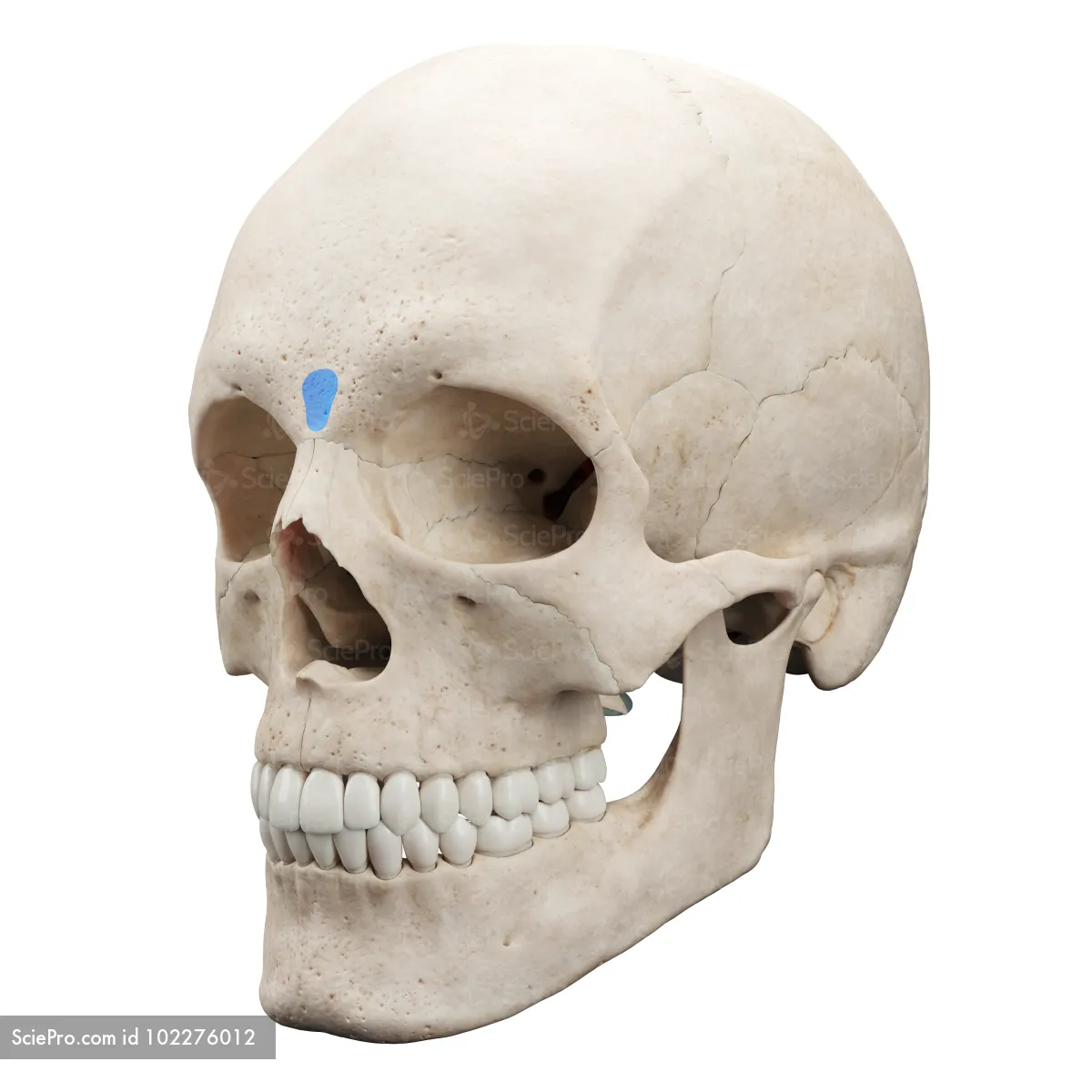
parietal and frontal
temporal lines for an arc across the _____ bones
squamous part
zygomatic process and mandibular fossa
temporal lines
attachment for temporalis muscles

styoid process
provides site of attachment for muscles of the toungue, pharynx, and hyoid bone
external acoustic meatus and styloid process
which features are found in the tympanic part of the temporal bone?
stylomastoid forament
part of the mastoid notch and is a passage for a branch of the facial nerve

basilar part of occipital bone

superior nuchal line

external occipital protuberance

osteology
study of bones
blood formation, protection, support, acid-base balance
which are functions of the skeletal system
medial pterygoid plate
inferior pterygoid plat
bone tissue
Dynamic tissue that continually remodels itself
connective, calcium phosphate
bone or osseous tissue is a ____ tissue with a matrix of harden materials _______
bone tissue, marrow, cartilage, and periosteum
What are individual bones are made of?
support, protection, movement, blood formation, mineral reservoir, pH balance, and detoxification
functions of the skeletal system
support
the skeletal system hold up body, muscles, and organs
protection
the skeletal system provides _____ for organs and bone marrow
movement
the skeletal system serves as a muscle attachment
blood formation
the bone marrow creates rbcs and wbcs
Mineral reservoir
the skeletal system stores calcium and phosphate
pH balance
the skeletal system buffers blood by absorbing or releasing alkaline salts
detoxification
the skeletal system removes heavy metals from blood; can later slow release
long bones

short bones
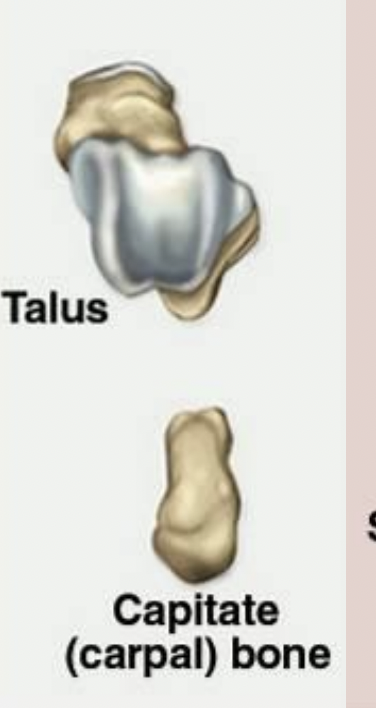
flat bones
most cranial bones, ribs, sternum scapula, os oxae

irregular bones

no
do flat bones have a marrow cavity?
C
Mark was riding his bike to school when he collided with an e-scooter. Which layer of the skull will not be affected?
A) Outer compact bone
B) dipole (spongy bone)
C) inner compact bone
D) peristoseum
suture
What is highlighted pink?

outer compact bone
what is highlighted blue?

spongy bone (dipole)
what is highlighted green?
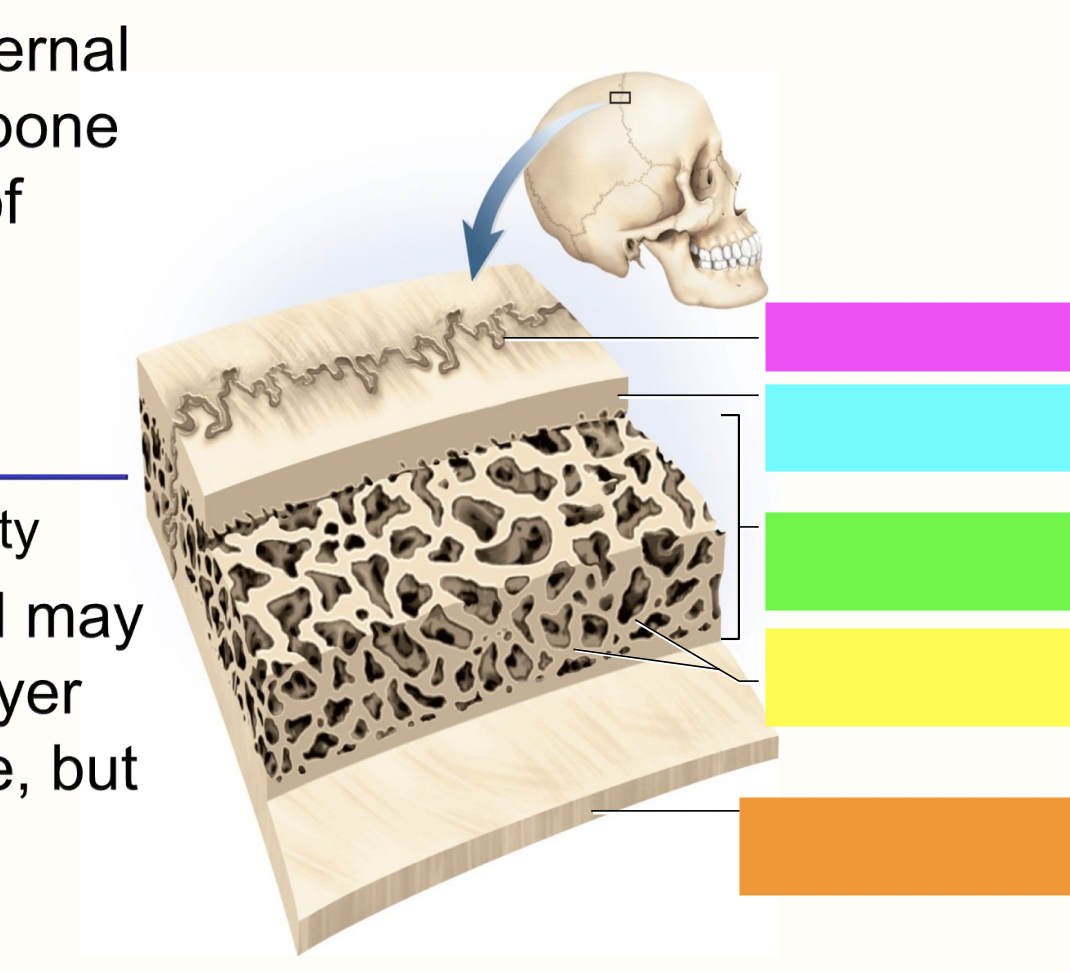
trabeculae
what is highlighted yellow?

inner compact bone
what is highlighted orange?
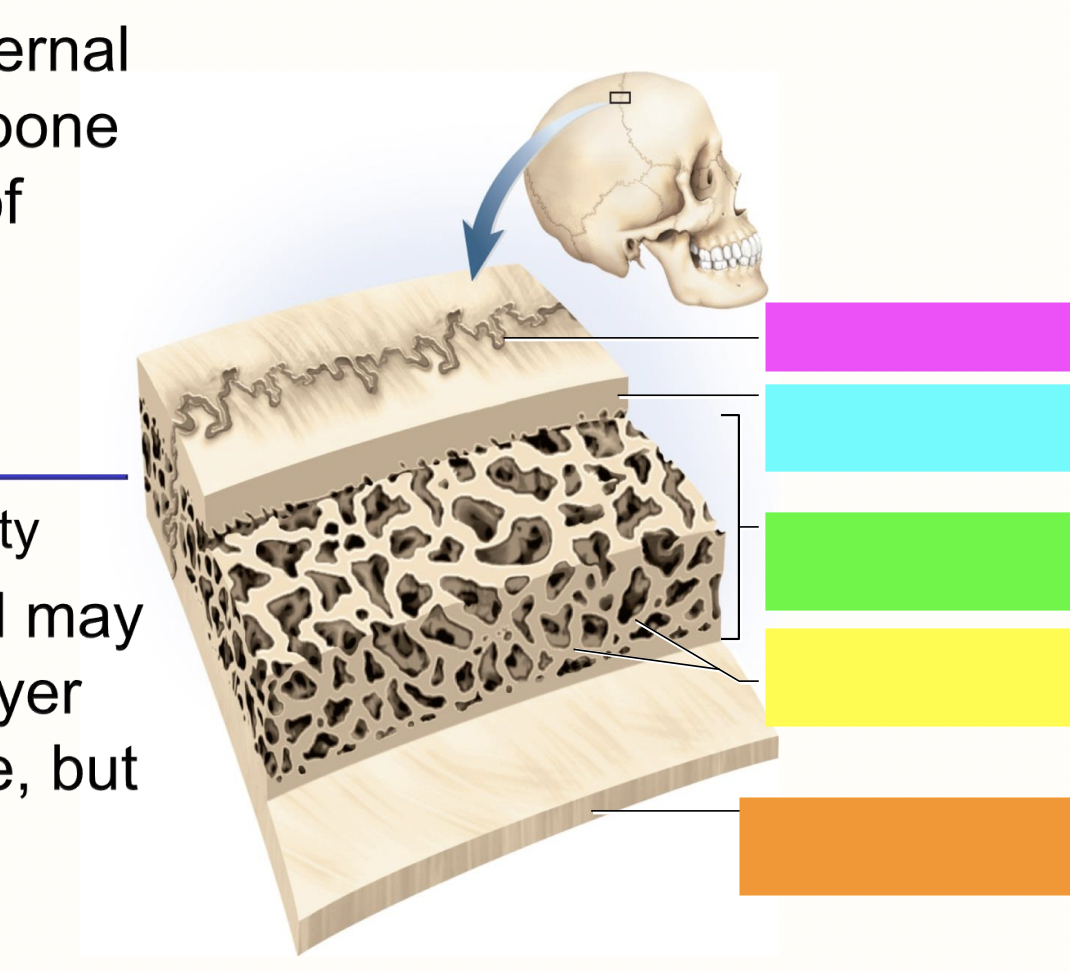
epiphysis
the ends/head of long bones
diaphysis
shaft of bone
articular cartilage
What is highlighted light pink?

periosteum
layer of fibrous connective tissue covering the bone
articular cartilage
hyaline carlilage
endosteum
lines internal surface
epiphysial line
what is highlighted light orange?

red bone marrow
What is highlighted light yellow?

marrow cavity
what is highlighted light green?

yellow bone marrow
What is light blue?

periosteum
What is highlighted light purple

nutrient foramen
what is highlight dark red

site of endosteum
what is highlighted dark orange?

compact bone
what is highlighted dark yellow?

spongy bone
what is highlighted dark green?

epiphysis
what is highlighted dark purple

diaphysis
what is highlighted dark blue

Long Bones, Humerus, Radius, Ulna, metacarpals, Phalanges, Femur, Tibia, Fibula, Metatarsals, Phalanges
long bones
carpals and tarsals
short bones
sphenoid, ethmoid, and vertebrae
irregular bones
shaft (diaphysis)
compact bone, contains marrow cavity (medullary cavity)
endosteum
contains cells providing bone reprobation and deposition
enlarged ends (epiphyses)
spongy bone covered with a layer of compact bone; enlarged to strengthen joint and provide for attachment of tendons and ligaments
periosteum
covers remainder of bone; outer fibrous layers continuous with tendons
osteogenic cells
reside in endosteum or periosteum; multiply continuously & differentiate into osteoblasts
osteoblasts
form organic matter of matrix and help to mineralize response to stress or fractures
osteocytes
osteoblasts that have been trapped; reside in lacunae- connected to each other via canaliculi; signal osteoclasts/osteoblasts about mechanical stress
osteoclasts
bone-dissolving cells; develop in bone marrow by the fusion of the same stem cells that give rise to monocytes of the blood
resorption bays
osteoclasts reside in pits called ____________ that they have eaten into surface of the bone
organic matter, inorganic matter
the dry weight of the matrix of osseous tissue is 1/3 _______ and 2/3 __________
collagen, glycosaminoglycans, proteoglycans, and glycoprotiens
organic matter
85% hydroxyapatitie, 10% calcium carbonate, and other materials
inorganic matter
hydroxyapatite
crystalized calcium phosphate salt
strength and resiliance
the mix of organic and inorganic tissue provide ________
resist compression
what do the minerals in bone do?
resist tension
what does the collagen in bone do?
bone softening, deformity
minerals in bones contribute to ____________ or ____________; especially in weight-bearing bones
rickets or osteomalacia
the condition(s) that comes from defective mineralization in bones
rickets
•In children
•Insufficient sunlight or vitamin D
•Dietary deficiency in calcium or phosphate
•Liver or kidney disease
osteomalacia
•In adults
•Insufficient sunlight or vitamin D
•Dietary deficiency in calcium or phosphate
•Liver or kidney disease
osteons or haversian systems
cylinders of tissue formed from layers of matrix concentrically arranged around a blood vessel; osteocytes connected to each other and the Haversian blood supply by tiny cell processes
lamellae
individual layers of the osteons
haversian canals
holds blood vessels in osteons
perforating canals
branches from nutrient arteries that run perpendicular to haversian canals
circumfenteral lamellae
heavy rings of bone matrix that run completely around the outer and inner borders of a long bone shaft, much like the growth rings of a tree
outer lamellae
what is highlighted light pink

osteon
What is highlighted light orange
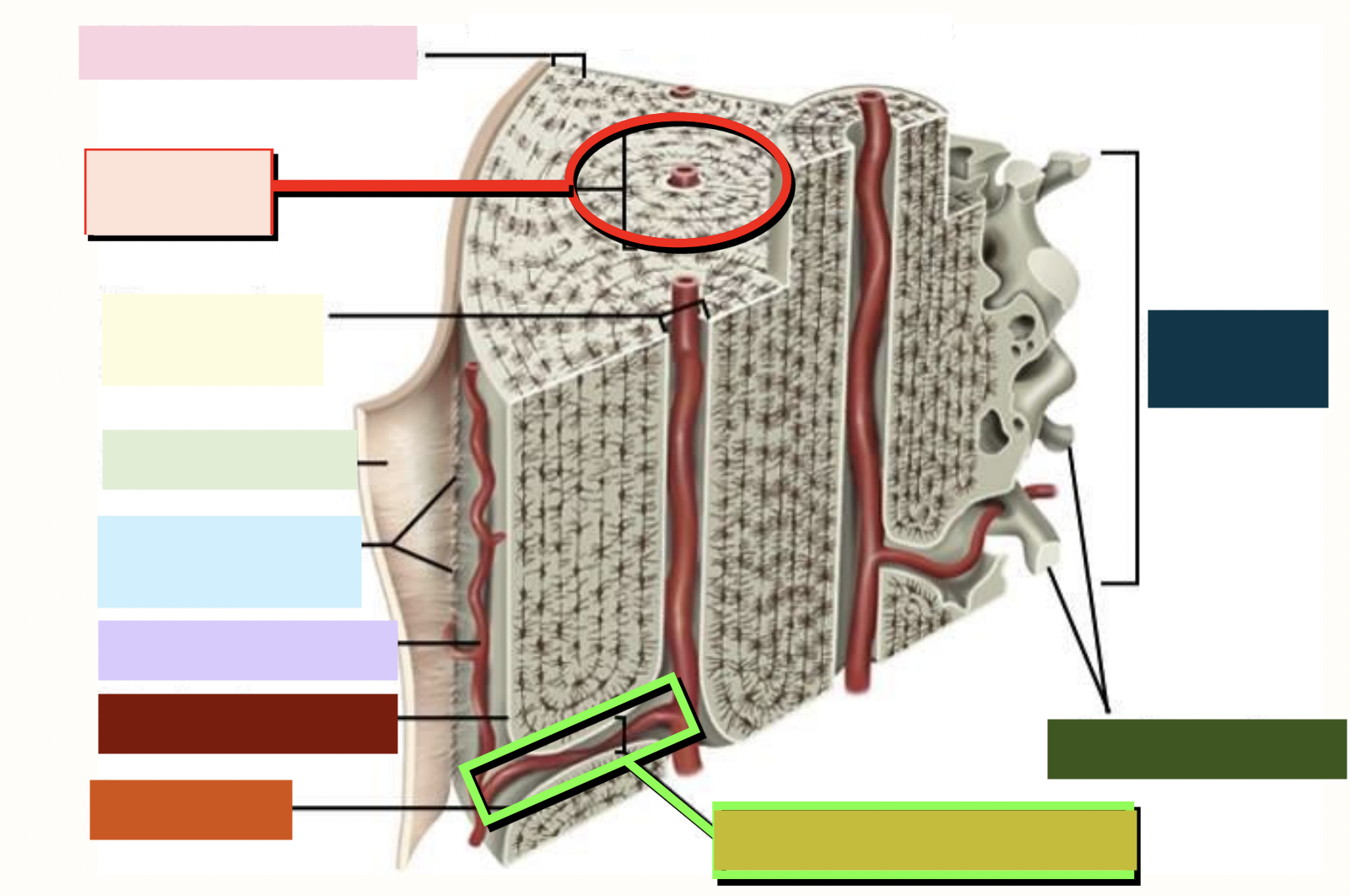
Haversian canals
what is highlighted light yellow

periosteum
what is highlighted light green
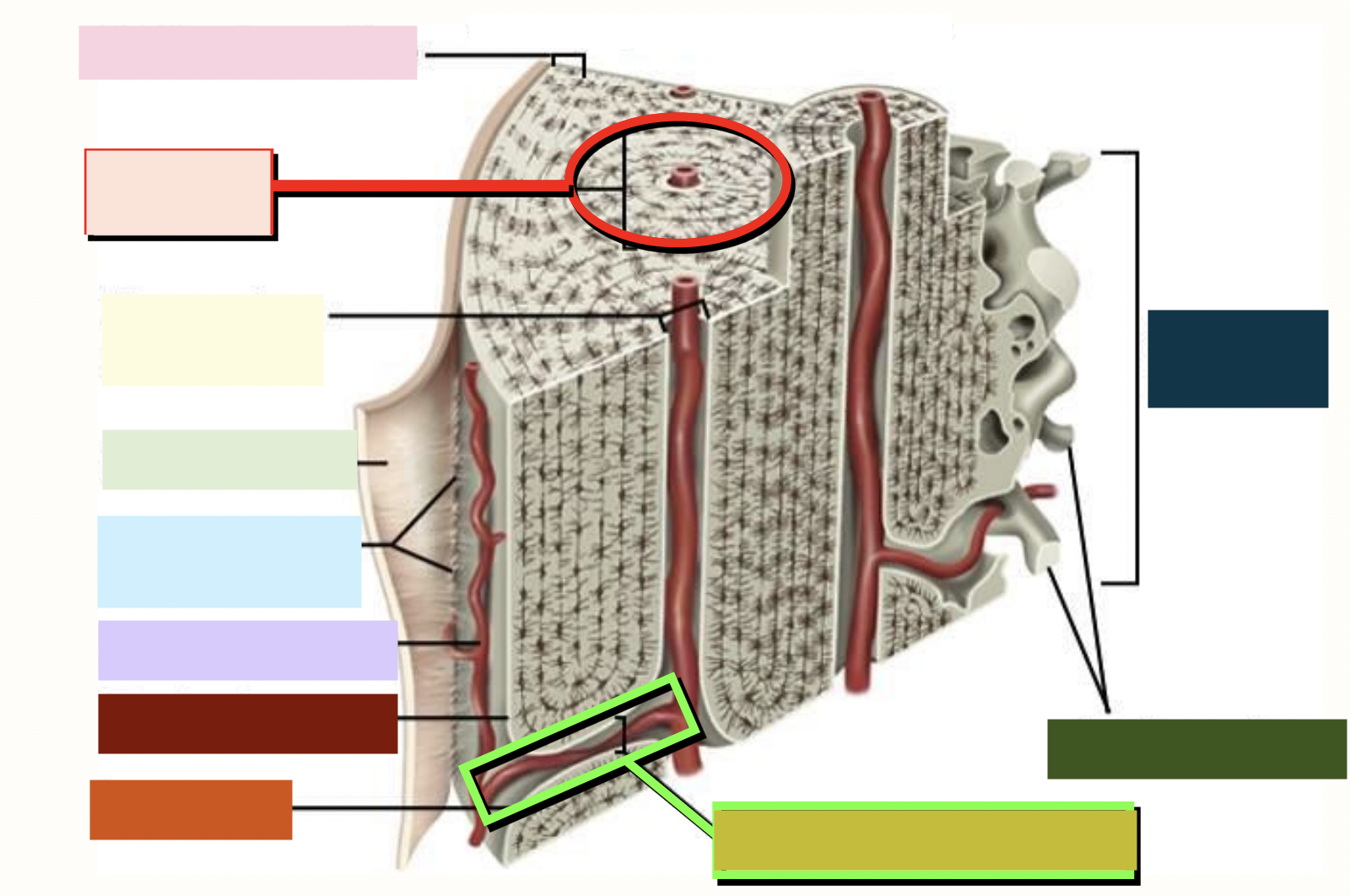
perforating fibers
what is highlighted light blue

blood vessels
what is highlighted purple

endosteum
what is highlighted dark red?
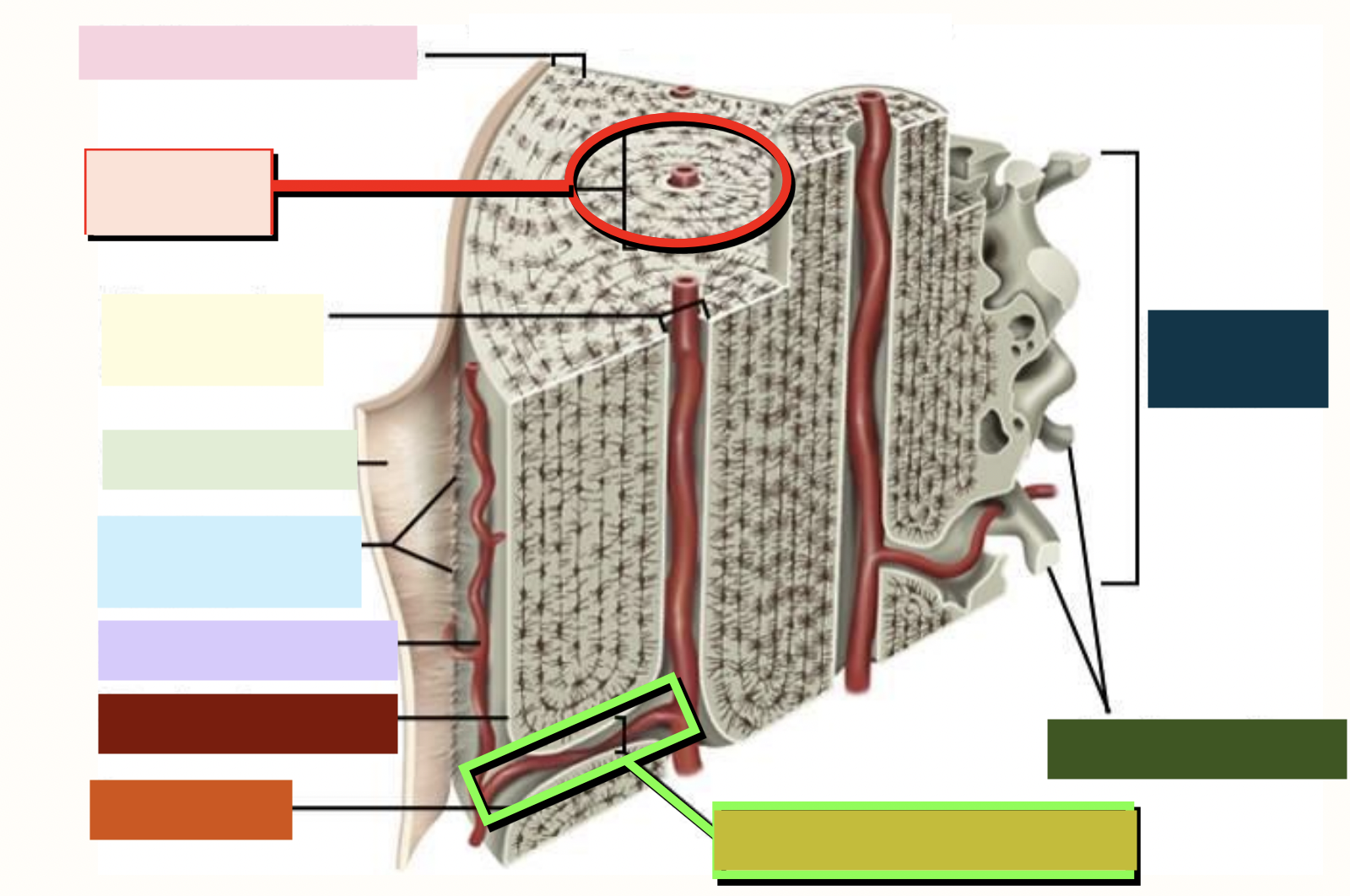
lacunae
What is highlighted dark orange?

perforating canal
What is highlighted dark yellow?

trabeculae
What is highlighted dark green?
