PHY 1 - concept Exam 2
 Call Kai
 Learn
 Practice Test
 Spaced Repetition
 Match
 Flashcards
 Knowt Play
1/21

There's no tags or description
Looks like no tags are added yet.
22 Terms
An object is moving at a constant velocity. All but one of the following statements could be true. Which one cannot be true?
No forces act on the object.
Three forces act simultaneously on the object.
A single force acts on the object.
Two forces act simultaneously on the object.
A single force acts on the object
A cup of coffee is sitting on a table in a recreational vehicle (RV). The cup slides toward the rear of the RV. According to Newton’s first law, which one or more of the following statements could describe the motion of the RV?
(A) The RV is at rest, and the driver suddenly accelerates.
(B) The RV is moving forward, and the driver suddenly accelerates.
(C) The RV is moving backward, and the driver suddenly hits the brakes.
A, B, C
The apparent weight of a passenger in an elevator is greater than his true weight. Which one of the following is true?
The elevator is either moving upward with an increasing speed or moving downward with a decreasing speed.
The elevator is either moving upward with an increasing speed or moving upward with a decreasing speed.
The elevator is either moving upward with a decreasing speed or moving downward with a decreasing speed.
The elevator is either moving upward with an increasing speed or moving downward with an increasing speed.
The elevator is either moving upward with a decreasing speed or moving downward with an increasing speed.
The elevator is either moving upward with an increasing speed or moving downward with a decreasing speed.

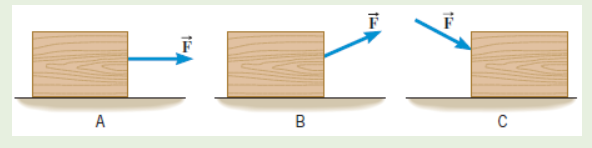
Three identical blocks are being pulled or pushed across a horizontal surface by a force F, as shown in the drawings. The force F in each case has the same magnitude. Rank the kinetic frictional forces that act on the blocks in ascending order (smallest first).
B, A, C
If you pound a feather with a hammer, which one feels a greater force?
The size of the force is always exactly the same on both of them.
You are in a train traveling on a horizontal track and notice that a piece of luggage starts to slide directly toward the front of the train. From this observation, you can conclude that this train is
slowing down and changing direction.
changing direction.
speeding up and changing direction.
slowing down.
speeding up.
slowing down.

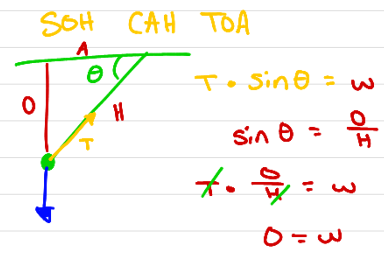
Inside of a train a ball of weight w is hanging by a light wire at rest from the ceiling. The wire makes an angle θ with the ceiling, as shown in the figure. Which one of the following conditions must be true about the tension FT in the wire?
T cosθ = w
T sinθ = w
T tanθ = w
T = w
T sinθ = w

In the figure, what does the spring scale read? The pulleys are ideal and the strings and scale are also massless.
1.0 N
the scale reads one side, one side has 1 N of force


A 30.0-kg load is being held in place using massless wires in the ideal pulley arrangement shown in the figure. What is the magnitude of the force F?
147 N
294 N
30 N
73.5 N
147 N

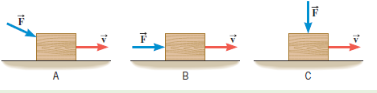
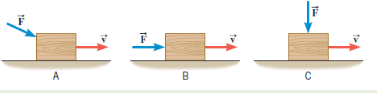
The same force F pushes in three different ways on a box moving with a velocity v, as the drawings show. Rank the work done by the force F in ascending order (smallest first):
C, A, B
Two forces F1 and F2 act on a particle. As a result, the speed of the particle increases. Which one of the following is NOT possible?
The work done by F1 is positive, and the work done by F2 is zero.
The work done by F1 is zero, and the work done by F2 is positive.
The work done by F1 is positive, and the work done by F2 is negative.
The work done by each force is negative.
The work done by each force is positive.
The work done by each force is negative.
In which one of the following circumstances could mechanical energy not possibly be conserved, even if friction and air resistance are absent?
A car moves down a hill, its velocity continually increasing along the way.
A car moves up a hill at a constant velocity.
A car moves up a hill, its velocity continually decreasing along the way.
A car moves along level ground at a constant velocity.
A car moves up a hill at a constant velocity.

A ball is fixed to the end of a string, which is attached to the ceiling at point P. As the drawing shows, the ball is projected downward at A with the launch speed v0. Traveling on a circular path, the ball comes to a halt at point B. What enables the ball to reach point B, which is above point A? Ignore friction and air resistance.
The ball’s initial gravitational potential energy
The work done by the tension in the string
The work done by the gravitational force
The ball’s initial kinetic energy
The ball’s initial kinetic energy
In which one of the following circumstances does the principle of conservation of mechanical energy apply, even though a nonconservative force acts on the moving object?
The nonconservative force is perpendicular to the displacement of the object.
The nonconservative force has a direction that is opposite to the displacement of the object.
The nonconservative force points in the same direction as the displacement of the object.
The nonconservative force has a component that points opposite to the displacement of the object.
The nonconservative force has a component that points in the same direction as the displacement of the object.
The nonconservative force is perpendicular to the displacement of the object.
You throw a baseball straight up. Compare the sign of the work done by gravity while the ball goes up with the sign of the work done by gravity while it goes down.
The work is negative on the way up and positive on the way down.
The work is positive on the way up and negative on the way down.
The work is positive on the way up and positive on the way down.
The work is negative on the way up and on the way down because gravity is always downward.
The work is negative on the way up and positive on the way down.
A person stands on the edge of a cliff. She throws three identical rocks with the same speed. Rock X is thrown vertically upward, rock Y is thrown horizontally, and rock Z is thrown vertically downward. If the ground at the base of the cliff is level, which rock hits the ground with the greatest speed if there is no air resistance?
They all hit the ground with the same speed.
If the units of your answer are kg ∙ m2/s3, which of the following types of quantities could your answer be?
power
Which of the following quantities are units of momentum? (There could be more than one correct choice.)
A) N ∙ m
B) kg ∙ s/m
C) kg ∙ m/s
D) N ∙ s
E) kg ∙ m2/s2
C and D
A rubber ball and a lump of clay have equal mass. They are thrown with equal speed against a wall. The ball bounces back with nearly the same speed with which it hit. The clay sticks to the wall. Which one of these objects experiences the greater momentum change?
the clay
Both of them experience the same non-zero momentum change.
Both of them experience zero momentum change.
the ball
the ball
In a collision between two unequal masses, which mass receives a greater magnitude impulse?
the larger mass
They receive equal impulses.
the smaller mass
They receive equal impulses.
In an inelastic collision involving an isolated system, the final total momentum is:
more than the initial momentum.
less than the initial momentum.
exactly the same as the initial momentum.
exactly the same as the initial momentum.