AP Bio Unit 3 - Topics 1,2,3,4 NOTES
 Call Kai
 Learn
 Practice Test
 Spaced Repetition
 Match
 Flashcards
 Knowt Play
1/38

There's no tags or description
Looks like no tags are added yet.
39 Terms
What is Metabolism?
All of the chemical reactions in an organism
What is metabolic pathways
Series of chemical reactions that either build complex molecules or break down complex molecules.
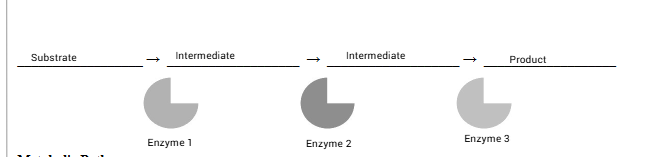
Tell me the Metabolic Pathway of an Enzyme
Substrate TO Intermediate TO Intermediate TO Product
What are the two types of Metabolic pathways
Catabolic - Pathways that release energy by BREAKING down complex molecules into simpler compounds
AND
Anabolic - Pathways that consume energy to BUILD complicated molecules from simpler compounds.

What is energy?
Organisms need energy to _________ and _________
The ability to work
SURVIVE/FUNCTION
A loss of energy flow results in death
What is kinetic energy?
Energy associated with motion
What is thermal energy?
Energy associated with the movement of atoms or molecules
What is potential energy?
Stored energy
What is Chemical Energy?
Potential energy available for release in a chemical reaction.
The study of energy transformations in matter is called _______
The laws apply top the _______
THERMODYNAMICS
UNIVERSE AS A WHOLE
What is the 1st Law of Thermodynamics?
Energy cannot be created or destroyed
- Energy can be transferred or transformed
What is the 2nd Law of Thermodynamics?
Energy transformation increases the entropy (disorder) of the universe
- During energy transfers or transformation's, some energy is unusable and often lost as heat
What is Free Energy
Since the laws of thermodynamics apply to the universe as a whole, scientists use a concept called free
energy to determine the likelihood of reactions in organisms, or if the reactions are energetically
The free energy change of reactions determine whether or not the reaction occurs _______
Based on free energy changes, chemical reactions can be classified as _______ or ________
SPONTANEOUSLY (No outside input is required)
EXERGNOIC/ENDERGONIC
What are Exergonic Reactions?
Catabolic Reactions
Reactions that RELEASE energy
Ex - Cellular Respiration
What are Endergonic Reactions?
Anabolic Reactions
Reactions that ABSORB Energy
Ex - Photosynthesis
What is ATP?
ATP couples _______ reactions to ________ to power __________
Molecule that organisms use as a sources of energy to perform work
EXERGONIC to ENDERGONIC
- Organisms obtain energy by BREAKING the bond between the 2nd and 3rd phosphate in a hydrolysis
- ATP turns into ADP (Adenosine Diphosphate)
What is Phosphorylation?
The released phosphate moves to another mnolecule to give energy
Rate of Metabolic Reactions
The laws of thermodynamics tells is if a reaction is ________, but it does not describe the _______ of the reaction
SPONTANEOUS
RATE
- Some spontaneous reactions move so slowly that it would be impossible for cells to utilize them efficiently
- The hydrolysis of sucrose to glucose would take 1000 years to happen spontaneously
If it takes nearly 1000 years for the hydrolysis of sucrose, then how is it possible that cells do this each day without waiting 1000 years?
We USE ENZYMES
What are Enzymes?
Macromolecules that catalyze (speed up) reactions by lowering the activation energy
Are not consumed by the reaction
Type of protein
Enzyme names end in -ase
Describe an Enzyme Structure
The enzyme acts on a reactant called a substrate
Active site: area for substrate to bind
What are Induced Fit?
Enzymes will change the shape of their active site to allow the substrate to bind better
What is Enzyme Catabolism?
Enzymes helps break down complex molecules
What is Enzyme Anabolism
What are the Effects on Enzymes?
Enzymes are proteins, which means their 3D shape can be affected by different factors
The efficiency of enzymes can be affected by:
- Temperature
- pH
- Chemcials
What are the optimal conditions?
The conditions (temperature and pH) that allows enzymes to function optimally (at their best)
The rate of enzyme activity _________ with temperature (due to collision) up to a certain point
Enzyme function best at a specific ______
INCREASES
pH
- Being outside the normal pH range can cause hydrogen bonds in the enzyme to break, changing the shape of the enzyme
What are Enzyme Cofactors
Cofactors - Non protein molecules that assist enzyme function
Inorganic cofactors consist of metals
- Can be bound loosely or tightly
- Holoenzyme: An enzyme with the cofactor attached
What are Enzyme Inhibitors?
Reduce activity of specific enzymes
Inhibition can be permanent or reversible
Inhibitor binds with covalent bonds
- Permanent: Inhibitor binds with covalent bonds
Example: Toxins and poisons
- Reversible: Inhibitor binds with weak interactions
What are Competitive Inhibitors?
Reduce enzyme activity by blocking substrates from binding to the active site
Inhibition can be reversed with increased substrate concentrations
Noncompetitive Inhibitors?
They bind to an area other than the active site (allosteric site), which changes the shape of the active site preventing substrates from binding
Type of allosteric inhibition
Regulation of Chemical Reactions:
A cell must be able to ______- its metabolic pathways
What is Allosteric Regulation?
Allosteric enzymes have TWO binding sites
TWO
1 active site
1 allosteric site (regulatory site, site other than the active site)
What is Allosteric Regulation?
Molecules bind (noncovalent interactions) to an allosteric site which changes the shape and function of the active site
What is Allosteric Regulation: Activator
substrate binds to allosteric site and stabilizes the shape of the enzyme so that the active sites remain open
What is Allosteric Regulation: Inhibitor?
Allosteric inhibitor: substrate binds to allosteric site and stabilizes the enzyme shape so that the active sites are closed (inactive form)
What is Allosteric Regulation: Cooperativity
Cooperativity: substrate binds to one active site (on an enzyme with more than one active site) which stabilizes the active form
Considered allosteric regulation since binding at one site changes the shape of other sites